
26 February 14
Orcas Island, Again
 I just returned from a spinning retreat on Orcas Island. I’ve been before two years ago; it’s a week of full-immersion spinning, fiber preparation, dyeing, and enjoying bald eagles fly over your cabin. This year I traveled with a friend from our new spinning guild in Davis by car, which was a luxury because I could take a lot more than I had before.
 This week was supposed to be Sheep, Then and Now, but since we started off spinning camel it was obviously going to be a journey through whatever is getting Judith Mackenzie excited then and now, which is probably just as useful if not more so. I love fiber people — they are so generous with their knowledge and share everything they know. Judith lost everything in her studio to a fire about 18 months ago, including numerous wheels and looms and priceless bison fiber, but she’s a tough cookie and manages, somehow, to look on the bright side of this.
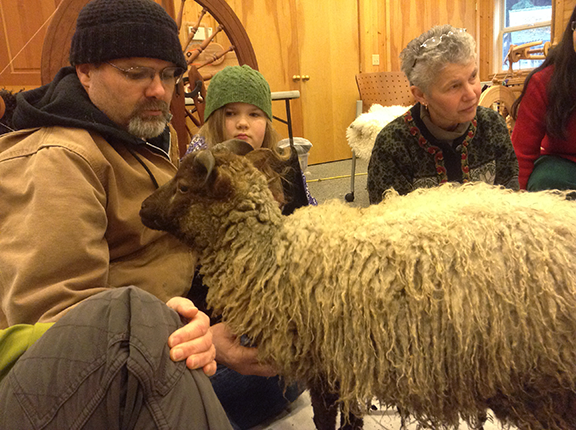 We learned to spin yak. We learned to make bouclé and hazed yarns. We learned how to spin a fat merino-silk single and stabilize it, then we hand-painted it. We were visited on the final morning by a diminutive Shetland sheep called Marvin. (He really is small, much smaller than normal Shetlands.)
 On the way there and back we stayed with some lovely people, the first of whom had a replica Lord of The Rings shawl made with Gotland wool. Road trips with a fiber bent are new to me and I’m revved up and excited to share what I learned with friends. Oh, and I want a loom. I’m not buying yarn this year — I have so much already and I’m spinning more — but I have such a craving for a loom. Too bad we can’t fit one into this little house…
19 January 14
The New OpenStreetMapper
I didn’t expect I’d launch into 2014 with a whole new hobby. Towards the end of winter break, I bought an 7” Android tablet, the Google Nexus 7. I was not entirely sure what I would do with it, but since it has a GPS chip, it didn’t take long for me to start exploring mapping applications for it. This led inevitably to OpenStreetMap.
OpenStreetMap is a project that has been around almost 10 years; essentially it is the equivalent of WIkipedia for worldwide street mapping. In other words, it is a massive crowdsourcing project to build a quite detailed map database for the world that’s freely available as open data. (There’s an excellent recent blog post entitled simply Why the world needs OpenStreetMap.) I’ve known about the project for a long time (in fact its founder once gave a talk about it to our lab group), but had never signed up to contribute data. Buying the tablet closed a loop for me, since I could now go on walks, pull out my tablet, and check a recent copy of the map to see if there were unmapped details I should record.
 What does one map? Anything and everything. Looking at the map, I quickly found that neither the California Raptor Center nor the network of trails on the other side of the creek from our house were in there, so I set about mapping them. And now these features are in OpenStreetMap! The figure show the trails I’ve added; they’re the tracks marked in dashed red lines just north of the creek.
It’s amazing amounts of fun. It helps that I’m a map geek already, but walking, exploring, and maps, what could be better?
12 January 14
Lichens!
 Numenius and I attended a workshop yesterday put on by the UC Davis Center for Plant Diversity and the California Native Plant Society (Sacramento Chapter). Pam Kirkbride taught the workshop, which was a morning of lecture and practice keying (at which I have very little experience; Numenius has much more) followed by a field trip to just over the Napa County line, where lichens are far more diverse and numerous since it’s just inside the fog belt.
I had learned a little about lichens in connection with natural dyes at my spinning retreat with Judith Mackenzie in 2012. I learned a whole lot more yesterday — the various forms of lichens, their unique symbiotic biology (they are a relationship between fungi and algae), their sensitivity to pollution and other environmental stressors… and their great beauty. This was my first time using a dissecting workshop and now I want one.
I came home with some Ramalina (Spanish moss) I found on the oak woodland floor. I’d like to try it out on some white yarn I have. Lichen dyes don’t need a mordant because of their acidic chemistry. I’ll update when I have something to show!
16 November 13
From Field to Flour
Two years ago we started getting involved with Farm 2.6, a new educational community farm a few miles west of Davis. I had the odd idea then of putting in a small wheatfield, with the idea of baking some bread from wheat I had grown myself. Today I ground my first batch of flour from the wheat!
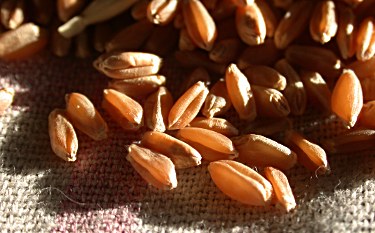 There is a reason why grains do not figure in most home gardening efforts, despite being an important diet staple. It is an awful lot of work to produce grains in any sort of quantity at all. (For those who are nevertheless still interested, one good text is Gene Logsdon’s Small-Scale Grain Raising). The timeline of our efforts was as follows. In late winter of 2012 we sowed the field in red clover as a cover crop and to put nitrogen into the soil. It then lay fallow until late January of this year, when we planted the field in a hard red spring wheat. It didn’t end up as a very densely planted field, and there were many, many weeds in it, but wheat we got, and several of us harvested it by hand in early July. The wheat then sat in the barn until last week when at a work party it was threshed and winnowed. The threshing was done by dancing on the heads of the wheat placed in a pillowcase; the winnowing was done with the aid of a small fan. The resulting wheat berries are at left.
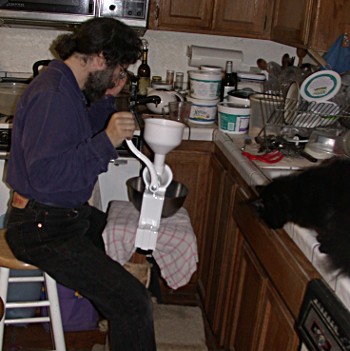 We have a small hand-cranked grain mill at home and I set to grinding today. This too is hard work, and in about an hour-and-a-half I grinded about 3 cups of flour. I ended up borrowing one of our pieces of cat furniture to clamp the mill to; the cats were curious what use I was making of it. Below is some of the flour. Next up comes baking a loaf of bread!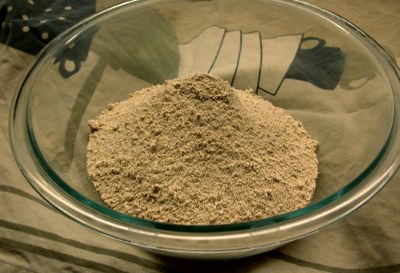
21 October 13
A County Flu Drill
On Saturday I volunteered at the Yolo County Flu Clinic. This is a service provided by the Health Department and flu immunization is free to all residents. I was alerted to the volunteer opportunity through Yolo ARES, Amateur Radio Emergency Service, but in the event they requested my translation skills rather than radio (no radios were needed in this exercise, which doubles as an emergency drill).
The day was pretty slow. This might be explained by the fact that it was a perfect day: no wind, warm but not hot. A perfect day for a century bike ride, in fact, which coincidentally it was – Foxy Fall Century didn’t have me as SAG 10 this year. During the long, slow morning, I got to talking to a Cambodian volunteer. When we discovered we had French in common an interesting conversation ensued where she explained to me how she had worked in Cambodia in some field of public health. Her switching between French and English was entirely natural, fluid, and I don’t think she knew she was doing it. (I’m sure there were also a few Khmer words thrown in there I didn’t catch.) Anyway, I was strongly reminded of the hybrid English-Spanish patois of the Gibraltarians, which they call Llanito and which also contains words of Arabic and even Maltese origin.
Cambodia to Esparto: what a change of scene for this woman. Different health problems—no obesity in Cambodia – but not so different, either: diabetes is a growing emergency among the Cambodian poor, just as it is in upper Yolo County.
My time with OCD epidemiologists at the Wildlife Health Center showed in my horror at seeing a volunteer who was registering patients shake hands with each of them. No hand sanitizer at the ready, either… In an epidemic, that would have been stamped on pretty quickly.
14 October 13
Signals From The Southland
No television at our house, so we follow playoff baseball on the radio, a plan that works well except for Sundays and Monday evenings, when all the ESPN Sports radio stations regrettably have NFL football on them. Last night I missed hearing the incredible comeback by the Boston Red Sox, though I was aware of what was going on from the computer. This evening was the Dodgers game, and thanks to the magic of skywave, I had an option. One of the stations in the Dodger network, AM 1560 KNZR, comes in pretty well from Bakersfield in the evenings, the signal refracting off the ionosphere.
This lead to a moment of complete nostalgia. Hearing on a staticky and fading distant AM radio station the voice of Vin Scully, now talking about Drysdale and Koufax losing the first two games away at Minnesota. (He was referring to the 1965 World Series; I’m sure he was there.)
As it once was, as it still is. Baseball and radio, what a great combination.
7 October 13
Spinning Update
The past few weeks have been devoted to getting ready for Lambtown, a small festival celebrating sheep held annually in Dixon, California. It used to be held in July, when it was hot. It was hot this weekend too, but just in the mid-80s. Not too hot, but lots of flies…
The featured breed this year was Shetland. The Davis Spinners Guild planned a display about Shetland sheep. We bought two fleeces at the Spinning at the Winery event in June in Livermore, one dual-coated white, one black. We divided up the raw fleece among members then we all washed, prepared and spun the various fibers we had. Some of us even went ahead and knit or crocheted what we’d spun.
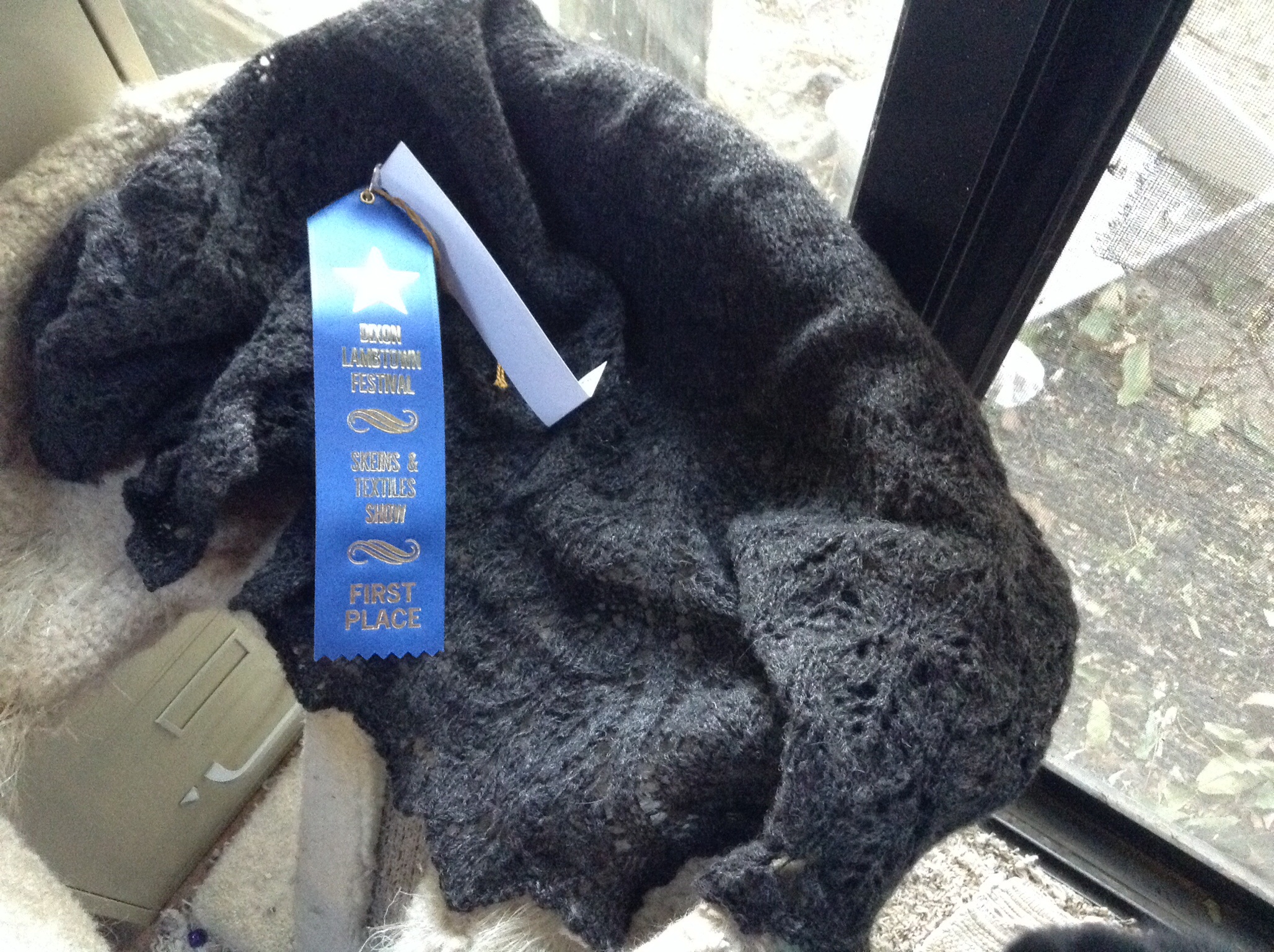 I have never entered my work in a fair competitively but I was worried there wouldn’t be any entries for the Shetland category we’d worked hard to have recognized, so I spun and knit a lace shawlette with the darker (much softer) Shetland and made a handspun tam, stranded with the different colors in the purchased Shetland roving. I also entered two skeins of Shetland yarn I’d spun.
 ! Pushing me way out of my comfort zone was the spinning contest, where we had to spin blindfolded, then with gloves, then in pairs (one person treadles, the other person drafts). The yarn design (use at least four different fibers, make sure you ply your yarn) was very challenging but surprisingly fun (although not for one of the participants, who practically had a nervous breakdown in the middle of it all). The last event was to take three colors of roving, spin them so that when plied each color repeat is no longer than 18”, make sure there are at least three full repeats.
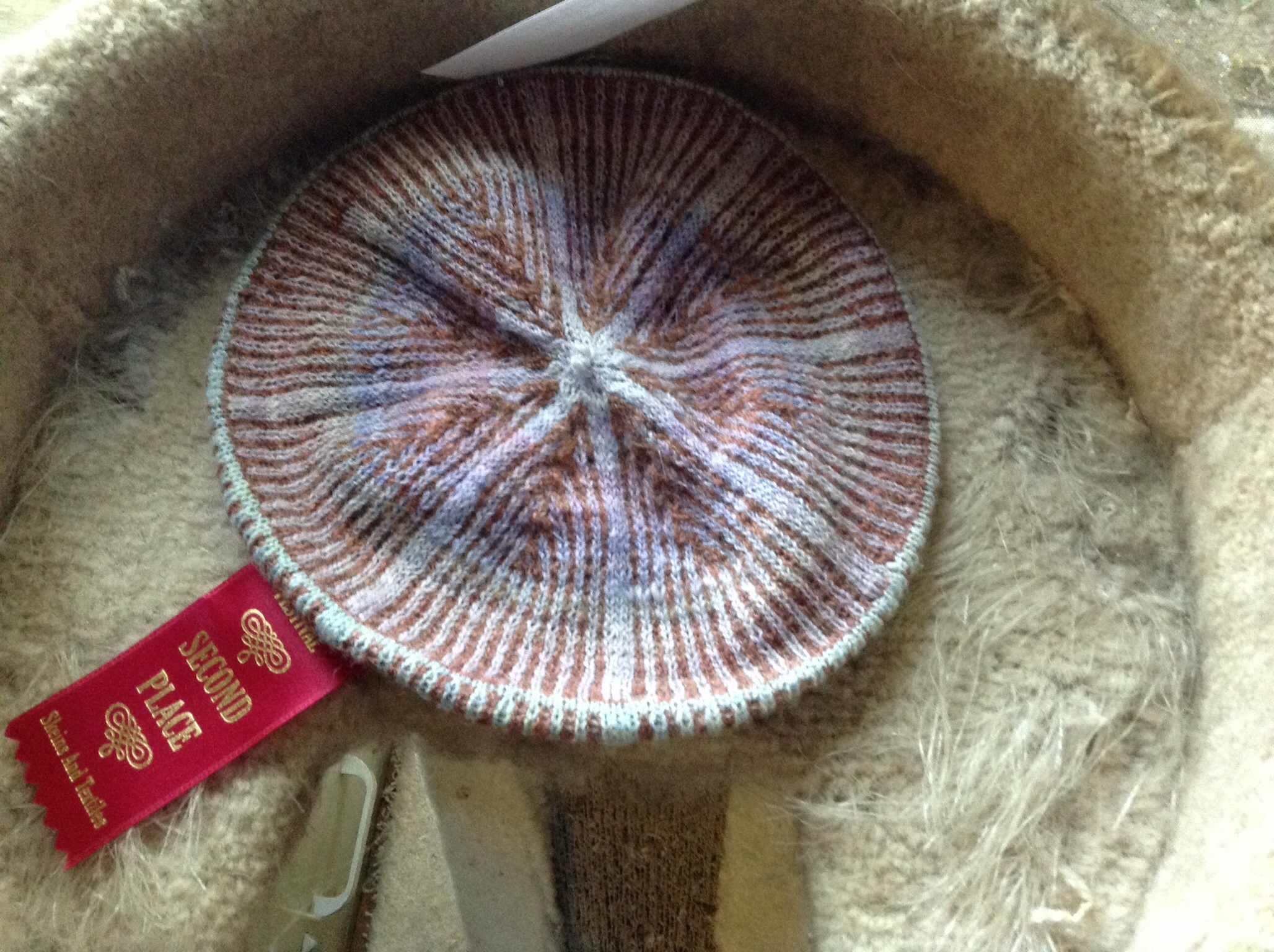 With the linen spinning class I took on Saturday morning (red badge of courage, impaled myself on a linen hackle, below right) and my other volunteer duties, I didn’t get to see much else of Lambtown. But I understand it was very successful. I came home with half a huge Romney fleece, some silk alpaca, some yarn, some more bobbins, and some blue ribbons.
 This week is Spinzilla, where we’re supposed to spin as much as we can. I won’t be spinning competitively. I’m working all week and have stuff on almost every night. But I’m working on it. Two pounds of Jacob roving not prepared by me. Diego Cat comes running the second I sit at the wheel and settles in.
9 August 13
The Nevada City Riddle
We’re going on an outing tomorrow for our anniversary, want to head towards the Sierras, and have come up with the idea of going to Nevada City for a short hike followed by lunch in town. Nevada City is not a town either of us knows much about, so the question becomes what do we do for our little spot of tourism?
After a brief look online I found myself headed to the campus bookstore to look in a guidebook for the Sacramento-Gold Country region to get a better sense of the town. Upon reflection this is curious. We’re in Year 22 of the World Wide Web, we’re told from many quarters that print is dead, long live the screen, yet my sense is that it’s easier to find reliable local knowledge about a place in a book than readily online. The first pages that come up in a search are for the city government (good if you need a building permit, not so much if you’re trying to get a sense of the place), the chamber of commerce (avoids playing favorites among the businesses), and then digging a little further one comes across reviews in services such as Yelp, but these are easily gamed and always have the air of the outsider about them.
By now the Internet has ossified into a number of structural forms that are changing on a fairly long time scale (5 to 10 years), and for whatever reason there is a big gap between on-the-ground local knowledge and virtuality. In Davis we are lucky to have the Davis WIki which is a knowledge base to which many locals contribute. Though the Davis Wiki has a few progeny, the list of such communities is quite short and the sense is the Davis Wiki and its ilk are the exceptions that prove the rule.
For now, we’ll find a short trail near town, and then have a wander downtown. Walking is always the best way to learn anyway.
31 July 13
Veering Middle
I have just returned from a conference in New York preceded by a one-day class in Graphic Recording. This is a field I’d never even heard of before March, but it turns out one of the eminences grises of the field, David Sibbett, went to school with a friend of mine, and runs the very successful Grove Institute in San Francisco, dedicated to Graphic Recording and Facilitation.
I’ve been taking the Conflict Resolution Certificate through University Extension since March also. Convergence? Yes. Convergence of intent, convergence of right and left brain. Changing careers to a move to the middle ground of graphics and words, where it actually makes sense instead of compartmentalizing as I suppose I’ve been doing. And doing it to help people find clarity, so that they can move forward, too.
Graphic recording is all about listening, listening to what people say. There may be just one person giving a plenary, or it may be many people in the room in conflict and in pain, all speaking together. The key is to listen and to record what’s happening. Since I’ve now seen this done quite a few times, I can say from experience, and not just from hearsay, that it’s potentially transformational. People see what they said on a huge white piece of paper, and feel heard. This means they have room left to listen to what other people have to say, instead of sitting on the one thing THEY have to say and making sure everyone else hears it.
My trial-by-fire, the morning after our class last Tuesday: I volunteered to record a presentation by the ebullient, fast-talking bi-coastal Michelle Boos-Stone. I gulped. I stuck five markers, uncapped, in my left hand, looking like Wolverine intent on ruining my new handknit cardigan. I made a huge title, giving me and everyone else a panic attack because I’d used up a huge amount of real estate on a 4’ x 8’ sheet of paper before the talk was even underway, but I stuck with it and basically pretty much captured everything substantive. I had help — my mentor Julia quietly and calmly passed me post-it notes with suggestions — and I think I managed to do it all without freaking out too badly.

Nuggets from the panel of experts who came into our classroom at the end of Tuesday:
“You still draw better than most people in the room.”
“Don’t show your ass the whole time, let people talk to you.”
“Keep a lot of white space available; prepare a template.”
“Commit to your line, use pen.”
“Don’t be afraid to record content on a post-it note.”
“If in doubt about your drawing, just label it ‘cat’.”
“Set your intention and go with it.”
“Diversify. Go small, go big, go digital.”
“Help the people in the room get over their own fears of drawing. It helps them too.”
“Open your possibilities to this work; it can change everything.”
I feel so lucky to have discovered this new and exciting way forward for me. I think it is the most interesting thing about living in the United States: it’s perfectly normal for people to reinvent themselves over the course of a work life, sometimes several times. Look out, world, I’m 53 and armed with Neuland markers.
13 June 13
Moneyball Cubed
Today was a good day for Bay Area baseball fans. The Giants salvaged a game in their series against the Pittsburgh Pirates, and more dramatically, the A’s swept the Yankees in Oakland, winning the final game of the series in the 18th inning on a bases-loaded single by rookie Nate Freiman against the all-time great reliever Mariano Rivera. It is satisfying to see the team with the largest payroll in baseball, the Yankees, losing out to the team with the fifth lowest payroll, the Athletics. How to do well with few resources is of course the theme of the book on the A’s from a decade ago, Moneyball, and it seems the A’s, or maybe in particular their general manager Billy Beane, have found some tricks to doing this again.
Last week I had a glimpse into what baseball analytics is like today in the era of big data. I attended a portion of the Semantic Technology and Business conference held in San Francisco and learned about one company’s work on applying semantic big data technologies to baseball. Vince Gennano, who is president of the Society for American Baseball Research (a.k.a. SABR, after which the term sabermetrics gets its name) gives further details of this work in his writeup here describing how big data allows for the creation of cluster diagrams (see the illustrations in the prior link) mapping out the similarities between different pitchers. Gennano says that when Moneyball was written, there was 2% of the data on baseball player performance there is now. To a good extent this is due to the use of technologies such as PITCHf/x, HITf/x, and FIELDf/x that are tracking the flight of every pitch, every batted ball, and the movement of every fielder in exquisite detail. With that much data being generated, it takes serious analytical know-how to make use of it all, and teams that build that capacity will gain an advantage. Not surprisingly, the company at this conference would not name which major league team (or teams?) they are working for. An arms race is afoot.