
28 July 26
In Praise of Public Transport
A friend of mine is flying to Germany today. We met at the Mexican restaurant kitty-corner from the railway station for lunch before she left. It’s now possible to get to San Francisco International Airport by taking the train from Davis to Richmond, switching to BART there and boarding a subway train that stops basically inside the international terminal.
Resources for public transport are always under tremendous stress. Improvements tend not to be lucrative for the local governments that implement them, but they do improve the quality of life of the citizens they serve. I’ve driven others to and from SFO and it’s not a lot of fun; there is always a lot of traffic on the Bay Bridge. So much better to hop on a train, spare the air, spare the aggravation.
These are the kinds of factors that are brushed aside in the name of efficiency…
13 July 26
A Drop in a Deluge
As I noted last Thursday, the deadline for submitting comments on the proposed Office of Management and Budget regulation that would turn federal funding into an ungodly system of patronage and at the same time devastate American science is this evening. This surely breaks the record for the most public comments on a proposed federal regulation — as of 11:59 PM last night 292,157 comments have been received. A text analysis of about 51,000 comments that were posted by July 9th indicates that 94% of the comments oppose the regulation. Of the 6% of comments in support of the regulation, they were almost all from a single form letter copy-and-paste campaign.
I am posting the public comment that I submitted below. My comment emphasizes the harms to science because that is where my expertise lies, but this regulation would basically codify a system of federalism by extortion, to use language cited in an excellent piece posted today.
—
I am a retired geographer and environmental informatics specialist who over the course of a 34-year university career has received funding from many federal agencies including NSF, USDA, USFS, USGS, EPA, and USFWS. I am also a second-generation scientist. Both my parents were scientists, and I grew up deeply appreciating the massive postwar investment in scientific research that made the United States the leading power in science. All Americans have been beneficiaries of this investment and our country’s commitment to open research.
I strongly oppose the proposed rule change published as OMB-2026-0034 and urge that OMB withdraw it in its entirety. Its impacts to American science would be devastating. I will comment on some of these impacts below section-by-section.
Section 200.205 (b) would mandate pre-issuance approval of grant funding by a senior political appointee. Such political control over its direction is antithetical to the progress of science. Many comments to this proposed rule mention the case of Lysenkoism in the Soviet Union. Such a comparison is apt. Trofim Lysenko was a charlatan agronomist who curried favor with Josef Stalin and destroyed genetics as a science in the Soviet Union. Lysenko’s theories led to crop failures, and to this day Russia and the post-Soviet successor states lag behind in research in related fields like molecular biology.
Section 200.205 also states that activities under Federal awards should comply with administrative guidance respecting “Gold Standard Science”. This phrase is not defined anywhere in the proposed rule. It would be surprising if it could be defined — many decades of scholarship in the history and philosophy of science has shown that there is no one overriding methodology by which science can progress. The phrase “Gold Standard Science” is likely intended as a cudgel by which political appointees can squash research on topics that are uncomfortable for them.
Section 200.340 (a)(2) allows a federal agency to terminate a grant at any point due to arbitrary reasons. This is remarkably poor governance and is a violation of the public trust. People and institutions make serious commitments on the basis of funding agreements, especially multiyear ones, and it is a waste of public investment to halt these prematurely. I have personal experience here: in April 2025 the US Department of Agriculture ended the Partnership for Climate-Smart Commodities program which was about two years into its five-year funding cycle, the agency not wanting to continue a Biden-era program. Thousands of enrolled farmers lost funding under this termination. I was an academic partner on one of these grants, and the resultant halt in funding essentially ended my university career.
Section 200.340 (e) allows a federal agency to temporarily suspend a federal award for a period of up to 90 days. In funding-constrained environments like almost every university, a 90-day cessation of funding of an already-awarded grant will cause layoffs to occur. Some of the afflicted individuals end up leaving their field, an enormous waste of training, talent, and educational investment.
The “domestic-first” framework of Section 200.202 will strongly discourage foreign collaborations. But science is a global endeavor, and isolating the United States in such a manner will only serve to greatly weaken the country in science.
Section 200.461 would make all journal publication costs unallowable by default. Publication of one’s research findings is core to the scientific research process, and failing to pay for journal publication costs hurts American scientists and weakens American science as a whole.
Section 200.432 requires that conference travel be pre-approved and written into an award at the time of grant application. But research is a process of discovery, and a scientist may want to present their findings at conferences they did not anticipate when they applied for the grant. This requirement hinders scientific communication.
The proposed changes will be remarkably deleterious to the American scientific enterprise. American science has been an engine of our country’s prosperity in the postwar period, and such changes will make our country poorer, more isolated, and a more backwards place.
The added administrative burden of complying with this rule go way beyond science. It will be harmful to a huge range of entities including schools, universities, non-profit organizations, small businesses, and state, local, and tribal governments.
The scope of changes in this proposed rule is massive and will have many unintended consequences. There are too many interactions between the various pieces of the rule that will lead to harms that no one will be in a position to understand in their entirety, let alone correct. For a rule that claims to increase transparency, accountability, and oversight it will fail at all three of those goals. I strongly urge that the proposed rule be rejected outright.
9 July 26
Hunting For Apples
I just read the travelogue Apples Are From Kazakhstan: The Land That Disappeared by British journalist Christopher Robbins. The title statement about apples is true, but there is a tragedy around its discovery which has ripples that unfortunately are of great concern today.
The origin of apples was tracked in the 1920s to the Tien Shan mountains which run through northeastern Kazakhstan by a brilliant Russian botanist, geneticist, and geographer named Nikolai Vavilov. Vavilov was highly lauded by the Soviet state for his research on agronomy and the geographical origins of many crops, becoming the youngest member of the Academy of Sciences of the Soviet Union.
Vavilov ran afoul of his onetime protegé, the scheming and ambitious agronomist Trofim Lysenko. Lysenko adapted his research so as to align with the Soviet policy of forced agricultural collectivization. To support his claims of making agronomic innovations that radically increased crop yields, he rejected both natural selection and genetics in favor of a modified sort of Lamarkianism. Lysenko became a favorite of Josef Stalin, and genetics research in the Soviet Union was destroyed. Over 3,000 biologists were dismissed from employment, and some were imprisoned and executed. Vavilov was arrested in 1940 and died in prison in 1943. Rather than improving crop yields, Lysenko’s ideas did the opposite, and when implemented in China they would contribute to the famine there between 1959 and 1961.
Lysenkoism is much on my mind because of changes to federal funding administration that are being proposed by the US Office of Management and Budget. These changes are quite lengthy; former National of Institutes of Health program officer Elizabeth Ginexi provides a good summary of them. Her article is subtitled “Russell Vought [the director of OMB] is going to destroy American Science”. Probably the most significant change is that senior political appointees would be mandated to conduct a review of every grant before it is issued. Moreover, these appointees would be under no obligation to defer to the recommendations from peer review.
This proposal is open for public comment through July 13, and there has been a massive campaign to elicit comments opposing the new rules. I am presently working on my own comment. As of this writing 98,973 comments have been received. OMB may well ignore all the comments but such an outpouring provides a strong basis for legal action against any finalized rules.
Searching through the already-submitted comments, Lysenko has been mentioned in several hundred of them. Amusingly, someone has in jest submitted a comment as Trofim Lysenko. It concludes with the following:
I therefore urge OMB to finalize the rule and give America what every great centrally managed scientific system requires: political officers empowered to decide which science may live, which science must wait, and which science must be uprooted before it bears unauthorized fruit.
With ideological warmth and agronomic confidence,
Trofim Lysenko
Dictator Emeritus of Politically Convenient Biology
Former Specialist in the Suppression of Bourgeois Genetics
10 June 26
Olé León Olé
Numenius wrote yesterday about the Pope’s visit to Spain. Unlike him, I’m [still nominally] Catholic. I haven’t attended Mass for years, though this Pope’s fearlessness in criticizing autocracy is inspiring and almost has me wanting to reconnect.
Fr. Massimo Faggioli, who is a professor of Ecclesiology at University College Dublin, was interviewed by France 24 recently and talked about the rock star quality of popes. I was an active Catholic in the early 80s and went by bus from Birmingham University to Wembley to see Pope John Paul II, the first of the rock star popes. (His subsequent authoritarian tendencies and in particular his favoring of Opus Dei soured me on the papacy and on Catholicism in general, and in the United States the church tends to be far more conservative than in the UK, which doesn’t sit well.) But this Pope? Instead of worrying that he’d be eclipsed by Bad Bunny, who was in Madrid (and who my niece flew to Spain to see in concert at the Estadio Metropolitano last week), he decided to meet with him. At the Bernabéu no less. (When asked whether he supported Real Madrid or Barça, he said as Pope, he has to support all teams; as Prevost, he supports Real.) Well over a million people turned out to see him as he celebrated Mass in downtown Madrid.
I’m impressed by the breadth of the program in Spain, by the Pope’s willingness to dip his toe into Catalan which he speaks with a Brazilian accent, by his visiting a jail. By the performance of Sara Baras and the impassioned speech by Antonio Banderas in support of the arts. It’s been quite the trip.
Side note: I’m categorizing this post as “political” because like it or not this visit is highly political in all kinds of ways, not least in putting Trump’s nose badly out of joint again.
6 June 26
Pride
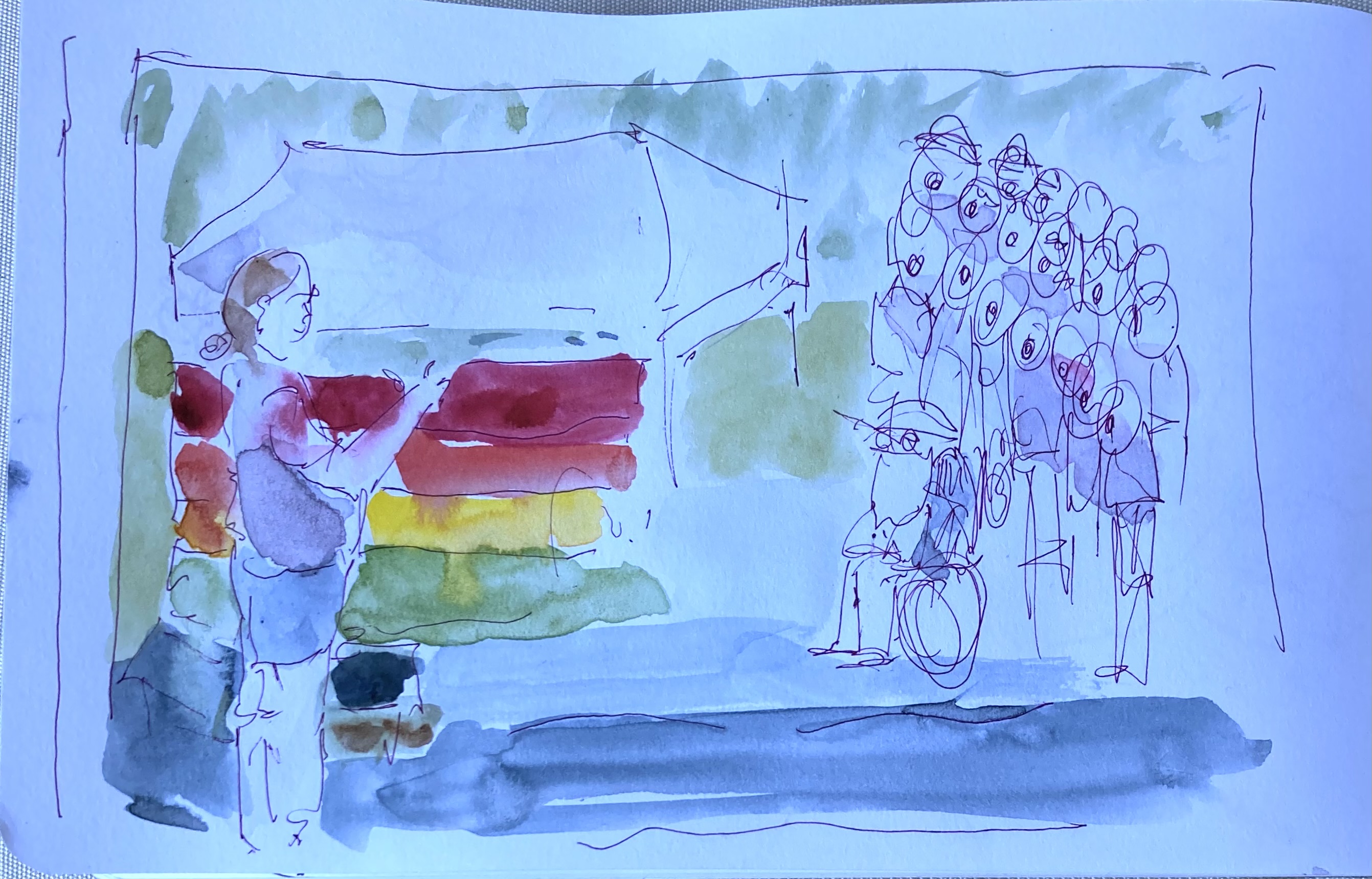 The 12th annual Davis Pride Fest is going on at Civic Center Park. We walked over there a couple of hours ago and did some quick sketches. Fun to see friends and acquaintances and join in the celebration. It’s much cooler today than it was yesterday, which I’m sure everyone appreciated.
7 May 26
Other Perspectives
I had a doctor’s appointment in Sacramento on Tuesday… for various reasons I elected not to drive a borrowed car across the Causeway, which is under massive construction, and took an Uber both directions. My first driver was Iraqi (I think, though am not sure, he was Kurdish); the second was from Venezuela. He was given political asylum three years ago; because of the Trump administration’s moratorium on green cards for refugees, he finds himself in an uneasy limbo. He was able to bring his wife and son over from Venezuela eventually through hard work; his wife has a degree in business administration but is selling fruit.
When I asked my driver whether it was better here than in Venezuela, he was very clear: at least here they can eat three times a day and his wife doesn’t have to use ripped up shirts as sanitary pads (he choked up as he was telling me this part — the shame he felt at having to put his wife through this ordeal was still very real for him).
These stories are not unique. What struck me was how buried they become in the anti-immigrant narrative. People are working so much harder than I ever have, and can barely make ends meet… It’s a reminder that those of us who are fortunate to have enough to live comfortably shouldn’t take any of that for granted, when a lot of it is just an accident of birth and/or geography.
4 May 26
Saving California Science
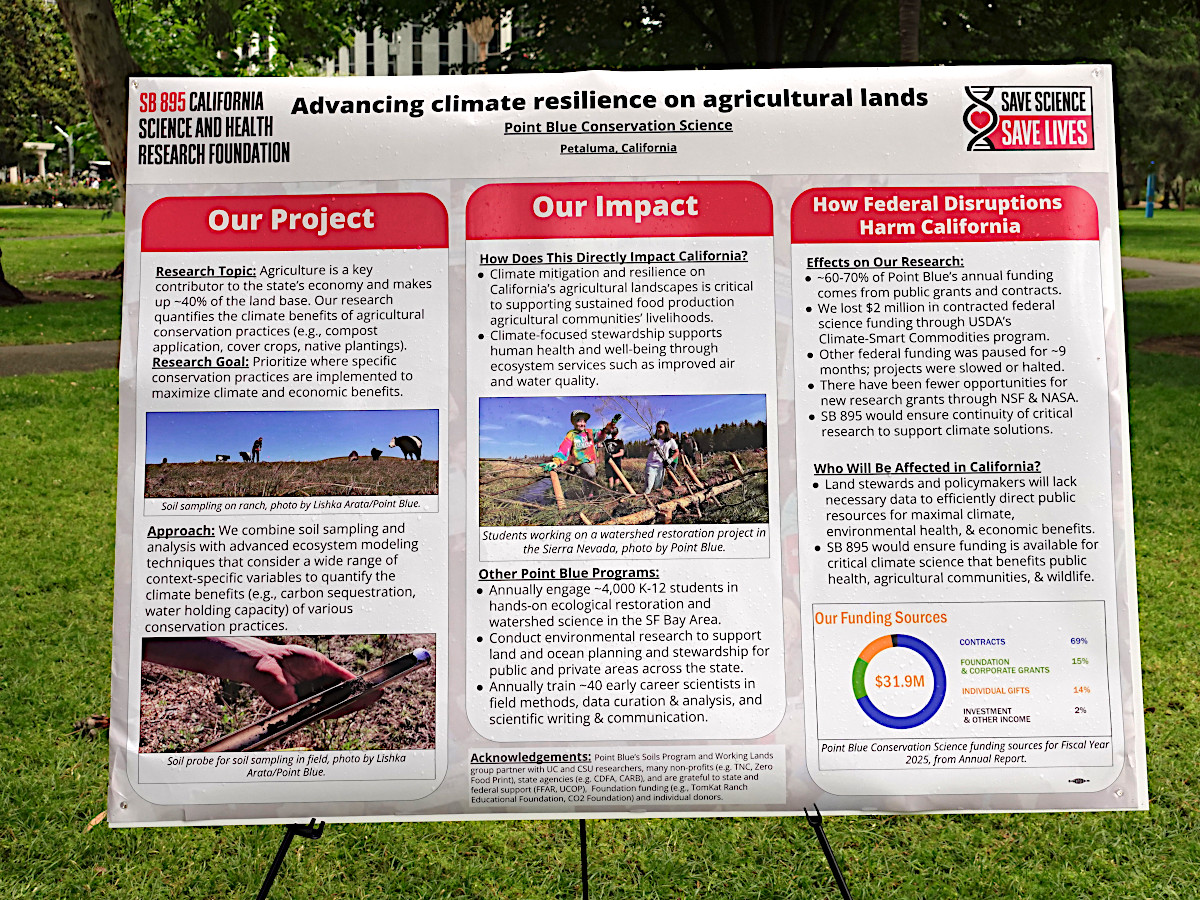 I caught the tail end of a rally in Sacramento today in support of California state senate bill SB 895, which would put a $23 billion bond measure on the November 2026 ballot to create a California Science and Health Research Foundation. This would essentially be California’s version of NSF and NIH (the National Science Foundation and the National Institutes of Health), needed since federal funding for science has been decimated by the actions of the Trump administration.
I meant to attend most of the rally, but it was not where I expected it to be on the west side of the State Capitol Building which is where every other rally at the Capitol that I’ve been to has been. Instead, there was the surreal sight of hundreds of police officers in formal garb, with several troops of them mounted on horses, attending the annual memorial event for California peace officers fallen in the line of duty. No science activists were gathered on the west side of the building, nor on the north or south side of the building, and the east side of the building is now under heavy construction of a new capitol annex. After a long while I looked at the web page of the state senator sponsoring the bill (Sen. Scott Wiener), and discovered the rally was taking place at the State Capitol Rose Garden, several blocks to the east past all the construction.
I missed the speeches, but fortunately these are up on YouTube already (especially see Sen. Wiener at 21:25 and Shawn Fain at 52:27). Over at one side of the rally area there was a gallery of scientific posters highlighting research that has been cancelled by the loss of federal funding. The photo at left is a poster from Point Blue Conservation Science describing how they lost $2 million in USDA funding from their Climate-Smart Commodities program. The termination of that same program was the funding loss that led to my retirement last year.
The senate bill now has broad support including from universities in the state and labor organizations (Shawn Fain who spoke at the rally is the national president of the United Auto Workers, which represents 60,000 University of California employees). I think there is enough support to get the bill through the legislature, though the timeline is short. The bill would then need to be signed by Governor Gavin Newsom, but he is an agent of chaos when it comes to signing liberal legislation. The measure would then have to be approved by the voters of California, who may or may not be in a stingy mood in November. It is both a lot of money, and not very much compared to what has in past times come from the federal government.
More information about the initiative is at the site Save Science Save Lives.
7 April 26
Zeus Backwards Spells Suez
This is to say I believe that the epic fury of the gods is turning the Iran war into the United States’ Suez Crisis. Our power on a global scale is diminishing day by day.
I’m reading a lot about the Vietnam War right now. I just finished The Best and the Brightest, David Halberstam’s 1972 account of the technocrats in the Kennedy-Johnson administrations who led us into that war. I’ve now started Fire in the Lake by Francis FitzGerald also from 1972, a much-lauded account of how Americans failed to understand the history and culture of Vietnam when they went to war there.
Given the complexity of alliances that are under strain right now maybe I should be reading Barbara Tuchman’s The Guns of August too. It’s quite the escalatory mess.
28 March 26
No Kings, Again
 This morning we went to Winters to attend a No Kings rally. We knew it would be small and easy to get to compared to the much larger march from West Sacramento to the Capitol. Winters was very accommodating of people with mobility problems and featured a lot of sing-along music.
In the afternoon Numenius also went to a family-friendly gathering here in Davis (this photo is his and features local celebrity Whymcycler Peter Wagner).
From all accounts the turnout at today’s rallies set a record. The trick will be to have a massive turnout of voters in the mid-terms. Assuming they don’t get cancelled… at this point anything seems possible.
8 March 26
Graphic Reportage
 In Making Nonfiction Comics, Eleri Harris and Shay Mirk talk about the power of reporting on events using comics. There are advantages: a loose sketch of someone is a screen to hide behind in case they fear investigation. But it also humanizes the whole process, and I’m glad I took a pen and brush along to yesterday’s gathering in Woodland.
There are so many things to make us upset and even despair about this administration’s recklessness in all areas of public life here and in disrupting the world, but doing something, anything, to stand up to it feels helpful.