
Sunday June 7, 2026
For Lease
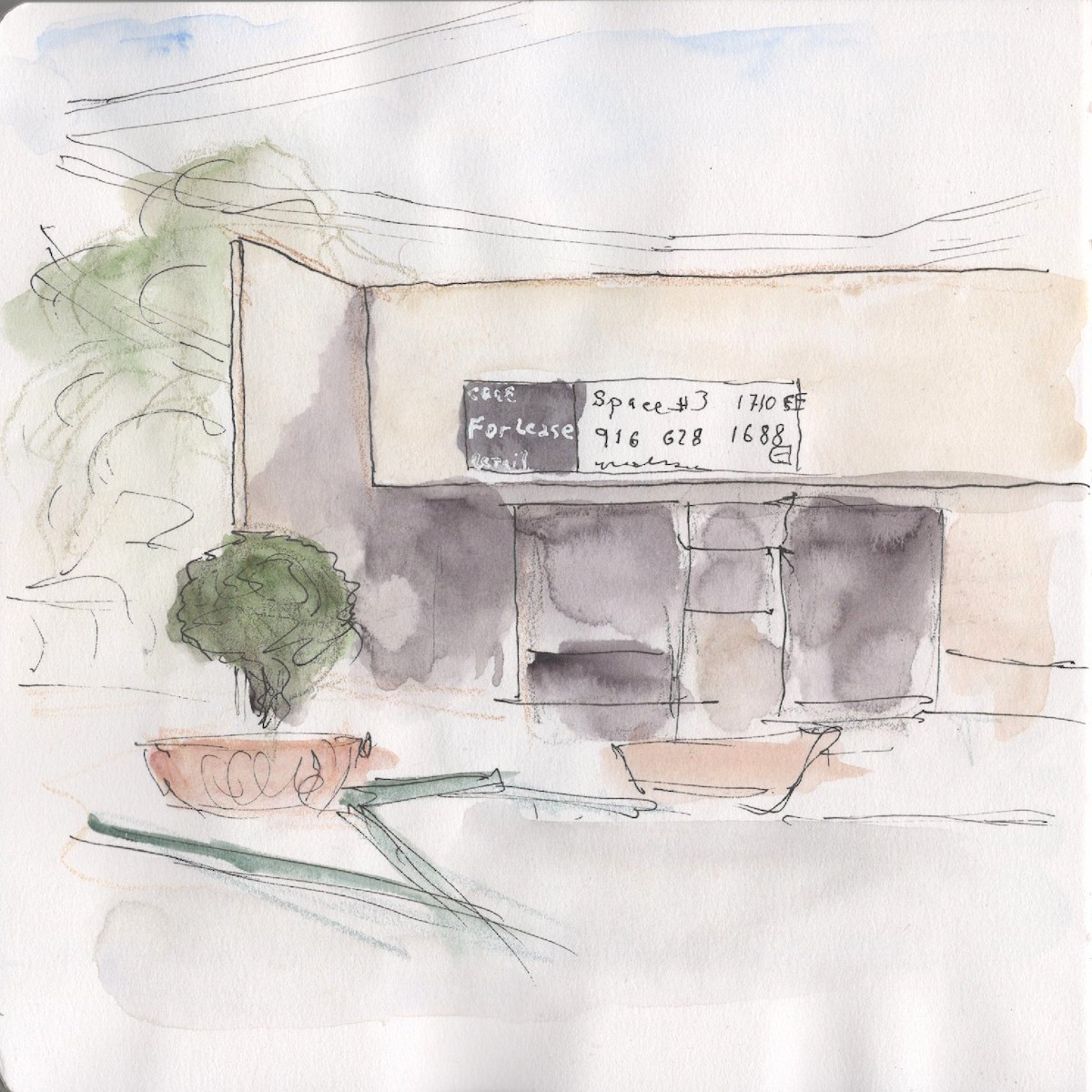 Here is yesterday’s urban sketch. This is the northernmost corner of the retail mall on G Street north of the Davis Food Co-op. Three of the nine spaces in this mall are vacant, though it does contain a good bike store and our favorite local bakery.
Saturday June 6, 2026
Pride
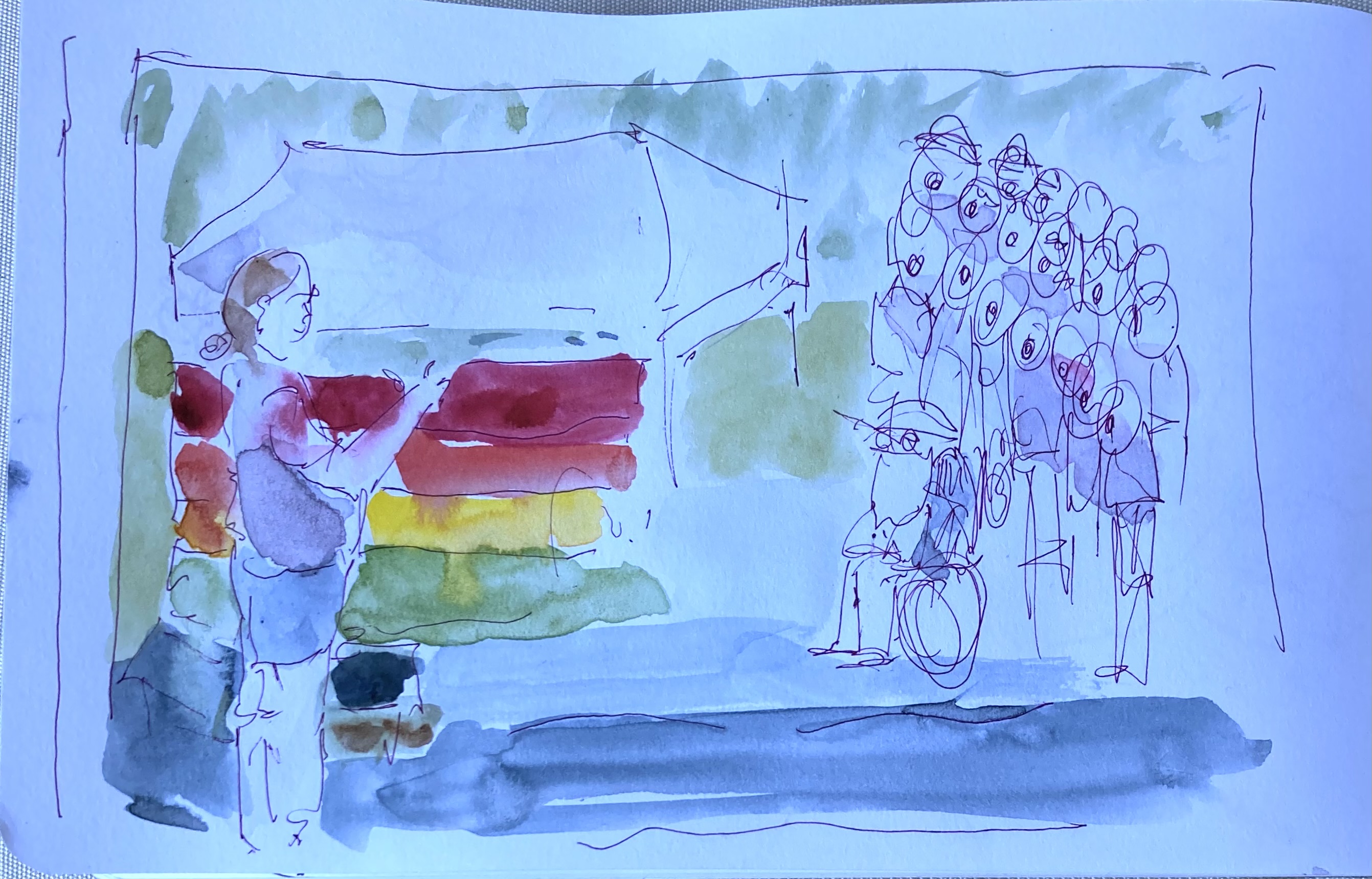 The 12th annual Davis Pride Fest is going on at Civic Center Park. We walked over there a couple of hours ago and did some quick sketches. Fun to see friends and acquaintances and join in the celebration. It’s much cooler today than it was yesterday, which I’m sure everyone appreciated.
Friday June 5, 2026
On Green AI
Contrary to the normal progression of things, the computer that I built a year ago in May has increased in value by about $1150. This is because of the extraordinary demand being placed on supplies of memory and storage components of all sorts by the buildout of AI data centers — most spectacularly in my case, the 64 GB of DDR5 RAM which I purchased in May of 2025 for $165 is now priced at $915. With my workstation, I am continuing to play around with local AI models. The quality of these local models has increased dramatically over the past year, which is leading many developers to explore how they can be used in preference to the huge models from providers in the cloud such as Anthropic, OpenAI, and Google.
One could make the argument that running AI models locally is more sustainable than invoking the resources of huge server farms every time one calls upon AI. But are there other threads that might constitute “green AI”? Sharon Stein has a good piece about this topic on resilience.org. She identifies three visions for green AI. The first of these technical greening. This means running AI with fewer resources, for instance by using smaller models that demand less energy and materials. The second of these is ecological intervention. This refers to developing AI applications that help us understand and ameliorate environmental change, for instance by optimizing agricultural resource use. The third vision is relational reorientation. This focuses on questioning the assumptions around nature, intelligence, and relationships that are built into contemporary AI. A lot of this vision comes from Indigenous perspectives: one interesting research program in this vein is called Abundant Intelligences (also see an open access paper titled Abundant intelligences: placing AI within Indigenous knowledge frameworks).
On a more amusing note, here is a literally hand-cranked solution to the cost and energy use of contemporary AI systems.
Thursday June 4, 2026
Marjane Satrapi
In 1977 I travelled to Iran to visit a boyfriend whose father was an Australian geology professor at the University of Shiraz. This was before the Islamic Revolution, and Clint Eastwood was playing at the movie theater, bootleg tapes of rock music were for sale in the streets, and girls wore chadors over jeans and T-shirts.
The VW bus owned by Cameron’s family drove us around southern Iran, including a trip to Persepolis, the ancient capital of the Achaemenid empire. Processions of victorious warriors and their captives were carved in bas-relief on the walls of great buildings. The city was conquered and burned by Alexander the Great, so any remains are solid stone. I remember walking around the ruins above a copse where Cameron’s parents napped in the shade, among huge numbers of bee-eaters flying around. In the shade of massive blocks of stones, wild gerbils hopped about.
Since that time I’ve been particularly interested in Iran, in this great ancient civilization that has been through so much and which continues to do so. Today I learned that Marjane Satrapi, the author of a graphic memoir about her life in Tehran and France, had died at age 56. Her memoir, which was also turned into a film, was called Persepolis. It was only the second serious comic I ever read, after Art Spiegelman’s Maus. Satrapi lived in France for years and wrote her memoir in French. The style is bold black and white. Her family has said she died of a broken heart after the death of her husband. Whatever the official cause of death, I hope she is at peace now.
Wednesday June 3, 2026
Buglets On The March
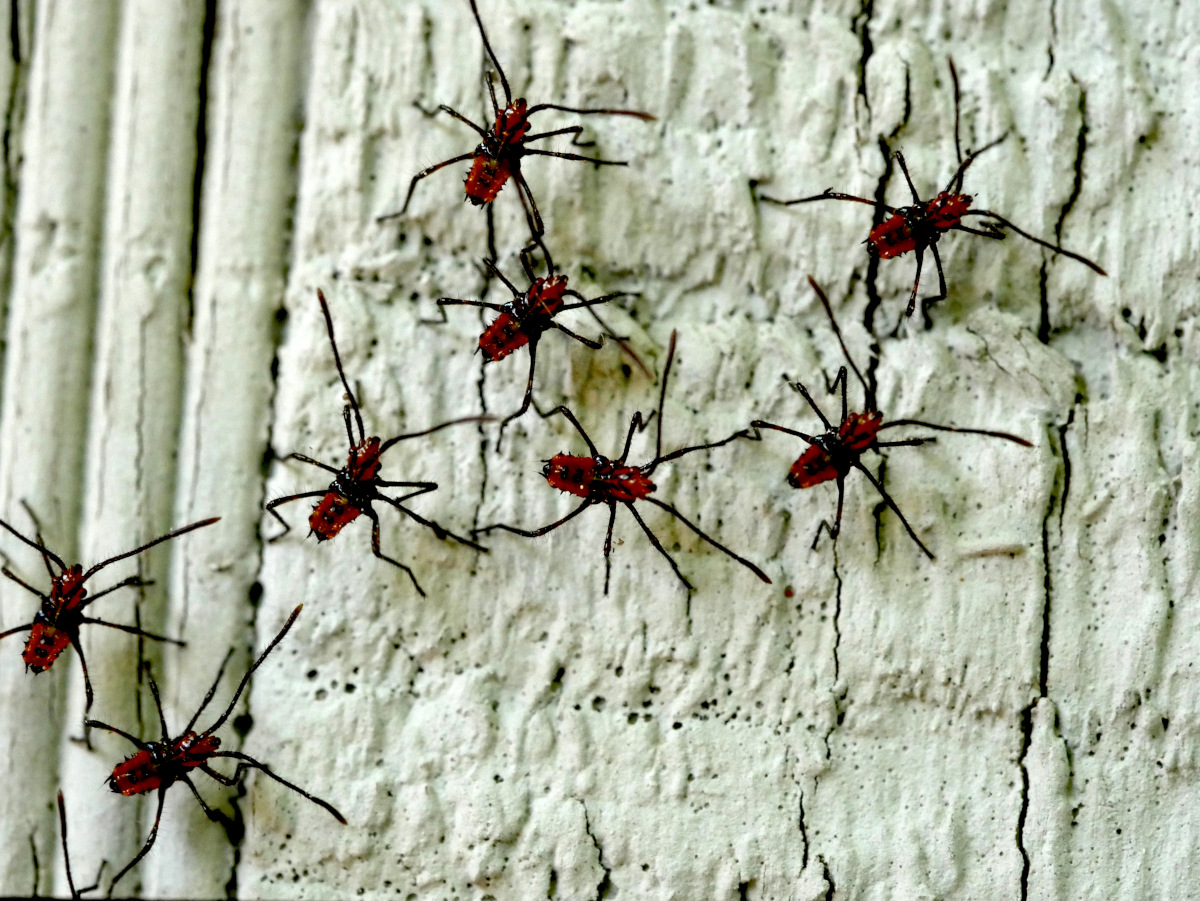 Pica this morning spotted about sixty or so small creatures in formation on the wall of our garden shed. When she moved her hand towards them, they would retreat away a few millimeters. We at first thought these were spiders but looking closely at the photographs they have six legs, not eight. Their body length is about 2 millimeters long.
I ran this photograph through a number of visual identification apps without a great deal of luck, but did come up with some possibilities. They appear to be early instar nymphs of some sort of bug, possibly Rediviidae (assassin bugs) or Rophalidae (e.g. boxelder bugs). Insects are tough to identify, immature insects even tougher.
Tuesday June 2, 2026
Monday June 1, 2026
A Time For Swarming
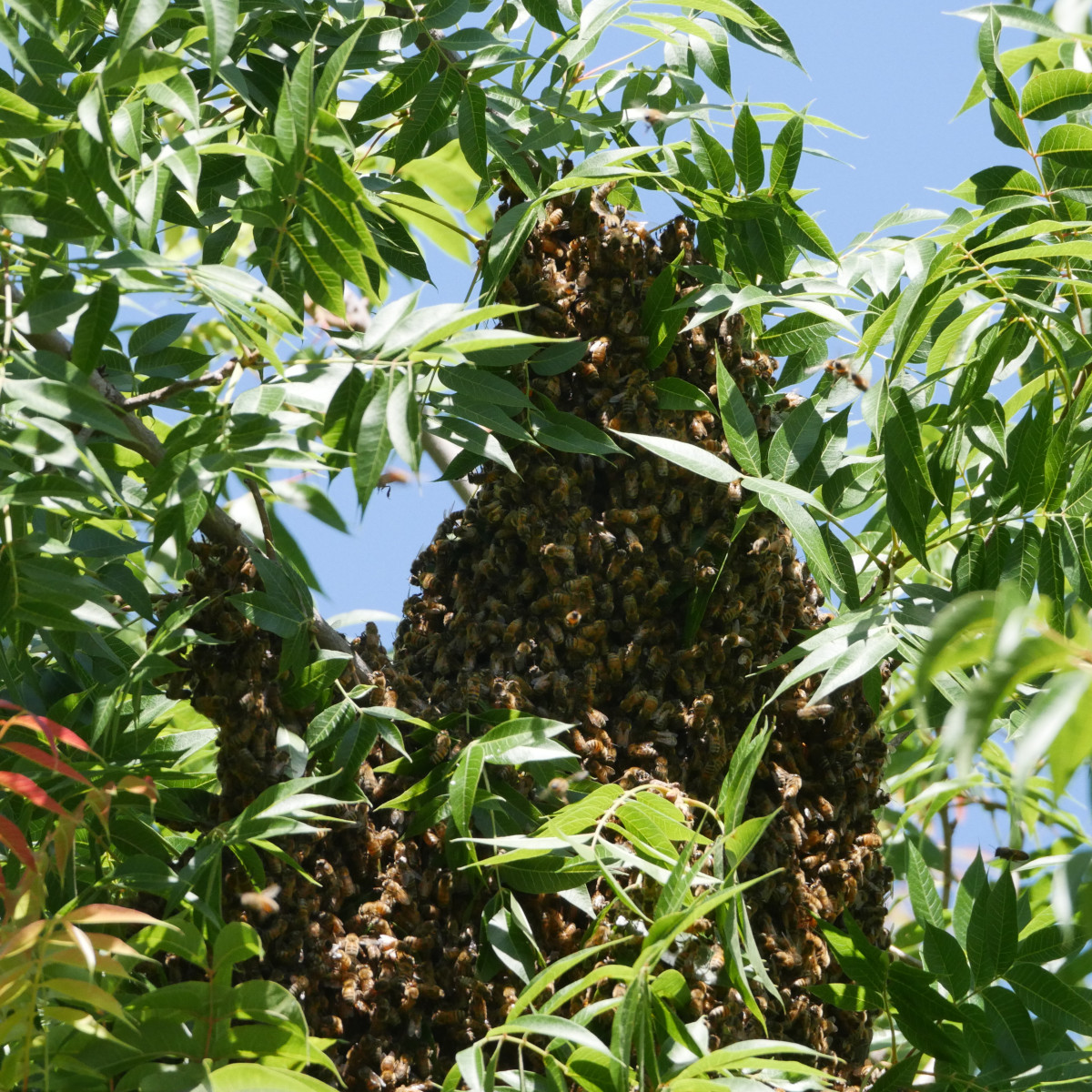 Yesterday afternoon I stepped out our front door and heard a whirring roar coming from the trees immediately to the north. Looking up there were many bees about and clearly there was a bee swarm nearby. The swarm turned out to be in a sumac tree in the yard of our neighbor immediately to the north.
Our neighbor quickly found a response to the new inhabitants of the backyard. There is an organization called Swarmed that is a community-based bee rescue network. At the Swarmed website there is a form to report a bee swarm; soon thereafter a beekeeper gets in touch and volunteers to retrieve the bee swarm to add to their own apiaries. The swarm yesterday was handled by an 83-year-old beekeeper who gathered it up with some sort of vacuum device and transported it (estimated at 60,000 bees in number) to its new home near Marysville.
This morning another bee swarm showed up in the same sumac tree, but about five feet higher. The photo is of this second swarm. Our neighbor reported it through the Swarmed site, summoning a different pair of beekeepers. They don’t seem to be as skilled as yesterday’s beekeeper, and as of 5 PM today the swarm is still up in the tree.
Sunday May 31, 2026
New Postcrossing Stamps are Here
 I wrote before about the new postcrossing stamps. (I pre-ordered some but they haven’t arrived yet.) The stamps were featured at the Boston Expo and Ana and Paulo, the couple from Portugal who launched Postcrossing, were in attendance along with the designer, the USPS art director, and other folks from the post office. There is a lovely writeup about this event here. Also in attendance were over 100 postcrossers who attended a “meetup” in Boston — where postcards are written and signed by multiple people to send all over the world.
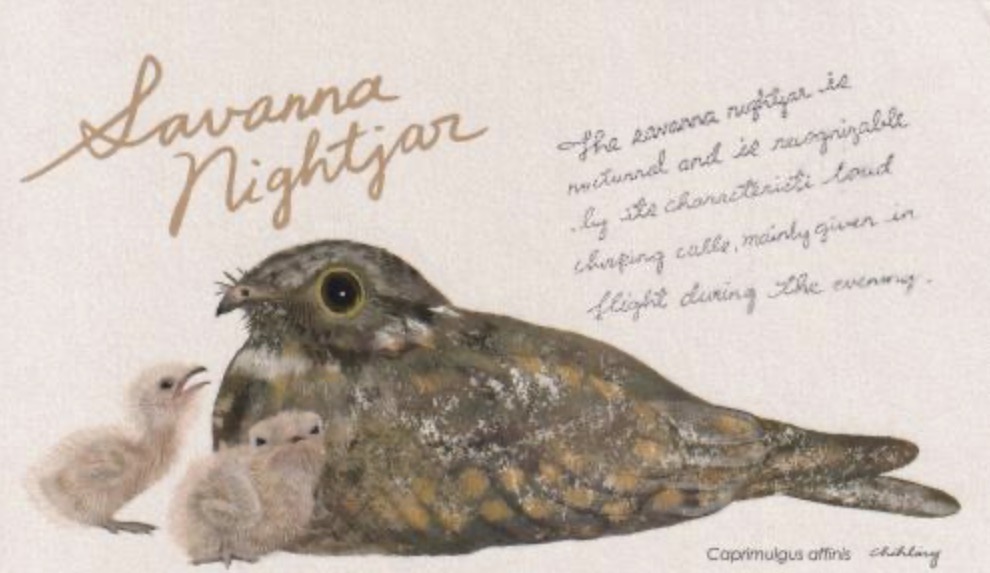
Yesterday I received a card from Taiwan featuring an endemic nightjar. I am so impressed how many people are able to find, and send, bird postcards.
Saturday May 30, 2026
Radical Cartography
One of my habits is stopping by the public library briefly and seeing what is on their new book shelf. This past Tuesday I found a copy of William Rankin’s new book Radical Cartography: How Changing Our Maps Can Change Our World and didn’t hesitate to check it out. Bill Rankin is a historian of technology and the geographical sciences at Yale University. He has been experimenting with cartographic techniques for a couple of decades now and has kept up a library of his projects at the site radicalcartography.net.
To Rankin radical cartography is not so much about the politics of the theme, but rather getting away from the conventions of mainstream cartography with its emphasis on neutrality, deference to data, and aspirations towards a single interpretation. Instead he proposes fostering the values of uncertainty, subjectivity, and multiplicity.
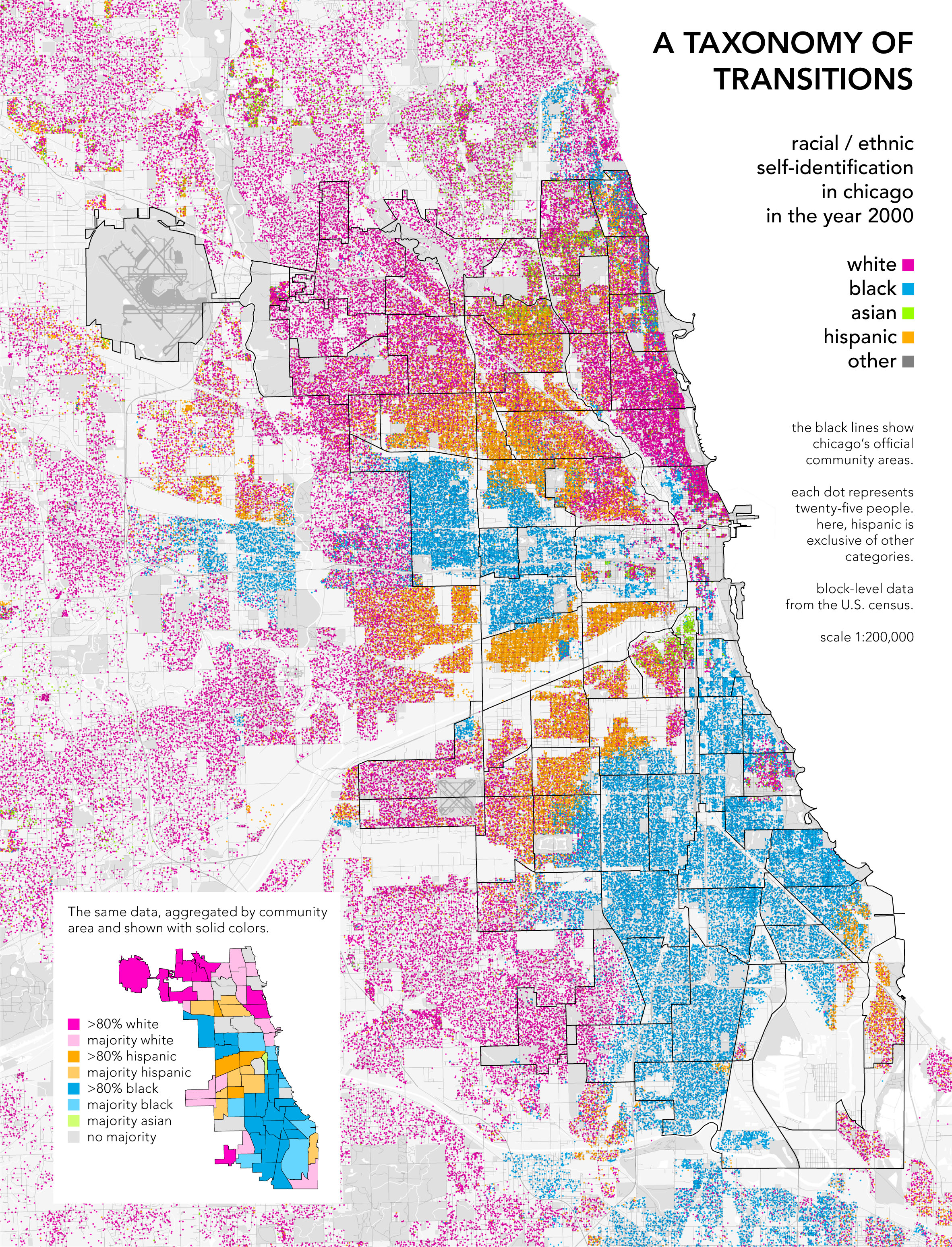
An example of this is Rankin’s work on mapping ethnic self-identification in Chicago. There is a long history of mapping ethnic neighborhoods in Chicago dating back to the 1920s. The maps of these patterns got reified into community areas which became the way Chicago understands its own geography. Rankin’s map illustrates that the transitions between many of these community areas are a lot more gradual than the “jigsaw puzzle” mapping of the areas would suggest. His technique in this map is to do fine-scale dot mapping: each colored dot represents 25 people of a particular ethnicity. This contrasts with shading the entirety of the community area with a color representing the majority ethnicity.
The book is organized by seven different elements of cartography: boundaries, layers, people, projections, color, scale, and time. As somebody who has done a fair amount of cartography professionally, I learned interesting concepts in all seven of the sections. Some of Rankin’s approaches run against my instincts, but that is part of his message, and there are techniques I’d like to experiment with. I’d definitely recommend the book for map lovers and geography students.
Friday May 29, 2026
Winston
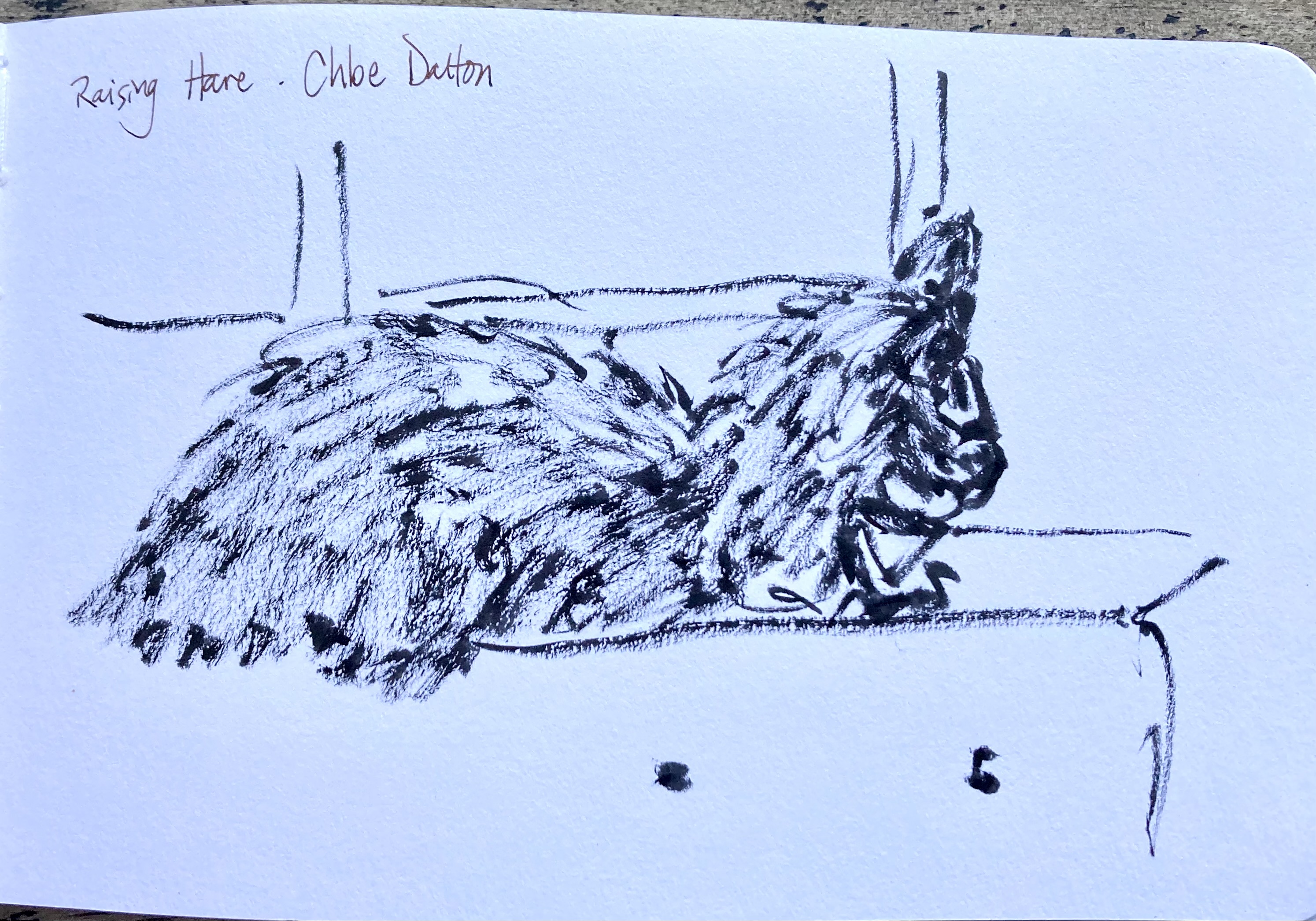 It’s been a while since I drew either of the cats. Numenius does one cat sketch per day. Maybe he’ll include some of his here at some point.
(I had a coffee with a friend this morning who recommended the book I made a note of above the drawing)