
21 August 26
El Call de Girona
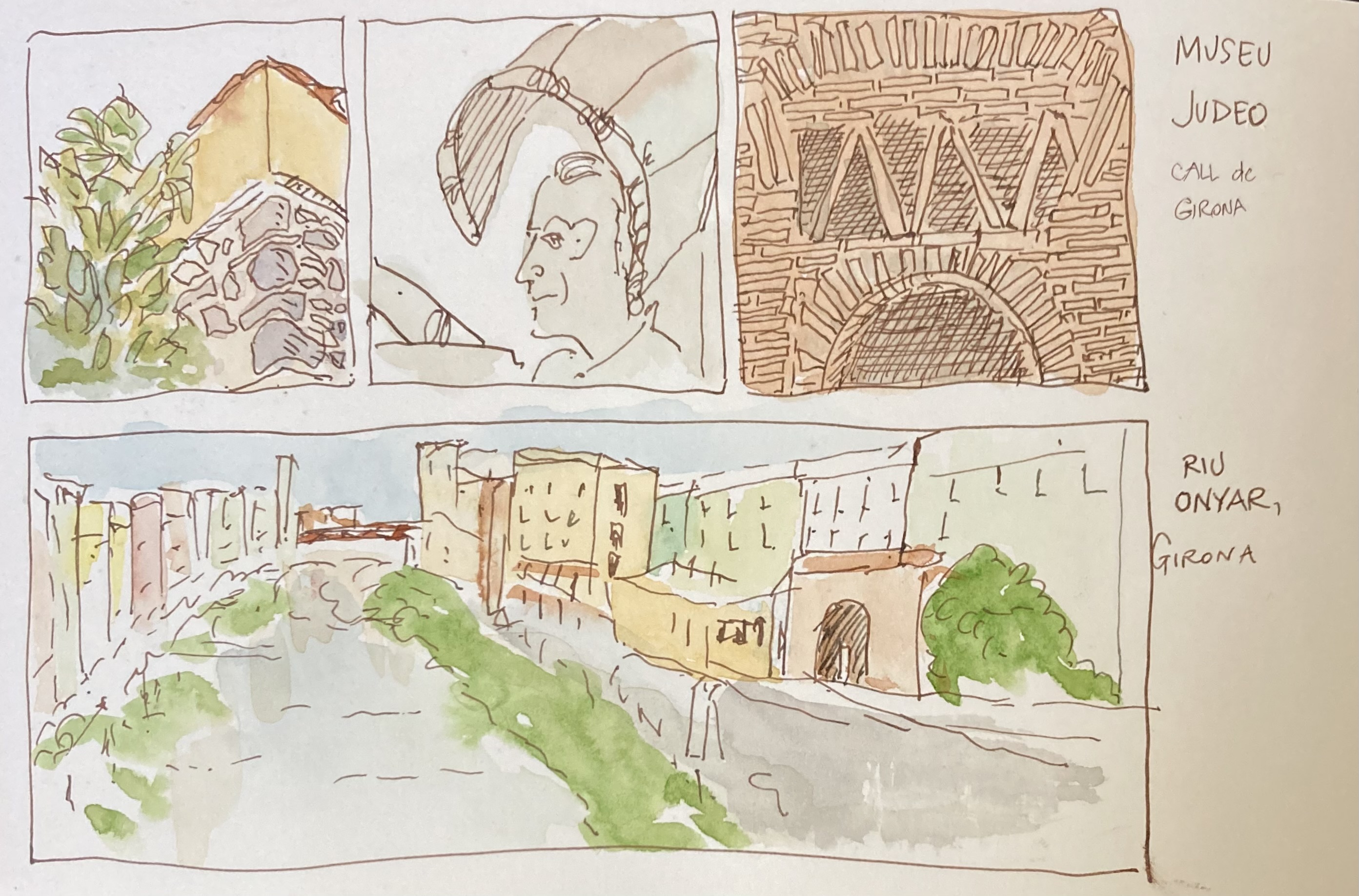
 A highlight of our sojourn in Girona was visiting the medieval Jewish quarter in the old part of the city, which is known as El Call. It is one of the best-preserved medieval Jewish quarters in Europe. Girona was a thriving center of Jewish scholarship; most notably the 13th century scholar Nahmanides lived in Girona most of his life before emigrating to the Holy Land where he established a synagogue in Jerusalem.
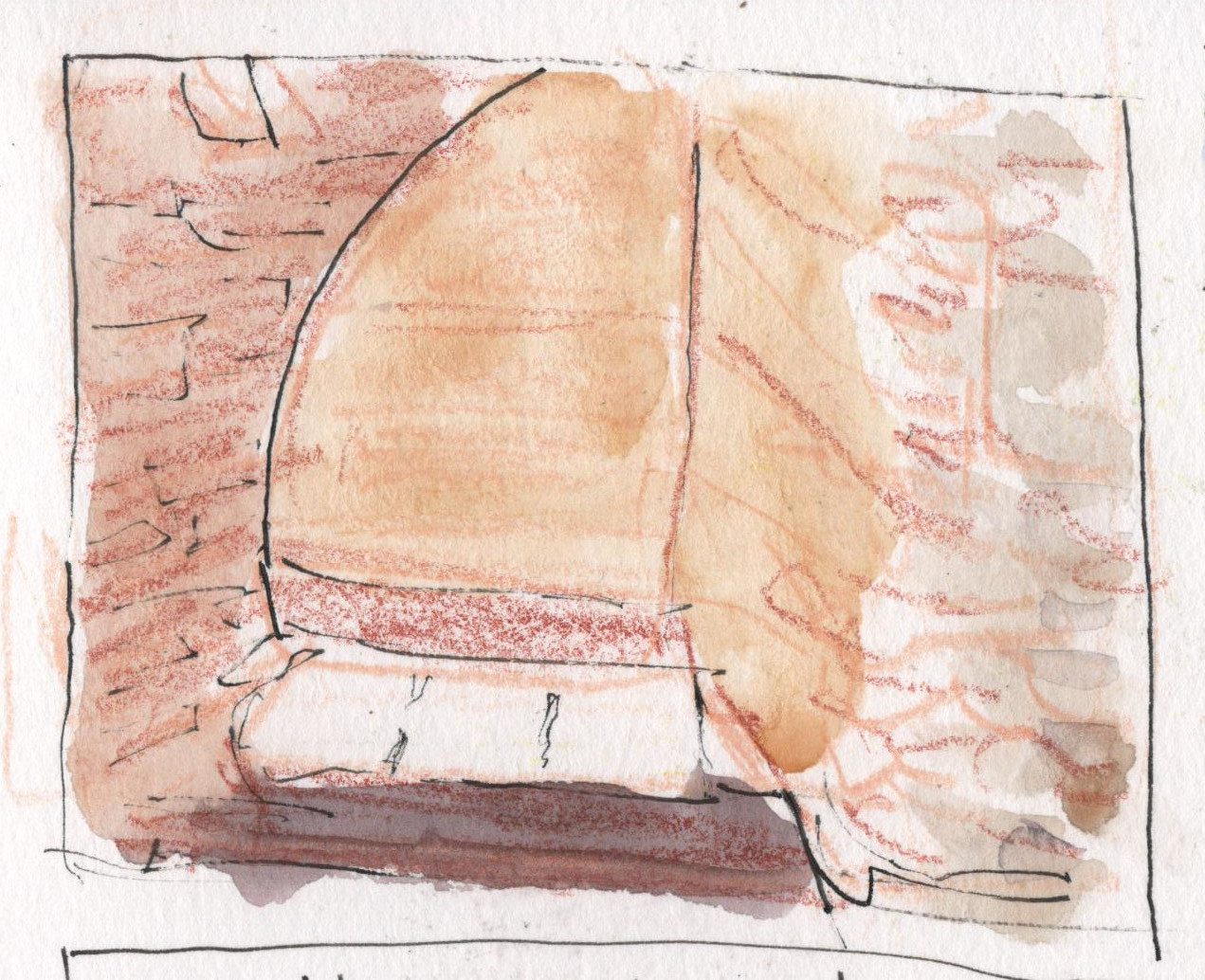
We went to the Museum of Jewish History which is housed in a building at the edge of the call. It contains lots of artifacts that were excavated nearby as well as a series of tombstones with inscriptions in Hebrew from a cemetery a couple of kilometers to the north. The museum also contains an excavated mikvah (Jewish ritual bath) from the 15th century that was unveiled to public view in 2014. I’ve illustrated the mikvah at left.
Together with the University of Girona, the museum also hosts the Nahmanides Institute for Jewish Studies, which organizes research and educational activities on Jewish culture both in the Girona area and far beyond, including a long-running lecture series. We did not investigate any of the institute’s activities though.
20 August 26
Girona
After a one-night stop in Barcelona, we moved up toward the Pyrenees to spend three nights in Girona. This is a city on a hill first lived in by Iberians then, like so many settlements in Catalunya, by a succession of Romans, Visigoths, Moors, and finally Christians, the Reconquista of Spain starting in the northwest and spreading south over the course of decades until the capitulation of the Caliphate in Granada in 1492. Much of the successive buildings are intact, and walking up the hill to the cathedral we saw a lot of offices with stone walls in the background, several centuries old, selling insurance or real estate or fans. (Or football shirts.)
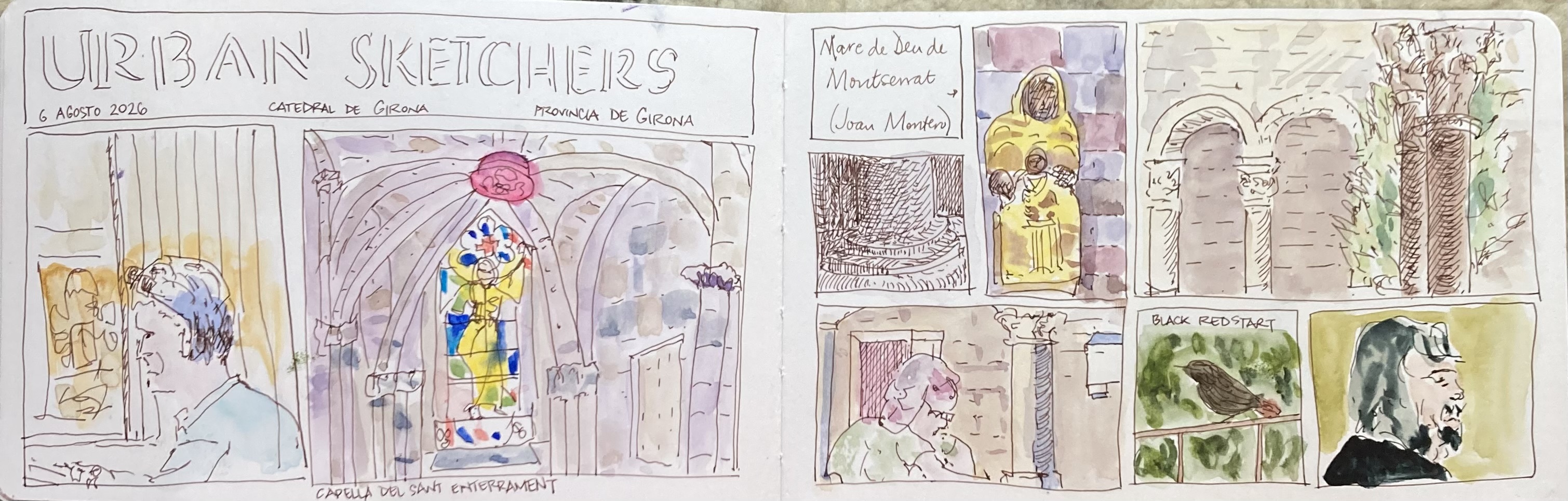
Our trip coincided with the weekly meeting of the Girona Urban Sketchers in the cathedral at the top of the hill. The cathedral’s construction was halted for some time by the arrival of the Black Death, with the result that it ended up being the second widest nave in the world by the time it was finished (after St. Peter’s in Rome). It also never received its second spire. We spent a lovely few hours sketching in and around the cathedral and cloisters.
 Girona has the reputation of being very expensive. It is now a major cycling hub, since many professional cyclists on the grand tour circuit like to train in the mountains; many of the better paid cyclists can afford to live here. A constant refrain throughout our trip was the bemoaning of housing prices that have been driven up by foreigners, many from northern Europe, who earn more than the locals and are having a deleterious effect on prices (and, of course, dilution of the Catalan culture, about which Gironans are especially proud). The Catalan government is very eager to promote Catalan language learning. Another modern office set in a house that was centuries old was a language school, with a request for volunteers to help teach their language.
19 August 26
Football In The Plaza
We arrived in Spain just two weeks after the country had won the World Cup. One of the threads we mused upon during the tournament is why it will be generations before the United States men’s team wins the World Cup. This felt evident during the loss of the United States team to Belgium, where the US simply did not have the ball control skills to beat a mid-tier European side. If they had somehow managed to win that match, they would have next met and surely lost to Spain in the quarterfinals, a team whose ball control skills overshadows everyone else’s. The point is that ball handling skills are picked up early on in children’s play, and the culture in the United States simply doesn’t engender this.
In Tivissa we stayed with friends whom we met in 2024 when the family came to Davis and rented the house two doors down from ours because the mother had a postdoc at the university here. They have three children: the two boys are now 12 and 13, and the girl is now 6. While staying in Davis the boys were active in youth sports, both in soccer through the Davis Legacy soccer club and in little league baseball. The soccer coaches in Davis all wanted the middle-aged boy to play on their team, because he scored lots of goals.
We got to witness the kids playing street soccer in Tivissa; in the evenings they would troop on down unsupervised to the plaza next to the church part of which dated back to the 13th century and kick the ball around, attempting to score goals against the wall of the church, the oldest boy in the family being the goalkeeper. There were 6 to 8 kids in total, ages maybe 10 to 13, including a couple of girls, one of whom was a long jump champion across Catalunya for her age group.
I felt like an anthropologist watching these kids. First, because this sort of unsupervised play is not something one has seen in the United States for a couple of generations, though this is facilitated by the small size of Tivissa — it is a village of 1700 people. (We’ve mentioned watching the television show El Foraster about village life in Catalunya before; Tivissa has in fact featured in an episode of this show.) More germane from the sports culture point of view, there is a direct line from this sort of street play by the kids to the dominance of Spain in global soccer, both men’s and women’s sides. The winner of the best young player award at this year’s World Cup, the center-back Pau Cubarsí, now 19, grew up in a village in Girona province in Catalunya of less than 200 people. Learning to kick a ball around is simply what kids do in Catalunya.
18 August 26
A Trip to Catalunya
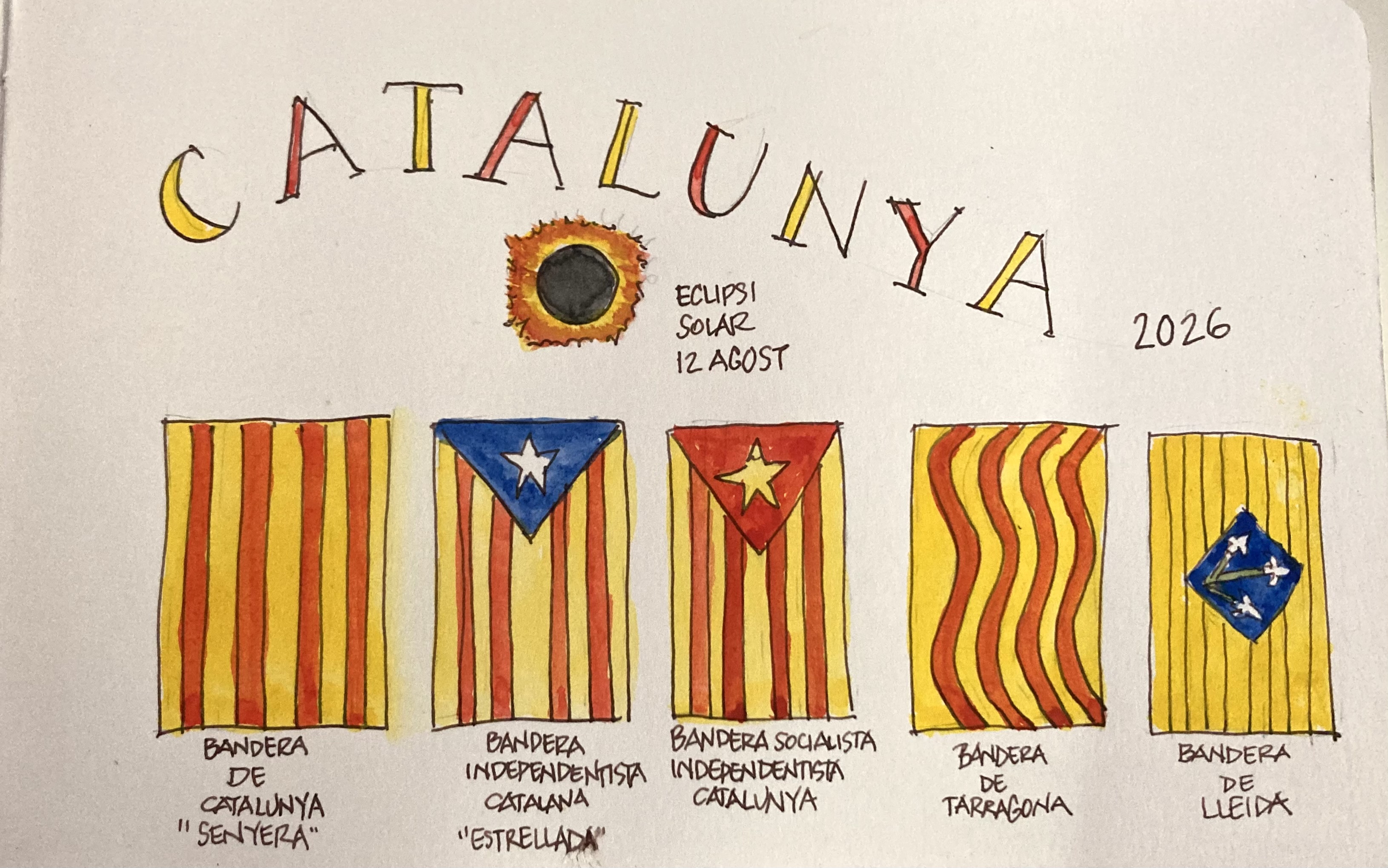
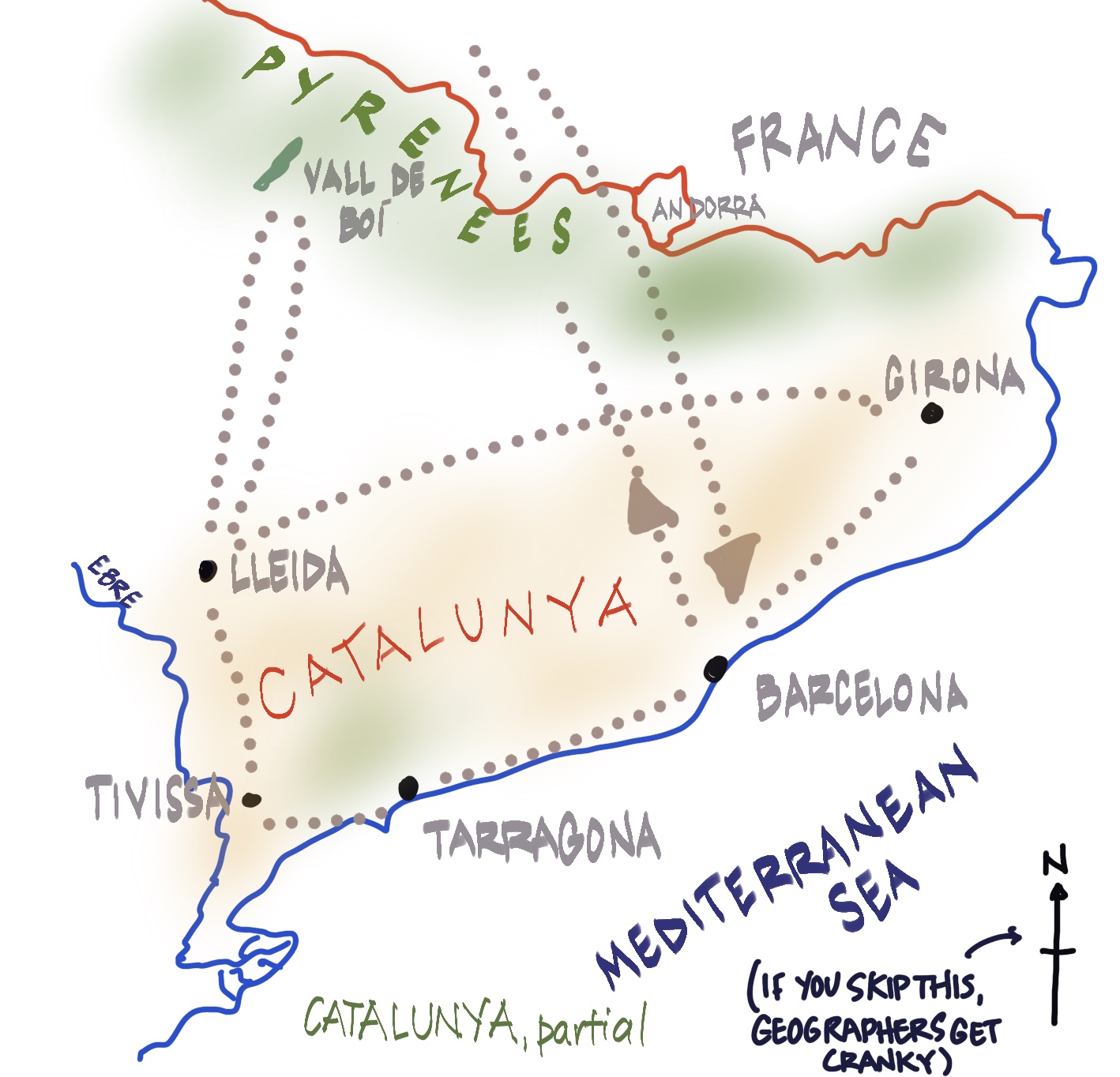 We returned late last night from a trip to Catalunya, an autonomous region in northeast Spain. We flew in and out of Barcelona, went north to Girona where we saw some friends and met up with an avid Urban Sketching group, met up with childhood friends in Lleida where we stayed in a converted convent and from where we ventured into the Vall de Boí in the Pyrenees, went south to Tivissa where we saw some Catalonian friends from Davis and the solar eclipse, rounding out our trip with Tarragona (capital of Roman Spain, Hispania) and finally three nights in Barcelona.
We are tired and a bit out of sorts with the nine hour time difference but we’ll be posting quite a bit about this trip over the next few days. I will say at the outset that I’m glad I’ve been studying my Catalan: I found I was able to hold quite fluid conversations in Catalan! This is much easier because most Catalans speak fluent Castilian but once again I was met with pleasant surprise that I’d made the effort. We visited a Catalan language bookstore in Barcelona and I picked up a novel, a fun and well-illustrated Catalan coursebook, and Numenius picked up a copy of Pratchett’s Equal Rites in Catalan. We were busy. I got blisters.
8 August 26
Some Ideas For Baseball
My baseball team the San Francisco Giants is now 22 games out of first place in the division. The Los Angeles Dodgers are heading up the division as they have the past few years, and to make matters worse they have traded for the best pitcher in the game, Tarik Skubal. The phenomenon of the richest teams staying that way and denying smaller clubs chances of success is frequent in baseball. The second half of the season is not very interesting if your team is far behind.
Does global soccer have any ideas that might make baseball more interesting for teams that are well behind in the standings? Here are several.
- Have more concurrent tournaments. The World Baseball Classic is fun to follow, but it is only every three years.There should be an equivalent of the FA Cup too: all the major, minor, and independent league competing in the same unified contest.
- Adopt a promotion/relegation system. Nobody believes the baseball ownership structure would ever agree to such a thing, but it is interesting to contemplate. Here is one idea to implement such a thing.
- Start to make the minor league teams independent of the parent major league team. Minor league games can be family-friendly, but the teams aren’t competing for anything significant.
7 August 26
Finished Pair of Socks
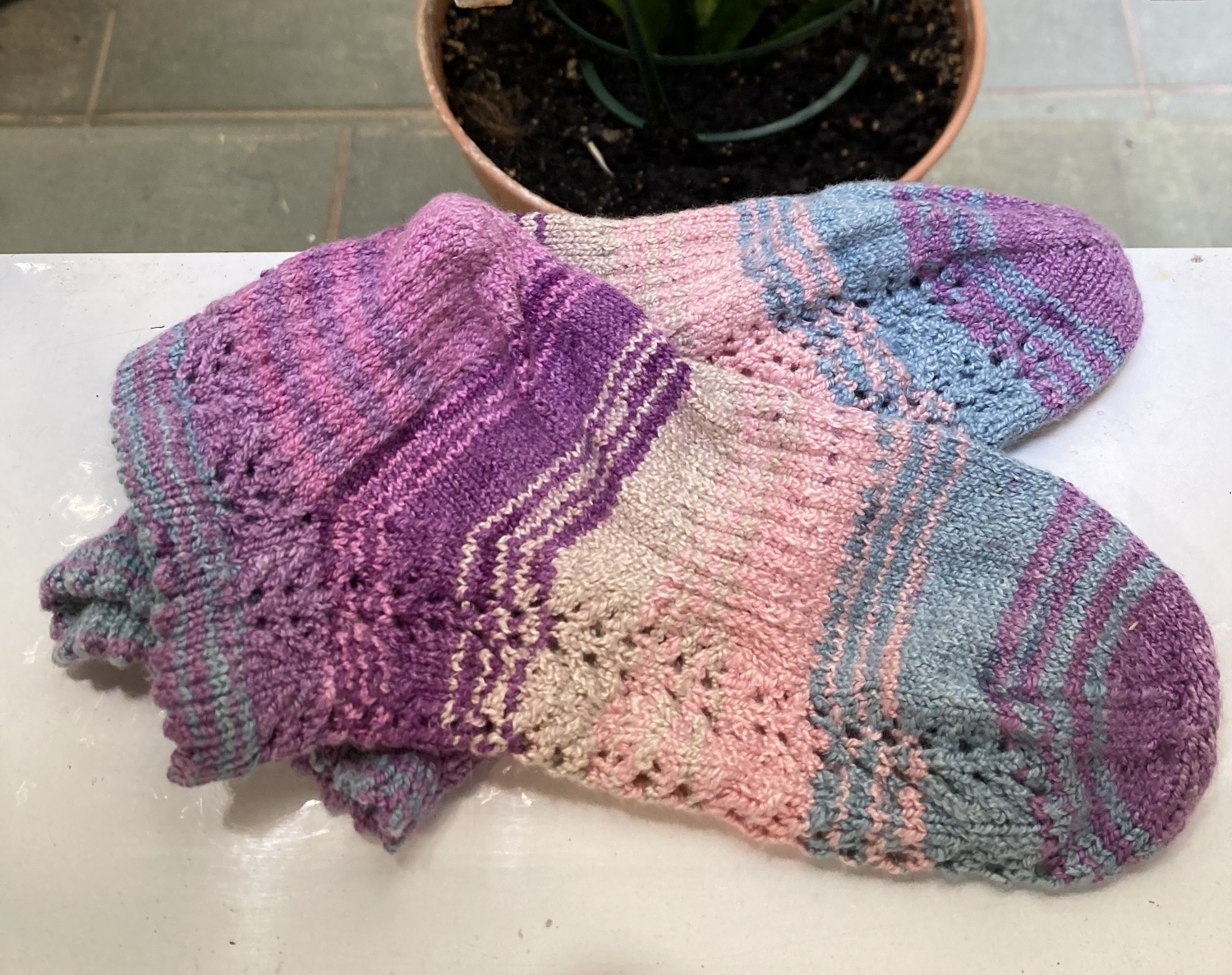 My summer socks are finished. I tried them out last night and they fit perfectly. Love them!
I am probably more of a Virgo than I make myself out to be because I just can’t not match up the stripes on a self-striping yarn…
6 August 26
A New League of Their Own
On August 1, the Women’s Pro Baseball League held the game of its inaugural season, the Los Angeles Queens beating the New York Heights 10 to 8. The league was the brainchild of Justine Siegel, the first female coach in the MLB, and Keith Stein, co-owner of the Canadian Baseball League’s Toronto Maple Leafs, with the intent of increasing the visibility of women’s baseball. The games are all being broadcast on ESPN Select.
This first season features four teams: in addition to the Queens and Heights there are the Boston Hunters and the San Francisco Firebells. The games are all being played at a neutral site in Springfield, Illinois from August to September. Over 600 women tried out for the league from around 25 countries. An notable draftee, now playing for the Los Angeles Queens, is Mo’ne Davis who in 2014 was the first girl to throw a shutout in the Little League World Series.
Throwing out the first pitch on August 1 was 99 year old Maybelle Blair. She played in the All-American Girls Professional Baseball League made famous by the movie A League of Their Own.
5 August 26
More Musings on My Family's Past
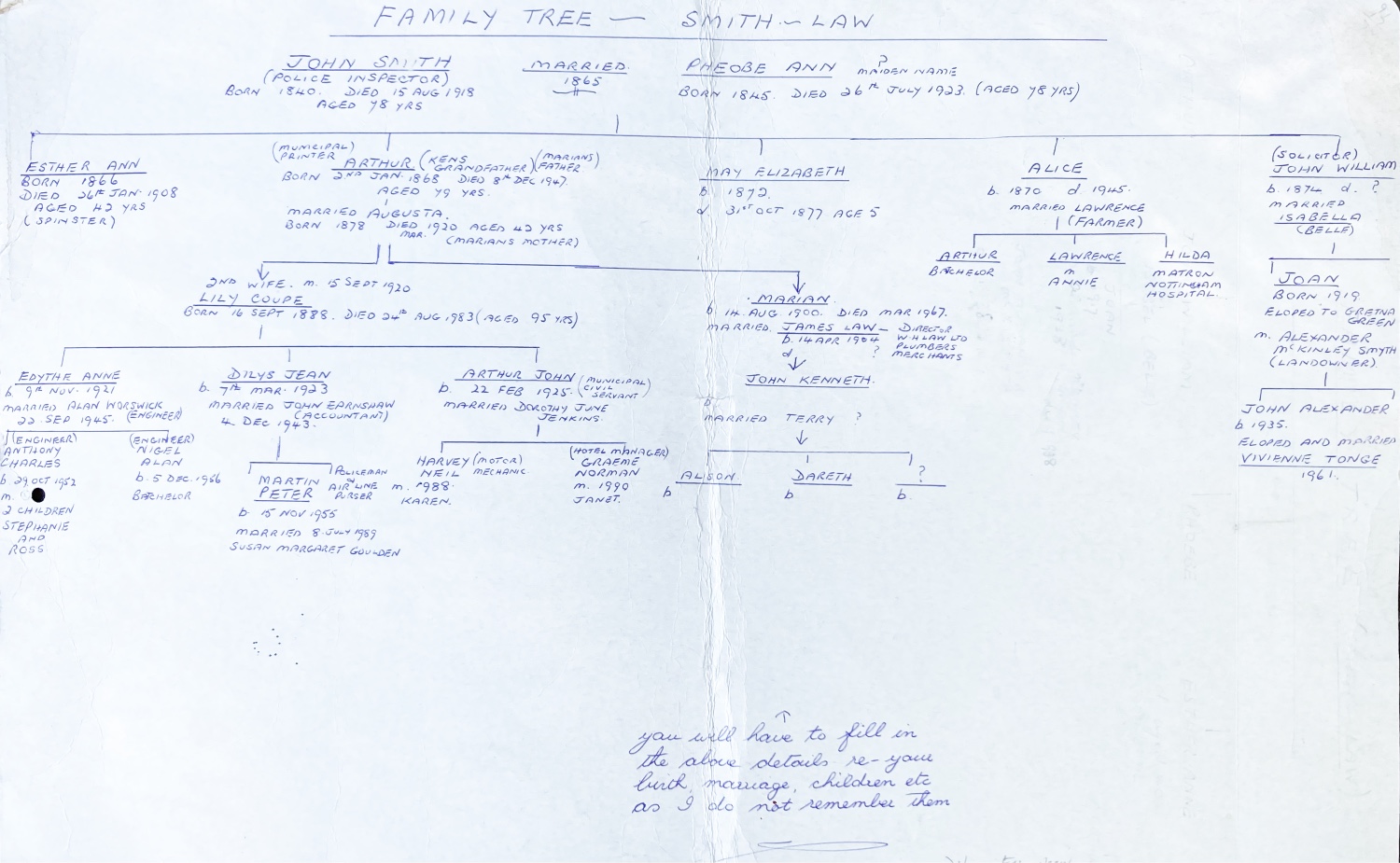 Sometime between 1860 and 1870, according to census data, my paternal grandmother’s family shifted from being farm laborers to working in the textile industry. (Her mother Augusta’s father was a loom overseer by 1871; she married a municipal printer.) Unfortunately she died young, and had only two daughters. (My grandmother’s half-sister Lily was the mother of Dilys, who wrote out this family tree on the back of a dairy calendar. There was a big family feud I’ve never understood and anyone who ever knew about it is now dead, but my father and Dilys became quite close at the end and we invited her to my first wedding.)
I dip into genealogy on a very sporadic basis but at the moment I’m glad, because it turns out my siblings and I definitely qualify for Canadian citizenship since our maternal grandfather was born in Toronto, and I have a lot of the documentation required to prove it. Kind of collecting passports, says Numenius…
4 August 26
Voting Out Of Spite
In November 2018 I went to the national convention of Reconstructing Judaism, which is the organization behind the Jewish denomination I am involved with, Reconstructionism. On the last day of the convention, there was a keynote talk by Andy Levin who was and is an active member of his Reconstructionist congregation in Michigan and who had just been elected to Congress for his first time. It was a good talk, full of hope and ideas and progressive values.
His tenure in Congress lasted four years. In 2022 he was primaried out of office. Running against him was Haley Stevens who had received 4.5 million dollars in funding from AIPAC. They were opposed to Levin because in Levin’s words: “AIPAC can’t stand the idea that I am the clearest, strongest Jewish voice in Congress standing for a simple proposition: that there is no way to have a secure, democratic homeland for the Jewish people unless we achieve the political and human rights of the Palestinian people.”
Today Haley Stevens is running in a primary to be Michigan senator against Abdel El-Sayed. El-Sayed is a progressive, Stevens is a moderate. Stevens continues to receive AIPAC money, with about $30 million flowing into her campaign. But AIPAC is now a dirty word among Democratic voters, and Stevens has been trailing badly in the polls. She has also been ramping up the anti-Muslim and anti-Arab bigotry in her campaign. (There are far too many politicians in the Democratic Party who are bigoted in that way).
I find it really rich that Stevens who is not Jewish is claiming the mantle of defending the interests of Jewish Americans when she vindictively primaried Levin in 2022.
There are strategic reasons for voting for Stevens — she polls better against the Republican nominee in the general election than El-Sayed — but were I in Michigan, I would vote for El-Sayed out of spite.
3 August 26
A Textile Center
Blackburn had been a wool weaving centre since the mid 13th century, with handlooms in houses providing much of the wool needed for trade especially following the settlement of Flemish weavers in the area. During the Industrial Revolution Blackburn’s population went from 5,000 to over 130,000. (The spinning jenny was invented a few miles away, driving the need for machine looms to turn Blackburn into the “weaving capital of the world.”) My grandmother’s family moved from just east of the Pennines to Blackburn; my grandmother worked in the cotton mills as early as age 15.
Housing for this population explosion was often provided by the mills. But what was it like? Small, cramped, damp. The Victorians could expect to lose a third of their children before they reached adulthood; how much higher would that figure have been when adjusted for these kinds of conditions? My grandmother had two surviving sisters and one brother, all of them living in a two-bedroom townhouse. The idea of laundry in a time before washing machines, in a part of the country where it ALWAYS rained and where the only indoor source of heat was a coal fire, makes me shudder. (I hung a full load of laundry outside yesterday; much of it was almost dry before I finished hanging it. California summers… And yet, most Davisites dry their clothes in a dryer. Not sure why.)
But this is where my grandfather’s family comes in: my great-grandfather was a plumber. Outhouses were common through the 1950s in this part of the world but indoor water supply needed installing, and plumbing provided the answer. Terry Pratchett’s Dodger is a fun glimpse into the rise of sanitation practices in London, but the extensive sewers put in by the Romans had no equivalent in smaller towns in the north.