
1 November 14
Supporting the Student Farm
I have to make a big confession here: I’m not a fan of the Davis Farmers’ Market. It was one of the big selling points about Davis, and when we told people we were moving here from Santa Barbara they drooled. When I got here I admit to wondering where the rest of it was… It’s tiny compared to so many of the markets I grew up around in Spain and France. I guess I am a fan up to a point: I think it’s a wonderful place to go and socialize and enjoy good music and pretty stalls and it’s a great place to sit and spin, under the big valley oak, but for buying vegetables and fruit? Not really.
Here’s how it goes: I have, in my head, that I need to buy carrots, leeks, turnips and parsley for a soup base, along with several leafy greens and whatever else. I get there. I peruse the 4-5 organic sellers. Not one of them has all four items. In fact, I can’t find turnips anywhere in the whole market, so I end up spending $50 on stuff I didn’t come here for and end up at the Co-op anyway. It just doesn’t work for me. I know people love it and I really want to support local growers but I can buy what I need from local growers at the Co-op. (I haven’t put in a garden this year because of the drought.)
We have recently gone in with a friend on a CSA box from the UC Davis Student Farm, which is organic. The past three weeks have seen us awash in vegetables and fruit. Nothing has gone to waste. We are getting things picked three hours before we get them, and it has forced us to be creative about getting things cooked quickly. Delicious food. Stuff I ignore week after week at the Co-op. I even used dill in the soup this week, which was a stretch for this dill-averse girl.
Even half a box is almost too much for us vegetarians. But not quite. We are throwing nothing out.
We got half an inch of rain yesterday, it’s definitely soup weather. And the students know how to grow turnips…
12 October 14
Organization
It’s interesting how small changes in one’s information systems can lead to successful outcomes. Last May, Pica reported on adopting the Bullet Journal. We both tried it, and by now I can report it’s working brilliantly for me. The system is a favorable combination of organic notetaking with enough structure to keep track of information in sequence. No need to rigidly fit things into narrow calendar boxes, no struggles with cranky software, and plenty of room to annotate special projects.
Last month, realizing it was finally time to get a handle on household finances, we started using the software You Need A Budget. Two themes to this software are 1) defining an explicit monthly budget and being able to track expenses against subcategories in the budget as they occur. 2) being able to sync transactions instantly across multiple devices, both desktop and mobile. We haven’t accumulated as much history with YNAB as with the Bullet Journal, but so far it is working really well for us.
The latest innovation I brought back home from my office, where it was merely accumulating dust. This is a wooden four-slot stacked filing device. We are now using it to sort incoming mail, keeping it off the kitchen counter. The simplest of devices, but need here.
Organization. What a concept.
11 August 14
Brum Meetup
Yesterday we traveled to San Francisco, to the Off the Grid food truck Sunday event, to meet up with other alumni of Birmingham University who happen to live in Northern California. I’ve been invited to several of these before but since I’ve never felt much of a connection to the university, haven’t made it a priority to attend (I’ve hardly kept in touch with any of my classmates, I who keep in touch with everyone). However, this time we thought we’d go.
 I was pleasantly surprised by the event. I found myself in the middle of three distinct cohorts representing three brain drains to the U.S.: graduates from the 50s, 70s, and 00’s. Most of the folks were people in tech or engineering fields, which of course weren’t my own (language graduate here), and since I’ve come home to Northern California which is where I was born, I don’t consider myself quite typical of the group. They didn’t seem to mind, though.
We ate excellent food. Numenius sketched. I held a cricket bat for the first time in 35 years. And I got a prize sunburn through the San Francisco fog…
31 July 14
Chromophobia, Colonialism, and the Freeway
Often when I find myself in traffic I marvel at just how dull the colors be of the American automotive fleet. Dark grays, white, blues that are no brighter than midnight, and only the occasional red, but even that not straying to the glories of vermilion. The lack of imagination — where are the sports cars banded like king snakes, the station wagons two-toned in cerulean and stratus gray? — depresses me a bit.
Here is a historical gloss on the lack of color choices in the American car market, from an article Color,Chromophobia, and Colonialism: Some Historical Thoughts (via the estimable medievalpoc)
According to some art critics, sensory anthropologists, and historians, this mutual attraction and repulsion to color has centuries-old roots, bound up in a colonial past and fears of the unknown. Michael Taussig has recounted that from the seventeenth century, the British East India Company centered much of its trade on brightly colored, cheap, and dye-fast cotton textiles imported from India. Because of the Calico Acts of 1700 and 1720, which supported the interests of the wool and silk weaving guilds, these textiles could only be imported into England with the proviso that they were destined for export again, generally to the English colonies in the Caribbean or Africa. These vibrant textiles played a key part in the African trade, and especially in the African slave trade, where British traders would use the textiles to purchase slaves. According to Michael Taussig, these trades are significant not only because they linked chromophilic areas like India and Africa, but also because “color achieved greater conquests than European-instigated violence during the preceding four centuries of the slave trade. The first European slavers, the Portuguese in the fifteenth century, quickly learned that to get slaves they had to trade for slaves with African chiefs and kings, not kidnap them, and they conducted this trade with colored fabrics in lieu of violence.” Ironically, many of these slaves were then put to work in the colonies cultivating plants like indigo, that yielded dyes whose monetary values sometimes surpassed that of sugar.
21 May 14
A Trip to the Southland
In 1996 I moved west from Cambridge, Massachusetts, to be with Numenius while he finished his PhD at UC Santa Barbara. In the manner of these things it took longer than the year we were both expecting, and we moved up the mountain after the first year to live in a cabin porous to weather (it was a ferocious El Niño year) and vermin, mammalian and insect. (We didn’t consider the canyon wren, whom we named Marcel, to be vermin, but we did discourage him from building a nest in the light fixture of the entryway.)
We left this idyllic setting to move to Davis in 1999. We’ve been back a couple of times since, but this past weekend was to help a friend celebrate his 25th anniversary of ordination as a Paulist priest. Catholic gatherings are often large, chaotic and sloppy, and I enjoyed spending a quiet couple of hours on the beach with Frs. Ed and Ruben, and Jeff and his family, ahead of the big celebration before meeting Numenius on the train from Burbank.
I did sneak in a quick trip to Solvang, home of Village Spinning and Weaving, in the morning. I wasn’t spinning yet when we lived in Santa Barbara and it was a delight to drive up past the Trout Club, yuccas all abloom, and over the pass into the Santa Ynez Valley. (I used to climb that hill on my bike! I could hardly believe it.) The following morning, after a walk around Lake Los Carneros and submitting our entries to the final International Flower Report, Numenius and I took Cathedral Oaks Road into town, seeing old haunts and reciting street names as they unfolded through the windshield.
Memory is a strange phenomenon, treacherous and fickle, much poked at by the likes of a different Marcel. It’s triggered by externals we can’t control, befuddled by others (driving through the UCSB campus was an exercise in complete disorientation). How we crave stability, control. How futile that is. How very futile. Best to enjoy the ride, like the bright young things on the beach in Isla Vista, surfing through the weekend…
11 May 14
Whole Earth Festival 2014
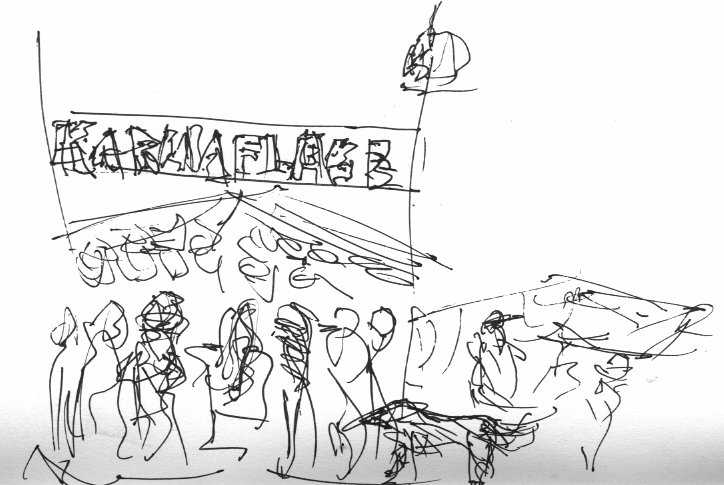 The hippies returned to UC Davis this weekend for the 45th year in a row, as it was the 2014 edition of the Whole Earth Festival, held on the main campus quad over Mother’s Day weekend rather to the annoyance of the university powers-that-be. It is my favorite event in the annual cycle of Davis community activities, and love its direct connection to the early flourishing of the culture of sustainability in the 1970s. Pica held down the fort at the booth of the Davis Spinner’s Guild, while the highlights for me included 1) local science fiction author Kim Stanley Robinson having a panel discussion with his friend Michael Blumlein, another sci-fi author and a UCSF physician. They talked about the future in the face of climate change and resource limitations, economics, and epigenetics. Thomas Piketty was mentioned often. 2) learning about the Third Space Art Collective, an recently founded group that since August has occupied physical studio space in a third of a warehouse just the other side of the freeway and 3) doing lots of sketching, filling up a small sketchbook over two days. Despite the abundance of tie-dye color, I stuck with monochrome pen, sketching rapidly with a black Gelly Roll or a brown UniBall Signo pen. Here are several of my many sketches.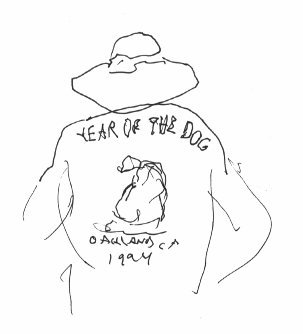

5 May 14
Bullet Journal
I’ve been getting frustrated with my system for tracking things I need to get done, both at work and at home as well as in my multiple alternate worlds (Davis Spinners’ Guild, Lambtown, FARM Davis, Meridian Jacobs, Yolo Audubon, Conflict Resolution training, Graphic Facilitation training, ham radio, etc.) in conjunction with a calendar. I’m now on a shared calendar at work, which means that I have to stick with an electronic calendar, but I’m a person who likes pens and writing things down on paper. I carry around a French Notor diary with a day-per-page, dutifully copying calendar events from Outlook^1^, but the Notor has no real room for notes; conversely, I have a lot of dated pages with next to nothing on them which is annoyingly wasteful.
I chanced upon a reference to the Bullet Journal the other day. I was intrigued. I can live with the duplication of a calendar – I’ve been doing that for a while already – but this seemed to amalgamate the best features of the Franklin Planner (index, prioritized task list) in a slim, flexible system, designed for people who prefer paper, without having to carry around a brick. (I also tried the Hipster PDA for a while as I tried to ditch the brick but got frustrated by the tiny size and multiple cards.)
 I’m already sold on the Bullet Journal, I think. I bought a gridded Moleskine notebook on Saturday (not that Moleskine is my favorite, I’m a Clairefontaine girl with a lot of fountain pens, but I liked the size, flexible and washable cover, and pocket in the back). Calendar one side of a spread, tasks for that month on the right, subsequent days in the pages that follow, seven days to a page or three or only one – depends what’s going on. The best bit? I can include pages as and when I want to devoted only to books I want to read, or spinning projects current and planned, or classes I want to take, and always find those pages (and add to them) because they’re indexed. Tasks have a square checkbox, calendared events have a round one, notes are a black bullet. I’ll be able to sketch in this notebook too, which is really important to me.
Early days yet, but I’m hopeful this system will work. (Numenius independently bought almost the identical journal on Saturday, only his is hardbound. We’ll see how long we can go before we each end up with the wrong journal at work and I suddenly face a lot of tasks relating to analyzing geospatial data in R, which will give me nightmares. I have no doubt that a task called “Spin Tunis mohair batts” would trigger the same response in him, so we’ll have to work on keeping them separate…)
1. I know: I made it into my fifties without ever having to use a PC at work, but it finally caught up with me.
6 April 14
Volvos Return To Davis
 On the way home from a meeting at Mishka’s Cafe in town today, we stumbled across the annual Volvo meetup at Central Park, always on a Sunday in the spring. This seems to be the largest Volvo meetup on the West Coast; why they have settled on Davis as their location is not clear. But I’m always happy to see these cars return — I grew up with Volvos in my family and have quite a soft spot for the older ones. Here are photos of the 1800 sports car and the 122S station wagon, both of which we had, the station wagon arriving in 1966.
27 March 14
Pollinators in the Garden
Last week we attended a workshop put on by the California Center for Urban Horticulture on Gardening for Pollinators. A full morning of talks followed by a trip to the Honey Bee Haven, followed by a trip to the Arboretum Plant Sale (for the record, we bought a manzanita, three Spanish lavenders, a giant buckwheat and an ericameria). All but the lavenders should grow into large shrubs that qualify as four feet, and the lavenders should end up filling that slot.
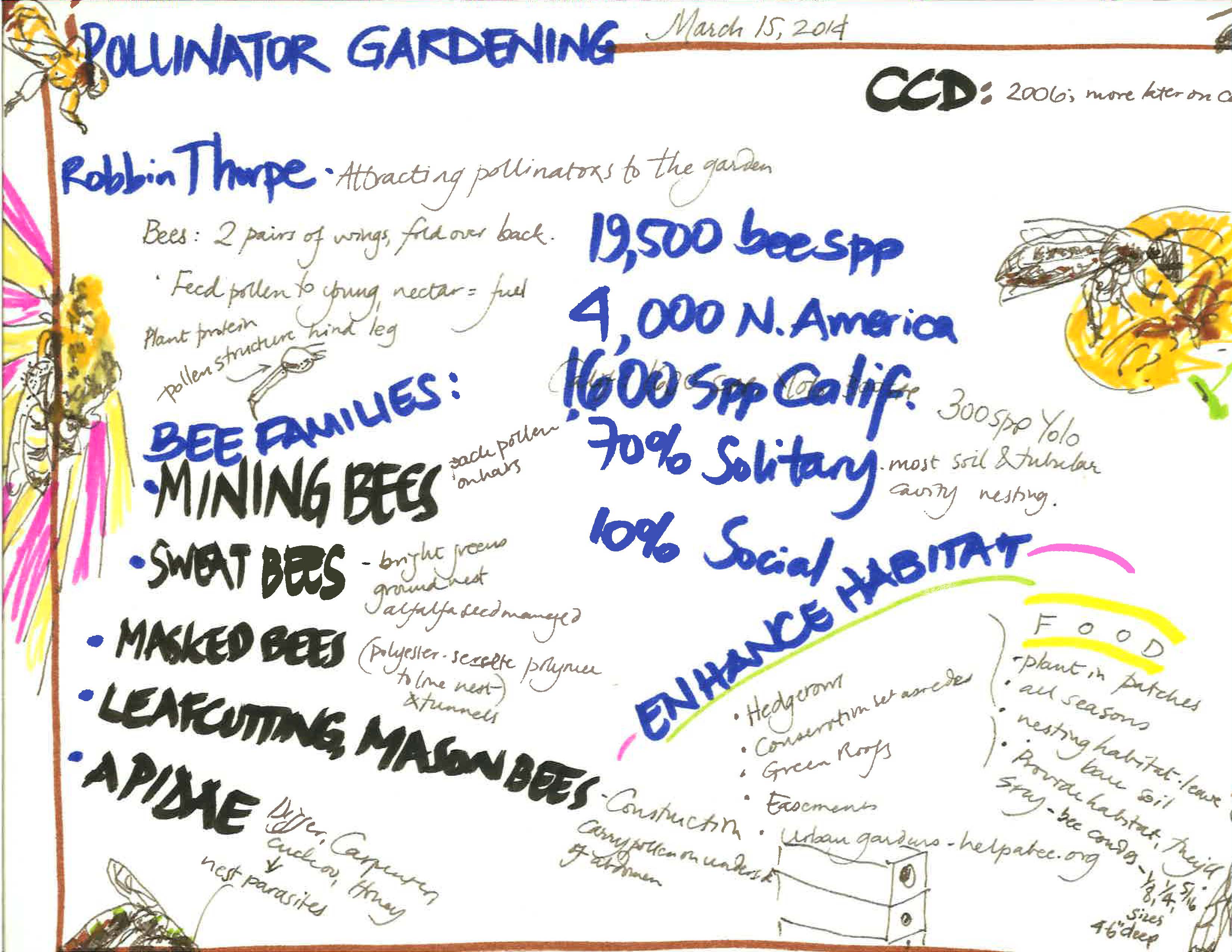 I’ve written a blog post for the ANR Green Blog that provides more background, but here are the big take-homes for me from the workshop…
- Planning for succession blooming (in the Central Valley, that means late winter through fall)
- Putting plants in clumps at least 4 feet long if possible (honeybees, especially, like to specialize)
- Putting in plants that provide both nectar and pollen (nectar is fuel for adult bees, pollen is protein for the young)
- Using native plants where possible; they’re drought tolerant and have what our native bees need
- Avoiding most-toxic pesticides and herbicides
- Providing a clean source of water (a slow-dripping tap on a sloped surface is ideal; bees like to drink from very shallow sources)
- Providing cavity nest holes in wood for carpenter and other bees
- Leaving some areas of gardens unmulched for ground-nesting bees
15 March 14
Megadroughts
Our rain gauge stands at 6.21 inches for the water year (in California, precipitation is measured from October 1 through September 30, since it is a Mediterranean climate), which is about at 38% of what we’d expect to this date. And there is not much more of a rainy season left. Some say we’re on pace for the driest year since 1580 and discussion has begun on whether we’re entering a megadrought.
The paleoclimatic history of California is a fascinating story which I am just starting to read up on. (I’ve just started geographer Lynn Ingram’s recent book, The West without Water: What Past Floods, Droughts, and Other Climatic Clues Tell Us about Tomorrow) In the past several millenia, the Pacific Southwest has seen droughts lasting decades to upwards of a couple centuries. One of the more dramatic pieces of evidence comes from geomorpologist Scott Stine’s work at Mono Lake. In 1941 Los Angeles started diverting water from its tributary streams, causing the water level in the lake to fall some 50 feet, which exposed a lot of lakebed. When hiking across the lakebed at one point, Stine found dozens of tree stumps. Jeffrey pines do not grow in the middle of lakes, and the conclusion follows that the lake level was much lower in the past due to prolonged drought. Radiocarbon dating on the tree stumps showed that these trees came from two periods of drought, one lasting about 140 years ending about AD 1100, and the other lasting at least a century ending about AD 1350.
It is interesting how megadroughts illustrate an aspect of climate change that is independent of anthropogenic global warming (there was not much in the way of greenhouse gas emissions in the 13th century) that is nevertheless quite worrisome. Megadroughts have occurred recently enough so that they are clearly part of the general pattern of climatic variability in California at this point in geological history. Unlike a millenium ago, the past century-and-a-half has been fairly benevolent in terms of California’s climate. How would we cope now with a 140-year long drought?