
9 January 23
Swatching
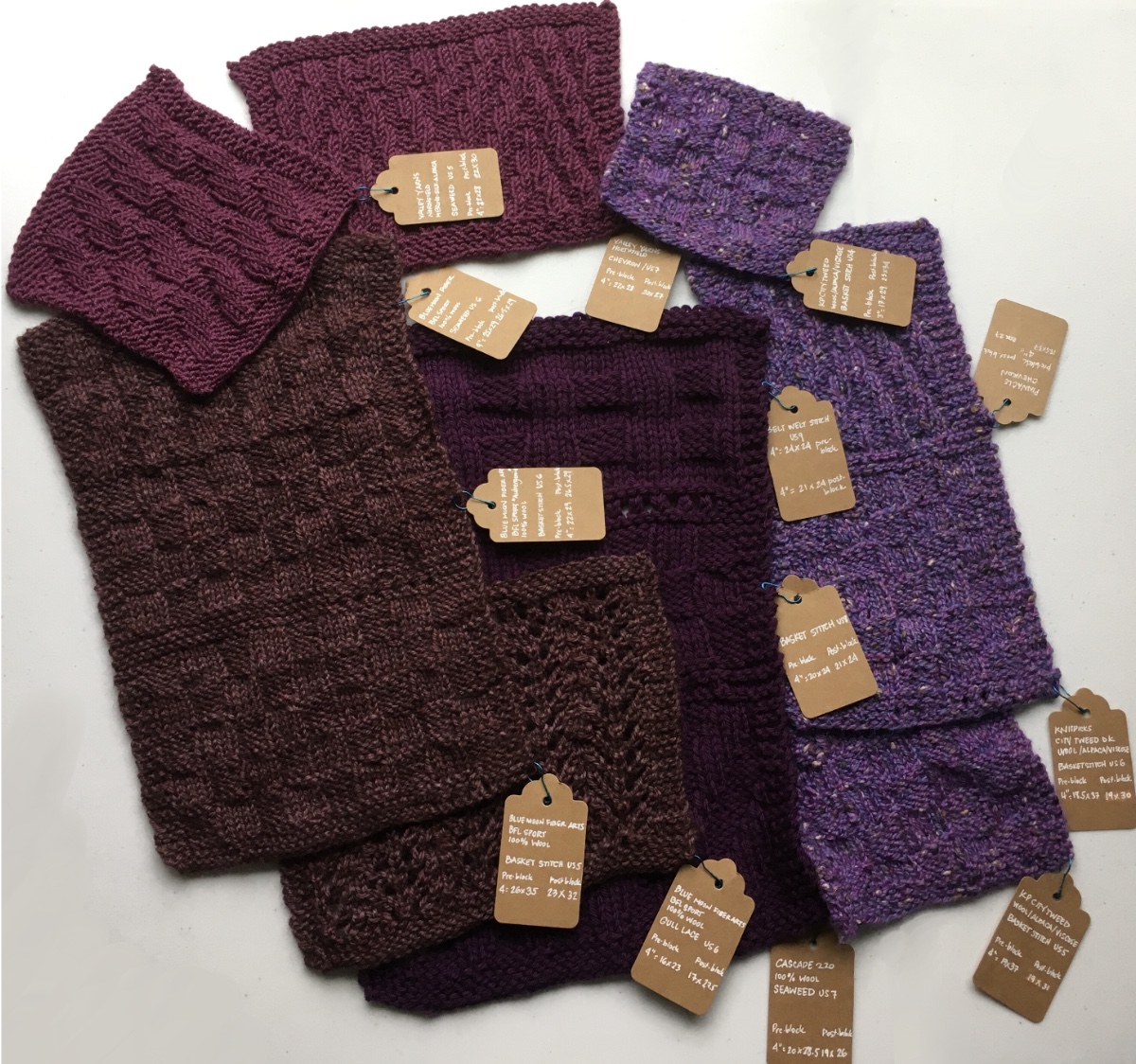
Although I was born on August 23 and am therefore technically (if only just) a Virgo, precision has never been my thing. I’m more of a mudpie kinda gal, sloshing around and having fun in the world of “it’s good enough.”
But I’ve knit enough sweaters in my time that have NOT FIT well, and this is a huge waste of time and resources. So I’ve learned to embrace swatching.
Swatches are notoriously untruthful, so it’s best to make a large swatch in the pattern you mean to use, and measure how many stitches per centimeter/inch you end up with, calculated over at least a 4”/10cm width and breadth. Measuring the entire swatch and then weighing it will give additional information such as yardage required. So I’ve done all this. (My mudpie-self is looking at me incredulously.)
My sister would like me to make a tunic vest for her based on a commercial one she bought. I’m sending her all these swatches to make her decide which yarn, pattern, and fabric she likes. Once she chooses there will be more calculations to make, difficult for those of us in mudpie-land, but for now a huge shoutout to Norman of Nimble Needles whose video tutorials are so impressive I’ve gone ahead and supported him on Patreon. I’ve learned so much about knitting in the past month or so (and I consider myself an advanced knitter).
7 January 23
Weather Watching
I think we’re in the middle of the fourth storm here in 2023 already, and we have so far gotten 3.09” of rain in January. This has meant paying a lot of attention to what the weather is going to be doing in the next hours or days. Today for instance I wanted to know if I’d be able to cycle out to fetch take-out burritos sometime between 12:30 and 1 PM without getting rained on. It’s about a 4 mile round trip bike ride. So I studied my weather apps scrupulously. No precipitation was predicted to fall before 2 PM, so out I went.
There are two apps I’m finding especially useful. The first is Windy, which is available equivalently as a webapp or as a iOS or Android app. It provides many different weather visualizations, including reported temperatures and wind speeds, and radar and weather satellite views. Here is a view of radar imagery from Windy, showing a precipitation cell about 3 minutes away from reaching Davis.

The scientist in me particularly likes how Windy give you several different major forecast models to choose from, at various different spatial extents. For instance it lets you animate the ECMWF global weather model over the next 11 days, good for predicting how long this rainy pattern will last. But Windy also has visualizations of the HRRR (High Resolution Rapid Refresh) model for North America, which is at a 3 kilometer resolution and is updated every hour. Here is a view of predicted precipitation from the HRRR model over a 15 minute period, the image being straight from the HRRR website.

I also just discovered the wX app, available solely for Android. It is basically a repackaging of many different National Weather Service products, allowing you to avoid wading through lots of different NWS website page. From the app’s starting page you can just scroll down to see the NWS text forecasts for your location, and you can also click on an icon to get to a comprehensive suite of different weather radar products e.g. storm relative mean velocity, or reflectivity at various different radar tilt angles.
5 January 23
The Holiday Card
 I’ve now been living in the U.S for nearly 35 years. It sounds a lot when you put it like that, when it seems like just a few short years ago that I stepped off a plane in January into a brilliant blue sky made more blinding by piles of snow at Logan Airport. The drive south to my uncle’s house had me reeling with the exciting architecture right and left of the freeway. (I had just discovered postmodern architecture; the love affair didn’t last all that long but it was fun while it did.) I applied for a job as soon as I could to an architecture firm in Cambridge.
That November the ex and I took the train to my Aunt Nancy’s for my first American Thanksgiving. (She wasn’t really an aunt; my mother’s elderly first cousin.) On the way back I started drawing trees, all of them long-denuded. I decided to cut up all my fast pen sketches and use them as Christmas cards, called “trees from a moving train.”
My Christmas card list was long that year — keeping in touch with friends and relatives in Europe seemed really important as we forged a new life in New England. But I have made a holiday card every year since. Drawings, collage, calligraphy, stamps — and while the list has shrunk dramatically in recent years because most people have eschewed sending anything by mail, I still somehow do it.
This year? Cedar waxwings in the persimmon tree.
3 January 23
Storm A'Coming

This is a magnificent view from the GOES 17 geostationary weather satellite of the storm that is about to impact Northern and Central California. This is coming not long after Saturday’s big storm, and yesterday’s forecast discussion from the Bay Area office of the National Weather Service did not mince words:
“To put it simply, this will likely be one of the most impactful systems on a widespread scale that this meteorologist has seen in
a long while. The impacts will include widespread flooding, roads washing out, hillside collapsing, trees down (potentially full groves), widespread power outages, immediate disruption to commerce, and the worst of all, likely loss of human life. This is truly a brutal system that we are looking at and needs to be taken seriously.”
The storm will arrive around daybreak tomorrow and last into Thursday morning. And there are at least two and perhaps more storms following this one.
Time for hunkering.
2 January 23
Bringing Back Blogging
Starting again… Happy New Year.

1 January 23
Weekend Building Sketching
It’s a very different world now than when we were last blogging but with the implosion underway in social media it feels timely to restart the habit. We will see how we do with the activity in 2023.
I have a daily sketching practice, always of objects from life. On weekdays I tend not to have time to venture out and often this means I do a quick sketch of something in the kitchen, vegetables being frequent choices. But on weekends I sally forth to find a building to sketch. At some point a year ago I decided I needed more practice sketching buildings so this became a weekly habit. I don’t go far as a rule, either on foot in the neighborhood or sometimes over to campus either on foot or on bike.
My daily sketches are in a 5.5” × 5.5” notebook. I am currently using a Hahnemühle watercolor sketchbook, which has exquisite 100% cotton paper. Having good watercolor paper for the sketchbook is fun because the paper tolerates a lot of abuse. My sketches are done with some combination of watercolor, watercolor pencil, and ink, but how I deploy these varies from sketch to sketch and week to week. Here are three examples of my building sketches from my current sketchbook.
 The sketch at left is of a house across the street from the local food co-op, which is conveniently only a couple of blocks away. The ink work is with two sepia Faber-Castell pens, one of them a brush pen, another a fine-tipped marker pen.
 This painting at right is from yesterday. I didn’t actually go outside to paint this, since it was raining all day (we got 1.94” of rain in the storm, and San Francisco got a near-record 5.46” of rain yesterday). So I looked out through the window in my office at home to paint. It is entirely in gouache, which I am not very experienced with and find a little cumbersome to use in the field. Not a problem looking out my window though.
 At left is today’s sketch, which is of Young Hall on the UC Davis campus. I sketched this in a combination of watercolor and colored pencil.
25 June 15
Catchup
UC Davis held a retirement celebration last night for anyone who had retired since June 30, 2014. I’ve “retired” in that I draw a check from the university every month that is a “retirement” check, but Listen-ink is moving along. I love this new work I’ve chosen to do and it’s a great fit. (I just volunteered, perhaps rashly, to record a session in Spanish at the IFVP Conference in Austin in three weeks. The speaker will be speaking in English, I’ll be recording in Spanish. Translation and translation on the fly. Wish me luck!)
Here’s a list of Things I Know Now. I am so behind with blogging it seems like the only way to give the space to Numenius, who has been gently pressuring me.
- If you wind a warp on a loom unevenly, threads will pop. This is really annoying.
- Hens stop laying eggs reliably when they’re over 18 months old, and much less in winter. The rest of the time you have stroppy pets that make a mess and try and escape at any opportunity. I maybe should have let the hawk keep one of them instead of chasing it off.
- Daily Life for Working Americans consists of a lot of rushing about. It’s been very nice to turn down that spigot.
- If you stop rushing about (to get to work on your bike, say), it’s really easy to pack on the pounds. Forget the Freshman Fifteen; this is more like the Retirement Eighteen.
- Obviously, more exercise and less food is a way to address this. Obviously. Hmm.
- The U.S. confectionery lobby has succeeded in banning Cadbury’s chocolate from retail outlets here on the dodgy loophole that it doesn’t quite count as chocolate. It can still be found, however, in a drugstore in Davis (not telling which one). Obviously, this is not helping with the Retirement Eighteen thing.
- I really hate housework (except mopping floors). It was easy to find excuses when I was working. Rushing about. Now I just have to fess right up here and say I’m a slob, I live with someone who doesn’t see the mess, and though I don’t like it, I’ll tolerate it because I don’t like housework more.
- There is lots of suffering in the world and it can get overwhelming.
- A lot of suffering in the world, and particularly here in the U.S., is inflicted by people of my skin color.
- One small thing I can do is speak up about it. Speak up against even very veiled racism. And start talking to other white people about it. People of color are so exhausted by the futility of trying to educate us, plus it’s not safe for them. We can work to get to a place where we educate ourselves. It’s really important right now
5 April 15
The Perils Of Color In The Digital Age
Last fall we bought a digital DSLR, and this has led me to dabble in a bit of astrophotography, even buying a good equatorial mount to facilitate this. Astrophotography is an interesting hobby. Practiced at its upper echelons (which I have no aspirations towards), it calls for extremes of technique, patience, and expensive gear. The aesthetic which many astrophotographers aim for is a quite colorful image showing many subtleties in the details of a nebula or other deep-sky object.
The use of color in this manner is in most ways an illusion, at least from the point of view of human visual perception. Cones, the anatomical structures in the retina that respond to color, are not sensitive to light at low levels, so looking through even a very large telescope at the nebula one will not discern the color brought out in the photograph. The color in the image may be useful in terms of scientific visualization, for instance illustrating different emission spectra, but it’s not what the eye can see.
Astrophotography is perhaps an extreme example, but I’m philosophically confounded by the question of representation of color in the digital age. Consider what might be the modal life of a digital photo shared with others. A snapshot taken with one’s smartphone, then posted to the web via Facebook or Instagram. The issue is of calibration. How does one ensure that the color intended by the photographer is what is seen by the recipient? Without both the creator’s and recipient’s monitors calibrated to a common standard, one cannot. These standards exist, but 99.99% of the time both parties are not so calibrated. Even enthusiastic photographers tend to spring for new lenses in lieu of color calibration equipment. One can adjust color curves in image software to one’s heart’s content, but without calibration both sides, one’s artistic intent in terms of color cannot be reliably shared.
And what if the intent is simply to record the colors one sees? The problem persists and is refracted twicefold. First, how faithfully do the levels of color recorded by the digital sensor represent the spectra of light being reflected by the object? Second, what are the colors being displayed by one’s monitor?
A solution I often adopt is to directly record the color in watercolor paint. With sufficient practice in color mixing, this can work reasonably well. Soil scientists have a more scientific answer to this problem — they go to the field armed with Munsell color swatch books to match and note the color of a soil unit. And the astrophotographer in me wishes there was a market for black-and-white consumer digital cameras: these problems go away, and cameras without RGB filters are more sensitive to light.
It’s also not clear where octarine fits in any color calibration system I know of.
[Image below is one of my attempts at astrophotography, being of the Orion Nebula.]

5 February 15
New Directions
 I’m finally able to announce that I’ve retired from the University of California in order to start my new graphic recording/facilitation business, Listen-ink. So excited, a little daunted. Many thanks to Rachel Rawlins for doing my website for me — quickly and efficiently!
I am looking forward to helping people find their way.
16 November 14
A Day On The Rift Zone
Walked down Shoreline Highway in Point Reyes Station yesterday in search of lunch. I was quite happy with the burrito I eventually found at a Whale of a Deli, but feeding myself cheaply was otherwise going to be a challenge. Pica spent the day at the 2014 Fibershed Wool Symposium, and I tagged along to wander along the San Andreas Fault for a bit, hiking along the Rift Trail and visiting a few cows.
Point Reyes Station is an odd place. Marin is one of the very richest counties in the United States, and on weekends the town is a gateway for recreational and culinary tourism. Cyclists meander in over the hills from towns on the San Francisco Bay side of the county, stop to browse at the Bovine Bakery. The food here is pricey, emphasizing the local and organic — if I hadn’t found my burrito, I was going to settle for a $8.95 mac-and-cheese. West Marin is quite stably rural though — most of the land is in agricultural easements, mainly for dairy ranching. It made perfect sense for Pica’s symposium on locally-sourced fiber production to be held in this town.
 At left is a view from Point Reyes Station, looking west towards the ridge of the Pt. Reyes Peninsula.