
25 February 11
Paris, 1986
The metro.
The dogshit.
The smoke.
The traffic.
The noise.
The stairs.
The walls.
The silence.
Dwindle-cash.
Dwindle-truths.
Dwindle-joy.
Dwindle-god.
Dwindle-voice.
Fake smile.
Fake joy.
Fake French.
Fake marriage.
Fake self.
Book-delve.
Deep-delve.
Story-delve:
Sheherezade
on a perch
weaving tales
(in flawless French)
to save her life
This is a contribution to the Language, Place Blog Carnival hosted this time by Jean at Tasting Rhubarb with a theme of “another place, another language, another self.”
5 February 10
Fighting for the Right to Study
Slumber party at Shields Library! Students have occupied the library in protest of cuts that will reduce services. In a very different approach to last fall’s protest in Mrak Hall, this one comes with the full support of the Chancellor and Provost. Library staff have volunteered to work at the library to provide minimal assistance. I wonder if there will be midnight cocoa runs, ghost stories, and strange dreams…
21 January 10
Joyce While Spinning
I’ve started listening to Ulysses while working on some hand-dyed (not by me) merino wool. I’m planning fingering/sock weight. It’s beautiful at least in singles, we’ll see what it looks like plied.
I couldn’t get the second CD to work for some reason and am a thwarted Joycean. Loving the language, the exuberance.
It’s still raining.
10 January 10
Not Reading for the Plot
I’ve discovered the e-audiobook service at the Sacramento Public Library, and now I’m knitting away while someone reads me a book. It’s wonderful. I’m gobbling up big books I’ve read before and bigger ones I haven’t.
I’ve always managed to miss Edith Wharton. I saw the film version of the Age of Innocence when it first came out but it seemed a Merchant Ivory period piece, pretty and insubstantial. What I’m astonished by in the book is how perfectly she nails American (specifically, New York postbellum but easily transposable to a Boston I knew when I lived there in the 1990s) snobbery. This might get dull after a few hundred pages but it unfolds in such perfumed, stifling, dark-panelled and rose-bedecked prose that I find myself pulling at my neckline, trying to get more air.
I will never again say that irony is not one of the weapons in the American writing arsenal. Wharton deploys it like a stiletto, inlaid with mother-of-pearl and bearing at its tip an orchid poison. I’m following along in horrid fascination.
For anyone still reading this blog, any recommendations for other books, given how much I’m enjoying this?
10 December 09
Troperville
We’re now well into the off-season, and one of these days we will need to break out the baseball movies to make it through the winter without ballgames to entertain us. Maybe we’ll even watch some we haven’t seen before. Of course the tropes of these movies will be familiar: sports movies seem to center around the same half-dozen tropes: the Ragtag Bunch of Misfits (Major League), the player on an end-of-career Redemption Quest (For Love of the Game), the Miracle Rally (Major League again)…
The above links are all from a wonderful site that took me only six years to run across, the by-now-quite-misnamed TV Tropes. This is a wiki whose participants have been cataloging all the tropes of creative storytelling they can identify: not just in TV, but in film, literature, poetry, anime, games, theatre, and real life. Completely fascinating. Even A Spot of Tea hasn’t escaped their attention.
12 May 09
Rhétorique Française
I am very happy to be back in touch with an old friend and wonderful translator from my Harvard Press days, Art Goldhammer, and even more so to learn that he has a blog, French Politics. It’s a great way to follow gallic happenings, which I admit I haven’t been, much. (I really wish there were a counterpart for Spain, and if anyone knows of one, in Spanish or English, please let me know.)
Today there’s a link to an article by Jean Daniel of the Nouvel Observateur on his recent luncheon meeting with Nicolas Sarkozy. This is quality, elegant writing, and reveals, as Art points out, a nuanced series of layers in the French President which I found surprising. (Why? I mean, nobody can argue he’s not a clever bastard.)
Nuanced he may be, but Sarkozy doesn’t seem to tire of the sound of his own voice, and the quote in the article I thought most telling about his character, about his vision of his place in history, and which he apparently uses to justify his “maverick” independence, is this one: « Les grandes choses, on les décide seul car le consensus interdit l’audace. Reste que les grandes réformes, comme la décolonisation ou l‘élection au suffrage universel, sont nécessairement impopulaires au départ puis qu’elles modifient le cours des choses. » (The really big things, you decide on alone because consensus precludes audacity. So the great reforms, such as decolonisation or universal suffrage, are necessarily unpopular at first, because they change the course of things. Sorry if my translation’s not as good as Art’s would be, but you get the idea.)
This sort of quote would in years past have found its way into British A-level, Oxbridge entrance, or university examination papers, with the simple addition of the word “Discuss.” We’d have been expected to provide copious (but not too many!) historical examples along with memorized quotes for bonus points and provided a series of pros and cons, plonking down in the end on one side or the other, trying all the while not to make it look too pedestrian. Our French counterparts, though, would have been expected to provide, in addition to such arguments, an elegance of phrasing and structure.
I bet Sarko aced these kinds of exam questions.
26 February 09
Delighting in a New Vowel
Hanging around the hispanohablantes on Ravelry has introduced me to the gender-unspecific vowel that is apparently now being widely used in Spanish texting: @.
Spanish, like many Romance languages, has an obligatory masculine/feminine divide in nouns. Sometimes the endings are unintuitive (la mano [the hand], el drama [drama]) but mostly “a” is feminine, “o” is masculine. This being a culture where historically the masculine incorporated everyone, in the 60s if you said “hola a todos” it was assumed you meant hello world, or hello everyone, masculine feminine and neuter.
I’m delighted to see new spanish-speaking knitters chime in on Ravelry with the “hola a tod@s,” the ‘o’ encompassing the ‘a’ as a perfect, ambi vowel. It’s particularly heartening because in fact not all spanish-speaking knitters are female, nor are all of them straight, and I love the inclusiveness that’s implied…
2 November 08
Cooking, Carpentry, and Sewing
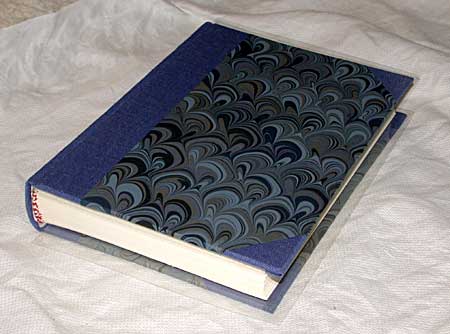 That’s how one of my classmates described the activities in the Bookbinding III class I took this weekend at the San Francisco Center for the Book. This time we only produced one book, but this was a large and complicated one, with 20 signatures, sewn endbands, and a split-board binding. The cooking bit was learning how to make wheat paste glue, for the carpentry we had to do lots of precise cuts with the board shear and guillotine, and the sewing of course was the signatures and the endbands, the latter being very finicky and difficult. I’ve now completed the introductory bookbinding series at SFCB so it’s time to start applying these skills. It would be nice to produce something other than blank books, so my next project might be to typeset some text from Project Gutenberg, print it up on a laser printer, and bind it as my very own book design. Imposition problems here we come.
22 September 08
Bookbinding
 We’re starting to accumulate a small pile of books we’ve bound. I am quite enjoying the paper in the “Ideal Sketchbook” — Kelly Classic — for pen and ink. I think this may become my main bird sketchbook.
Numenius has been dazzling me with his new binding skills. Headbands and everything. I have no idea where this is leading but we’re both enjoying it. It’s companionable and that’s unusual for what is often a solitary activity.
Our trip to Art Ellis in Sacramento and lunch at Tapa the World (they catered Chris and Karen’s wedding — we were impressed then; we were impressed again on Saturday) yielded the following conversation at the next table:
“Mauritania. Sand. Lots of sand.”
“Do you get robbed there?”
“No, I got mugged in Rio. Machete.”
“I know a guy who got mugged in Rio by machete.”
“Really? Who?”
“Christian.”
“Christian left Rio a few hours before I got mugged on the beach by machete.”
“You’re kidding! You mean he took your story?”
19 September 08
Left Unsaid
Before my mother moved back east a couple of summers ago, she handed me bags and bags of things she wasn’t taking with her but didn’t want to throw away. These included improbable numbers of bottles of moisturizing lotion; they also included all my letters home — since I first went to boarding school in 1973.
I know they must have made us write home weekly, but I was still shocked by the sheer number of them, and by their mostly uniform vacuousness, which continued on into university and beyond. They’re painful to read and mostly I haven’t. But they lurk…
I finished Geraldine Brooks’s March last night, a novel that starts out with the Little Women father writing home. It has been a horrific day, a day in which he, a green army chaplain, has tried (and failed) to save a wounded man from drowning as they retreated in terror from a confederate counterattack. He is wracked with pain and cold and shame and fear and guilt yet none of this makes it onto the page: he writes about the cooking fires around him and the beauty of the sky. The truth of that day — and many other terrible truths about many other days, truths that likewise never made it onto the pages that are sent with love and remorse about the deception — the truth of that day finally emerges as Marmee visits her “very ill” husband in hospital and tries to save him from his demons. She is transformed in this novel from a milquetoast goody-two-shoes into a raging spitfire with a terrible temper (and how we love it: tell it like it is, Marmee), and she feels anger and betrayal at the lies that have been flung her way. Yet when she tries to write home to her daughters, she is faced with the same dilemma: tell the truth and cause pain and anguish, or spare them from it and lie. And then live with the consequences of your lies.
Choices, these are. At the time, it doesn’t seem so momentous. “I’ve started smoking” is a truth I felt able to divulge in a letter home, difficult though it was, leading to a reminder my grandfather had died of emphysema; “I lost my virginity in the darkroom on Saturday” is one I left out. It reveals to me, again, how difficult parenting must be: choosing between honesty and wanting to protect your young. Of course my own omissions can be explained in terms of teenage rebellion, but looking through these letters, there’s more.
If I had been encouraged, or decided on my own, to share with my parents the struggles I was facing — wanting to fit in, wanting to be “cool,” feeling the pressure (of course this would have involved acknowledging it, which was far from the reality) — it may have been possible to write the letters with the integrity that, in hindsight, I wish I’d had. And it’s possible I might have made different choices, guided by parental wisdom and love and, perhaps, honesty.
My grandfather — the one who died of emphysema — was a man for whom lying was close to a crime; it was certainly a sin. He raised my mother and uncle to share this view. Yet, looking through his own letters home during World War I, I see the same reticence to reveal the truth in letters in as Mr. March’s. “I’ve had the grippe but some poor fellows have it much worse” is the only mention I’ve found in any correspondence anywhere from family members that touches on the great flu pandemic of 1918. It is left to my imagination to fathom what he was really seeing, because in tents in western France with thousands of soldiers, many of them ill and dying, it can’t have been something you’d want to see, ever.
Much has been written on the impossibility of language to convey some things so horrific most of us would rather they remain unsaid. This is the project of many films about the holocaust: say the unsayable, because it is the truth, speak it even though you don’t find the words. Truth becomes a driving imperative. We recognize it when we see it — if we’re lucky.
At a time when most of us expect lies of all our leaders, even those at the highest level, when outright untruth or misremembering or failure to remember or I’ll take the fifth or other permutations of culturally sanctioned lying from the top down, lying that has led to, for example, people still dying in Iraq — now is the time to take baby steps to learn how to tell the truth again. It can start with the innocuous things. I didn’t, in fact, make my bed this morning. I got a less than stellar performance review. I made some stupid mistakes in the stock market. We can then progress to “I did have sex with that woman” and “we knew all along there were no weapons of mass destruction.” From there, perhaps, when there are real consequences inherent in the truth we tell, we might make wiser decisions in the first place…