
5 September 07
Fantasizing
Neil Gaiman has got me very much in a fantasy-reading mode, having recently finished his books American Gods, Stardust, and Neverwhere. So I’ve been compiling a reading list, and raids on the local libraries and bookstores are imminent. Some of the works on the list include:
Neil Gaiman: Anansi Boys, the Sandman series. The Sandman books may take a while to get a hold of from the public library.
Susanna Clarke: Jonathan Strange & Mr. Norrell.
Guy Gavriel Kay: A Song for Arbonne. I’ve never read any Kay; this one seems like an ideal one given its setting based on medieval Provence.
China Miéville: Perdido Street Station. Urban fantasy a little in the vein of Neverwhere.
Naomi Novik: Throne of Jade. Think Patrick O’Brian with dragons. I just finished reading her first novel in the series, His Majesty’s Dragon, which was quite fun.
Tim Powers: Declare, The Anubis Gates.
Terry Pratchett: Reaper Man, Making Money. I don’t know how I missed reading Reaper Man. Making Money is about to be published in a couple of weeks.
Mervyn Peake: Gormenghast books. Classics, never read them.
Philip Pullman: His Dark Materials series. With the movie version of the first book in the trilogy coming out in December I’d better get a head start. Intriguingly, it is seen by some critics as being an anti-Narnia series.
This should keep me busy for a week or two.
If there’s a focus to this list it’s mythic fiction, and I probably couldn’t go too far wrong with the Endicott Studio folks’ recommendations, for instance this list here.
3 July 07
Jane Austen with Fangs
On a friend’s recommendation I got a couple of novels out of the library by Ivy Compton-Burnett. I had vaguely heard of her, thought she was vaguely Victorian in the same generally vague way that Edith Wharton might be (I’d say this with more authority if I’d ever read Edith Wharton, which is my loss, I’m sure).
I’ve finished one of the novels — The Mighty and their Fall — and started a second, and I’ve just never read anything like this.
The characters speak (and there is no description, or narrative, at all: these could easily be one-act plays) what they feel, all the time. It’s mostly not edifying. (Especially when children speak, unedited despite the best efforts of governesses — they are monsters.) Raw, sparse, cruel, ironic, and ultimately sort of hopeless. The house — a decaying Victorian estate — is a character in the Edwardian background, a menacing presence that somehow affects the plights of the family members busily ripping one another apart, watched by one or two servants. (I think I now know where the idea for Gosford Park may have originated.)
Compton-Burnett has been described, I’ve discovered, as post-Impressionist, and as a torchbearer for the Nouveaux Romanciers. It seems ghastly to read this stuff at all, and if I were less honest than her characters I might mumble about the chronicling of the busting open of the British class system. But in fact it’s riveting, this kind of voyeurism. I’m mesmerized. If I’m honest.
What is so astonishing, though, is the way the two worlds collide: the brutality of honesty, definitely post-World-War-One, juxtaposed with the veneer of pre-war respectability of diction. It seems so seamless. This is how it comes across as so very modern. It almost makes me want to some try and imagine the households of my great-grandparents, overlaying the stuffy syntax with what little I know to have been the quasi-sordid truths about their financial and personal dealings. It has me thinking deeply about what their world must really have been like, rather than what I can see in photographs. What must have been spoken about at luncheons, and what must have been avoided, the big silence as eloquent as any effusion…
28 April 07
Tu/Usted
Susan writes about the tu/usted familiar/formal usage of the second person pronoun in the village where she and her sweetie spend half the year in Mexico. I’m interested in this because the usage seems fluid, local, and changing constantly.
When I returned to Spain after many years away, about four years ago, I was stunned by how complete strangers now used the “tu” form to each other. (I looked like a gringa or, to use the Old World form, a giri, and it wasn’t until I opened my mouth that they, once they got over their stupefaction, danced in multiple ways around the tu/usted maypole.) But usually one person sets the rules: either by establishing “nos tuteamos, ¿vale?” or simply by assuming that a “tu” will not be considered rude. (I did notice that nobody said “tu” to my mother while we were there for a wedding last year unless they had known her VERY WELL when she lived there. Perhaps there’s a certain age above which it’s never considered okay beyond the family.)
I had a sad occasion to call Madrid on Wednesday to order flowers — the mother of the groom died suddenly on Tuesday night. (Auntie Margaret, I hope there’s lots of good hot tea milk not cream, and toast and marmite, wherever you are now.) The local florist, Carlos, was from Ecuador. (This is definitely a new face of Madrid: the influx of Latin Americans, willing to do all the work that Spaniards etc. etc.) We discussed colors and the layout (the US usage “arrangement” is translated to “arreglo” in Ecuador but in Spain the term is “centro,” so once we got through all that we communicated quite well. I certainly used “usted” but I suspect that makes me a bit quaint. Carlos showed no sign of discomfort with it, though. I think the key here is to be attentive to the comfort level of the person you’re talking with…
Susan says that in contrast to the morass of Spanish usage, she understands the French usage of tu and toi and vous, but again I think it might be more nuanced. For instance, my boss in an insurance company in Paris in the early 80s was from a minor Belgian aristocratic family. She called her father “vous” on the phone and would never, ever dream of calling God “tu” — so when I attended her sister’s wedding in the Loire it was a chaotic, hilarious mishmash. The 12th century church was full of people who a) rarely went to mass, and didn’t know the vernacular prayers at all, having learned them in Latin pre-Vatican II; b) were aristocrats, and used the “vous” form loudly and proudly; c) were commoners who mumbled along with the “tu” voiced by the priest. But in the street, even in the early 80s, people of my age would never call me “vous” — it would accord me a status I hadn’t earned and didn’t expect.
I expect I’d be surprised, again, if I were to alight in Paris today, as Leslee is doing: but in this as in many things I suspect there are clear distinctions of region, urban/rural, class, and colonized versus colonizer. Of course it’s very hard to form any clear sense of how this is evolving on brief visits… Care to weigh in at all, Nicole? Jonathan? Beth, with a French Canadian perspective?
3 March 07
Ekphrasis
I’ll be co-editing qarrtsiluni with Lori Witzel of Chatoyance for the next couple of months.
The full description of the theme and how to submit is here, but here’s a short version:
This qarrtsiluni theme pairs submissions in poetry, or poetic prose, with a form of visual art. Ideally they need not be by the same person: this is a collaborative experiment. Non-bloggers are particularly encouraged to participate. Find a partner whose work you admire and have at it!
The visual art contributions will be posted in our gallery awaiting writers – check back often over the next two weeks, as we will have more to share.
All work, visual and otherwise, will be reviewed and juried by the editors before publishing. Poems should be no longer than 30 lines; prose pieces should be no longer than 500 words. Image files should be a maximum of 500 pixels in width.
Please take a look, and consider partnering with someone (they can be dead: if you’d like to write a poem about or inspired by Las Meninas, please feel free), or if you’d like to send in a photo or a piece of art you think might lend itself to poetry, send them in!
13 February 07
Imped
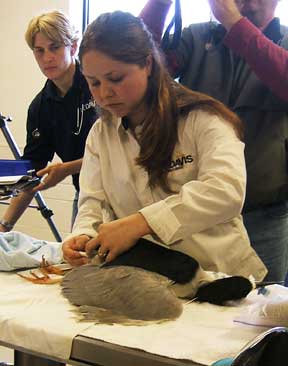 Yesterday for work I was present at a surgical procedure on a bird. A black-crowned night-heron had gotten snagged in some fishing line and was found in December, dangling from a tree, with its left wing flight feathers severely damaged.
Feathers grow back, but you have to wait for a new moult, which can take months, always to be avoided with wildlife. So the vets decided to undertake an “imping” on the bird, a transplant where donor feathers are grafted onto the trimmed existing shafts using bamboo skewers and five-minute epoxy glue. No blood involved: this is all dead tissue.
This night-heron had nine feathers imped yesterday.
Wondering where the term came from (the vet who did the surgery didn’t know, but he knew it was a very old falconry technique), I asked Language Hat. Right person:
“You’ve come to the right place! The Oxford English Dictionary says it’s from a (rare) Old English verb impian, which is related to various other Germanic verbs (like German impfen) but its earlier history is obscure, though it’s presumably ultimately derived from Greek emphuteuein ‘to implant, engraft.’ Its earliest meaning was ‘to (en)graft,’ which goes back to around the year 1000; what you want is definition 4:
4. Falconry. To engraft feathers in the wing of a bird, so as to make good losses or deficiencies, and thus restore or improve the powers of flight; hence, allusively, with reference to ‘taking higher flights’, enlarging one’s powers, and the like. In various constructions: a. To imp feathers into or in a wing, etc. Obs. 1477 Paston Lett. III. No. 794. 185 Like as the fawcon Which is alofte, tellith scorne to loke a down On hym that wont was her feders to pyke and ympe. 1580 LYLY Euphues (Arb.) 249 Ymping a fether to make me flye, when thou oughtest rather to cut my wing for feare f soaring. 1589 NASHE Pasquil & Marf. 11 Such an Eccho, as ultiplies euery word..and ympes so many feathers vnto euery tale, that it flyes with all speede into euery corner of the Realme. 1641 ROME Joviall Crew II. Wks. 1873 III. 374 To see a swallow..with a hite feather imp’d in her tail. 1706 PHILLIPS, To Imp a Feather in a awk’s Wing (among Falconers), to add a new piece from an old roken stump.”
etc.
The bird was expected to stay in an aviary for a week or two while it strengthened its flight muscles. By nightfall yesterday, though, it was was flying around and generally freaking out. It was released this morning after a band had been put on its leg; flew up into a tree where it stayed for 20 minutes, and then headed off into the Suisun Marsh.
27 January 07
Rumi in the Chaparral
Today was the final session in my Cold Canyon docent training . The final three presentations concerned plant adaptation, Patwin uses of the native plants, and a selection of Farsi poetry. Iraj read us some of the poetry in Farsi.
There is a strong tradition of Persian nature poetry, with Rumi and Omar Khayyam perhaps the best known in the West. I visited Shiraz in the 1970s, home of the poet Hafez. These poets were all revered in their time, though marginal socially and politically.
The great find of the day for me was Sohram Sepehri, a twentieth-century Iranian poet who started out as a painter and who chanced upon an eccentric patron who offered to buy all his paintings if he would travel for some time to Japan and India. His art inspired his poetry and vice-versa.
The poem I read was called Water. The first two stanzas:
Let’s not muddy the water:
somewhere down the stream a pigeon may be drinking,
or in a distant wood, a goldfinch may be washing her feathers.
Or in a village a jar may be filling.
Let us not muddy the water:
Perhaps the current passes by a poplar,
washing sorrow from a lonely heart.
Perhaps a dervish has dipped his dry bread in it.
—
I have some books to look for in the library… oh. And let’s not muddy the water.
18 January 07
Fungus the Bogeyman
A friend brought a copy of this amazing graphic novel, now out of print, when they were up here doing the Christmas Bird Count, hoping , perhaps, I’d agree with her that it was the best children’s book ever.
Ron, you’re right.
I’m seeing from the Wikipedia entry that this was turned into a TV miniseries in 2004. I’m sure my niece and nephew, who are heavily into all things gross just now, would appreciate it. I love the art, I love the philosophical turn of thoughts of poor old Fungus (“but what’s it all for?”), and I love the side comments. (And I especially love the triple nipples.)
Thank you, thank you. A treasure.
22 December 06
On Holiday
Nine days off! I’m thrilled we’re staying put, not trying to catch planes and deal with weather.
A book arrived today from my sister and brother-in-law, Sam Harris’ Letter to a Christian Nation. I didn’t wait till Christmas to open it, nor to read it.
I haven’t read The End of Faith, but I will now. It’s good to read an atheist with a good command of Christian scripture. What to do about the lamentable state of affairs in the United States is something that was explored in this year’s San Francisco Mime Troupe play, but, as Harris points out, “the fact that nearly half of the American population apparently believes [that the world is about to end and that its ending would be glorious, purely on the basis of religious dogma, should be considered a moral and intellectual emergency.”
12 December 06
Making Sense of Gobbledegook
Finally, some long-needed new proofreaders’ marks from Eve Corbel. Via Language Hat.
In other news, speaking of gobbledegook, we may be hitting some snow this weekend as we do our Christmas Bird Count along the ridge at Mount Vaca:
MODELS SEEM MORE IN LINE WITH THE DETAILS OF A TRANSITION BACK TO A MORE AMPLIFIED PATTERN OVER THE WEEKEND. THIS MAY DRIVE A STRONG STORM INTO THE REGION THIS WEEKEND. 18Z GFS NOW BRINGS A SEPARATE WAVE ACROSS THE FAR NORTH THURSDAY NIGHT BEFORE THE JET AND ASSOCIATED PRECIPITABLE MOISTURE PLUME TAKES AIM AT OUR AREA BY FRIDAY NIGHT. THIS SYSTEM MAY HAVE A DEEP MOISTURE TAP... STRONG DYNAMICS AND CYCLOGENESIS. 18Z AND 06Z GFS DEVELOP A SURFACE LOW SOMEWHERE ACROSS THE AREA... EITHER OVER SOUTH CENTRAL CALIFORNIA OR IN THE GREAT BASIN. THIS COULD BE A MAJOR SNOW PRODUCER
30 November 06
Books
Modal Minority has started an interesting exercise: an inquiry into the best books we read in 2006, regardless of when they were published. I’m still thinking about this.
Today I received word of an interview by my former boss and mentor at Harvard. (Thanks Sue.) This interview reminds me why it’s important to remember that not all the best books were published last Tuesday. On Lindsay’s list of books he’s most proud of having published, I worked on well over half. It doesn’t mean Harvard has published nothing of note since I left ten years ago, but I’m glad some of those great books didn’t get relegated to the dustbin of publishing history…