
3 August 26
A Textile Center
Blackburn had been a wool weaving centre since the mid 13th century, with handlooms in houses providing much of the wool needed for trade especially following the settlement of Flemish weavers in the area. During the Industrial Revolution Blackburn’s population went from 5,000 to over 130,000. (The spinning jenny was invented a few miles away, driving the need for machine looms to turn Blackburn into the “weaving capital of the world.”) My grandmother’s family moved from just east of the Pennines to Blackburn; my grandmother worked in the cotton mills as early as age 15.
Housing for this population explosion was often provided by the mills. But what was it like? Small, cramped, damp. The Victorians could expect to lose a third of their children before they reached adulthood; how much higher would that figure have been when adjusted for these kinds of conditions? My grandmother had two surviving sisters and one brother, all of them living in a two-bedroom townhouse. The idea of laundry in a time before washing machines, in a part of the country where it ALWAYS rained and where the only indoor source of heat was a coal fire, makes me shudder. (I hung a full load of laundry outside yesterday; much of it was almost dry before I finished hanging it. California summers… And yet, most Davisites dry their clothes in a dryer. Not sure why.)
But this is where my grandfather’s family comes in: my great-grandfather was a plumber. Outhouses were common through the 1950s in this part of the world but indoor water supply needed installing, and plumbing provided the answer. Terry Pratchett’s Dodger is a fun glimpse into the rise of sanitation practices in London, but the extensive sewers put in by the Romans had no equivalent in smaller towns in the north.
1 August 26
The Blackburn Side
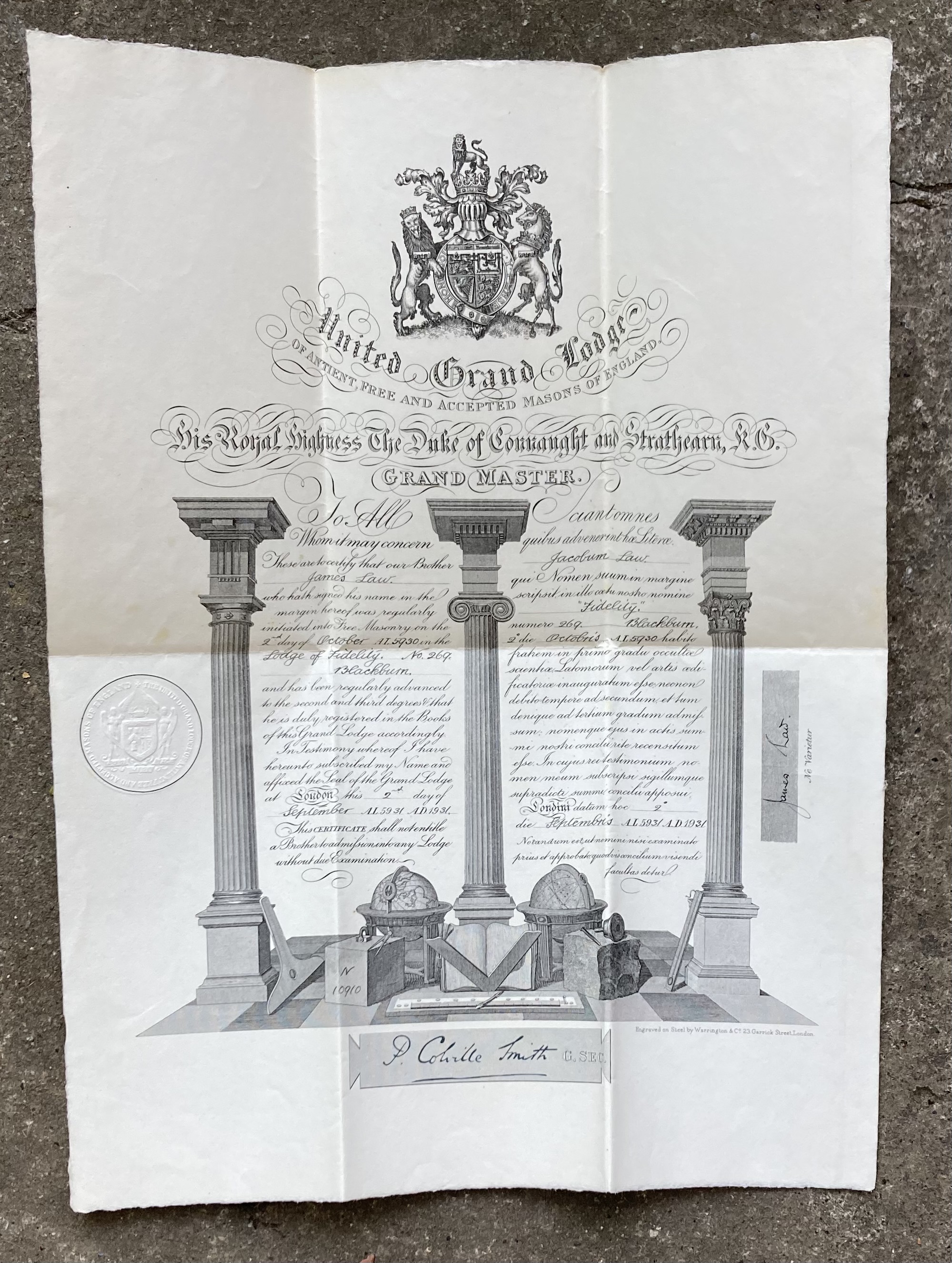 The piece I wrote on rhoticity in the northwest of England has had me pondering a bit about my father’s origins, origins he was so eager to leave behind. His father and grandfather were freemasons, which I imagine isn’t especially high among the reasons he wanted to leave (the weather, narrow-mindedness and lack of modern conveniences such as showers and central heating were certainly much higher on the list), but he was well educated in this old mill town and to his death he loved Blackburn Rovers, living to see them become Premier League champions in 1995.
Over the next few days I’m going to be focusing on his family of origin. What was life in this bleak town like in 1931, the date on this certificate? What was life like for my grandmother, who I last saw in the Blackburn Royal Infirmary in Blackburn in 1965? And how does the city make its way now, in the post-cotton mill era?
9 July 26
Hunting For Apples
I just read the travelogue Apples Are From Kazakhstan: The Land That Disappeared by British journalist Christopher Robbins. The title statement about apples is true, but there is a tragedy around its discovery which has ripples that unfortunately are of great concern today.
The origin of apples was tracked in the 1920s to the Tien Shan mountains which run through northeastern Kazakhstan by a brilliant Russian botanist, geneticist, and geographer named Nikolai Vavilov. Vavilov was highly lauded by the Soviet state for his research on agronomy and the geographical origins of many crops, becoming the youngest member of the Academy of Sciences of the Soviet Union.
Vavilov ran afoul of his onetime protegé, the scheming and ambitious agronomist Trofim Lysenko. Lysenko adapted his research so as to align with the Soviet policy of forced agricultural collectivization. To support his claims of making agronomic innovations that radically increased crop yields, he rejected both natural selection and genetics in favor of a modified sort of Lamarkianism. Lysenko became a favorite of Josef Stalin, and genetics research in the Soviet Union was destroyed. Over 3,000 biologists were dismissed from employment, and some were imprisoned and executed. Vavilov was arrested in 1940 and died in prison in 1943. Rather than improving crop yields, Lysenko’s ideas did the opposite, and when implemented in China they would contribute to the famine there between 1959 and 1961.
Lysenkoism is much on my mind because of changes to federal funding administration that are being proposed by the US Office of Management and Budget. These changes are quite lengthy; former National of Institutes of Health program officer Elizabeth Ginexi provides a good summary of them. Her article is subtitled “Russell Vought [the director of OMB] is going to destroy American Science”. Probably the most significant change is that senior political appointees would be mandated to conduct a review of every grant before it is issued. Moreover, these appointees would be under no obligation to defer to the recommendations from peer review.
This proposal is open for public comment through July 13, and there has been a massive campaign to elicit comments opposing the new rules. I am presently working on my own comment. As of this writing 98,973 comments have been received. OMB may well ignore all the comments but such an outpouring provides a strong basis for legal action against any finalized rules.
Searching through the already-submitted comments, Lysenko has been mentioned in several hundred of them. Amusingly, someone has in jest submitted a comment as Trofim Lysenko. It concludes with the following:
I therefore urge OMB to finalize the rule and give America what every great centrally managed scientific system requires: political officers empowered to decide which science may live, which science must wait, and which science must be uprooted before it bears unauthorized fruit.
With ideological warmth and agronomic confidence,
Trofim Lysenko
Dictator Emeritus of Politically Convenient Biology
Former Specialist in the Suppression of Bourgeois Genetics
25 June 26
Sister States
There is a story on the front page of yesterday’s Davis Enterprise with the headline “Catalonia, UC sign agreement on research”. The first sentence of the story reads “In 1986 the Spanish region of Catalonia and the state of California fostered the first agreement between the regions as sister states, recognizing the long relationships of culture, geography and climate that exist between the two regions”.
The story describes a memorandum of understanding between University of California Agriculture and Natural Resources and the Catalan Institute of Water Research (Institut Català de Recerca de l’Aigua) to collaborate on research on sustainable water resource management. The president of the government of Catalonia, Salvador Illa, visited California in May and came to the UC ANR offices in Davis to sign the agreement, which incidentally is where Pica used to work.
I’ve known about the sister state relationship for a while now, and as a Californian this story makes me feel validated to be delving a bit into Catalan culture from afar. Coming in August we will be taking a trip to the region and I will learn much more in person.
It is not too widely known but many of the 18th century Spanish explorers and settlers of California were Catalan. Some of these people include Gaspar de Portolá (from Os de Balaguer — my junior high school was named after him) , Father Junipero Serra (from Mallorca), Juan Crespi (also from Mallorca), Pedro Fages (the first European to climb Mt. Diablo, born in Guissona in Lleida Province), and Pedro Font (drew one of the first maps of San Francisco Bay, born in Girona).
18 May 26
Redemption In A Walnut Orchard
Last weekend I watched the Errol Morris documentary from 2003 on Robert McNamara, The Fog of War. I followed this up with listening to a podcast interview from 2022 with his son Craig McNamara, which was produced not too long after Craig’s memoir of his difficult relationship with his father came out, entitled Because Our Fathers Lied after a line in a poem by Kipling.
Craig’s journey landed him not very far from here. In fact his interviewer, Michael Dimock, is somebody I have worked with: Michael is a regenerative food system activist who leads a group called Roots of Change. Craig became an organic farmer who has a walnut orchard near Winters, about 25 km west of Davis. Craig’s response to the Vietnam War as a young adult was in 1969 to wander south: he spent several years traveling through Latin America, working on subsistence farms, eventually ending up staying for a while on Easter Island. Agriculture got into his bones, and he returned to California and enrolled in UC Davis to get formal training in the agricultural sciences. He later bought the land and orchard near Winters with his father coming in as a financial partner.
This is one of these stories whose arc is multigenerational. After Robert left (or was fired from) his position as US Secretary of Defense he becomes president of the World Bank for 13 years, and meets with many heads of state all over the globe. Such travel does not make for a grounded life, but his son discovered such grounding on a bit of land near Putah Creek. The generations continue on there: Craig’s children Emily and Sean are both partners in the organic farm.
17 March 26
Newspaper Machinations In The City
I am continuing to work my way through Gray Brechin’s book Imperial San Francisco. Being from the Bay Area, I’ve gone on numerous outings to the M. H. de Young Memorial Museum which is the fine arts museum located in Golden Gate Park. I didn’t know a thing about M. H. de Young before I read Chapter 4 of the book. Here are my notes from it.
- Contra what San Francisco Chronicle publisher Richard Tobin Thieriot said in 1990, lenses refract rather than reflect reality; the three San Francisco newspaper clans all agreed the city must grow and property values rise.
- Michael and Charles de Young arrived as adolescents during the Civil War. The brothers founded the Daily Dramatic Chronicle with a borrowed twenty-dollar gold piece. Their father who didn’t join them in San Francisco was of Dutch Jewish background. Michael claimed aristocratic descent but didn’t fit into upper-class Gentile society nor the pecking order of the German Jews around Temple Emanu-El.
- In its formative years the Chronicle lampoons the wealthy and goes after monopolists.
- As a result the de Youngs get hit with many criminal libel suits. The favor of the Chronicle becomes something to be curried.
- Charles de Young gets into a libelous spat with popular Baptist minister Isaac Kalloch. Kalloch calls the de Youngs “the bastard progeny of a whore born in the slums and nursed in the lap of prostitution.” Charles de Young shoots Kalloch at point-blank range in front of his church. Kalloch recovers and is elected mayor; after de Young resumes accusing Kalloch of adultery Kalloch’s son goes and shoots Charles de Young dead. A jury acquits young Kalloch on grounds of reasonable cause.
- Michael de Young goes after “sugar king” Claus Spreckels with stories about virtual slavery on Hawaiian plantations and swindling their stockholders. Claus’s son Adolph snaps and shoots Michael de Young. He is badly injured but is saved because he was carrying a package of books. Adolph was acquitted on grounds of reasonable cause. Ambrose Bierce writes “Hatred of de Young is the first and best test of a gentleman.”
- Mining mogul George Hearst takes over the San Francisco Examiner to help him become U.S. Senator. His son William Randolph Hearst takes over management in 1887. He has an eye for talent and a lust for power. In the 1890s the Examiner becomes the leading paper in Northern California.
- The block of Market, Kearny, Geary and Third becomes newspaper row.
- Claus Spreckels buys the San Francisco Call. His son John takes over. They speak for the Progressive wing of the Republican party, and keep tabs on the peccadilloes of the Chronicle’s owner. It turns out the Chronicle was incorporated in Nevada rather than in California, making it difficult for plaintiffs to sue de Young.
- In 1894 de Young clears a 180 acre site in Golden Gate Park for a Midwinter Fair that architect Willis Polk calls an “architectural nightmare”.
- de Young owned land north and south of the west end of the park and hoped for skyrocketing land values with the Fair.
- Hearst hires muckraking Scots journalist Arthur McEwen who uncovers the story of de Young’s long-forgotten brother Gus who is rotting away as a pauper in an insane asylum in Stockton.
- The Fine Arts building at the Midwinter Fair remains standing to become San Francisco’s first public art gallery. In time this morphs into the M.H. de Young Memorial Museum. de Young was an incurable collector of everything.
- After the victory in the Spanish-American War, the Chronicle promotes “The Imperial Future of California.”
- Corruption in City Hall (Mayor Eugene Schmitz and attorney Abraham Ruef.) The Bulletin funded by Rudolph Spreckels, goes after them but then starts going after the bribe-givers. The city’s elite turn against this investigation.
- The prosecution gets stopped because it is damaging business and tourism.
- The Chronicle in its society pages starts to rehabilitate reputations, including Patrick Calhoun. Calhoun had a syndicate that wanted to build an electric interurban between San Francisco and Sacramento. The state railroad commission blocked this since Calhoun didn’t want his ledgers which contained evidence of bribery to be examined.
- The Chronicle and the Examiner collude to buy out the Call, and de Young is rid of the media presence of Spreckels.
- Michael de Young was never able to move in with the Hillsborough set, but his four daughters were able to marry into it.
- The Chronicle’s society pages were able to define who constituted the city’s “us.” Its communications empire expanded well beyond the Bay Area, with secretive holdings and value.
- In 1995 Michael de Young’s granddaughter Nan Tucker McEvoy held more than 26% of the stock of the company and wanted to move the publication more to the center. Private corporate intrigue follows: McEvoy is voted off the board, McEvoy sues her cousins, and this is settled behind closed doors out of court.
- The Chronicle would always champion new expansion, even though there were considerable environmental and social costs.
Afterword: The de Young museum is now managed by the Fine Arts Museums of San Francisco together with the California Palace of the Legion of Honor, which is on a hill in the extreme northwest corner of the city. The latter museum was built between 1921 and 1924 and is a three-quarters scale copy of the Palais de la Légion d’Honneur in Paris. It was a gift from Alma de Bretteville Spreckels and Adolph Spreckels. I am speculating that the Spreckels built the Legion of Honor so as to upstage Michael de Young, though I do not have a source for this.
11 March 26
The Thirst of San Francisco
I have been reading Imperial San Francisco by Gray Brechin, which is a history of the long shadowy reach of the development of San Francisco. It is an excellent book, and a good reminder that corruption of the elite did not begin with Donald Trump. Here are my notes on Chapter 2, which is about water development.
- The Sunol Water Temple was built in 1910 modeled after the Temple of Vesta at Tivoli northeast of Rome; its funder William Bourn had second generation wealth and a sense of civic responsibility.
- San Francisco has very little water in its territory; a financier named George Ensign got legislation to create private companies to claim water rights-of-way through eminent domain. Thus we get the Spring Valley Water Works.
- San Francisco County originally extended to the border of Santa Clara County, but in 1856 the legislature created San Mateo County. The city elite wanted San Mateo back. They diverted Pilarcitos Creek.
- Hermann Schussler becomes the chief water engineer at Spring Valley Water Works.
- William Ralston wanted an urban park but did not really like Frederick Law Olmsted’s suggested design.
- The civil engineer William Hammond Hall gets obsessed with building Golden Gate Park.
- Hermann Schussler builds an aqueduct from the Sierras to Virginia City, thus aiding one of Ralston’s rivals.
- Schussler recommended acquiring water rights to the Alameda Creek watershed.
- In a bold gambit Ralston acquires the rights to Alameda Creek, wanting to sell the water company to the city.
- In August 1875 there is a bank run on Ralston’s bank encouraged by William Sharon; Ralston is bankrupted and disgraced and dies swimming in San Francisco Bay.
- William Sharon (also senator from Nevada) manages to emerge from Ralston’s ruin with most of Ralston’s assets and few of his liabilities. He becomes one of California’s wealthiest men.
- Sharon dies in 1885. There is a spectacular estate battle involving a woman named Sarah Althea Hill, who claimed to be married to Sharon. Hill loses this case and eventually ends up in an asylum; much of Sharon’s estate winds up with Francis Griffith Newlands, Spring Valley’s attorney.
- Newlands takes up residency in Nevada and become congressman there. He starts to develop Burlingame as a luxury enclave for the elite of the West. Lots sell quickly there after the depression of 1890 ebbs. Hillsborough gets carved from Burlingame to become an even more exclusive town.
- The Hillsborough set is second-generation wealth, heavily intermarried and extremely secretive.
- But Hillsborough needs water for its estates and horses, not even Alameda Creek suffices.
- Newlands understands that the water has to come from distant sources, which requires taxpayer funding. James Duval Phelan, a fellow elite Progressive, becomes a proponent of this.
- Phelan is elected mayor of San Francisco in 1896, and wants to consolidate the Bay Area into “Greater San Francisco” a la the boroughs of New York. But this requires a great aqueduct.
- Phelan becomes fixated on Hetch Hetchy Valley on the Tuolumne River in Yosemite National Park.
- Newlands leads passage in Congress of the National Reclamation Act, launching the agency now known as the Bureau of Reclamation. This agency’s first project is in Nevada, not surprisingly.
- Down south, Fred Eaton, William Mulholland, and J.B. Lippencott quietly acquire water rights for Los Angeles at the expense of the farmers of the Owens Valley.
- Phelan’s claims for a reservoir within Yosemite National Park are thwarted by the U.S. Secretary of Interior.
- The 1906 San Francisco earthquake occurs. It is clear the city will quickly be rebuilt, and Phelan’s plan has a lot more support.
- The debate over Hetch Hetchy is bitter, pitting John Muir and the Sierra Club on one side and much of the Bay Area on the other side.
- City voters approve a $45 million bond issue in January 1910, but federal legislation for the dam construction doesn’t pass until December 1913. Hetch Hetchy does exactly what it is designed to do – raise land values.
- Michael M. O’Shaughnessy becomes San Francisco city engineer and leads the Hetch Hetchy project.
- Huge cost and time overruns on the Hetch Hetchy project, partly because the initial bond measure was lowballed to ensure voter passage.
- The water finally arrived in 1934. O’Shaughnessy had been stripped of power by his enemies. O’Shaughnessy dies in October, 18 days before dedication day for the water project. A new water temple is built in San Mateo County, the Pulgas Water Temple; it is a mile north of William Bourn’s estate, Filoli.
25 February 26
Tecumseh and the Survival of Native Nations
I just went to a talk at the UC Davis Alumni Center entitled “Tecumseh and the Survival of Native Nations” given by the historian Kathleen DuVal. DuVal’s most recent book is entitled Native Nations: A Millennium in North America and won both the Pulitzer Prize for history and the Bancroft Prize in 2025, as well as a couple of other history prizes. She also got her history PhD at UC Davis in 2000, and her talk today was something of a homecoming — there was a contingent in the audience who knew her from her graduate school days here.
I have not yet read Native Nations, but it was clear from her talk that as a retelling of Native American history it emphasizes the individual identities of sovereign Native nations, a characteristic that continues to be important today. She illustrated this with a photograph from the Standing Rock protests in 2016 showing flags from all the tribes who had assembled together. Her talk today was about the visionary Shawnee leader Tecumseh who along with his brother the religious leader Tenskwatawa (often known as The Prophet) tried to build a unified Native confederacy to resist the incursions of white American settlers into the lands beyond the Appalachians at the beginning of the 19th century. Tecumseh was a great orator and many listened to him and the prophesies of his brother, but overall their call for unification did not win out over sovereignty. Tecumseh ends up dying fighting with the British against the Americans in 1813. Tenskwatawa moved across the Mississippi and dies in Kansas in 1836. But the Native nations persist, and by the late twentieth century Native Americans have three identities in varying degrees: that of their tribe or sovereign nation, that of being a U.S. citizen, and of being a Native American.
23 February 26
Transcriptions Completed
A week ago Friday, I learned about the Douglass Day transcription project and promptly joined this crowdsourced effort to transcribe printed documents related to the series of Black political organizing conventions in the 19th century. The big push for this project was on Friday the 13th, but volunteers continued on and yesterday finished transcribing the entire collection. There were 1,445 volunteers who transcribed text from 3,416 images of documents. I ended up transcribing 32 documents over 10 days.
I am really happy with the way the effort turned out. This was a way to participate in Black History Month, the volunteers quickly got through the collection, and I discovered that online transcription is a contribution path towards increasing the accessibility of historical archives. It turns out there are plenty of opportunities to do this sort of thing online, through programs at the Library of Congress, the National Archives, the Smithsonian Institution, and other places I’m sure. I will be looking into these.
13 February 26
Douglass Day
Thanks to running across a post on BlueSky this afternoon, I ended up doing a bit of crowdsourced history this afternoon. When Frederick Douglass passed away in 1895, an activist named Mary Church Terrell led a effort to create a holiday celebrating Douglass’s birthday every February 14th. This holiday eventually grew into Black History Month. Starting in 2017, Douglass Day was revived as a way to bring participation into the Colored Conventions Project, a collaborative effort to surface the 19th century history of Black political organizing conventions.
One of the ways this effort is participatory is by running transcribe-a-thons of documents from the Colored Conventions during Douglass Day. This years’ effort was coordinated by the UC Santa Barbara Department of English and the UCSB Library. They are running this effort through Zooniverse, which is a platform famous for hosting crowdsourced research projects. As of this writing they’ve had 964 volunteers for the 2026 effort. I signed up on Zooniverse and transcribed five documents this afternoon. I’ll be doing more over the rest of this month.