
26 July 26
Test Knit
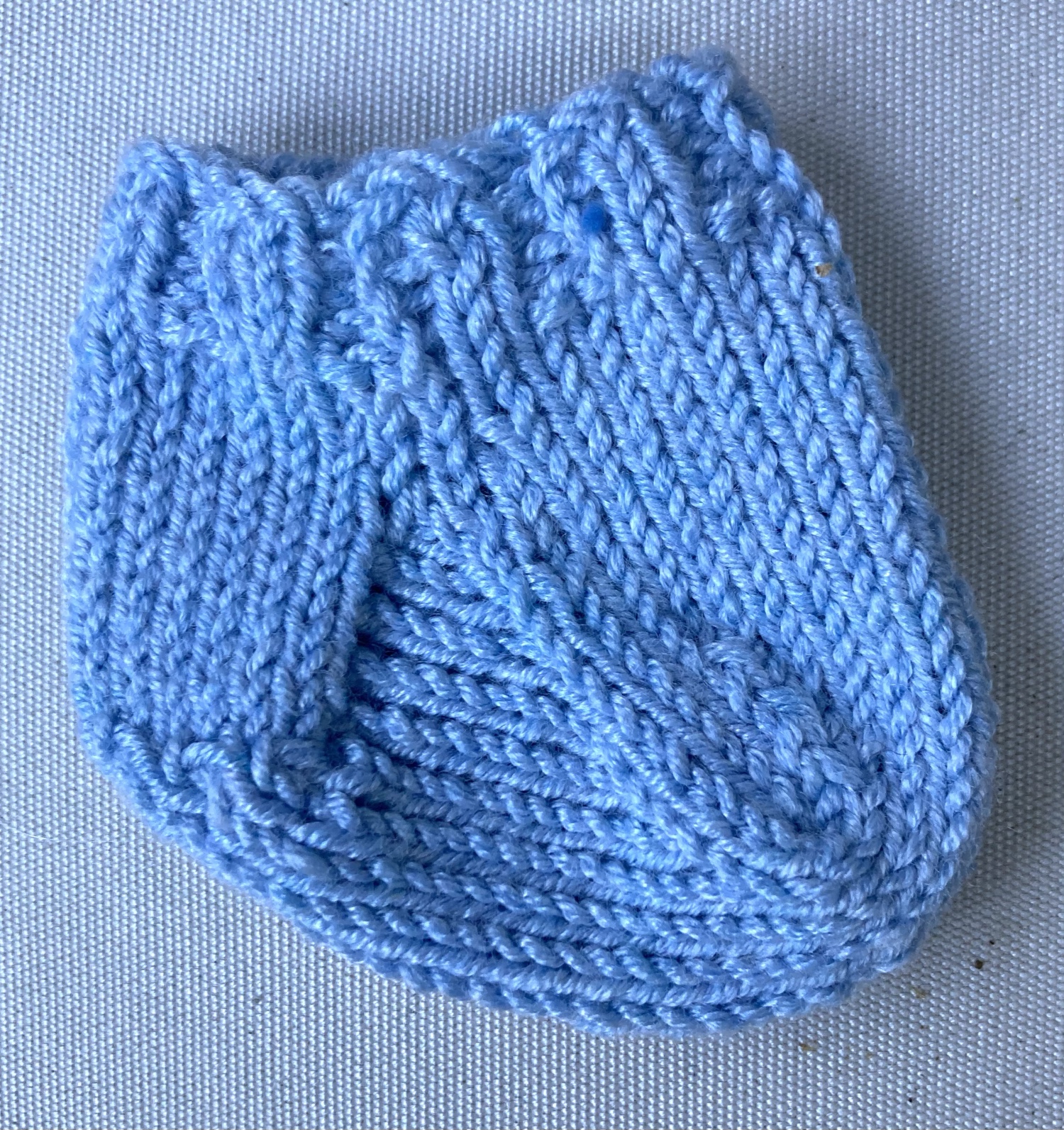 Nimble Needles is the website of a German knitter named Norman. He is a brilliant teacher and I’ve learned a lot from him over the time I’ve been following him on YouTube. So when he asked for volunteers to knit a sample sock for an upcoming class and time themselves, I signed up.
Socks are divided into five parts: the cuff and leg, the heel, the gusset, the foot/instep, and the toe. Since the cuff, leg and foot lengths can all be altered by how long they are, the sample just has to contain these five pieces. I think Norman was hoping for an upper time limit of 1.5 hours; I did this in an hour and 37 minutes. I’m not a slow knitter and I have a lot of experience knitting socks, but I was watching a show while I knit this which might have slowed me down. Anyway, I hope the data is useful to him.
24 July 26
18 July 26
Lining the Cardigan
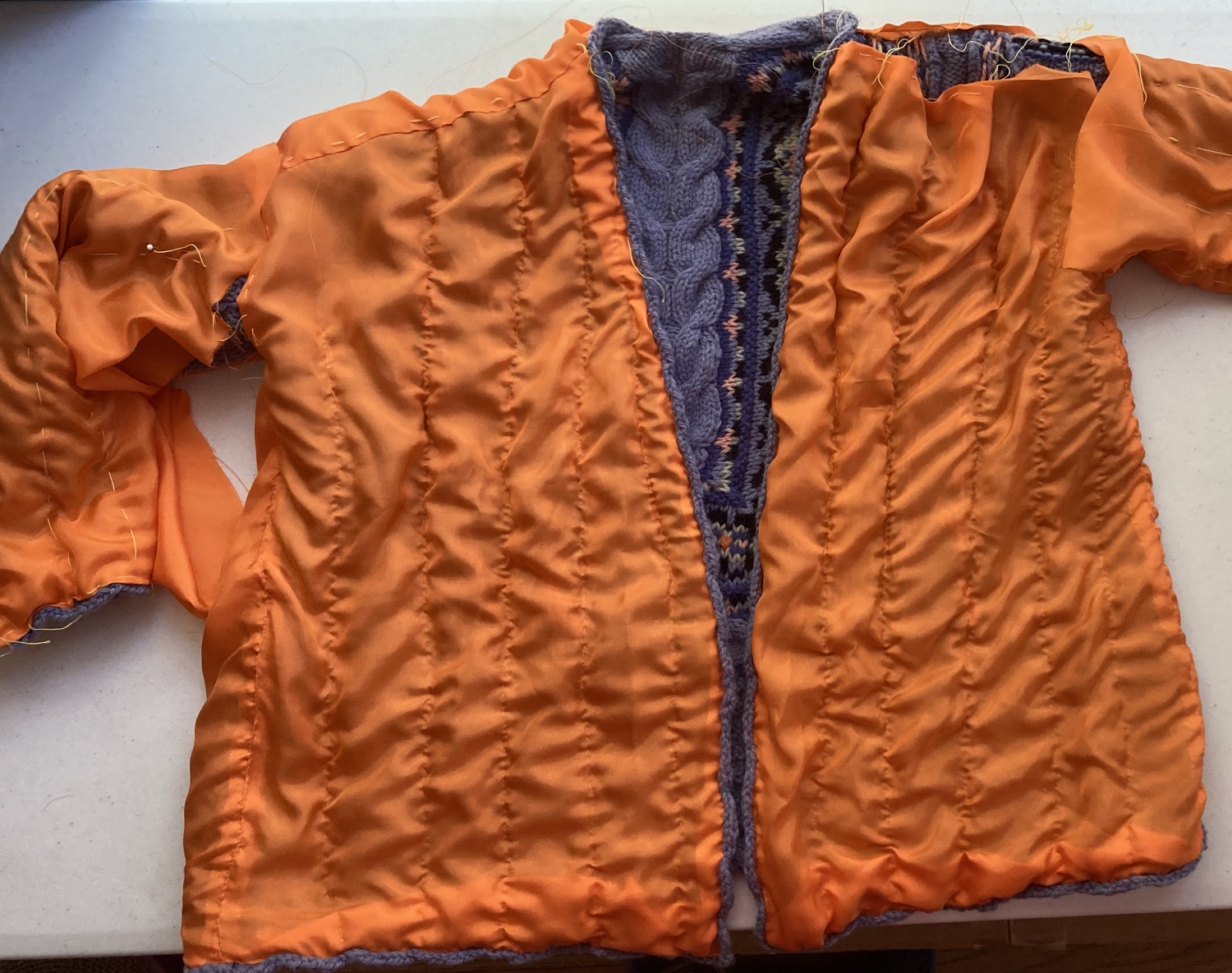
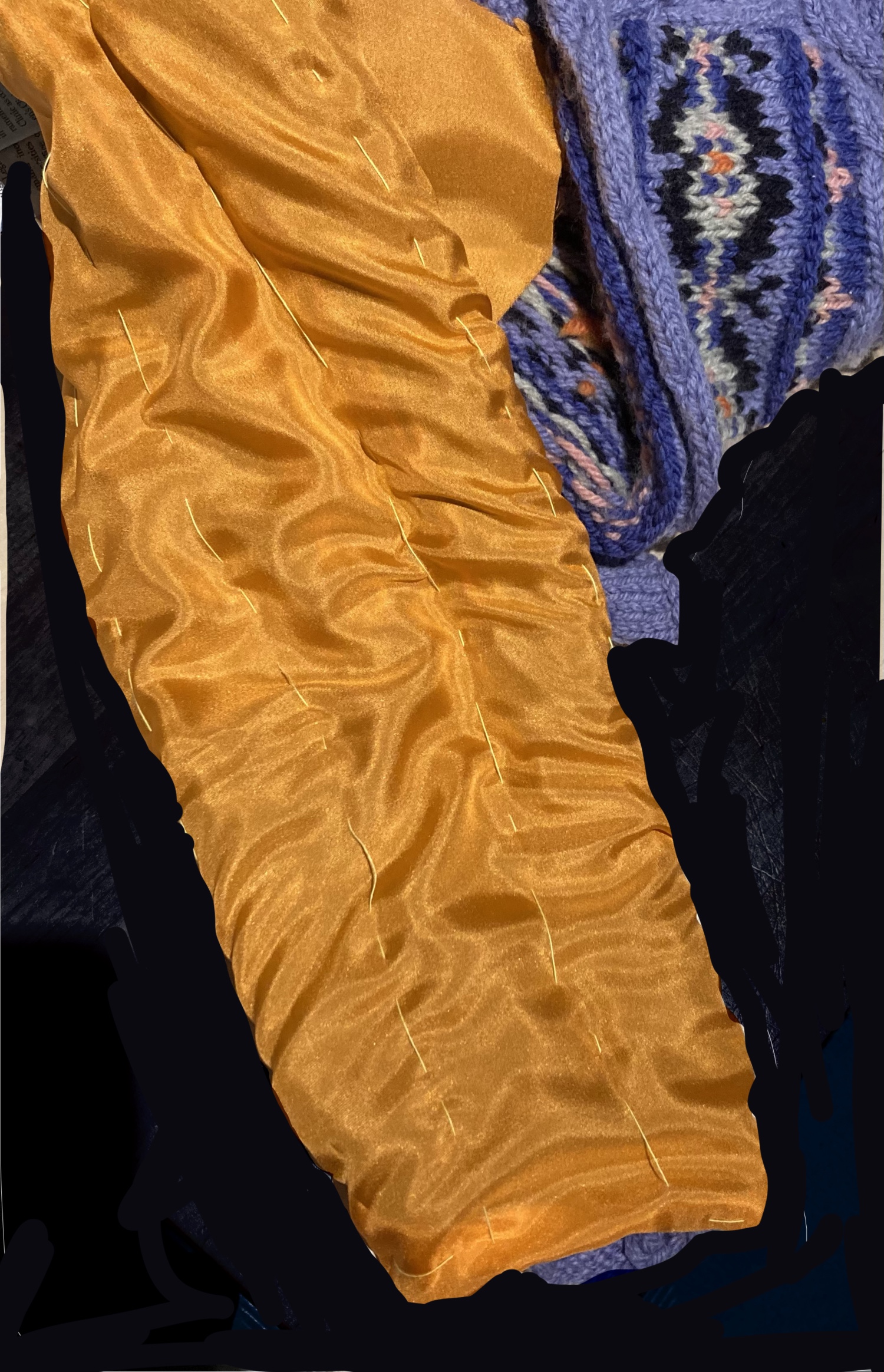 I finished my sweater last week and have started to line it with orange silk. The problem is this: knit fabric is stretchy, woven fabric is not. So you have to build in some ease puckering up the quilting every 2”. The good news is, it’s lining, not meant to be closely scrutinized, and Jean Frost, author of Custom Knit Jackets, discourages overscrupulosity with straight lines in the quilting, arguing that Coco Chanel didn’t bother with that sort of thing.
I am basting the silk to the jacket first before doing a small running stitch in matching orange thread, which might be a bit overscrupulous, but it’s much easier for me this way. This is all quite a laborious process but not difficult, and I’m enjoying how it feels so much that I’m given ample motivation to keep going. Hiding the somewhat unsightly wrong side of the stranded colorwork (and, more important, cutting out the danger of snagging stitches) is an added bonus. But the silk habotai I bought at Stonemountain and Daughter in Berkeley is delicious. Too hot to wear this garment now but I’ll love it in the winter!
14 July 26
Summer Socks
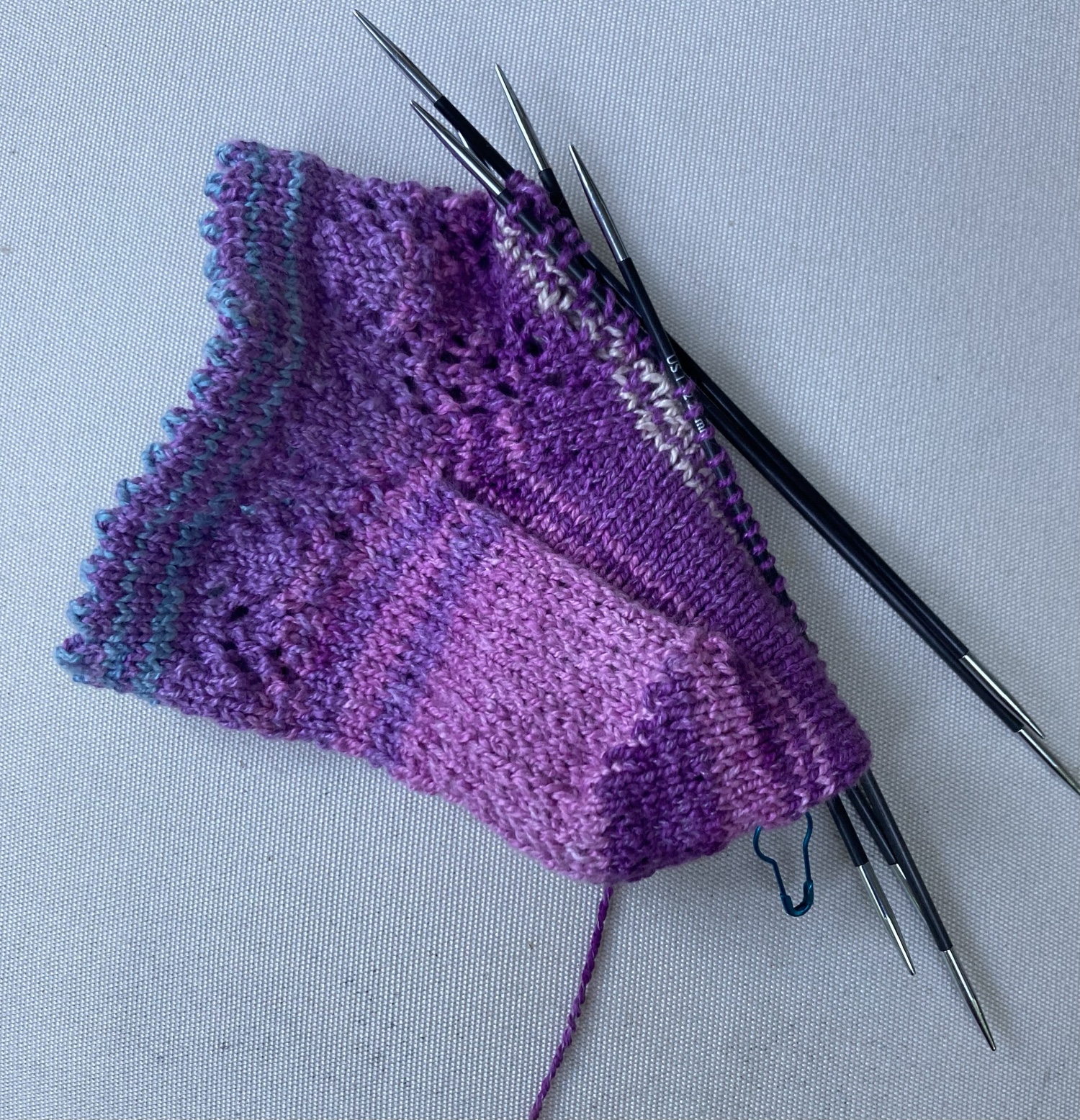 When we were growing up in Spain in the 1970s, white cotton lace ankle socks were a thing. I have no idea whether they still are, but my sister, recipient of a pair of wool birthday socks every year, asked me to design a pair of socks that could replicate these Spanish ones. I made her a pair last year and she was thrilled. So I’m working on a second pair. The yarn is a bamboo-cotton blend. The lace pattern is gull wings, which is easy to remember and does the required ventilation job.
Spain beat France. Wow.
16 June 26
Nervous Energy
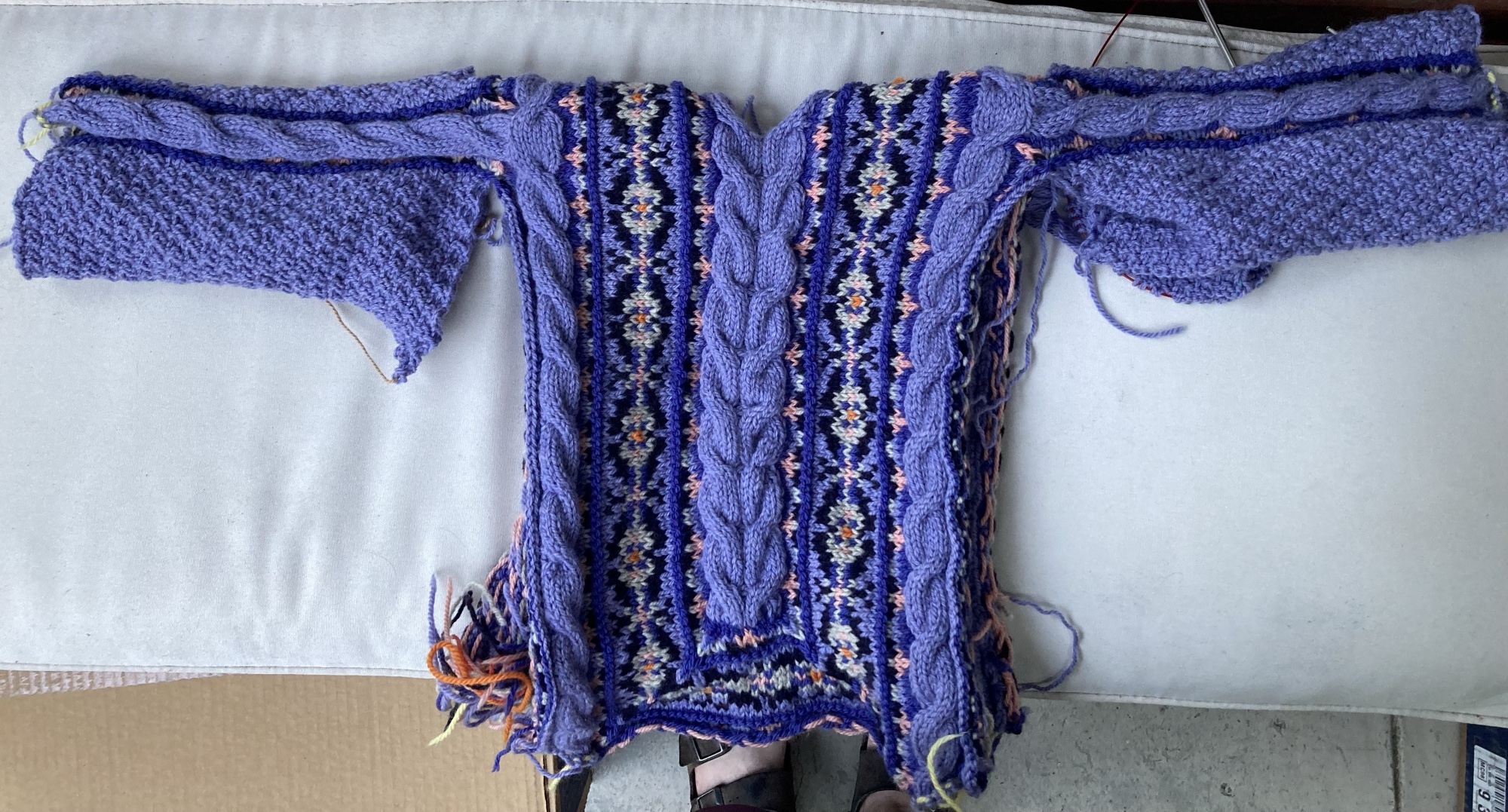 I’ve never been diagnosed with ADHD, but wouldn’t be at all surprised to learn it’s something I’ve lived with all my life. In some ways, it’s been something of a superpower. But it means that concentrating on just one thing seems impossible. And when it comes to listening or watching football, I have GOT to be doing something with my hands.
I have just entered the sweater pictured at right into our county fair, which takes place every August. I am planning to line it with silk, which will hide a lot of the mess caused by stranded colorwork (and make it much more pleasant to wear). There are now long sections that don’t require much concentration, making it the perfect World Cup knitalong.
Lionel Messi, nearly 39, just scored a hat-trick for Argentina, a massive feat for any player. I am not qualified to judge who the Greatest Player of All Time might be, but a lot of people who are think he’s it. That we have been alive to witness him AND Cristiano Ronaldo playing, egging each other on, is a privilege. (The game has changed a lot since Maradona and beyond him Pelé were in their prime, and such comparisons are sort of fruitless if entertaining.)
Lots more to go on this sweater but there’s a lot more football to follow over the next few weeks.
2 June 26
21 May 26
Very Simple Knitting
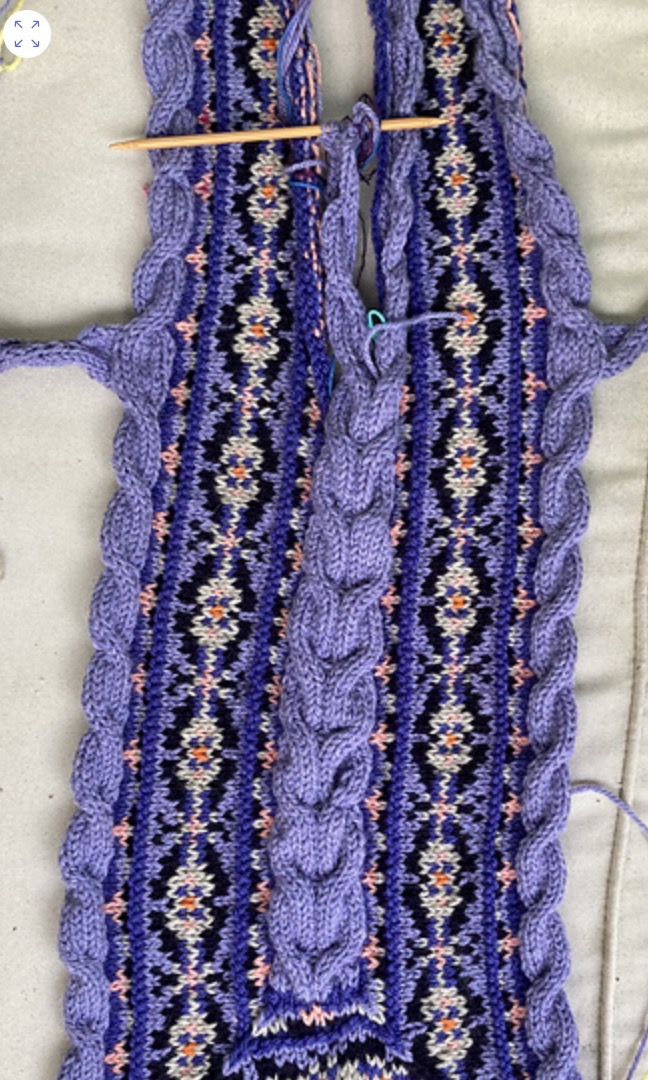 I was in the middle of knitting an extremely complicated cardigan, pictured at right, when I left for Europe at the beginning of April. This is an unusually structured piece with cables going over the shoulders, where stitches are picked up and then a stranded colorwork panel is worked, double moss-stitch forms side panels and sleeves, which also feature the cables and a smaller stranded panel going along their length. I’m knitting this with a worsted-weight yarn and it’s lovely but I’m finding it difficult to resume my work on it. (Note to self: don’t start a complex project when you know you’re going to be going away for a while; it’s now too hot to be knitting a heavy project.)
There are several knitting designers who are deeply influenced by the knitting cultures they grew up in yet who have managed to bring a contemporary feel to their designs. Ysolda Teague, a Scottish designer based in Edinburgh, has produced fascinating designs that draw on the traditions of her culture but are always unmistakably modern. I’m reminded of her Blank Canvas pullover which I’ve knit, which gives a well-fitting design in multiple sizes and encourages knitters to customize it freely. (One of the problems a lot of contemporary knitters face is their fear of modifying patterns either to suit their taste or individual bodies, resulting in a lot of sweaters that don’t get worn.)
Petite Knit is the brand of a Danish designer, Mette Wendelboe Okkels. This designer has taken a lot of flak for charging as much as she does for designs that are really very simple — no unusual stitches, no flamboyant shapes, just timeless, classic pieces (mostly sweaters) that highlight gorgeous, top-quality yarns. But simple doesn’t mean easy to design, and the care and effort that has obviously gone into each piece is a lovely testimony to the clean Scandinavian esthetic embraced by Petite Knit. (I’m of the opinion that designers deserve a fair price for their labor and get screaming angry when people find workarounds to paying for a pattern. It’s stealing, people. If you don’t want to pay for a pattern there are lots of free ones available on Ravelry.) Rosemary and Pines Fiber Arts looks into how Petite Knit took over the knitting world in a video here.I’m knitting Ysolda’s Musselburgh hat — my fifth — for a friend and I have cast on the Petite Knit Maggie Cardigan. Both of these are straightforward, stockinette projects. This is my first top-down sweater and a lot of concentration is required for the shaping around the shoulders, but once I reach the armpits, it will be very simple. (And, in this case, easy.)
26 March 26
A New Short Row Technique
 Short rows in knitting are used when you want a different amount of fabric in one section of a row than another without adding length at the end of the row. Typical uses include knitting a sock heel to make the L-shape of a foot, adding length to the back or front of a sweater (this can be extreme to accommodate a dowager’s hump or slumping shoulders or a large bust), or to shape a sleeve knit horizontally, as I’m doing with my Fort Amherst sweater.
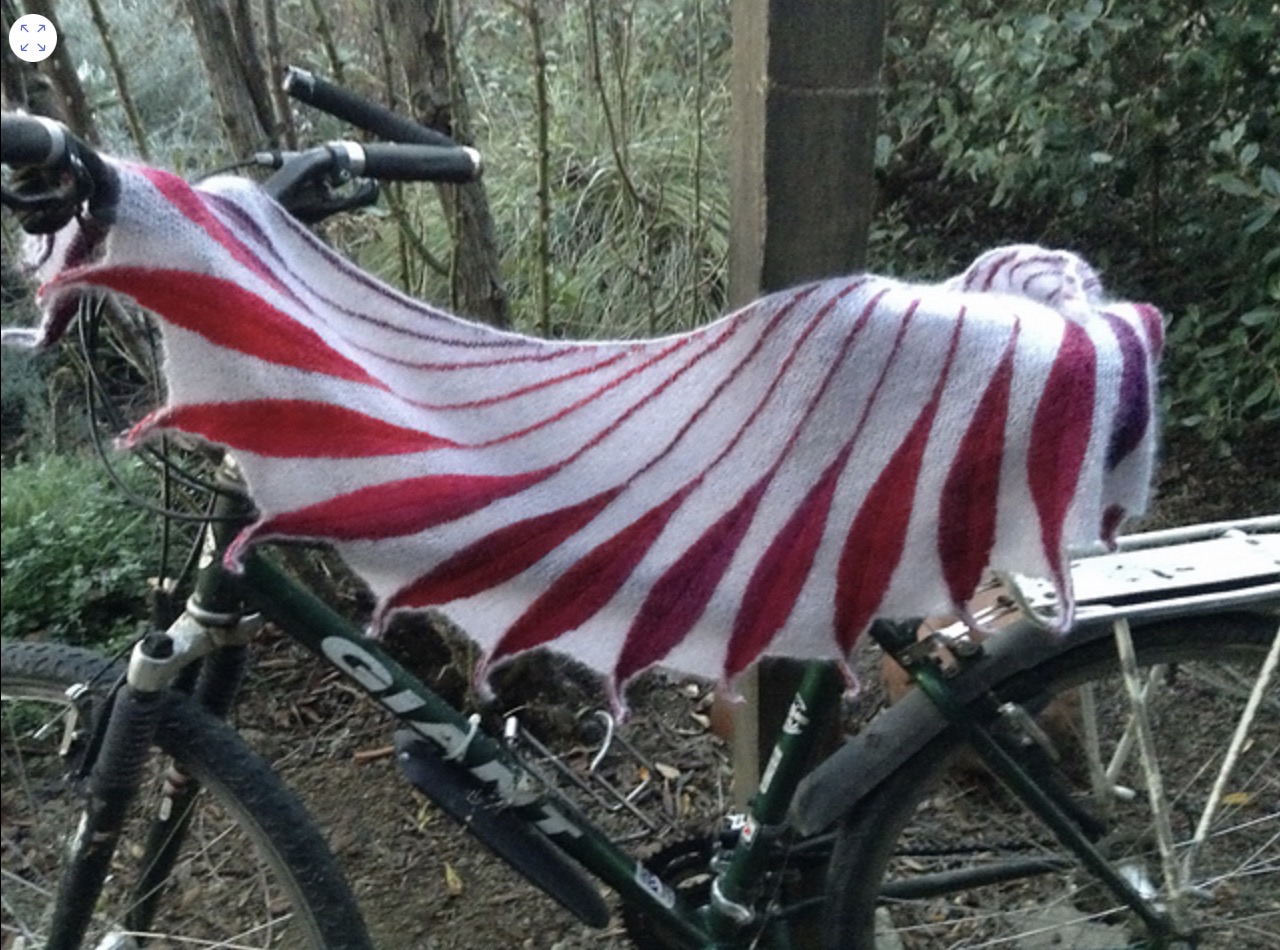
For years the only short row turn I knew was the wrap-and-turn, where you knit to the desired stitch, yarn forward, slip next stitch, yarn back, turn work (in the middle of a row). It’s clunky and inelegant except in garter stitch, where the bulk of the knitting hides a multitude of sins… With the internationalization of knitting I learned, and much preferred, the “German” short row, where the stitch is yanked hard over the needle making a “double-stitch” which you then knit as one on the next row. This has been invaluable in the swing-knitting technique where short rows are flung around with abandon to make some very interesting effects (I’ve knit the Dreambird shawl several times using this technique, pictured at right draped over my late-lamented bicycle which got stolen a couple of years ago).
The Fort Amherst project has introduced me to a third method, the Japanese short row (though designer Jennifer Beale calls this “Sunday short rows” in her pattern). Here, a removable stitch marker is placed over the working yarn, the return row is knit, but on the way back, you pick up the yarn held by the stitch marker and knit it together with the following stitch, removing the stitch marker. It is all but invisible! It might become my go-to method.
18 March 26
Progress Report
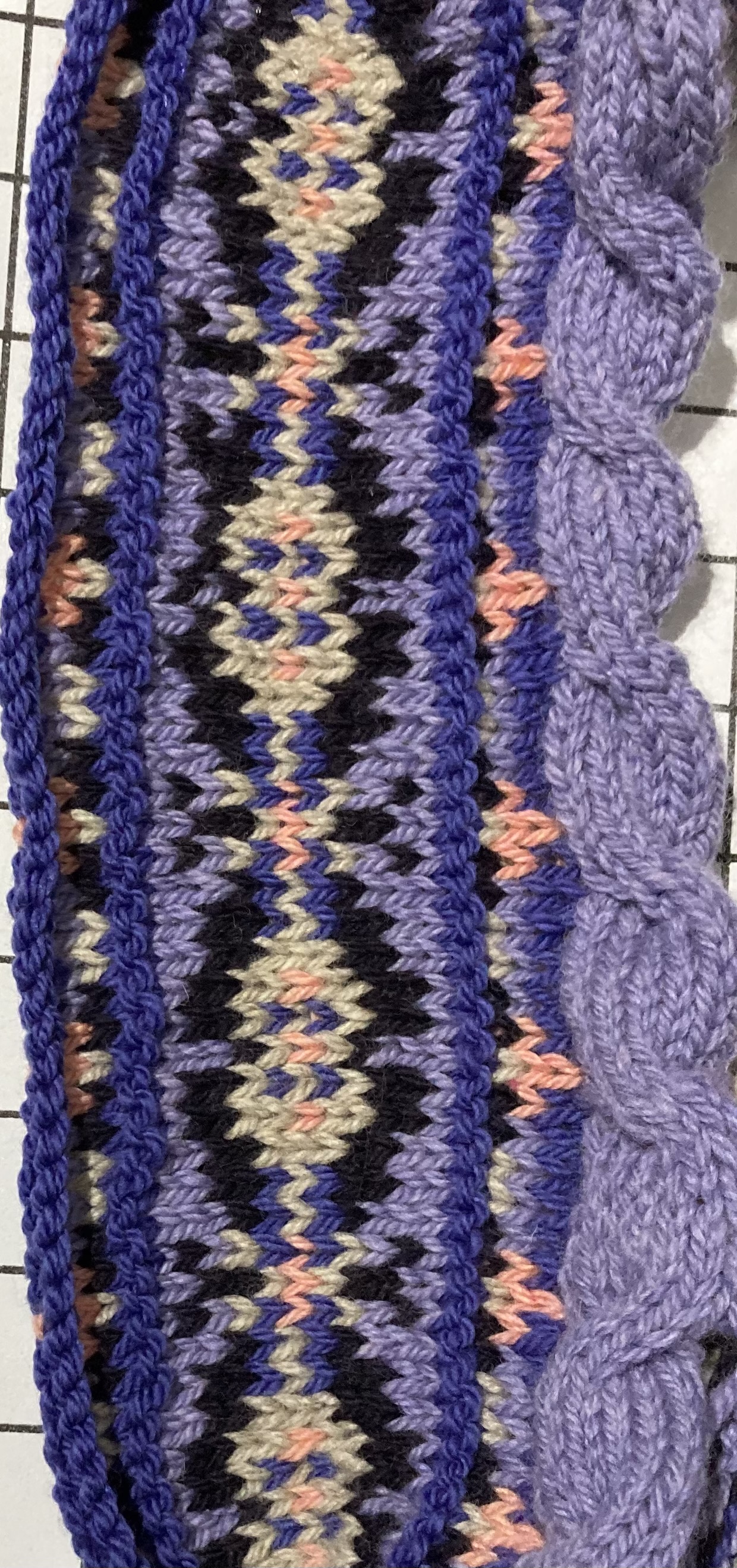 I’ve nearly finished the central back and front of the Fort Amherst cardigan. It’s a compelling knit: I’ve never done aran-weight colorwork before and it goes quite fast!
16 March 26
Duplicate Stitchery
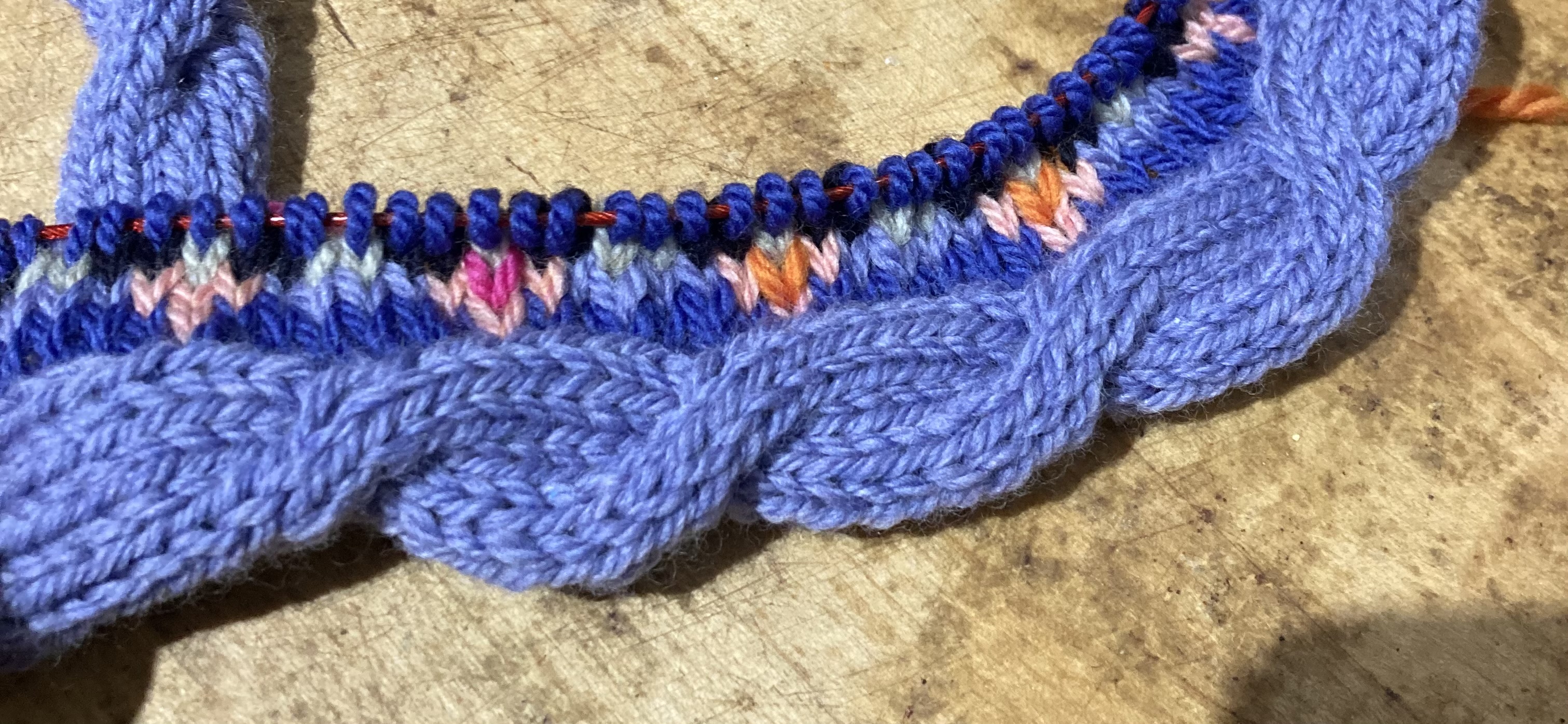 Most stranded colorwork is worked with only two colors at a time, because a) we only have two hands, b) color dominance is a thing, c) the knitting looks complicated enough on the back without adding a bunch of twisted, gnarled craziness.
I cast on the Fort Amherst cardigan and tried doing the peach color here in a much stronger orange in the colorwork section, but didn’t like it. I also have a very bright pink in this same aran-weight yarn. So I have sewn both these colors in to test out how they’d look in that central spot, which was otherwise looking a bit insipid, in a technique known as duplicate stitch or Swiss darning. It allows you to throw in a third color on a row, the embroidered stitch sitting happily on top of the stitch below it.
Not sure how this will all work out but I’m happy to have the option.