
26 March 08
Tired: Let Me Count the Ways (Then Name Them)
Nicole of Turning Leaves just posted about how we lack words for states of tiredness.
Not words for “tired” — we have plenty of those. She wants words to describe these feelings:
There is the wonderful fatigue of relief. There is the foul mood of not having slept at all, or worse, having slept tiny dribs and drabs while in an uncomfortable position. There is the nervy sensation of having had a chance to really sleep, but not being able to.
There are several I’d add: the irritable fatigue of trying to get some sleep in a hospital but being continually woken by officious nursing staff taking readings and changing drips at all hours of the night (and day). The sweet, salty but aching fatigue of a long bike ride (or hike or run or aerobics class) and the sweet, salty but utterly different aching of a day spent digging in the garden. The honey-fatigue of deep relaxation, such as that following a massage. The monotonous and monochrome fatigue of depression. The fatigue of having really been under sniper fire, instead of just misspeaking about it, and not just for a brief trip to an airport tarmac but for days, weeks, or even years, the miracle of adrenaline finally giving out with disastrous consequences. The long slow blank fatigue of hunger. The deep fatigue following energetic sex.
Any ideas for words for any of these states of being?
4 February 08
Two Historical Atlases
I haven’t seen either of these publications in print, but both are intriguing. First, the U.S. Census has just released their first major atlas is over 80 years. The book has over 800 maps and weighs in at 7 pounds. Happily, the complete content of the book is available as PDF downloads, though each chapter makes for a large download, averaging around 15 Mb apiece.
Second, last fall the University of California Press published a Historical Atlas of California, written by Derek Hayes. With nearly 500 historical maps and illustrations, the book should be a visual feast.
15 January 08
How to Stay Busy in Winter
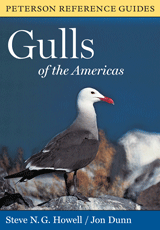 We bought a copy of this massive tome yesterday at the UC Davis Bookstore. It’s awe-inspiring. Gulls seem like the last frontier in birding, even more than sparrows…
3 December 07
Thought for the Day
“What is the cause of historical events? Power. What is power? Power is the sum total of wills transferred onto one person. On what condition are the wills of the masses transferred to one person? On condition that the person express the will of the whole people. That is, power is power. That is, power is a word the meaning of which we do not understand.”
Leo Tolstoy, War and Peace
2 December 07
Hot Stove League
Friday evening we ran into Chris at the co-op. Talk naturally turned to baseball, what’s the off-season about to bring (Bonds to the A’s???), the Hot Stove League now turning warm. None of us quite knew where that term came from, and we agreed the topic would make a good blog post. Chris then went on to teasing Pica about her new-found interest in samovars and smoky tea, and I decided to research the term, it making me think of players being traded around like sauté pans on a hot stove…
The term dates back quite a long time. The earliest reference online I could find was from a New York Times article from October 12, 1912 on the fourth game of the World Series between the New York Giants and the Boston Red Sox. The first paragraph reads:
Boston grabbed back its advantage in the world’s series yesterday on terrific smashing of Jeff Tesreau’s speed and moist offerings during the early innings, almost lost it when “Joe” Wood faltered under the strain, then cinched it by pounding Ames for a run in the ninth that made it 3 to 1 and broke New York’s last hope. Two to one in the ninth might not have been so bad, but 3 to 1, Wood settling again after three innings of the rickets and darkness gathering all conspired to make the Giants’ hopeless, and they lost without dishonor and might have won, providing a lot more hard luck alibis for the Hot Stove League this Winter.
The citation implies that the term by this date was in common use. The Random House Historical Dictionary of American Slang explains that the term is originally from baseball and defines it as “sports enthusiasts who continue to discuss their sport during the off-season”.
Paul Dickson’s book The Dickson Baseball Dictionary has a much longer account of the term, defining it as a “term for the gab, gossip, and debate that takes place when baseball is not being played”. The term gained popularity with the publication of a 1955 book by Lee Allen entitled “The Hot Stove League”, he believing that the phrase dated from the turn of the century. However, folk etymologist Peter Tamony found a usage of the term in 1886, describing the off-season in horse racing: “The sleighing has gone, and most of the trotting is done around the hot stove at present.”
28 November 07
Wanting a Samovar
I’ve finished the first three volumes of the Pevear / Volokhonsky translation of War and Peace. Rarely do I read a book this slowly, so rarely do I have the chance to realize that it’s a luxury, a pleasure all the more rich for how drawn out it is. (The last book I read of comparable length was Vikram Seth’s A Suitable Boy, which I confess I gobbled in less than a week.)
The samovar: an artifact around which people gather(ed), sometimes in great numbers, and often at great length, to drink tea. Sounds like heaven to me. I’m curious about the different types; about the way the tea was infused with the aroma of burning coals (I always thought Russian gunpowder tea was smoked to fit the Russian taste, which it is, but there’s a reason for that—it probably evokes ancestral memories of huddling companionably, perhaps on a long train journey); about how the tea concentrate (which Wikipedia tells me is called zavarka), to which the hot samovar water is added, is made. This doesn’t really seem to be the place to find this all out, because I find no indication that they actually have any samovars that are working (there seem to be an ocean of tiny teapots instead) but I may drop in next time I’m in the Castro anyway, because anywhere that takes tea this seriously (as opposed to a very poor second cousin to coffee, the West Coast norm) is worth investigating.
Slowing down, savoring. Trying to learn how to do this.
30 October 07
Pondering Adaptations.
Thanks to Richard’s recommendation I have just finished reading Philip Pullman’s exquisite trilogy His Dark Materials. I am skeptical though about the upcoming film of the first book The Golden Compass due out in December. There are too many possible ways the movie can go wrong. At the very least, it has quite a tightrope to walk: how do you make a movie that will appeal to mainstream theistic America when a major theme of the trilogy is condemnation of organized religion. The answer seems to be to water down the philosophy and throw in lots of CGI.
Several years ago there was a stage adaptation of the trilogy performed at the National Theatre in London in two different runs. I will never get the chance to compare the versions but I suspect that I would find the theatrical version much more satisfying than the upcoming film. Theatre leaves a lot more to the imagination, after all.
17 October 07
War and Peace: A New Translation
I’m making slow but delicious progress on War and Peace. A book this long and this good is not to be gobbled, and my reading so far has been limited to before bedtime, already disrupted these days because of post-season baseball (the less said about THAT, the better). Daylight is less and less but when there is any I’m digging and digging in the garden, racing to cage my raised beds against burrowing rodents (and contemplating above-ground cages too against bunnies, ground squirrels, and birds) so I can get my winter vegetables in before it gets too cold (though as Numenius’ brother, who lives in Indiana, said on Sunday night, “cold” is a relative term…). Anyway, as anyone who’s ever dug in a garden knows, there is always at least four times as much dirt as you think, no matter how big (or how small) the hole. It’s slow. And I don’t want to hurt my back, so it’s even slower.
But slow digging gives you ample time to think, and I’ve been thinking a lot about translation lately. I got the Maude and Maude translation of War and Peace out of the library a couple of weeks ago and it’s certainly very readable, comfortable, quaintly archaic with kindly, if slightly pedantic, footnotes (it was published in the early 1940s and features Clifton Fadiman’s comparison of Napoleon’s folly with Hitler’s in a fascinating and prescient foreword). I was then alerted to a translation, published just this week, by Richard Pevear and Larissa Volokhonsky, a translating dynamo couple living in Paris. I bought it yesterday.
A quick dig through a decent library catalog unearths well over 15 English translations (many long out of print) of this book. Why so many? Having worked for a publisher I can picture, and hear in my head, the wrangling that must have gone on in editorial meetings as the Advocate dismissed all previous versions, arguing that this translation would be the best, most complete, most contemporary, most relevant, most true to the original, most poetic, most imbued with the spirit of Tolstoy. It’s a hugely expensive undertaking, and the folks at Knopf must really be expecting people to run out and buy the new translation (list price $39, obviously heavily subsidized by the Borzoi imprint) even if they have an older one (or, if they are Language Hat, several) on their shelf. A gamble. Banking, perhaps, on the stardom of the translators?
Looking, so far, as though it was worth it. Reading Richard Pevear’s account of how they work on a translation as a partnership makes me shudder at the sheer effort involved (she, a native speaker of Russian, does the first pass, closely following the Russian; he then works through it, referring to the Russian throughout, making sure it reads as “English”; they then work together through his version, refining and perfecting it.) (I love her insistence on a phrase Tolstoy used in the Russian describing horses galloping over a bridge, “transparent sounds,” which has consistently been translated as a “thud” or “clang” of hoofs, both of which have perfectly adequate Russian equivalents; Pevear says “transparent sounds” is “pure Tolstoy” and notes how if there hadn’t been two of them working on it it would have gotten overlooked.)
Translation is always a labor of love. I don’t care how much these two got paid for this one: it can never, ever have been enough to compensate them for the three years of their lives that went into it. I haven’t read much so far (dithering between starting at the beginning or continuing on to Austerlitz and beyond and returning to the beginning when I’ve finished the whole novel) but it’s going to get read one way or the other.
The Reading Room at the New York Times is working through the new translation, led by Sam Tenenhouse. If you’ve ever wondered whether to read this book, the time might be now… or reread it, in its new English incarnation, the American edition at least set in Tshichold’s Sabon and printed on luscious smooth paper, ragged fore-edges, embossed gold foil neo-Victorian dust jacket, a comfortable but sumptuous brick on your lap for weeks…
Postcript: Ecco has also just published a new translation, by Andrew Bromfield, War and Peace: Original Version. It is essentially Tolstoy’s first draft and much shorter than what he ended up with after three years of revisions. Viking published a version last year by Anthony Briggs. Wow. That editorial meeting discussion must have been really interesting…
2 October 07
Reading "Unread" Books
These are the top 106 books most often marked as “unread” by LibraryThing’s users (as of yesterday). Bold what you have read, italicize what you started but couldn’t finish, and strike through what you couldn’t stand. (Via Steve Rubio’s online life)
What have I learned? That my knowledge of the grand Russian 19th century novel is poor; that I’ve never given Dickens much of a chance, and I’ve never given any later English Victorian novelists much of one either; that I’ve deliberately never given Ayn Rand any kind of chance at all, and I’m sure that’s not going to change; that I’ve never been able to stand Hardy (I really, really tried, read a lot of it, just get bogged down); that I really ought to try the Iliad and the Aeneid since I liked the Odyssey so much; that I ought to finally go through the Canterbury Tales since a copy’s sitting on my bedside table. Also, that I have a psychological or cultural aversion to starting a book and not finishing it even if I’m not really enjoying it. (I finished Don Quixote because I had to for college; I read Moby Dick in a public garden in Santa Barbara in 1996 and loved it but would have hated it in school; I read Zen and the Art of Motorcycle Maintenance before I had any business doing so but I kept going, not sure why, since I’m sure I didn’t get most of it; that “seminal” books of the American high school experience have mostly escaped me. I’d love to hear if folks think I should have a go at any of the unmarked books on here… Oh, I think Jared Diamond should be among them. And I usually read anything by Margaret Atwood, not sure how I missed the Blind Assassin. And I’m absolutely unsure about how I missed Northanger Abbey…)
I finished Jonathan Strange and Mr Norrell yesterday. Hilarious that it’s the first entry.
Jonathan Strange & Mr Norrell
Anna Karenina
Crime and punishment
Catch-22
One hundred years of solitude
Wuthering Heights
The Silmarillion
Life of Pi : a novel
The name of the rose
Don Quixote
Moby Dick
Ulysses
Madame Bovary
The Odyssey
Pride and prejudice
Jane Eyre
A tale of two cities
The brothers Karamazov
Guns, Germs, and Steel: the fates of human societies
War and peace
Vanity fair
The time traveler’s wife
The Iliad
Emma
The Blind Assassin
The kite runner
Mrs. Dalloway
Great expectations
American gods
A heartbreaking work of staggering genius
Atlas shrugged
Reading Lolita in Tehran : a memoir in books
Memoirs of a Geisha
Middlesex
Quicksilver
Wicked : the life and times of the wicked witch of the West
The Canterbury tales (64)
The historian : a novel
A portrait of the artist as a young man
Love in the time of cholera
Brave new world
The Fountainhead
Foucault’s pendulum
Middlemarch
Frankenstein
The Count of Monte Cristo
Dracula
A clockwork orange
Anansi boys
The once and future king
The grapes of wrath
The poisonwood Bible : a novel
1984
Angels & demons
The inferno
The satanic verses
Sense and sensibility
The picture of Dorian Gray
Mansfield Park
One flew over the cuckoo’s nest
To the lighthouse
Tess of the D’Urbervilles
Oliver Twist
Gulliver’s travels
Les misérables
The corrections
The amazing adventures of Kavalier and Clay
The curious incident of the dog in the night-time
Dune
The prince
The sound and the fury
Angela’s ashes : a memoir
The god of small things
A people’s history of the United States : 1492-present
Cryptonomicon
Neverwhere
A confederacy of dunces
A short history of nearly everything
Dubliners
The unbearable lightness of being
Beloved
Slaughterhouse-five
The scarlet letter
Eats, Shoots & Leaves: The Zero Tolerance Approach to Punctuation
The mists of Avalon
Oryx and Crake : a novel
Collapse : how societies choose to fail or succeed
Cloud atlas
The confusion
Lolita
Persuasion
Northanger abbey
The catcher in the rye
On the road
The hunchback of Notre Dame
Freakonomics : a rogue economist explores the hidden side of everything
Zen and the art of motorcycle maintenance : an inquiry into values
The Aeneid
Watership Down
Gravity’s rainbow
The Hobbit
In cold blood : a true account of a multiple murder and its consequences
White teeth
Treasure Island
David Copperfield
The three musketeers
29 September 07
Valencià
Numenius returned from his geospatial conference full of tales about the Open Source work being done by a group of geeks from Valencia and showed me the website for the Generalitat’s (regional government’s) geographic information system, which is very impressive and which is available in Valenciano (or Valencià) , Spanish (Castilian), Basque, Gallego, Catalan, English, Italian, French, German, and Portuguese.
Valenciano isn’t a language; it’s a dialect of Catalan. It’s spoken widely on the eastern/southeast coast of Spain but never was a written language (there is no literature in Valenciano, just Catalan; the de-facto official novelist of the Valencian region, Vicente Blasco Ibáñez, wrote in Castilian). The people of the region have more in common culturally with their Murcia neighbors to the south and their La Mancha neighbors to the west than with the clever, proud, progressive Catalans to the north. There’s a certain amount of mutual distrust and disdain. (Not unlike that felt by both the French and the Dutch for the Belgians, for instance, with the prickliness that ensues on the part of the Belgians.)
My sister was married for a while to a Valenciano and lived in Valencia, spending time at weekends and holidays in his village in Alicante. Joaquín’s grandmother spoke Spanish with difficulty but was chatty in Valencià. At the time of the creation of regional autonomies post-Franco, when they married, I remember one member of the enormous lunch party (this is paella country, and no paella is ever cooked that serves fewer than 18 people, because it’s a lot of work and you have to make it count), bemoaning the forced introduction of Valenciano into the school curriculum, because now the schoolkids were going to have to waste their time on the (implied worthless) Catalan authors at the expense of Cervantes, Góngora, Garcilaso de la Vega, Calderón, and the rest. He was grumpy in a particularly jovial Spanish way that involves a lot of shouting and gesticulating over lunch which is amicable and ultimately tolerant. It has certainly stuck with me…
I like it that this language is now in official use by Open Source geekery. It feels fresh, subversive, and very cool. Almost as subversive and cool as the persistence of the medieval (or possibly even Roman) Tribunal de las Aguas, the court held outside the Cathedral on Thursday at noon every week since, that decides the fate of irrigation in the region and punishes those that take more than their alloted share, a court that is presided over by judges dressed in black.