
4 September 26
Skirting The Pamirs
 We are continuing to follow on YouTube the Catalan adventurer Enric Luzán as he walks around the world, having started at the Plaça de Catalunya in Barcelona at the beginning of last November. Right now he is trekking through Tajikistan and is following the Pamir Highway. A portion of his walk has been along the Panj River that marks a border between Tajikistan and Afghanistan; he was walking entirely on the Tajikistan side and looking with great curiosity across the river at Afghanistan.
The Pamirs as a place name makes me think of the well-regarded historical board game Pax Pamir, designed by Cole Wehrle. This game is about the competition between Afghan leaders in the 19th century as they vie for autonomous control of the region amidst the “Great Game” being carried out between Great Britain and Russia over Central Asia. Wehrle’s design notes for the game give a number of book recommendations, the first of which is Return of a King: The Battle for Afghanistan, 1839-1842, by the Scottish historian William Dalrymple and published in 2013.
I quickly went to the library to fetch and read this book, which is an account of the First Anglo-Afghan War which was waged from 1839-1842. It is an excellent work of history, both in terms of its narrative style and the fact that Dalrymple was able to uncover some interesting archival material about the war such as 19th century epic poetry about the war that had not been previously translated into English. To do his research Dalrymple traipsed through Afghanistan and Pakistan during the 21st century war there.
At the end of his book Dalrymple comments on the parallels between the 21st century war and the First Anglo-Afghan War. The First Anglo-Afghan War ended disastrously for the British. Their objective was to install a pliant monarch in the region as a geopolitical counterbalance to Russian moves in the region. This Durrani monarch named Shah Shuja had been deposed several decades previously, the British returning him to power in 1839. A couple years later there was a general uprising resulting in the British and East India Company forces being driven from the region and Shah Shuja being killed.
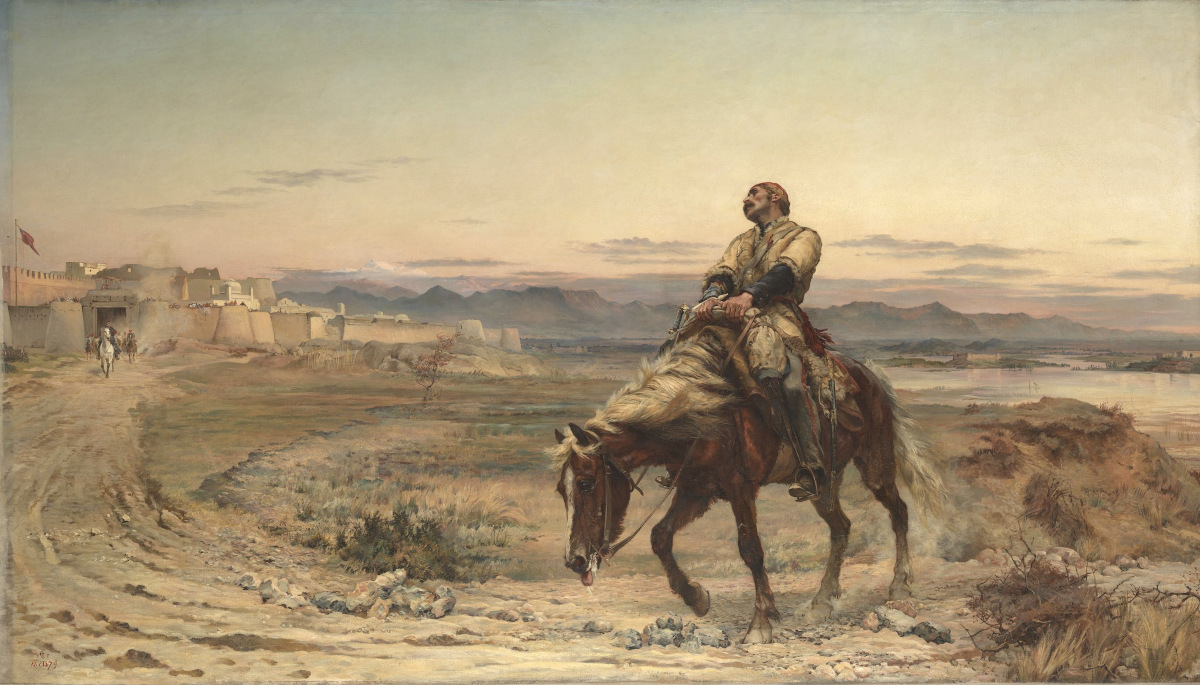
The painting above is entitled Remnants of an Army by Elizabeth Thompson from 1879. It shows Dr. William Brydon approaching the fort at Jalalabad following the retreat from Kabul in 1842. He was supposedly the only survivor of the retreat, though there were actually other stragglers.
Previous: Sometimes A Trap Next: Lessons from the East India Company