
24 August 26
Tivissa
We left Lleida on a bus to take us to Mora d’Ebre, a town on the major river of the region which was used as a principal mode of grain transport by the Romans. Our Davis Catalan friends live in Tivissa, on a hill overlooking the Ebro valley. We were privileged to get a glimpse of their day-to-day lives, which were quite hectic given that Marc is in charge of wildfire response in this part of the country and a major fire had just broken out.
 I haven’t spent much time in a Spanish village since the 1970s and I’m happy to report that not a lot has changed since then. I mean you don’t have to book a phone call to the outside world and everyone has internet, but wandering around, knowing all your neighbors and their kids and their cousins, buying fruit at the market and bread at the baker — this was all very familiar. Marc and Ruth own the oldest house in the village, built in 1408 on top of a Moorish house (a front courtyard was added and walled in). The house next to theirs was hit by Napoleon’s artillery fire and burned down during the Peninsular war. Marc explained to us that brick archways in the village denote Moorish doorways, stone ones medieval Christian. A combination of the brick arch and stone columns denotes a Muslim who had converted to Christianity (with the Catholic monarchs’ edict of 1492, to convert or leave, this was something of an expedient). The straight Roman streets curved and clustered in the middle ages to aid in defense of the village, where marauding armies could be stopped before building up attacking speed. (The house had a curious raised doorway, which was used by the resident knight in armor to be able more easily to mount his horse.)
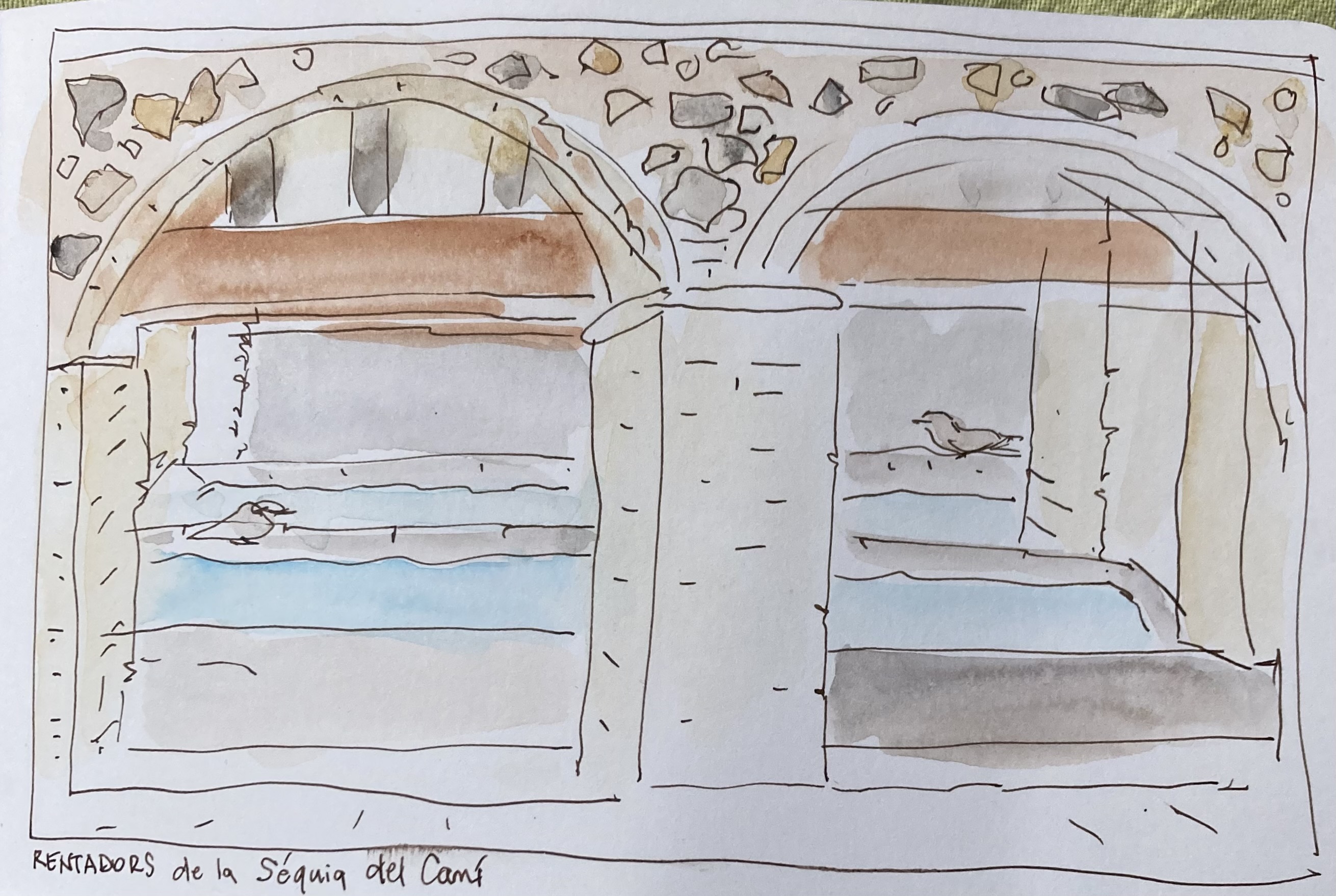
One of the most fun things about staying here was that as soon as we got our sketchbooks out, the three kids started drawing with us. We spent a lovely quarter hour or so drawing the 19th-century wash house (pictured at right) with Teresa, age six, after the boys had finished their football match.
Previous: Lleida Next: