
6 July 12
Developing Meaning
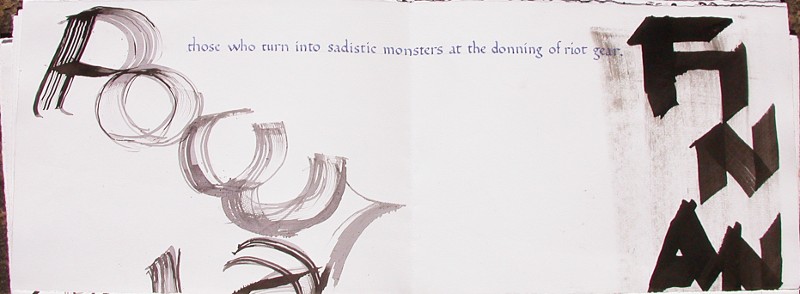 I spent last week up at Calligraphy Northwest held at Reed College in Portland, this year’s edition of the largest calligraphy conference taking place in North America, with 500 participants. Workshops ran 2 1/2 days and 5 days; I took a 5 day course entitled “Developing Meaning” taught by Brody Neuenschwander, which was an exhilarating workshop on improving the textual content of our calligraphy works. Prior to the workshop we had a homework assignment to write three short texts about a significant recent event in our lives, something that shook us to the core. I ended up choosing the pepper spray incident from last November. We used these texts initially for a series of calligraphic riffs and wrote these on good paper to be bound into a book. Towards the end, we started writing out the texts in full into the books. I don’t think anyone completed this task during the class, and I’m still working on writing in the texts. Here are a couple of images from my book in progress.
27 June 12
More Gray Foxes
 So the gray fox family is doing well. Five pups, now about 12 weeks old. I was able to catch the male this evening as he was guarding the whole territory. They make a funny kind of bark, like a terrier but much deeper, growling in there somewhere. (Below is a photo of the male barking at me.)
Having wild creatures like this so close to an urban area is thrilling but also worrying — too many cars going way too fast. For now, they seem fine.

17 June 12
Footie Overload
We just returned from The Graduate, the biggest sports bar in Davis, where we were watching the final matches in Group B of the Euro 2012 soccer tournament. The teams playing were Germany versus Denmark and Portugal versus the Netherlands, and the two matches were going on simultaneously. The two games in the final round of each of the groups takes place at the same time so as to avoid having the results from one match bias the play of the last match, and the concurrency makes for lots of drama. Going into play today any of the four teams could advance, though the scenarios for certain combinations were complicated.
All this makes for an interesting media experience, with half of the many screens in the Grad tuned to one match, half to the other match, and trying to pay attention to what is happening in both matches at once. I don’t think I have ever tried watch two sporting events like that before. I am pulling for Germany and Denmark to go through. But that means that who I root for at any given moment depends upon the scores in both matches. Let’s see — Netherlands are up 1-0….that means that if scores stay the same in the end Germany and Denmark go through, but we don’t want Netherlands to score 2 goals, because they would then go through, but now that Portugal has tied it up, we want Netherlands to score again…and wait, now that Portugal has taken the lead, if Denmark by some chance scores a goal, Germany would be going out…
In the end Portugal and Germany both finished strongly and won their respective matches 2-1 apiece. Portugal will play the Czech Republic in the quarterfinals, and Germany will play Greece. It’s a good atmosphere at the Grad to watch these big footie matches, with quite an international crowd always showing up.
7 June 12
Gray Foxes
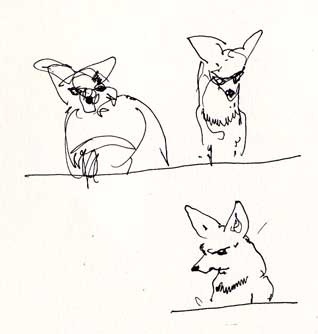 We’ve been noticing a gray fox around where I work. There’s a meadow that is more or less kept mowed between my building and a horse paddock; it hosts a lot of wildlife, much of it prey for things like red-shouldered and Swainson’s hawks, coyotes, and the feral cats we seem never to quite get rid of.
About three years ago I spotted a gray fox near the railway tracks. It was my first ever near our house and I was elated. Seems like they’re moving in, because this fox we’ve been seeing recently is a vixen with two pups. They have a den under the building I work in.
This sketch is of the mother who climbed a toyon tree to get onto a sea container in order to put us under surveillance last night. We made very quick sketches and backed away, not wanting to put her under any more stress. The pups, two of them, played happily in the twilight… Hope they stay away from the road and that they get enough to eat.
24 May 12
All-Fish Lineup
The Angels have a talented young player by the name of Mike Trout, who got me to thinking how hard it would be to construct a baseball lineup composed of players who are named after fish. Here, with a little help from Lookout Landing, is what I’ve come up with. The years are the time the player spent in the majors. No Catfish Hunter though: that’s a nickname.
- 1B — Sid Bream (1983-1994)
- 2B — Johnny Ray (1981-1990)
- SS — Bobby Sturgeon (1940-1948)
- 3B — Art Garibaldi (1936)
- RF — Tim Salmon (1992-2006, another Angels favorite).
- CF — Mike Trout (2011-2012)
- LF — Mike Carp (2009-2012)
- C — Carlton Fisk (1969-1994, fisk=fish in Scandinavian languages)
- SP — Steve Trout (1978-1989)
- RP — Anthony Bass (2011-2012)
20 May 12
Spring Migration
 I left Massachusetts for California in 1996, in mid-June after the end of spring migration. It was the best migration for years. For some strange reason I’ve left it sixteen years to return there in May. I don’t know why. What I do know is I’m not going to leave it another sixteen!
I spent most of the time with my mother who will be 80 this year. We birded. We sketched. We explored the Maine coast north of where she now lives. It was a fantastic visit, punctuated by warbler song and azaleas, warm rain, tearful belly laughs over a lamentable restaurant experience. Movies and popcorn.
Back home: no parulas singing here but I returned to this beautiful Carpenteria californica in bloom. This plant is incredibly rare in the wild: only seven known sites in Fresno and Madera counties. It has a light, orange fragrance. It’s in the arboretum’s moon garden and I’m glad I planted two. As we prepare to go out and watch the annular eclipse this evening, it can do the light and shade thing for us…
15 April 12
April Sketchcrawl
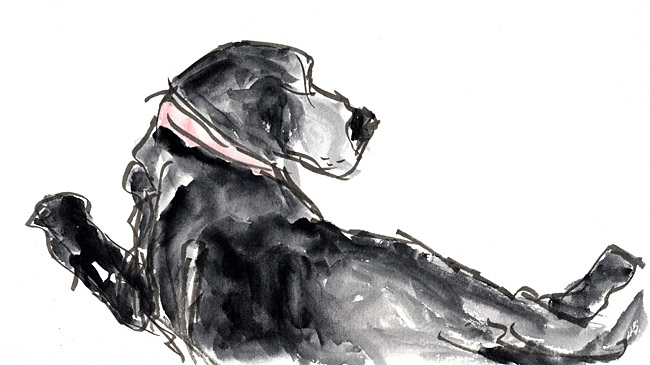 A lovely spring day today, though with the ongoing tornado outbreak in the Central Plains I am reminded that lovely weather in one place is always balanced by horrific weather somewhere else. We had our monthly sketchcrawl today in Davis, walking a four-block stretch on G Street downtown. I mostly worked large today, using a 9 × 12” pad of watercolor paper I picked up last time I was in Berkeley. Above at left is a black lab named Eliza who was outside at the Davis Food Coop. And at right is a gentleman with his coffee in Mishka’s.
11 April 12
Four Months Later
After the Pepper Spray Incident on November 18, 2011, which exposed sleepy Davis uncomfortably to a searing international spotlight, things slowly calmed down. The inevitable reports were delayed, almost as inevitably, by lawsuits.
But they were released today. In summary, egregious errors were made by university administration and the police force, including not ascertaining the makeup of the protesters on the Quad; use of weapons on the part of the police for which they weren’t trained and aren’t approved by university policy; miscommunication; failure to learn from errors that had been made on sister campuses just days before. But the best part, for my money, is this:
“The Task Force recommends The Office of the President should review provisions of the Police Officers’ Bill of Rights that appear to limit independent public review of police conduct and make appropriate recommendations to the Legislature. The Task Force did not have access to the subject officers. This limitation does not serve the police or the public. When information necessary to understand and evaluate police conduct is unavailable to the public, the public has less confidence in the police and the police cannot perform their duty without public confidence.”
Justice Reynoso and the Task Force panel had a hard time of it today in Freeborn Hall, but they have done their job in less than optimal circumstances. It now falls on the University to implement the report’s recommendations. My advice? Start soon.
1 April 12
Rainy Month
March comes to an end, being the rainiest month so far in the 2011-2012 water year. (Because California has a Mediterranean climate, yearly totals for precipitation are considered to begin on October 1st.) We recorded 4.81 inches this month, bringing the total for the year to about 11.7 inches. This is well behind normal, which is about 15.5 inches to date. Tuesday it poured — 1.5 inches of rain — and today we had showers and big winds, with 0.15” of rain.
Last morning we heard what sounded like a western kingbird, but didn’t believe it, since it seems awfully early for kingbirds. (A mockingbird imitating a kingbird?). But this afternoon I went for a walk out the levee leading past the Raptor Center, and saw at least two and possibly four kingbirds. An early spring for them?
27 March 12
Disembodied Soundtracks
I’ve been following the blog of James Gurney for a while now. Gurney is the author and illustrator of Dinotopia but like many creative people he is extremely generous about sharing his process. His most recent post is a sketch of some people in a diner with the snippets of conversation overheard jotted around the edges.
I do this a lot, listening to unrelated and hilarious-by-juxtaposition fragments of conversation. They are best done in a crowded place like a city, but usually more interesting if most people are moving, or at least moving on after a short stay in, say, a subway car. (This genre found a perfect outlet in Overheard in New York, but I love the idea of combining the fragments with sketches. Hmm.)
Edited to add: today is the blogday of Feathers of Hope. On March 27, 2003, Numenius posted his first entry in Moveable Type. To those of you who still stop in here occasionally, thank you. Welcome to newcomers too.