
12 August 25
The Plumbers Are Coming! The Plumbers Are Coming!
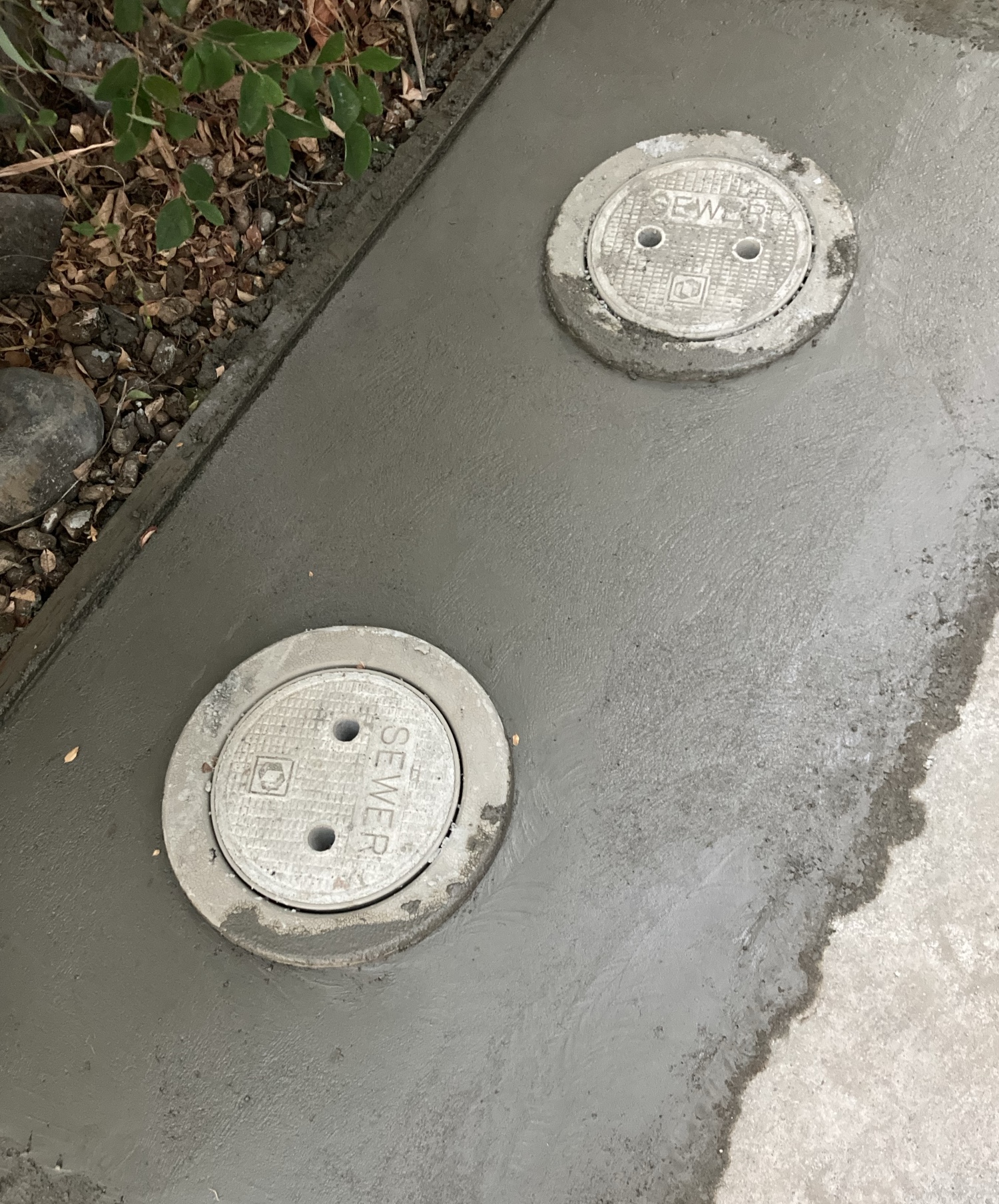 Several weeks ago the sewage backed into our shower. This is awful but at least it was contained in the shower so was easy to clean, plus it had drained on its own, I think because I was running the washing machine. At any event, the plumber came and with the help of a camera determined that the cause of the problem was tree roots that had broken through a bend in the main pipe rather than something clogging the drain. Two large trees (the apricot in our yard and the almond next door) were cut down recently and doubtless the roots of one of them were the culprit.
The plumbers returned today and replaced the pipe, after some jackhammering and arduous work with a pick. A job that was supposed to take about four hours ended up taking over seven, and they still need to come back tomorrow after the cement has dried to tidy it up.
I retreated to the trees outside the Senior Center in order to work on a pitch for a comic idea… I don’t like jackhammers. (But as my neighbor Barbara says, at least they’re better than leaf blowers.)
11 August 25
An AI Lesson From Urban Forest Mapping
Today I fielded an email from a staffer at the California Air Resources Board about the following topic, and I think there’s a general lesson to be had here. Between 2021 and 2023 I worked on a project that was looking at the extent of and ecosystem services provided by the urban forests of California. This was a follow-on to an earlier project our lab had done in 2015 about the same topic, and one of the goals of the project was to do a change analysis between the two time periods. For the question about urban forest canopy extent, we were working with high-resolution tree canopy cover datasets from a company called EarthDefine. In particular, we were comparing a canopy cover data layer from 2012 (used in our 2015 analysis) to a canopy cover data layer from 2018. In theory, all one has to do to measure in canopy cover extent is to subtract the 2018 layer from the 2012 layer. Pixels where there was canopy cover in 2012 but not in 2018, or vice-versa, would represent change.
In practice, we soon discovered this wasn’t going to work at all. These canopy cover datasets were developed using machine learning models applied over NAIP imagery, which is high-resolution aerial photography produced periodically in a program run by the US Department of Agriculture. When we compared the canopy cover maps in 2012 and 2018 with their source imagery, it was evident that the machine learning models for two canopy cover datasets used very different ideas about how to recognize and delineate trees in the source imagery. This resulted in unrealistic change statistics, for example the urban canopy cover in Riverside County purportedly increasing from 2012 to 2018 by 20%. Basically, the comparison was between outputs from different machine learning models applied over different datasets (in particular the 2012 imagery had a resolution of 1 meter, and the 2018 imagery had a resolution of 0.6 meters) — apples and oranges.
The general lesson for AI is to be very careful about extending an AI model beyond the domain over which it has been trained. Sometimes this works, but many times it does not, with deleterious consequences. In particular, this is one of the antipatterns that can result in AI bias.
10 August 25
Ripe Figs
While I was gone the figs on the tree out front got ripe. They have been the object of interest of the scrub-jays and squirrels, but this morning I saw the tail end of what I thought was a Nuttall’s woodpecker. It came back and turned out to have been a female black-headed grosbeak.
We had a fig tree out front when we lived at the Trout Club in Santa Barbara nearly 30 years ago; a grosbeak would visit it regularly when the figs were ripe. Numenius once made a fantastic sketch of one with fig detritus all over its beak; I wasn’t able to put my hands on this sketch today. I did try to capture the bird this morning (apologies for haste, I was also on the phone at the time) but afterwards also found evidence of its work, shown below.

9 August 25
Photo Cataloging
 I have started in on a project that will take me months to complete but this makes it a good activity for retirement. This project is cataloging all my photographs. I keep my archive of photos in a photo manager called digiKam, with most of the photos organized by year and then by month. I started this archive early in 2017 when I bought a little compact long zoom camera, the Panasonic ZS50, in advance of a trip to Iceland in fall of that year. In addition to organizing the photos by month and year, I also started tagging the photos with keywords and rating them in quality from one to five stars.
I fell off the program of tagging and rating the photos sometime in the middle of 2018, which leaves about a 7 year gap in this process. I have been working backwards to fill this in, and I have completed between July 2025 and May 2024. (I set July 2025 aside, and have just completed it. Because of my photo palette project in July, I ended up with 740 photos for the month, which made it a bear to get through.)
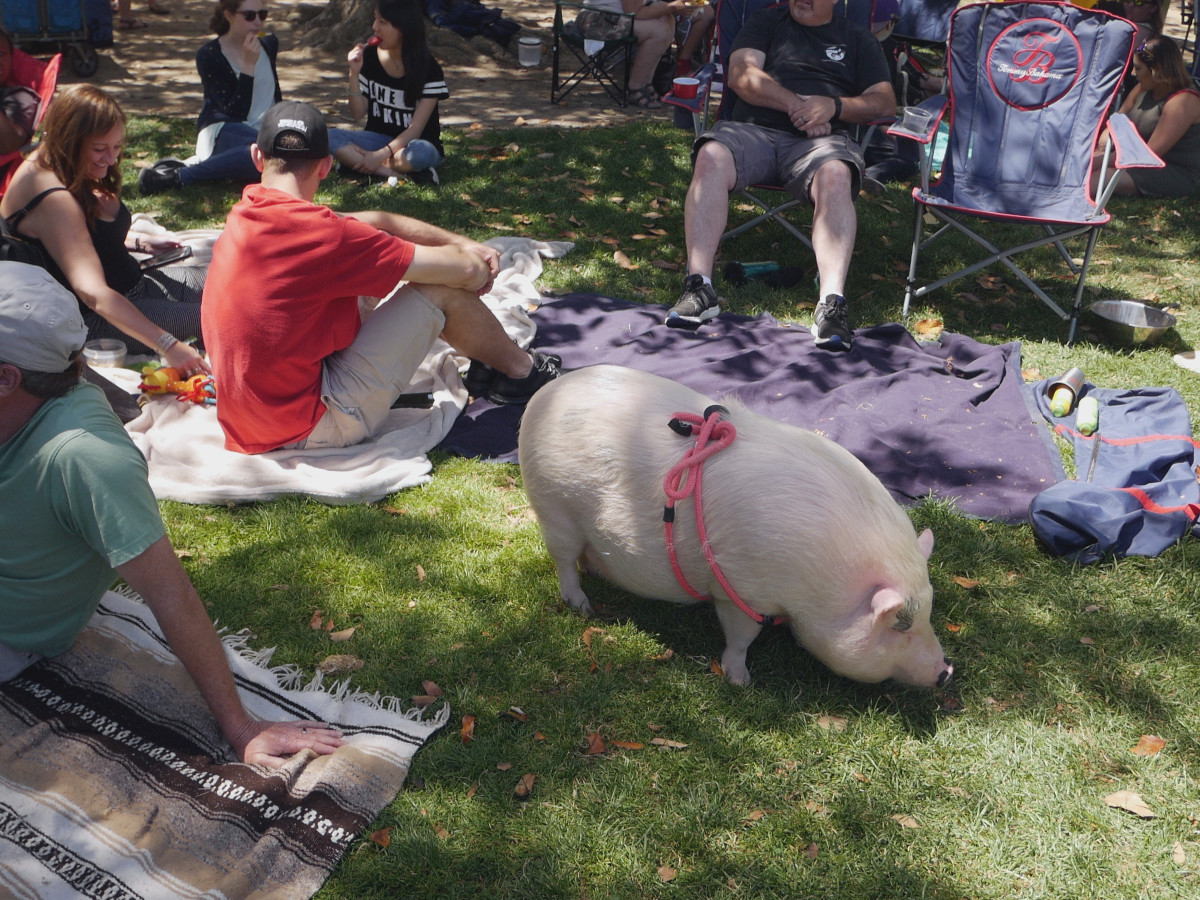
Is this effort going to be worth it? I think so. The rating process is an important exercise in figuring out one’s photographic style and aesthetic sensibilities, and tagging the photos helps a great deal with retrieval. The photo at right is a fun example of the latter. I wondered what I had cataloged under “Animals / pigs”, and came up with several photos of a pig enjoying the Whole Earth Festival in Davis in 2018.
8 August 25
Fast Drawing
My SAWgust adventure continues… this morning’s prompt was to draw, in five minutes or less, the basic story of our planned comic. I did the following drawing in exactly five minutes with the exception of the white bar on the no-entry sign. Mister Ginger heads toward Poland as the Russian invasion begins…

7 August 25
The Broken Arrow Up North
This is a follow-up to my last post about the B-29 crash near Fairfield in 1950. Today falls within those several days in August when we think about Hiroshima and Nagasaki, so here’s a tale from the Cold War about the other Broken Arrow incident to happen nearby.
On 14 March 1961 a B-52F bomber carrying two Mark 39 Mod 2 thermonuclear weapons, each with a yield of 3.8 megatons, crashed in Sutter County about fifteen miles west of Yuba City and 40 miles north of our location in Davis. The plane had taken off 22 hours previously from Mather Air Force Base just east of Sacramento. (This base closed in 1993 and the field is now a general aviation airport). The plane was flying on an Operation Chrome Dome mission doing circuits over the Aleutian Islands. Chrome Dome was a Cold War mission between 1961 and 1968 where bombers would fly on alert armed with thermonuclear weapons in a position to attack targets in the Soviet Union if they got the call, with some portion of the nuclear bomber force airborne 24 hours a day.
The mission of this particular B-52F did not go well from the start. About twenty minutes into the flight very hot air started bleeding into the cockpit and the crew was unable to sort out the problem. Temperatures within the cabin grew to between 125–160 °F, and the crew took turns going to the deck below the cockpit to escape the heat. In contact with the Mather command post, the crew received instructions to continue with the mission as long as possible. Fourteen hours into the flight the pilot’s window cracked with the heat, depressurizing the aircraft. The crew decided to descend to 12,000 feet following the depressurization.
At this point the crew was exhausted and dehydrated and started making many mistakes. One of these errors was miscalculating the fuel burn rate, which was higher than normal because of the lower altitude, and a stuck fuel gauge didn’t help with the perception of the problem. Eventually they alerted Mather of their need for an air tanker, but they ran out of fuel about 2 1/2 miles before the rendezvous with the tanker. With the plane doomed to crash at that point, all crew members were able to bail out successfully, with the pilot steering the plane at the last minute toward a fallow rice field. The only fatality in the incident occurred on the ground when a fire truck responding from Beale Air Force Base overturned. The two hydrogen bombs aboard the plane were severely damaged in the crash but the high explosives they contained did not detonate and no radioactive materials were released.
In hindsight the crew should have aborted the mission when the cockpit temperatures grew unbearable. But this was the height of the Cold War, and Strategic Air Command was pushing their wing commands very hard to keep the early airborne alert program operational at all times.
6 August 25
Guinea Pig Studies
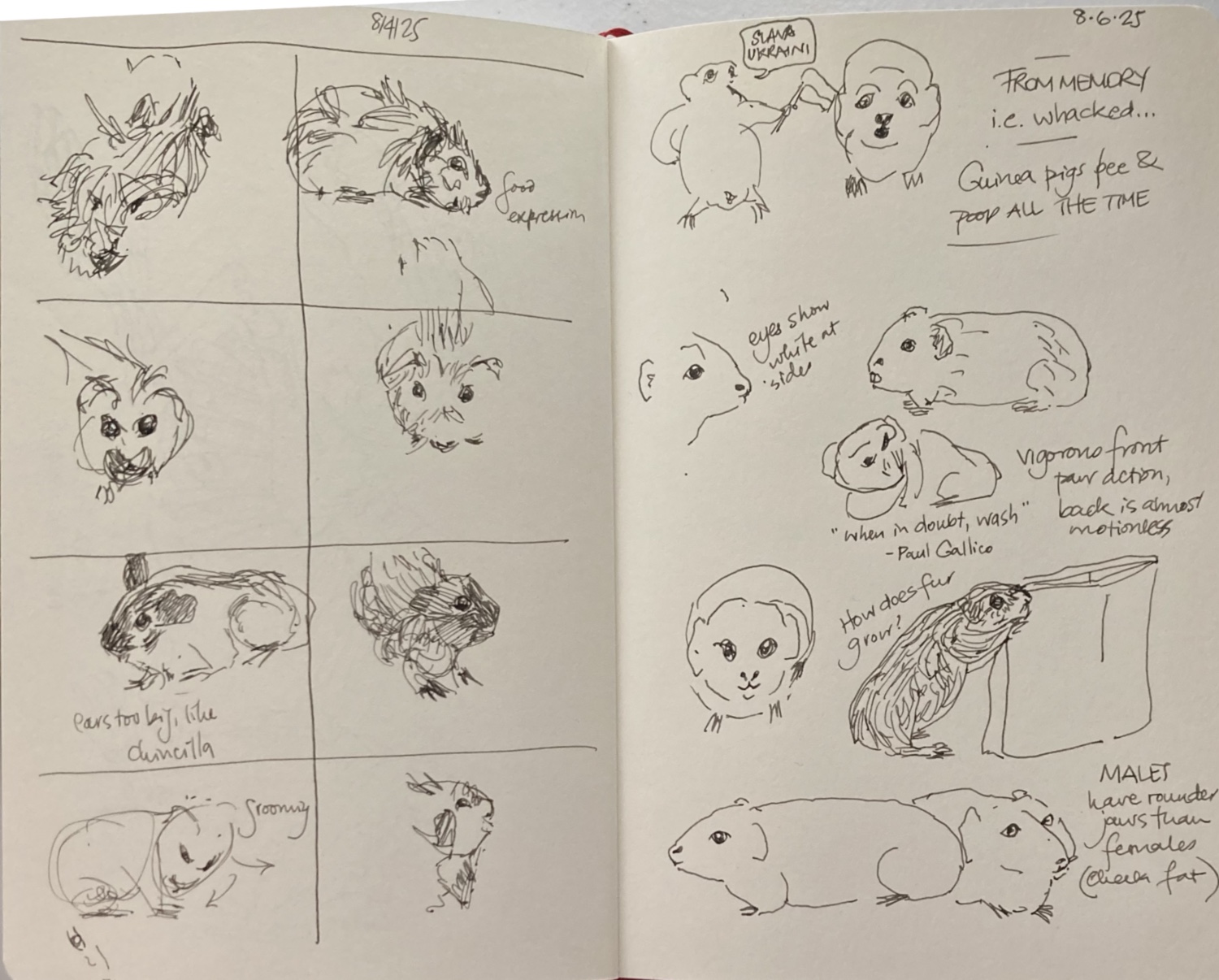
I’m working on a new comic, one that features a guinea pig that had some big adventures during the Russian advance on Kyiv in February 2022. (Since this is based on a true story, I’d like to make the guinea pig at least somewhat recognizable!) We owned a couple of guinea pigs as kids but that was a long time ago plus neither was the smooth-haired variety like Mister Ginger, so I’ve been doing some online image research (anatomy, though there is precious little available about musculature) and different poses, including some video I took at a PetSmart in Brunswick, Maine on Monday.
Getting the guinea pig to look “right” as a somewhat drawn-from-life animal is essential before I can turn this into the plucky heroic character of my story, and today was a bit of a test to see how far I’ve come. The ears are completely eluding me: you don’t want them upright (too much like a capybara), you don’t want them small (too much like a rat), you don’t want them big (too much like a chinchilla) and in fact in many photos of guinea pigs you hardly see them at all. It’s definitely back to the drawing board tomorrow, but I thought I’d share some progress sketches… There is a new PetSmart in town that might have some live guinea pigs, which would be a great place to start.
5 August 25
The Broken Arrow Down The Road
A Broken Arrow incident is, in United States military terminology, an accidental event involving nuclear weapons or components that does not create a risk of nuclear war. Today is the 75th anniversary of a Broken Arrow event that happened in Solano County less than 25 miles from here.
On 5 August 1950 a Boeing B-29 bomber was leaving Fairfield-Suisun Air Force Base bound for Guam when it crashed shortly after takeoff. It was carrying a Mark 4 nuclear bomb and was part of a contingent of 10 nuclear-capable B-29s being sent to Guam to serve as a deterrent to the People’s Republic of China at the start of the Korean War. The bomb in this B-29 did not have its fissile core installed so there was no risk of a nuclear explosion, but the high explosives in the bomb could and did explode in the fire subsequent to the crash. 12 of the 20 crew and passengers on the plane died in the event, as well as 7 people on the ground in the explosion which spread wreckage over about 2 square miles.
One of the passengers killed in the crash was Brigadier General Robert F. Travis, who at the time was commanding the 5th and 9th Strategic Reconnaissance Wings. To honor him, the base was renamed Travis Air Force Base in 1951.
I learned about this anniversary by seeing a reference to it on my Cat Lovers Against The Bomb calendar. I very much like the version of this calendar (the “classic” version) with black-and-white photographs of cats and have been using it as my office calendar for many years now.
4 August 25
Artists Support the Protests

On Saturday I attended the weekly Freeport, Maine protest against the current administration and its erosion of American democracy with my sister. We grew up in a fascist country and as the gentleman on the left is pointing out (his sign is not very visible), “Remember Germany 1933.” It was a pleasant way to spend a morning but we were all wondering what good it was actually doing… Lots of cars beeped in solidarity; some also shook their heads or worse. This is the point: we agree they have the right to disagree.
This protest coincided with the local arts & crafts fair, and one of the artists offered us all a notecard to thank us for showing up. I went over afterwards and talked with her: she is a farmer whose livelihood is being threatened by the administration’s cuts to the USDA… I loved her work and bought some more notecards. I gave the still life of just-pulled beets to my mother, who loves beets.

3 August 25
Google Creepiness Example 587
A couple weeks back, I bought a new cellphone. This was after the battery died on my old phone from 2019. I took the phone to a local shop to try to get the battery replaced, but despite a valiant attempt at the replacement, the phone was moribund and I ended up spending $160 to acquire a 2023 Moto Power 5G running Android 13. I have not put many apps on the phone to date, and don’t plan to load it up much.
The other day I opened my phone to a notification giving me a tour of the new features these days in Android. Google is now pushing their Gemini AI chatbot technology as much as possible. I have tried to disable Gemini as far as I can on my phone, but I’m sure it will creep back. Anyway, the first slide of this tour was about Gemini, and the slide suggested Gemini would be helpful in finding interesting places to check out in Barcelona, specifically in the Gràcia district. Um. This is all too close to my current interests to be a coincidence. I don’t think Google knows I currently have two books checked out on Barcelona from the public library, since libraries are extremely good about keeping patron information private, but on June 29 I did watch an Easy Catalan video entitled Barcelona’s Neighborhoods: Gràcia. (I know the date because I’m keeping a log of my Catalan input). I try my best to keep Google off my trail, but this is obviously quite hard to do.