
22 August 25
A Big Part of Our Lives
 Feathers of Hope was neglected for a long while but we’re both glad to be back to our alternating daily posting practice. One of the things we never did here was introduce the no-longer new cats. Charlie and Diego both died before we moved into town; we had been living here for a few months and decided we needed cats back in our lives.
The SAWgust prompt today was “Companions,” a pet tax asking about our pets. Here’s my entry from today, along with the photo at left:
Two gray cats that were rescued as kittens from under a pallet behind Walmart when it was blisteringly hot. Very different personalities… Winston is big and muscular, with a meow that is much higher and pitiful than his ballbuster persona would imply, and Esmerelda aka Esme aka Missy who always always looks scruffy even after you’ve brushed her.
ETA this was taken in winter; there is no way they’d be this close today even in the coolish pre-dawn hours….
21 August 25
The Domestic LLM
One of the reasons I built my own computer recently was to have a machine available considerably more powerful than my laptop so that I can learn about and experiment with current technology. I am now playing around with large language models (aka LLMs) which is the key technology behind ChatGPT and its rivals. As widely recognized, these state-of-the-art systems consume enormous amounts of resources to build and keep running. What’s less widely known is that smaller versions of these same models are continually being released as freely available downloads for community experimentation, research, and development. Many of these open models are still far too large to run at home, but many others will run happily on ordinary home computers (albeit the more powerful your graphics card is, the better off you are). I’ve been learning a great deal experimenting with these. Some of the things I’ve learned are:
- There is an enormous amount of development going on across this whole space. There are tools and approaches available now that would have been really useful to me professionally a year-and-a-half ago.
- Nobody really understands how this technology works. An example: I asked my local LLM to write a poem in iambic tetrameter about the cat sleeping on his cat bed in my office. After some nudging (the first version was in iambic pentameter, but I told it to try again), it succeeded in producing some doggerel with the correct scansion. How did the system do this? We have no idea. We cannot point to a “metrical poetry” module within the system — rather, we are seeing emergent behavior.
- It is straightforward to set up an LLM system (even one at home) to let you conversationally ask questions and get natural language responses about a body of documents. (My test corpus has been a set of 80 or so conservation management plans from California). What is not at all straightforward is getting responses that are reliably accurate. Enormous amounts of engineering effort across every domain is being expended right now to build reliable conversational systems, but for now this is both very challenging and expensive.
- It is not clear what the important real-world applications of local LLM systems (i.e. ones you can run on a laptop or desktop) are going to be. There are a great deal of privacy benefits to them, since you can avoid shipping your sensitive documents off to Meta/Google/OpenAI etc. for LLM-based analyses, but will the local systems be powerful enough to conduct the analyses? One application of much interest to me is extracting structured information from unstructured or semi-structured text documents. This has been a challenge I’ve been pondering for quite a number of years, and LLM-based techniques for doing this are just starting to emerge.
20 August 25
Material
 The good folks at SAWgust have been providing prompts daily to get us thinking about our process. I’ve sometimes answered prompts but I’ve ALWAYS thought about them; they’re very interesting. Today’s was #material: what materials do we use and why? I decided to draw it on one of my materials that isn’t pictured here (Procreate on my iPad). And it’s all from memory, since Winston was sprawled across the kitchen table where these materials all are.
Last night I had a call with Mr. Ginger’s owner, and hoo boy there is a lot more to this story. Good and bad. The good: Mister Ginger is still alive and well and living in Kharkiv (and he has a girlfriend); the bad: this has been traumatic for him, retelling this story for me. But A. did say that he thought Mr. Ginger helped him through some very hard times, which is great to hear because it’s the actual punchline — simply giving comfort to people in a war zone is heroic enough.
19 August 25
Daily Photo - Grocery Bags
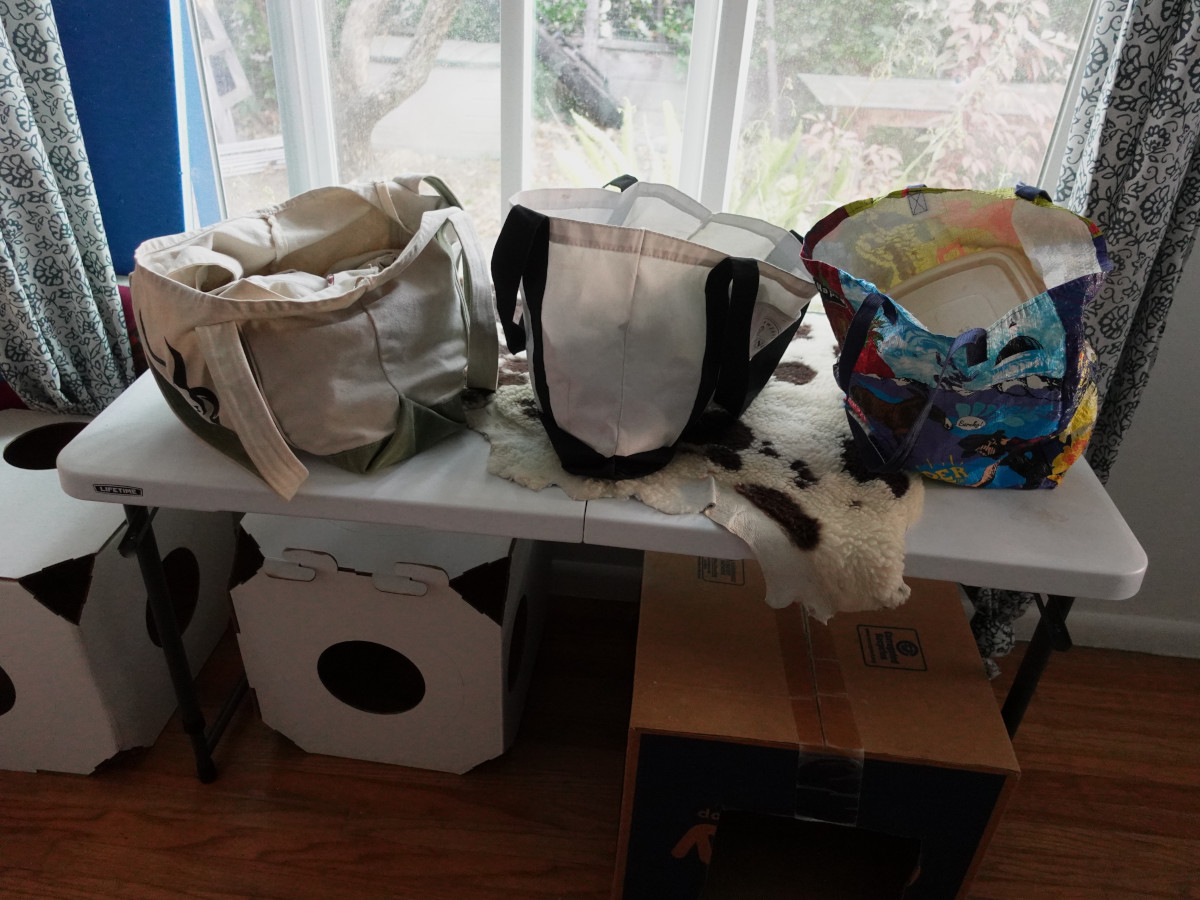 I’ve been keeping up my new practice of documenting my life via a daily photograph. Here are the grocery bags lined up prior to today’s food co-op run.
18 August 25
Matching the Medium to the Message
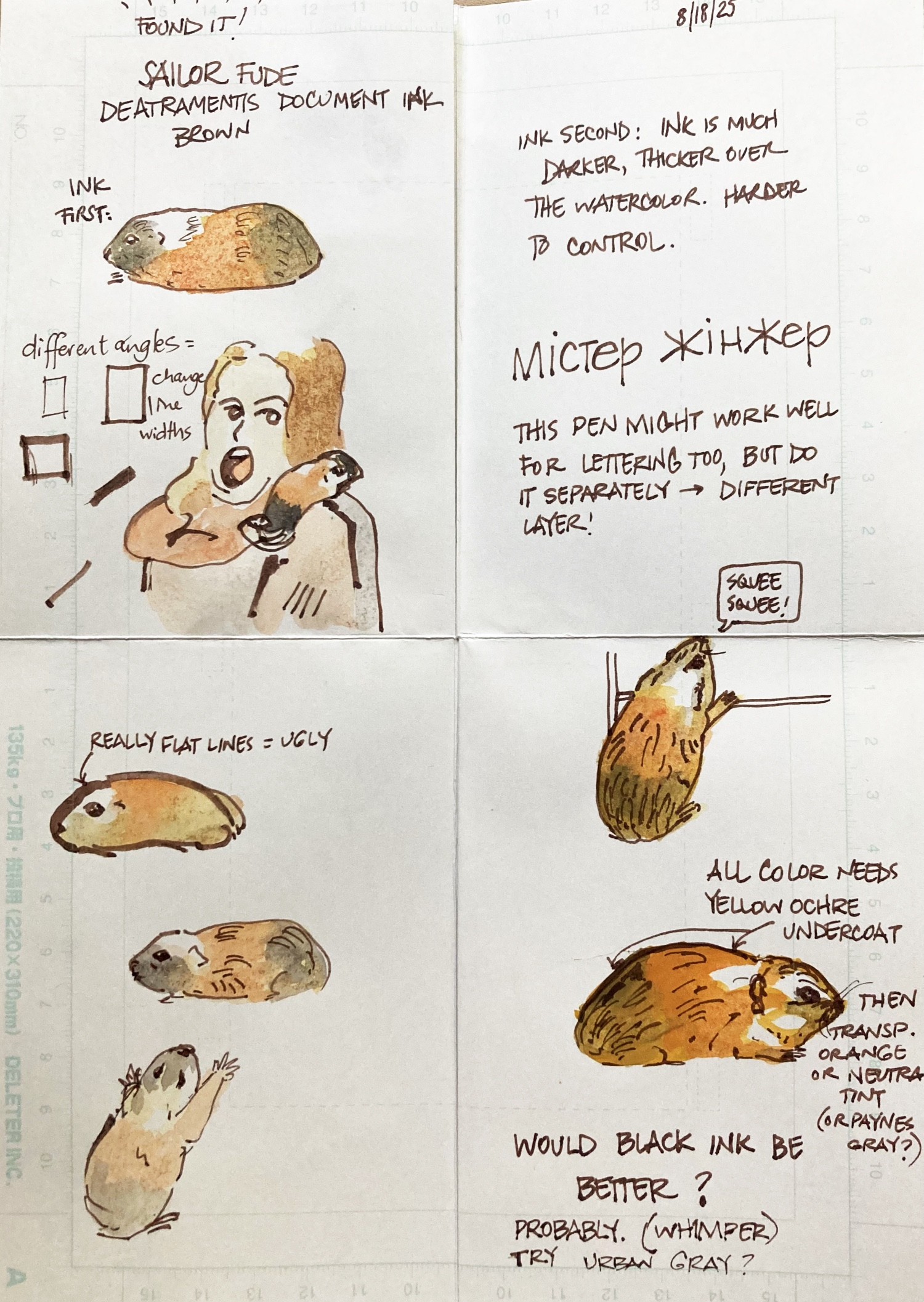 On Saturday I attended the SAWgust halfway point call. I had a question about how others organized their composition process if the final was going to be analog; mostly I work on paper then go digital. But for this Ukraine project it seems analog is a good way to go.
I’d done some sketches with a fountain pen but it has a fine nib and when reduced down it maybe too fine a line. I looked for and found my Sailor Fude pen, a fountain pen with a bent nib that can give you at least three different thicknesses. I think I can get this to work. I still have some fine-tuning to do but am pretty set on this course.
Someone said they just redrew and redrew panels until they were right. Someone else said when using watercolor they used a camera rather than a scanner. Another helpful suggestion was to write the names of the materials, paints, brushes and pens on the back of the work so if you revisit it a year later you have some hope of matching it.
Meanwhile it’s looking like I might do the whole section before the invasion in full color, moving to monochrome afterwards except for the guinea pig… The paper is Deleter A Comic Book Paper size B5, which is not as thick as Bristol board, takes a good wash, and is very pen-friendly.
17 August 25
Daily Sketch - Young Oak
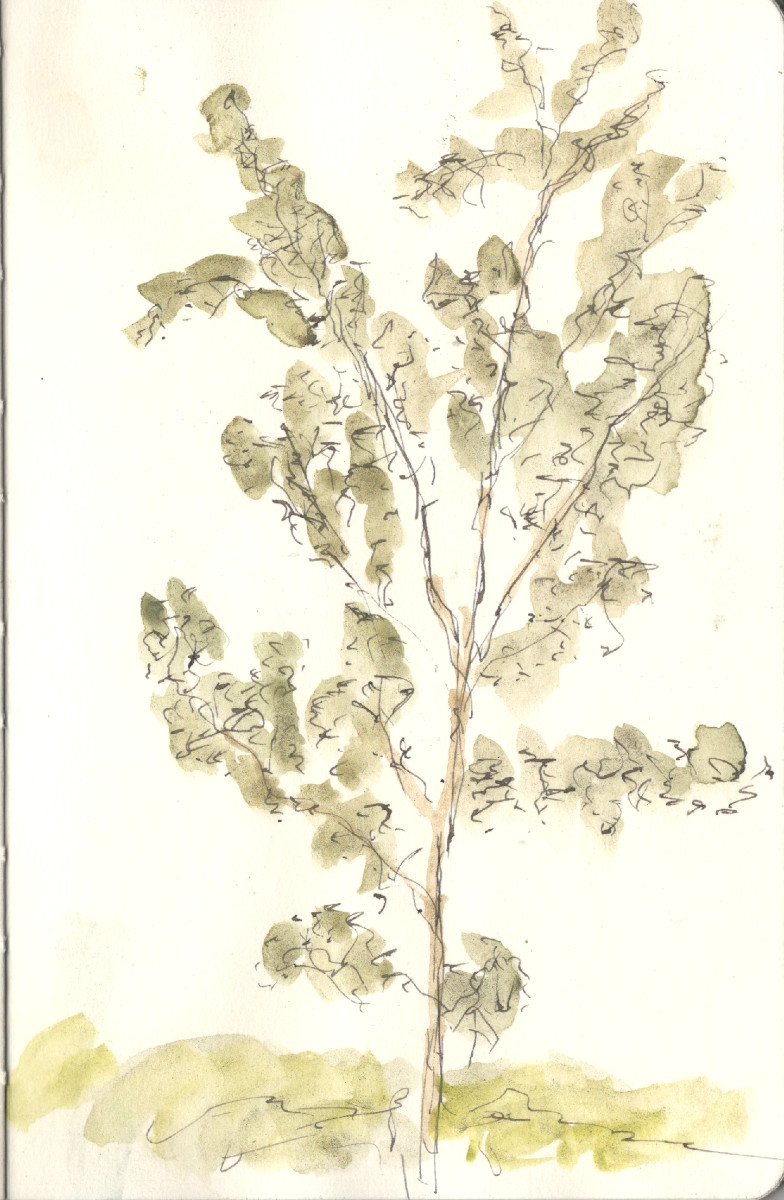 For today’s weekend tree sketch I ventured out on bicycle to the local arboretum where to no surprise there are many trees. I sketched this young oak with De Atramentis Urban Gray ink and used Derwent Graphitint pan paints for the wash. I like the Derwent Graphitint pan set a lot. The principle of the Graphitints (both in pencil and pan paint form) is that they are watercolor pigments mixed with graphite particles which mutes the colors a lot. Using the pan set I find I can mix a lot of realistic greens, and muted sketches work well at times.
16 August 25
Almost a Real Guinea Pig
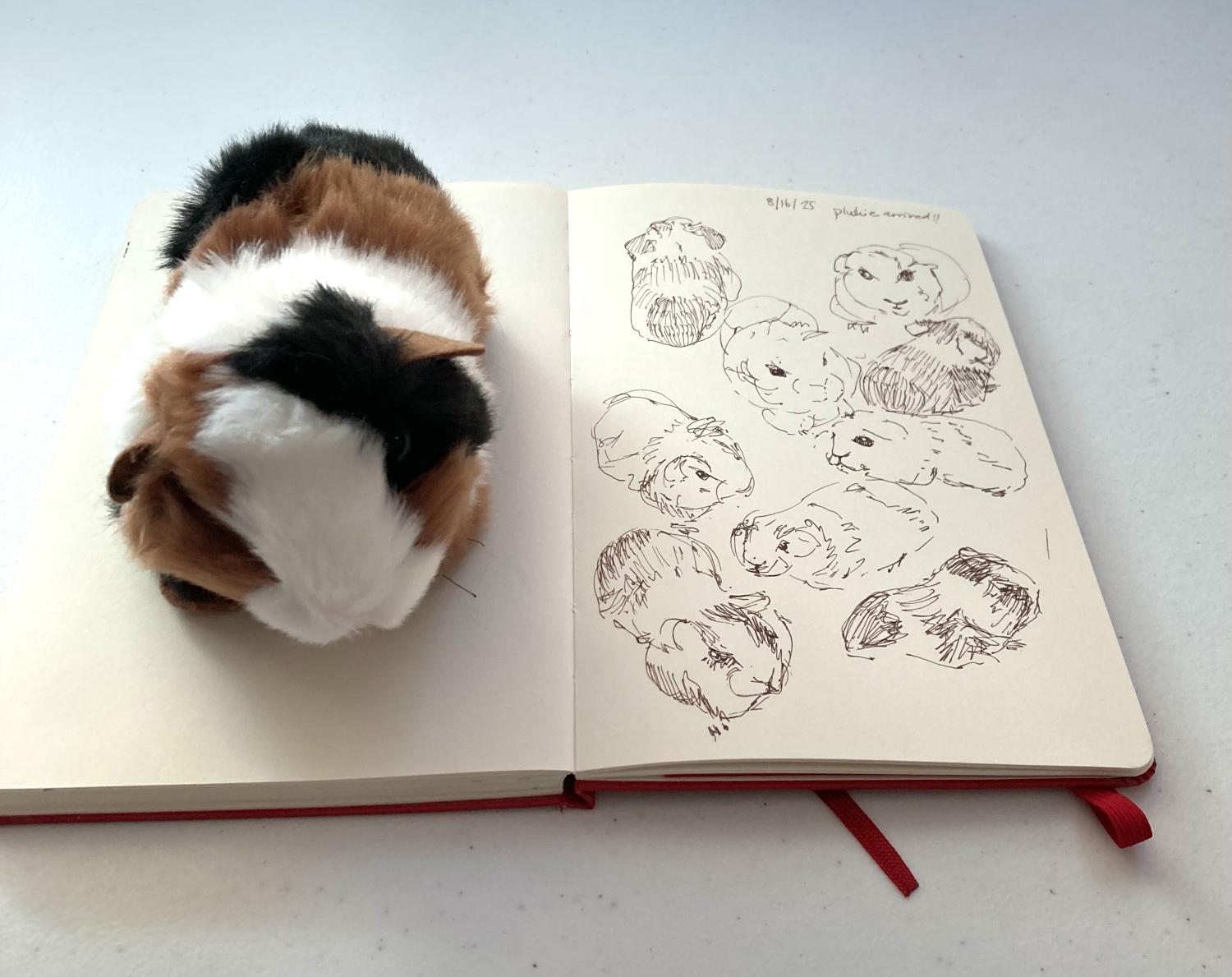 I’ve now completed a very incomplete first draft of the script for my Mister Ginger comic. There will need to be quite a bit of work on the script and also on the drawings… but to help with the latter, I ordered a plushie, pictured at left, and set about doing some sketches.
Drawing live guinea pigs is obviously better, but a) I don’t have one, b) if I did, the cats would kill it, c) if I go to the pet store, the animals are almost at ground level which makes it hard to get anything other than a bird’s eye view. So this plushie, while not perfect, at least allows me the luxury of placing at eye level and even higher, this way and that, 3/4 view and from behind. I am still drawing on reference photos but this will allow me to stage the drawings in my comic better.
15 August 25
Slow Focus
 One thing to learn from Saul Leiter is to not be afraid to experiment and to embrace imperfections in the resulting images. In this vein is playing around with vintage lenses which tend to be optically more interesting than their modern ilk. In my YouTube feed a couple days ago there popped up a video about the Helios 44-2 lens and I immediately thought oh! I have one of those. Time to take it out for a whirl.
The Helios 44-2 is a 58mm lens that was made in large numbers in the Soviet Union. It has a good reputation among vintage lens aficionados because as being a lens with character known for its “swirly bokeh”. I happen to have one; it was the lens that came with my first SLR, an all-manual Zenit. It is labelled “Made in U.S.S.R.” on the lens barrel. Sometime back, I picked up an adapter so that I could mount it on my micro four-thirds interchangeable lens camera (a Panasonic GX-85). For micro four-thirds lenses, their effective focal length (in full frame i.e. 35mm format terms) is twice that of their actual focal length. In other words, a 58mm lens, one with a normal focal length on a 35mm film camera, works out to be a moderate telephoto (effective focal length 116mm) on a micro four-thirds camera. The Helios 44-2 is also a fully manual lens: autofocus was many years in the future.
Anyway, on my late afternoon walk yesterday I took the GX-85 with the Helios 44-2 mounted to it. Focusing manually is a familiar experience, but it’s not one we do much of any more! It forces one to take one’s time, especially since the Helios 44-2 is a moderate telephoto on this camera. At right is one of the images I got on this outing.
14 August 25
Designing a Cape for a Guinea Pig
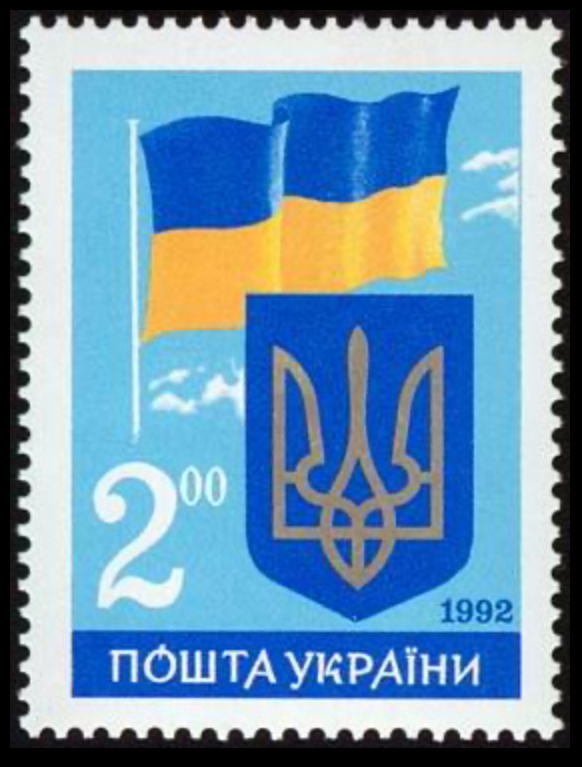 The Ukrainian coat of arms features a trident (“tryzub)”) that dates at least as far back as King Volodymyr (980-1015). It was redesigned following Ukraine’s independence in 1991: gold on a blue ground, as in this Ukrposhta stamp “The first anniversary of the independence of Ukraine. State Coat of Arms and State Flag of Ukraine.”
Working on my Mister Ginger comic has given me a lot to think about, particularly this prompt: “how does your character see themselves? how do others see them?” and it occurs to me that this guinea pig thinks he’s a hero, where the people around him see him as a lovable, cuddly pet. But if he gets a cape… even if it’s only a bandana, what does that change?
I am still very much in the beginning stages of all this but am pondering what defines a “hero,” what is “heroic,” and whether simply giving comfort to people in a war zone counts. I think maybe it does.
13 August 25
Painting In Kodachrome
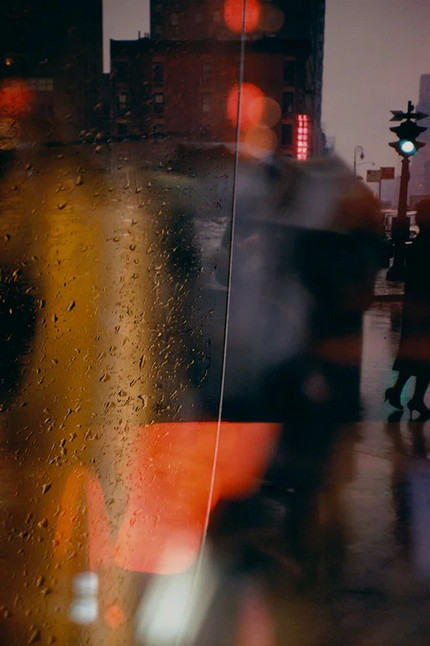 I have recently become acquainted with the photography of Saul Leiter, and am awestruck by his work. It is the most painterly color photography I have run across, and it is not surprising that he was also a painter.
Saul Leiter was born in Pittsburgh in 1923 and was descended from a line of rabbis, his father being a prominent Talmud scholar. Saul’s father wanted him to be a rabbi too, and Saul dutifully went to seminary in Cleveland for a bit, but then dropped out and moved to New York at the age of 23 to try to become a painter. Friends of his encouraged him to take up photography, and he developed a career as a fashion photographer, working mostly in black-and-white. His color work was a private hobby which started in the late 1940s and largely carried out in the neighborhood in New York where he settled in the 1950s and lived the rest of his life. But his color photography started to attract some attention in the 1990s, and in 2006 a book of his early work was published, entitled Saul Leiter Early Color. After that book was published many people got interested in his work, though Saul was quite humble and never comfortable with fame.
Saul died in 2013, and in 2014 friends of his set up the Saul Leiter Foundation to preserve his art and legacy. The photo at right was taken by him in 1958 on a walk in New York. Saul loved working with reflections and windows and raindrops: in a documentary about him completed in 2012 Saul remarked that “a window covered with raindrops interests me more than a photograph of a famous person.”