
19 December 25
Sketching A Triffid
 It was late in the afternoon and the rain was coming in when I got around to doing my daily sketch, so I drew a plant in the garden through the living room window. Nobody is sure what this is, but it seems triffid-like to me.
This is another sketch with the Neocolor II watersoluble crayons: I used yellow green, lemon yellow, prussian blue, malachite green, brown, umber, russet, and gray in the sketch. It’s fun mixing all the colors on the page.
18 December 25
Comix Coven
I finished the Comix Activism 4-week session with Maureen Burdock last Saturday, and decided to make more of a commitment to my comics making. I’ve signed up for her year-long Comics Coven starting in early January.
I got sent a syllabus for the first two months of the year along with a list of materials, most of which I already own. But I was puzzled by the requirement to bring a “visual journal” — I know of them, and I know people keep them, but I have sketchbooks and journals, and mostly never the twain shall meet, apart from my nature journal, which has actually been a good trainer for this activity. (I’m not in the least bit interested in doing the painted-collage-ephemera type thing which seems to me to be little more than scrapbooking, but I do like the Arne & Carlos “idea book” concept, though I’m not sure how likely I’d be to stick to it.)
I’ve decided to make a start on a visual journal which I’m hoping will replace my morning pages once I’m done with the Artist’s Way (three weeks to go). I like journaling. I like lettering. I like sketching. Throw them all together. Finding the perfect size, paper weight, and paper surface will be a trick, of course…
17 December 25
Record Salmon Run
Before we moved into the middle of town in November 2020, we lived four hundred meters from Putah Creek, a stream that flows eastward just south of Davis draining from the Coast Ranges into the Sacramento Delta. In the 1950s Monticello Dam was built at the outlet of the stream from the mountains to create Lake Berryessa, but the downstream flows below the dam were quite intermittent. This started to change in 2000 with the creation of the Putah Creek Accord following an environmental lawsuit which ensured adequate water flows and initiated a program of riparian restoration.
In 2013 the first chinook salmon were spotted swimming up the creek and fall salmon runs became a regular event. (We used to stand on the bridge over the creek on Old Davis Road and look for swimming salmon, but never spotted any.) In 2021 researchers established that at least some salmon were being born in the creek and returning to spawn several years later. Yesterday there was an exciting news announcement that this year there has been a record salmon run on the creek: 2,150 chinook salmon returned this fall to spawn in the creek. Putah Creek has become a hopeful story of environmental restoration.
16 December 25
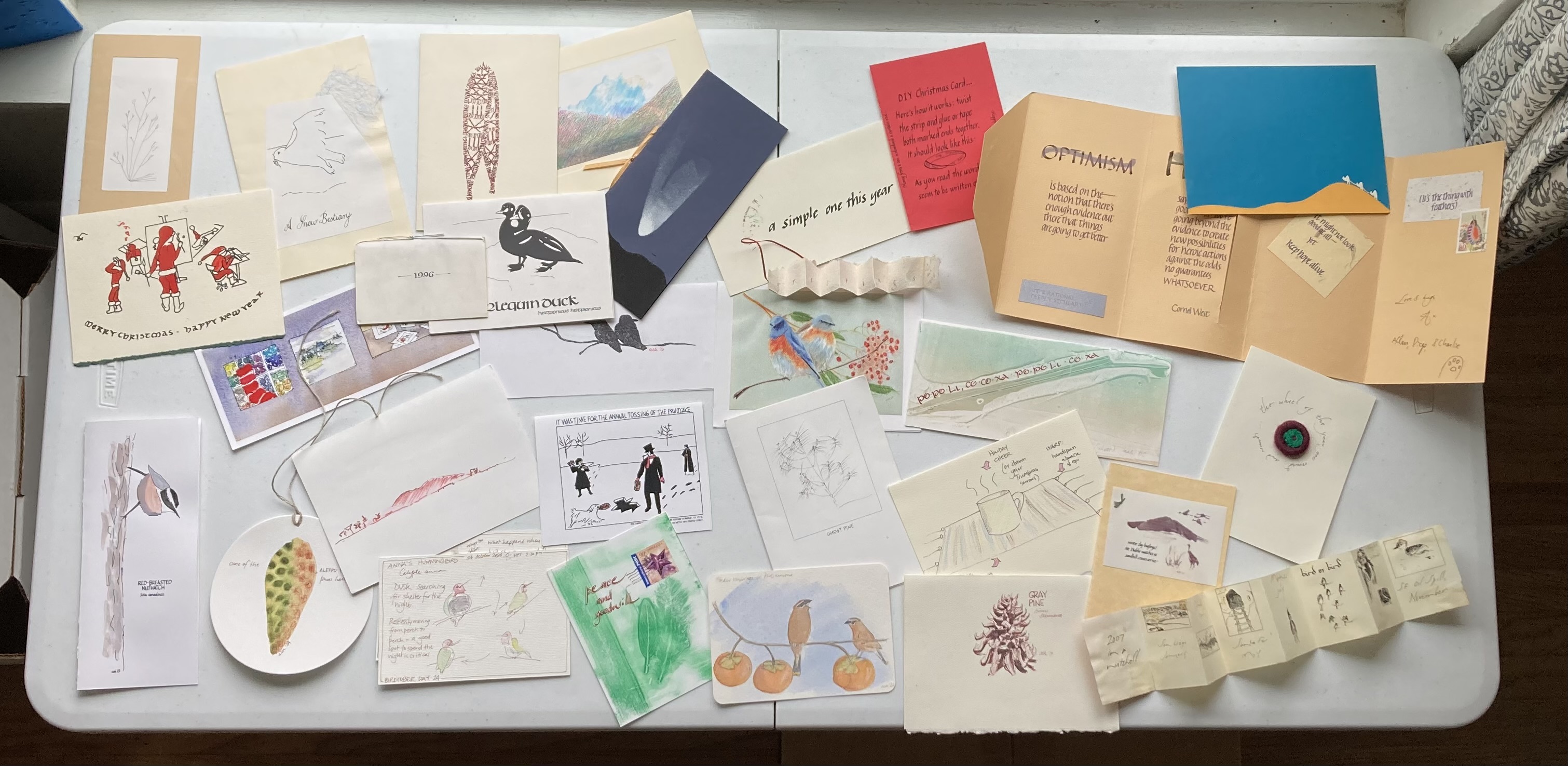
Christmas Cards
When I first moved to the US from the UK, back in 1988 (the Dukakis election), I got a job at an architect’s office in Cambridge, Massachusetts. I was fascinated by the new buildings I was seeing — postmodernism was in full, if somewhat uneven, force. But that experience drew me to, well, draw.
A train trip to Mystic, Connecticut, to visit my mother’s cousin for Thanksgiving that year had me drawing trees from the train — of necessity bare, spare, and plentiful. By the time the train pulled in to South Station I had dozens of small drawings, done in pen and black ink (pretty sure it was a Rapidograph, temperamental bitches that need to be held upright, not a comfortable way to draw, but hey, I was working in an architect’s office, and they had pen cleaning equipment galore; this was before anyone other than a couple of geeks was doing architectural drawings digitally).
This started me on a yearly Christmas card-making journey. Thirty-seven years later, I’m still making my own cards. (The xmas card list has dwindled significantly; I think I’ve only made 35 this year and I still have about six left.) They have been drawn, silk screened, painted, calligraphed, collaged, gelatin-monoprinted, accordion-folded — whatever I was into that year. So in a way this is a good catalog of my artistic journey over decades.
I figured out early on to keep copies of them. The fact that my mother handed me ones I’d sent to her and dad over the years filled out some of the gaps. This isn’t the full set but close…
15 December 25
Fig Tree in Fall
 I am continuing to sketch a lot with my Neocolor II watercolor crayons. I think they are a good match to the paper in the Stillman & Birn Alpha series sketchbooks; I really like using the 7” × 7” Alpha sketchbook and a new one of these just arrived for me today.
Here is a sketch of the yellow leaves on our fig tree which I did as an experiment in sketching light subjects against a dark background. This is very hard to do in watercolor without resorting to various forms of masking. I’m pleased with how this turned out via drawing with the watercolor crayons and activating the pigments with a small wet paintbrush to create the wash. The crayons I used were lemon yellow and yellow for the leaves, umber, light gray, and white for the branches, and emerald green and Payne’s gray for the leafy backdrop.
14 December 25
Sweetie Jar
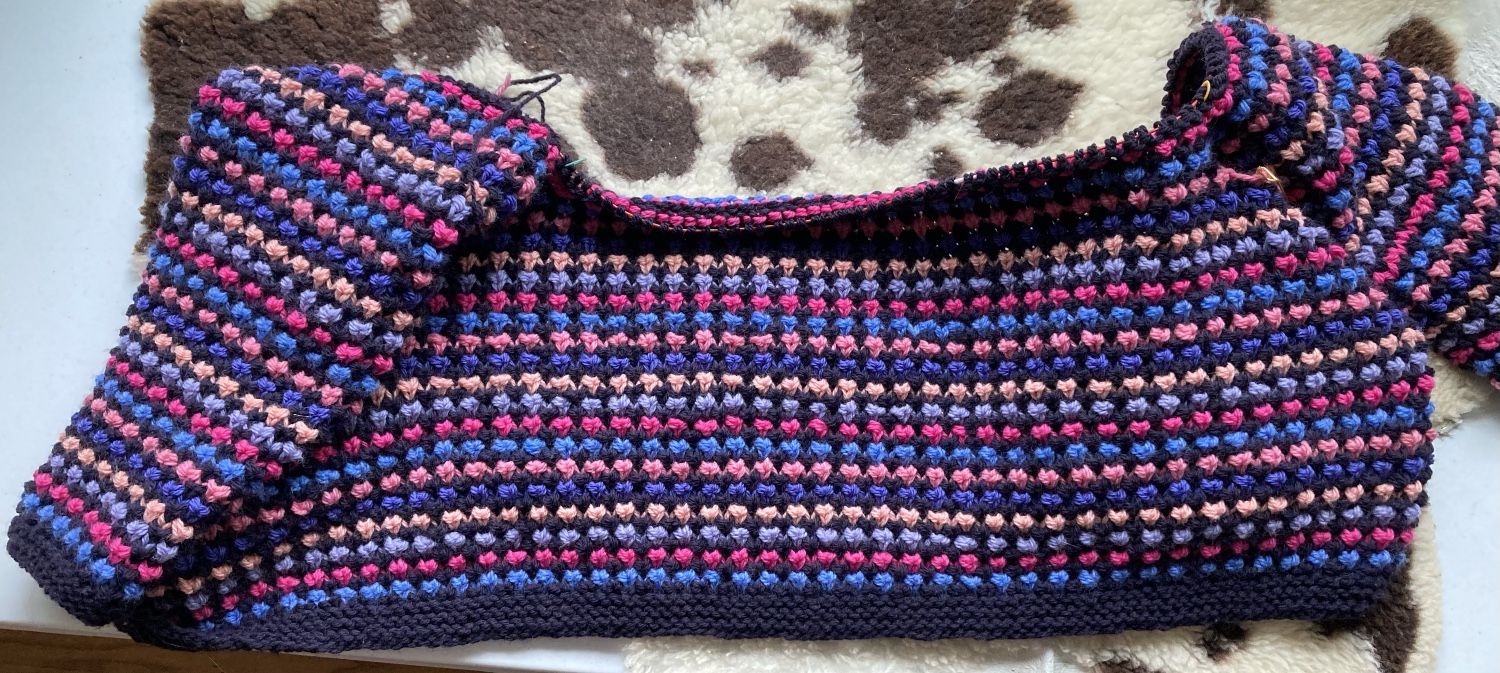
I’m knitting a very heavy cardigan-jacket which is a lot of fun. The pattern is Sweetie Jar from Knitty magazine. I’m using two strands of aran weight yarn held together.
Yesterday I joined the sleeves to the body which always looks a bit weird at first.
13 December 25
Sign of Error
 A month ago (back when we had sun) I was walking by the old church associated with the Newman Center near the university and noticed a paperback book stuffed into the empty bulletin board box in front. The book was Montaillou: The Promised Land of Error, by Emmanuel Le Roy Ladurie.
I have not read this book, though I’d like to. It is a classic work of French history about the lives of the inhabitants of a small village in the Pyrenees at the beginning of the 14th century in the wake of the suppression of the Cathars. The history is based on a set of records set down by the Inquisition (the Fournier Register) between 1318 and 1325. Historiographically the book was a famous study from the Annales school of historians and was an important example of writing microhistory. I do not know if the person who placed the copy in the display case was making a commentary on the inquisitorial legacy of the Church.
12 December 25
A Visit to the Dermatologist
 I crossed the Causeway today for the first time in a while. I had a 10:15 appointment. They wanted me to get there at 10. I left super early because there are road works on I-80 and, well, there’s fog. I did end up missing the turn to get onto 50 and had to turn around, but I was still very early. They were thrilled, because they were very busy but I was giving them a chance to catch up.
Clean bill of skin health. I took myself off on an Artist Date to Rumpelstiltskin, a yarn store on the way home, by way of celebration.
11 December 25
Unyielding Fog
 There has been unremitting fog over Davis and the rest of the Central Valley for about 18 days or so, ever since the 22nd of November. We had one half-day of sunshine on the 3rd of December but aside from that the temperature has stayed in the mid-40s Fahrenheit this entire period. It’s dreary and doesn’t make me inclined to sketch outside. Here is an account of this tule fog from NASA, complete with an satellite image animation. This is an unusual pattern and with climate change there have been fewer and fewer persistent tule fogs in the fall and winter in the Central Valley.
The natural color image at right is from the GOES-West satellite taken at 3:11 PM PST today (11 December).
10 December 25
Cold Remedies
 Both Numenius and I have colds. A friend who has spent some time in Peru recommends a concoction that is basically an onion, stem ginger, stem turmeric, and an orange and/or lemon. Add honey if there is a sore throat component.
Speaking with my Iranian tutee on Monday, I discovered there is almost the identical recipe given as a cold remedy in Iran.