
29 December 25
Four Palms And A Gym
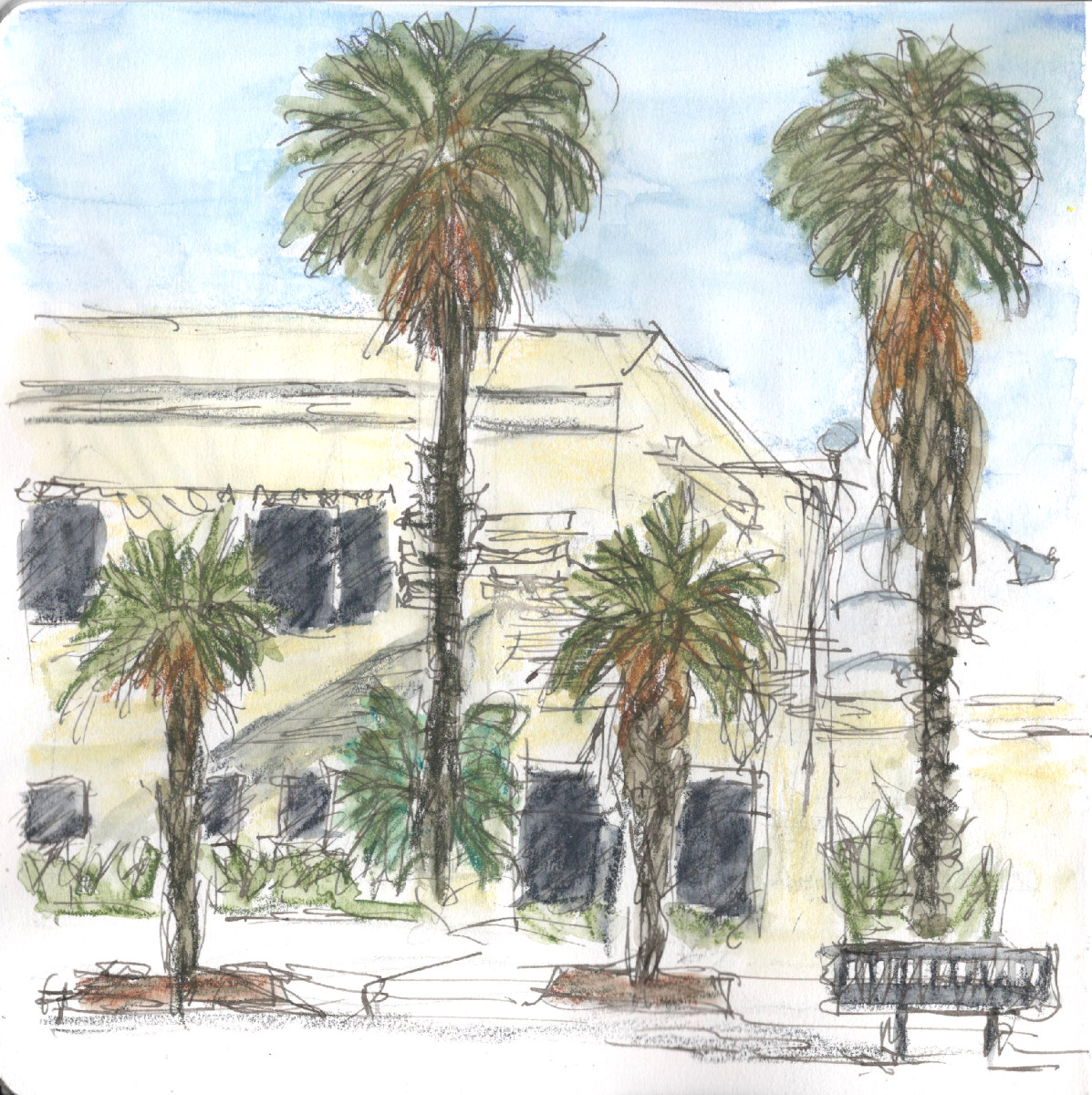 We’ve had the miracle of full days of sunshine yesterday and today, although it has been chilly: Pica was even able to wash and block her new jacket today. For my urban sketch yesterday I walked over to the bus circle near the student union on campus and sketched Hickey Gym and the palm trees in front of it. As is now my habit in winter, I colored the sketch once I got back home, testing out one of my newly added Neocolor II crayons, Sahara yellow, on the face of the gym.
28 December 25
The Artist's Way: Week 12
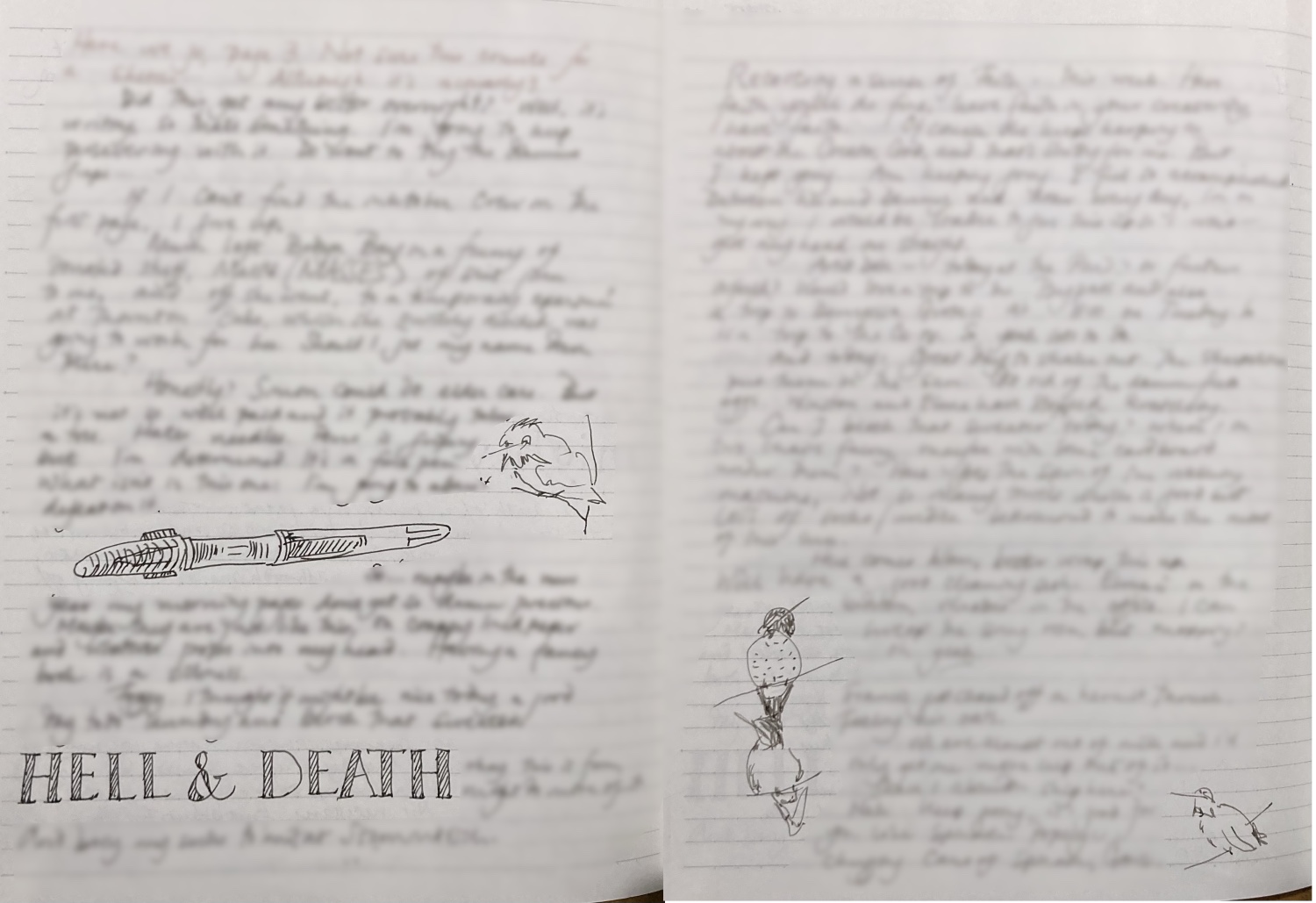 Much to my surprise I’m nearing the end of this twelve-week journey. (I thought it was 13 weeks, so that was like a bonus.) Here are my thoughts:
a) I am much less pissy about writing morning pages when I sketch in them too. Since hummingbirds are almost as present as cats during daylight hours, they get a lot of real estate in these pages.
b) I don’t care that she says these should be three pages of writing only. It takes me the best part of an hour to get through three pages of longhand drivel; at least I can make it more fun by drawing too.
c) Despite myself, I ALWAYS feel better if I’ve written my morning pages.
d) Artist’s dates are fun and I plan to continue having them.
e) I think I will be turning more to the Danny Gregory visual journal idea than morning pages per se, but without making them too precious.
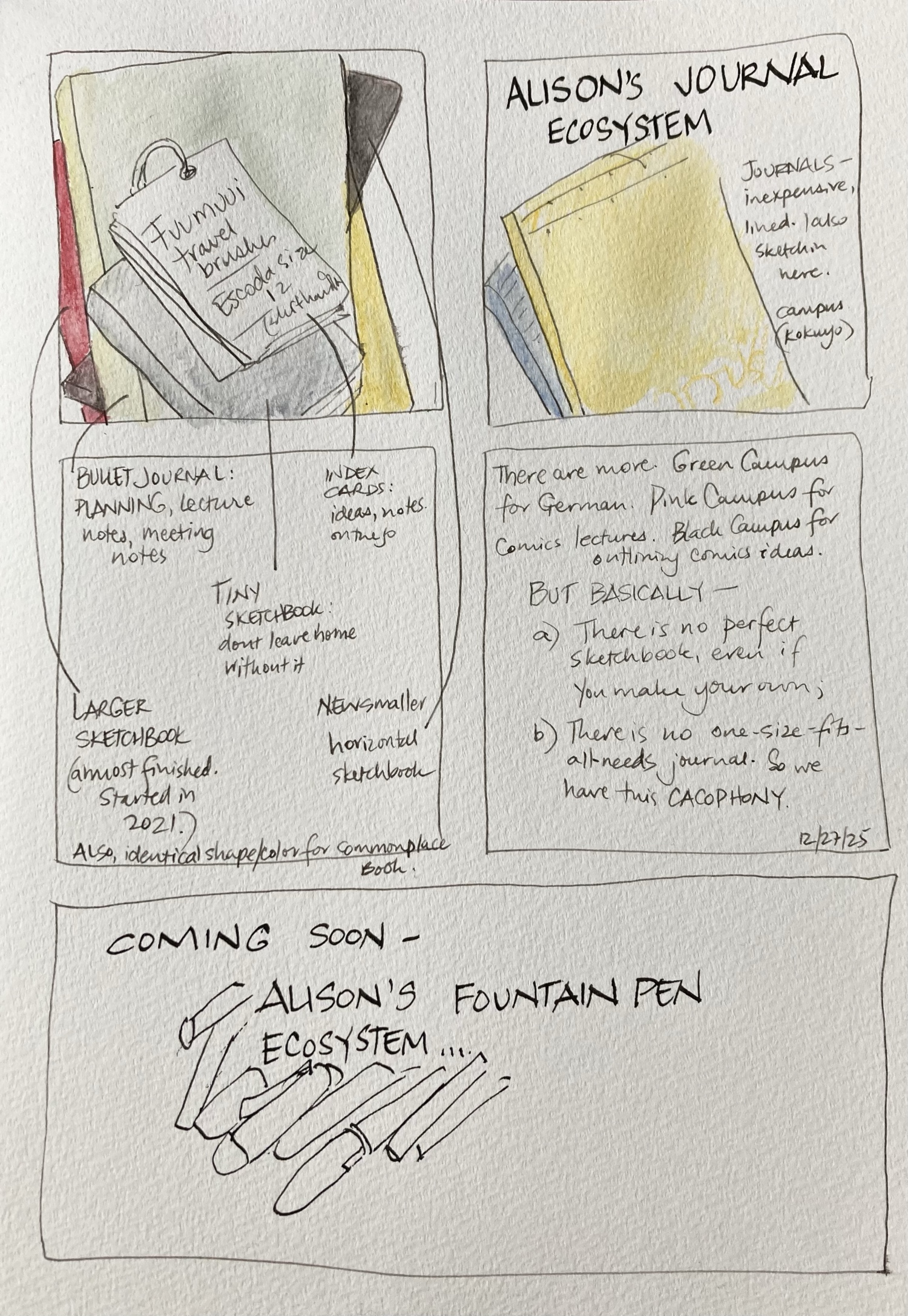
I made a drawing yesterday about my journal ecosystem… missing even from the list of missing items are my knitting journal and my nature journal. I ought to redo this drawing to include them all.
27 December 25
Sketching In The Fog
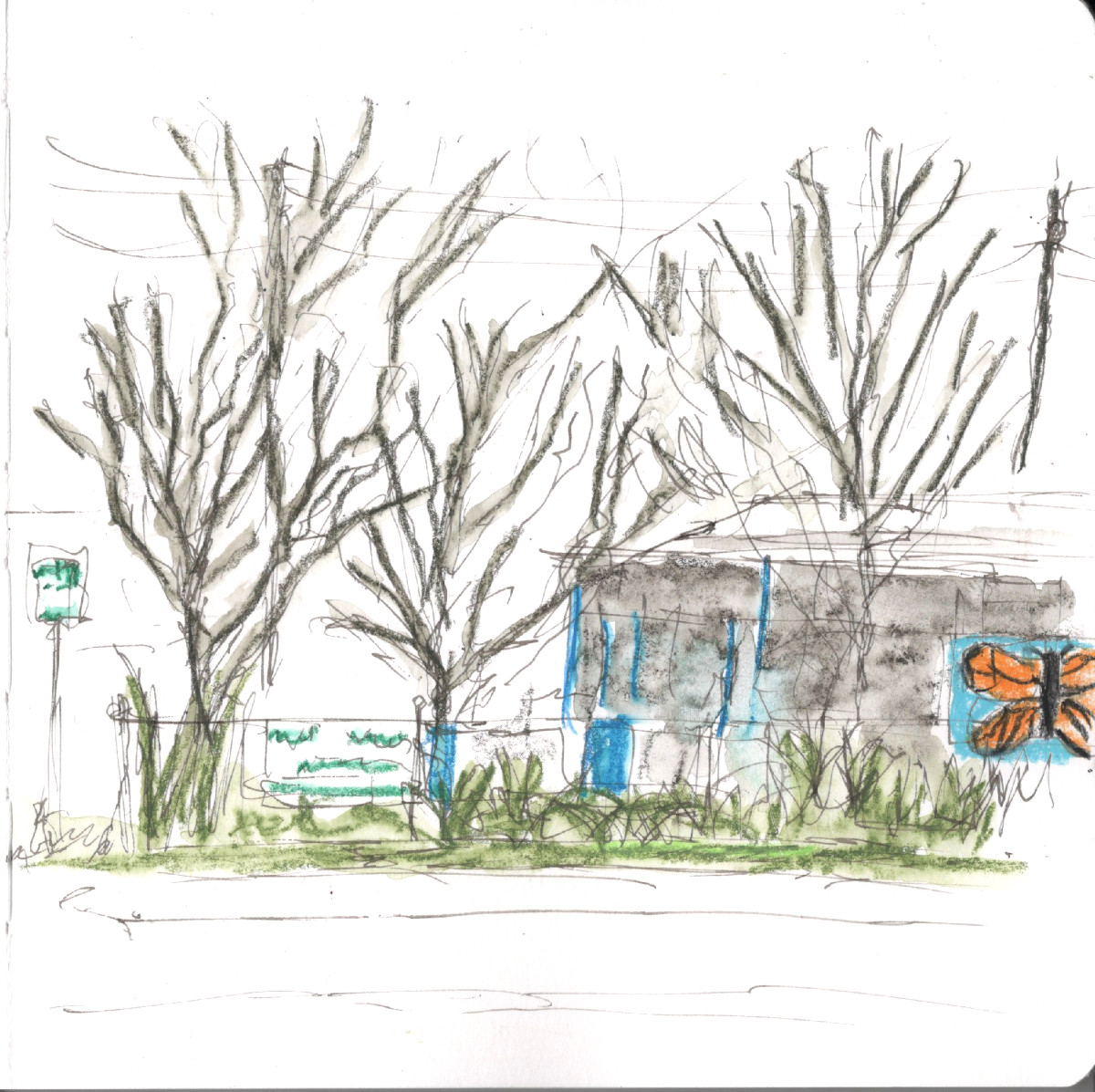 It’s been a stormy week in California, with floods in the Mojave region of Los Angeles County, 10 inches of rain in the mountains of Ventura County, and wind gusts of over 114 MPH doing major damage to the Lick Observatory on Mt. Hamilton in Santa Clara County, the worst damage in its 140-year history. The weather was comparatively mild here in Davis, but we did get 2.26 inches of rain over the week.
It cleared last night here and got chilly, which set up conditions for a tule fog in the morning. I went sketching around 10 AM, coping with the chill by only drawing with ink outside and waiting until I returned home to color the sketch. This is the Davis School For Independent Study on B Street.
26 December 25
Barbara Walker: In Memoriam
Having been deeply involved in the knitting renaissance since about 2008, I have come to know about the Knitterati who were there all along, through the bad ol’ acrylic 70s, still knitting with wool, still curiously curating the craft that their grandmothers had known, knitting socks in WWI. Elizabeth Zimmermann was one of these. Barbara Walker was another. I have three of her books, stitch dictionaries that involved massive amounts of research in the pre-internet days. But she was much, much more than this. Her son has made a modest website outlining her various far-flung achievements, some of which were not known to me (for example, her humanism; I did know a bit about her feminism and tarot work, though not so much.)
He has also written a diary of her last few weeks and days. Having been through something like this recently myself, my heart aches for him, especially since his mother was in considerable pain from her cancer and was on painkillers sufficient to dull it but that also made communication difficult.
Sleep soundly, dear Barbara. You were so generous with your knowledge, your mind, your self. May your cable always twist in the direction you want, may your mosaics be rich and always a surprise, and may your ssk’s lie flat and even. We’ll miss you.
25 December 25
Leyendo Con El Gato
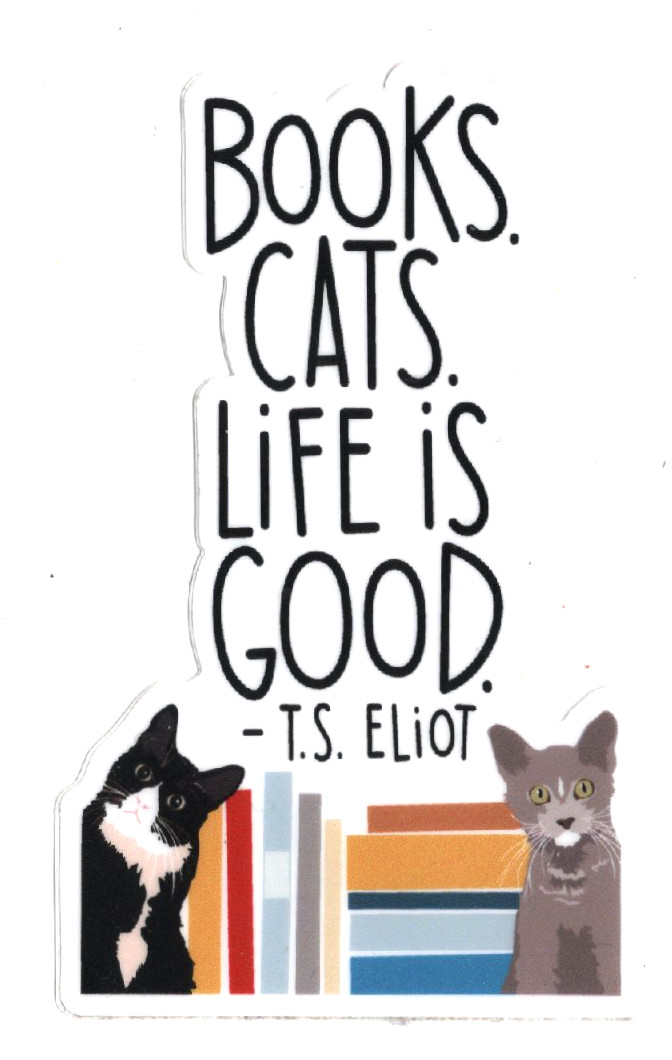 A friend of ours included the sticker at right in a small Christmas gift bag she delivered today. This was fitting considering my afternoon.
Our Christmas and Thanksgiving tradition is to feast on Indian takeout for an early afternoon lunch. After the lunch (I had a chana saag thali plate) I go off to the bed to read more of Yuval Noah Harari’s book Sapiens in Spanish. After a little while Winston, one of our cats, shows up, investigates, and settles in to doze on my chest. This is very nice — reading while snuggling with a purring sleepy cat. Winston is not as snuggly as our other cat Esme, who often comes back to sleep on me after her breakfast at 5 AM, and it is special to have a nap with him.
24 December 25
A Jacket, Almost Finished
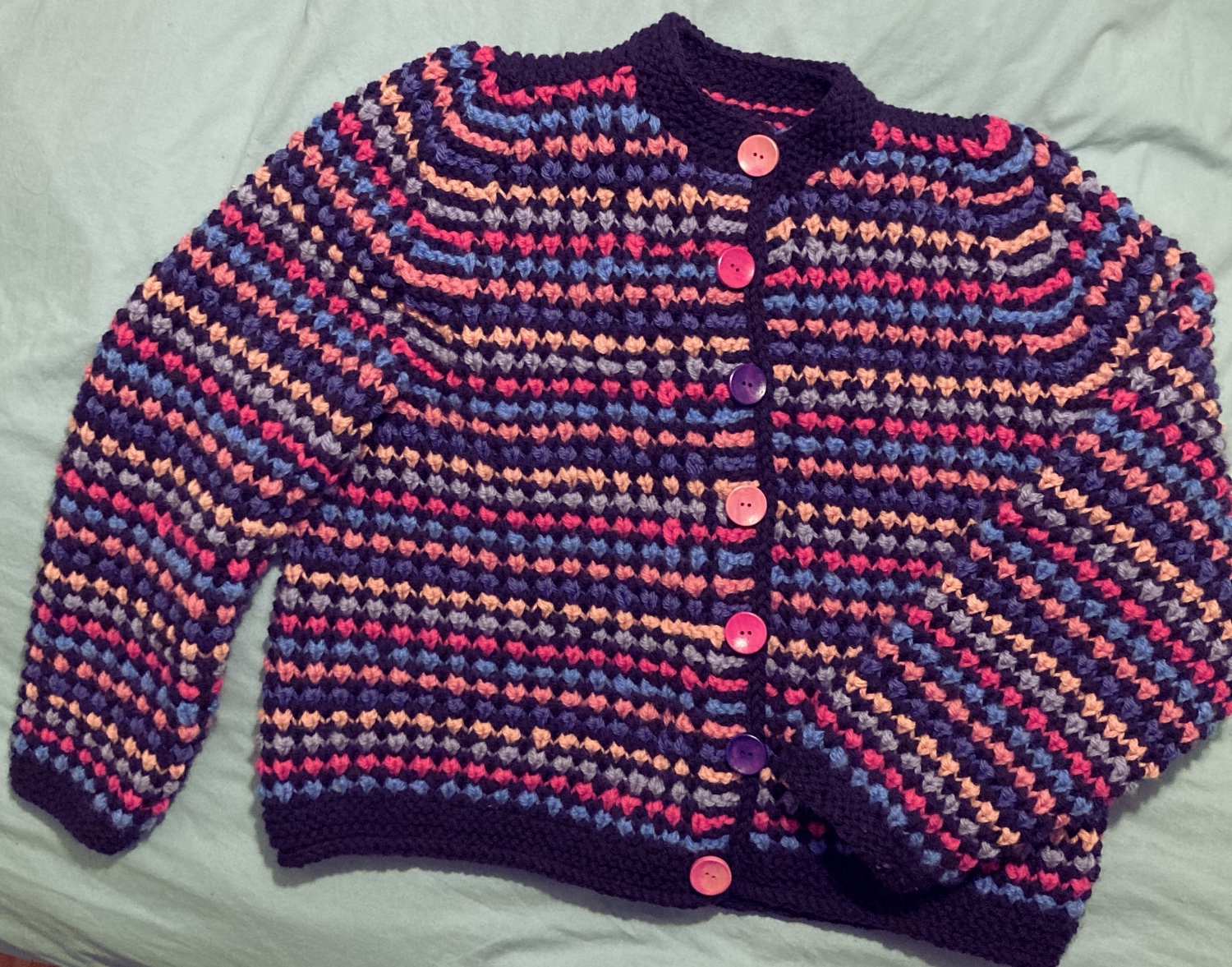 I finished knitting this jacket today. I want to line it, one of the armhole seams needs grafting, and the pattern is calling for an i-cord edging on the sleeves, which I’m very close to ignoring. But I probably won’t ignore it, because this is a magnificently written pattern and I want to give the designer, Kate Harvie, as much credit as I possibly can. The garter stitch saddle shoulders are brilliant.
The problem is this: two strands of aran weight yarn held double make for an especially dense fabric, and with this atmospheric river we’re in, it has basically zero chance of drying for four or five days. I want to block it before I line it and before I sew the buttons on, but jeez.
Was hoping to wear this on Saturday, but it might be a while.
I remember stressful Christmas knitting in the dim and distant past and am glad I don’t have any deadline more pressing than wanting to wear this on Saturday…
23 December 25
Mentalité and the Annenberg Bridge
Under construction right now in Ventura County, California is the Wallis Annenberg Wildlife Crossing. Once this is completed (expected Fall of 2026) this will be the largest wildlife crossing in the world, 200 feet long, 165 feet wide, and fully vegetated. It crosses the 10 lane freeway Highway 101 near Agoura Hills. Its function will be to connect the Santa Monica Mountains with open space to the north of the freeway, especially to provide passage for mountain lions, but also to benefit bobcats, coyotes, badgers, bears, and other animals. The project is costing about $90 million, with about 60% of the funding coming from private donors.
I am thrilled that this project is taking place, and hope it inspires the construction of other large-scale wildlife crossings in California and beyond. But I am struck by how such a project would not even be dreamed of fifty or so years ago, let alone funded at such a level. In other words, there has been a shift in mentalité over the past decades such that the movements of large animals across urbanized wildlands have entered public consciousness.
What is mentalité? Here’s a scholarly definition, from Daniel Little.
A mentalité is thought to be a shared way of looking at the world and reacting to happenings and actions by others, distinctive from other groups and reasonably similar across a specific group.1
This is a concept from French historiography, and it seems like an important way to understand the world. But what is a methodology for recognizing change in mentalités over time? That is a great challenge.
A long time ago I picked up a compilation of poetry, News of the Universe, edited by Robert Bly. The poetry in this book has been selected to illustrate a shift since the 18th century towards the awareness of consciousness in nature. Following this example, perhaps looking for changes in artistic expression is a methodological way forward.
1 Little, Daniel. New Contributions to the Philosophy of History. 1st ed. Vol. 6. Methodos Series. Springer Netherlands, 2010. https://doi.org/10.1007/978-90-481-9410-0. Page 196.
22 December 25
Geese
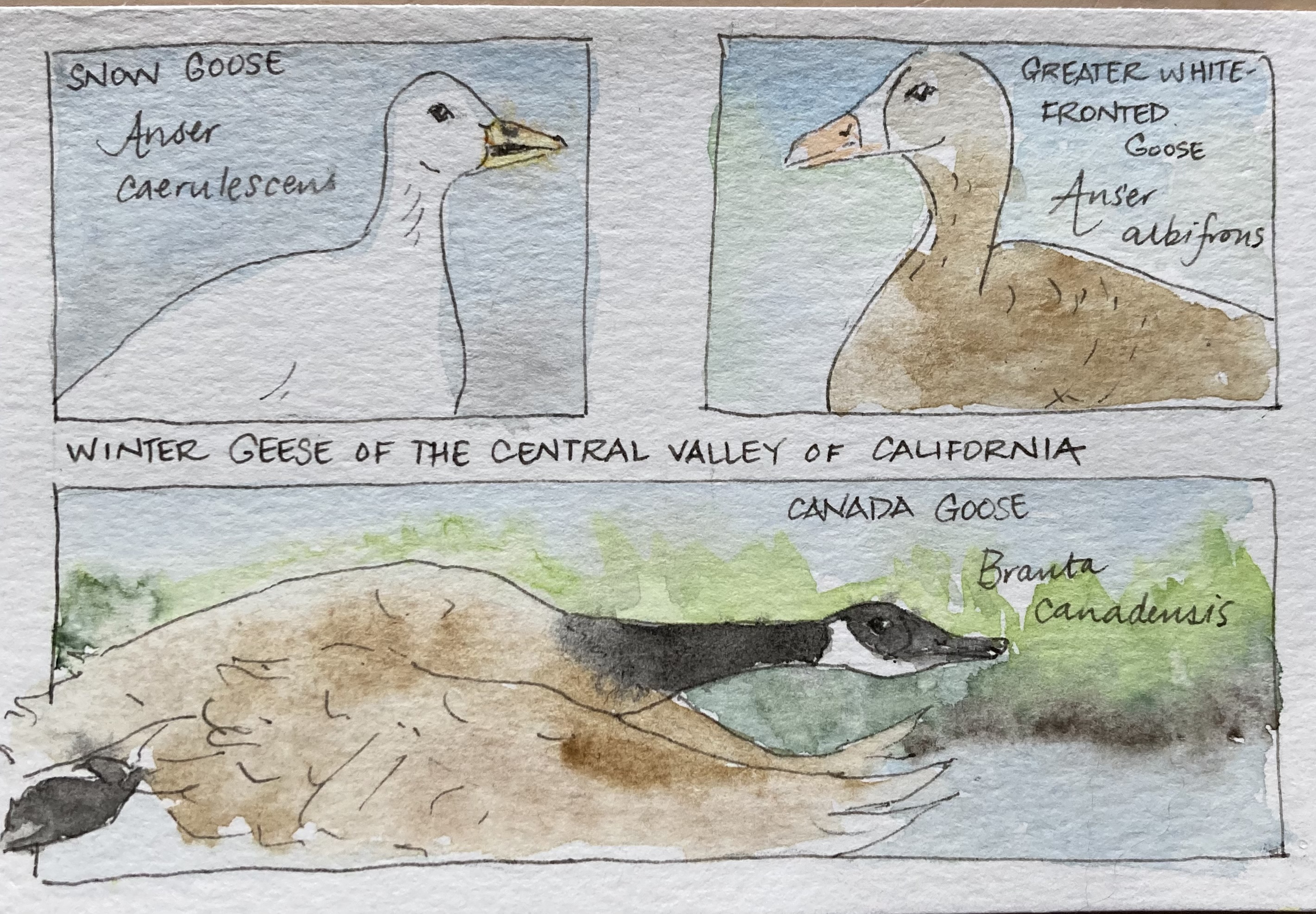 A postcrosser I was assigned to today likes geese and handmade cards, so this was an easy one for me today.
As a user of the mail services of many countries, not just my own, I’m saddened to learn that Denmark is abolishing its postal service at the end of this year.
21 December 25
From Space Into Time
As I’ve mentioned in my posts on Zettelkasten, I have begun an open-ended research adventure. Two months into this journey, I have figured out that I want to do history — a shift for me from being a spatial data analyst of present-day conditions to tracing threads in the past. In some ways this is coming full circle for me, since my route into the field of geography involved a deep dive into the concept of landscape and landscape history.
What sort of history and where? The where is most likely California, since I grew up here and live here and travel to archives is easier (I today learned about an online collation of some 60,000 collection guides to more than 350 archives in the state). As for what, some combination of historical geography and environmental history and cultural history, perhaps with an eye looking out towards the Pacific and histories of that ocean. It will be many, many months before I converge on a topic, especially since I have to bootstrap learning how to do history as I go along.
Here’s a thread I learned about this evening while watching one of my doubly-subtitled Catalan videos. I knew that the first governor of Alta California, Gaspar de Portolà, was from Catalunya. (My junior high school was named after Portolà.) This video was a short presentation on Occitan influence in the New World. It turns out Portolà’s family was from Arties in the Vall d’Aran, which is this little Occitan enclave up in the Pyrenees of Catalunya. There’s a restaurant named after the family there.
20 December 25
Illustrating a Journal
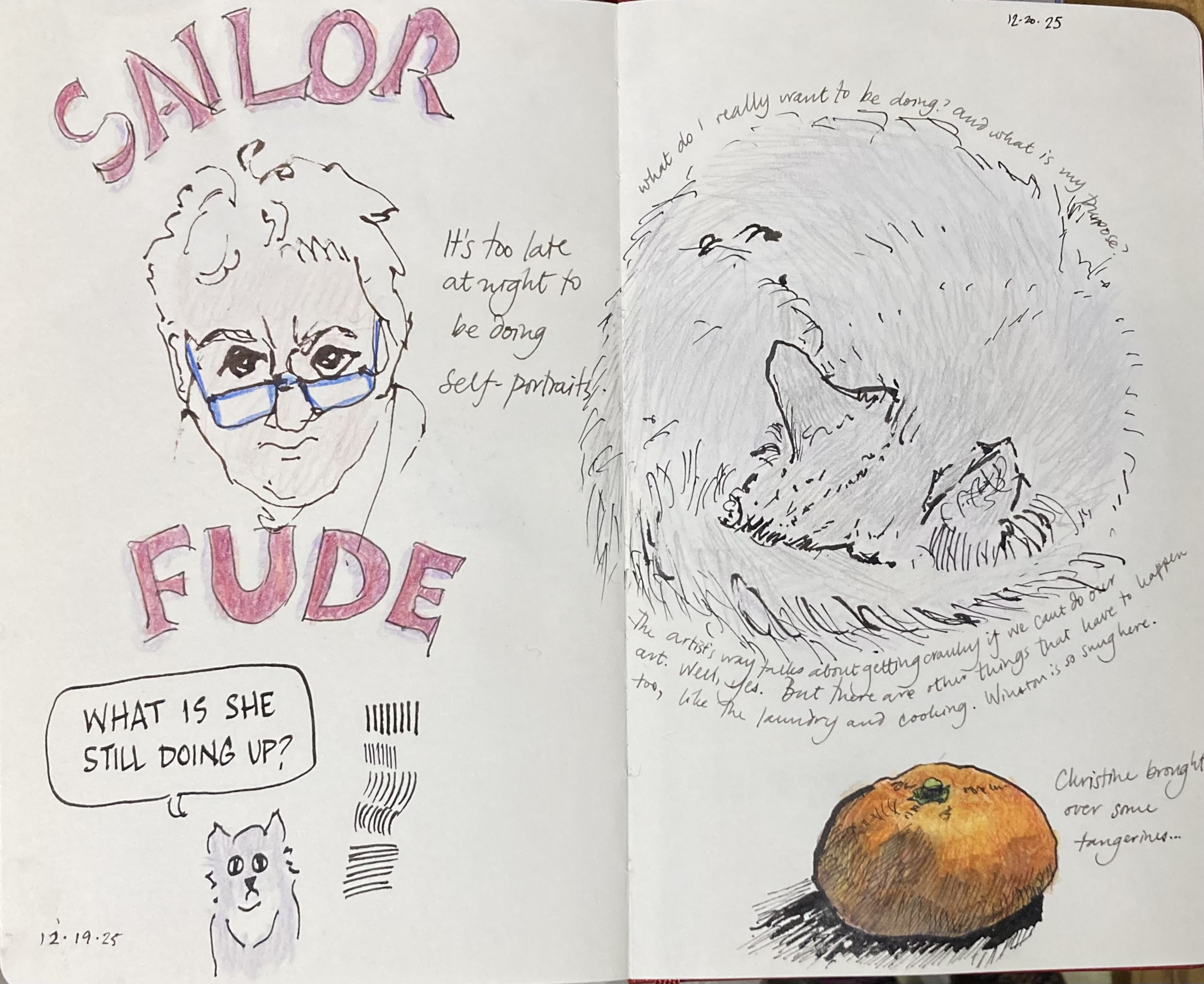 I’m playing with what I might do in the new year once I’ve finished with my Artist’s Way session, and this might work. I’m doing more and more drawings in my morning pages — cheating, I know — and here I’m landing, I think. A thick paper that will take a light wash, will stay open flat.
There will be a lot of cats in this journal, I’m guessing.