
10 December 25
Cold Remedies
 Both Numenius and I have colds. A friend who has spent some time in Peru recommends a concoction that is basically an onion, stem ginger, stem turmeric, and an orange and/or lemon. Add honey if there is a sore throat component.
Speaking with my Iranian tutee on Monday, I discovered there is almost the identical recipe given as a cold remedy in Iran.
9 December 25
Grocery List Talmud
Before setting out on our weekly grocery shop early this morning, I looked at the back of the grocery list. It turned out this was where Pica had written down the quotation from Pirke Avot that she used a couple weeks ago in her comic art post The Work.
The quote reads “You are not obligated to complete the work, but neither are you free to desist from it.” This seems equally applicable to grocery shopping as it does to charting out one’s life path. There is always one more item.
8 December 25
Drawing While Journaling
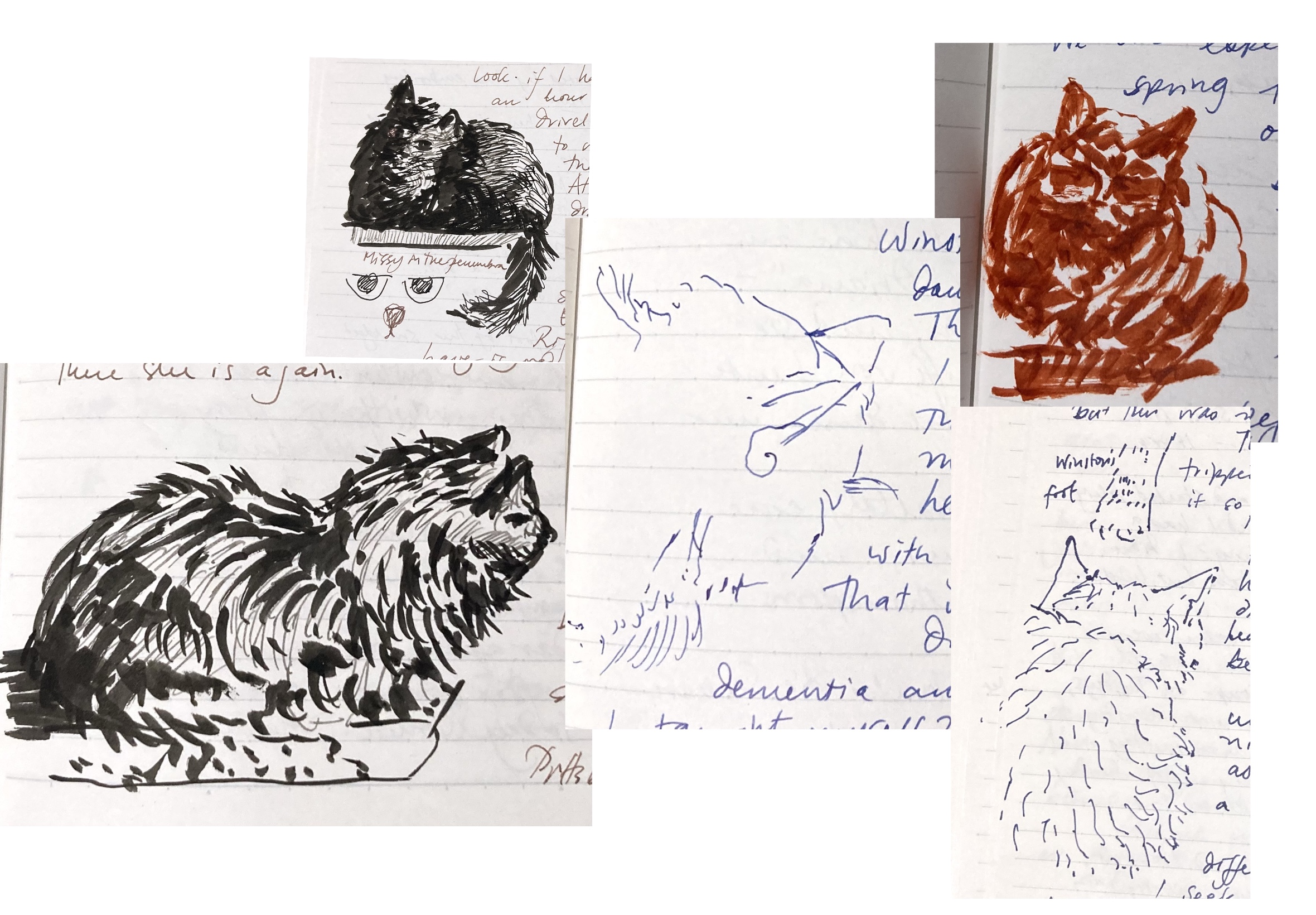 I’ve been doing my morning pages, but I keep getting interrupted by cats. So I draw them.
7 December 25
The Memory Keeper
I’m continuing down my genealogical rabbithole and while reading up on WikiTree I came across a reference to an obscure but quite intriguing piece of software called The Memory Keeper. This is genealogical and historical research that is built on something called TiddlyWiki.
TiddlyWiki is personal wiki software that extremely cleverly functions entirely inside of a single HTML page. The individual wiki pages are units called “tiddlers” and the code in the HTML page sets up forms to edit and save the tiddlers. I have been using TiddlyWiki since 2017 to keep a research log for work. There is a substantial community around TiddlyWiki who have built many extensions and plugins for the system.
Memory Keeper consists of a set of these plugins and templates that have been organized around genealogical and historical research. It is not meant as a replacement for traditional genealogy software but rather to help in the research process. The trouble with most genealogy software is that the software typically is good at organizing the results of the research (individuals, their relationships in families, events, places, and sources and citations) but the software isn’t really a place to record one’s working notes. Nowadays there are many software systems for taking non-linear notes (in addition to TiddlyWiki, systems like Zettlr, Obsidian, and Scrivener come to mind). What Memory Keeper does is marry the two types of software, providing fields for genealogical data while allowing for non-linear wiki entry linking.
I’ve been testing Memory Keeper out these past couple of days and I think it will be very useful. I’m using Hosea Curtice as my test case. Here is an illustration. There is a note in the published genealogy for the Curtice family that he served in the French and Indian Wars and that lists the captain commanding his company. I easily look up what company this was, but this leads into researching the campaigns of this company and its regiment. Traditional genealogy software will not have fields to store that information, but this is ideal for a wiki-based system.
My previous work with TiddlyWiki was not very sophisticated, but I see lots of potential for Memory Keeper, particularly around keeping track of geographies in personal historical research.
6 December 25
Anna's, Again
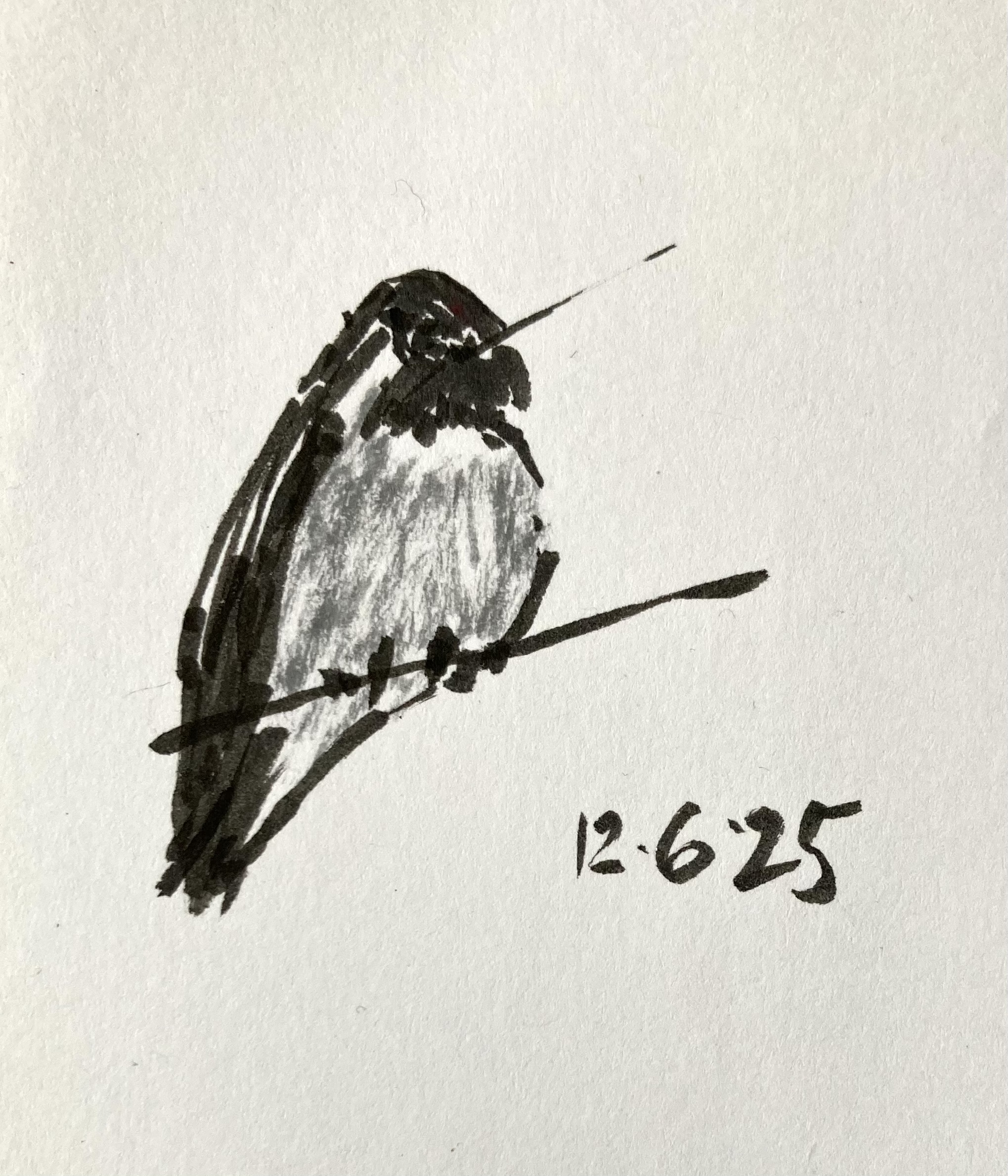 I got the page proofs back this week from my submission to an anthology entitled “Field Notes.” They are six pages featuring Anna’s hummingbirds, similar to my Birdtober series from last year.
Happy to have been able to get this done in and around the time of my mother’s illness and passing. I miss her every day.
5 December 25
Sapiens En Español
I’ve been reading Yuval Noah Harari’s bestselling book Sapiens in Spanish translation for language practice. This was inspired by Andres, one of the guides on Dreaming Spanish, doing videos on the book chapter-by-chapter. He is up through chapter 7 now as am I. Sapiens was originally published in Hebrew so if I were to read it in English it would still be in translation.
This is the largest book I’ve tried reading in Spanish to date. So far it’s going well — I don’t understand every word and don’t try to look them all up but I’m certainly getting the gist of his arguments. So far it is a very good popularization of an extremely wide sweep of human history but I don’t think it’s nearly as groundbreaking as a couple of books I’ve read in recent years with a similar theme: David Graeber and David Wengrow’s The Dawn of Everything, and James C. Scott’s Against The Grain.
Most of the books I read are history books so it makes sense for me to look for some in Spanish to read too. I’m thinking Eduardo Galeano might be next?
4 December 25
A Package from France
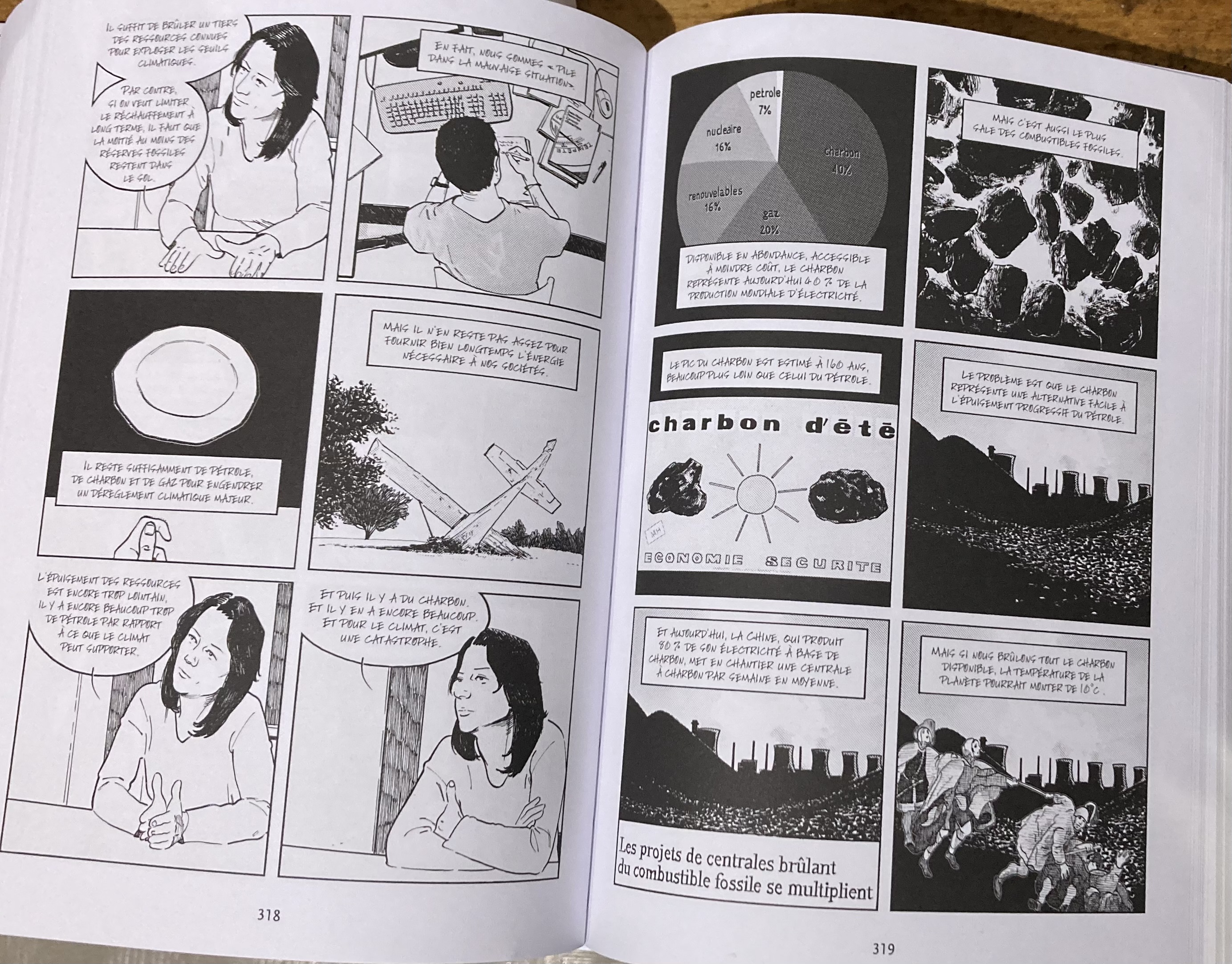 I met a friend for coffee this morning at Mishka’s (I don’t consider myself an expert in coffee but this European-style coffee shop seems to serve the best cappuccino in Davis). When I got home a book had arrived from Paris, a comic about climate change which has been assigned in my Comix Activism class. (The assigned book is actually an English translation but a quick bit of research revealed that the author was French, had interviewed multiple climate change scientists for the book who were also all French, so I decided to get a copy. In French.)
This is the kind of comic I’d like to write, though I shudder at the long, long hours it must have taken him, years even. Although I find the type treatment a bit fussy for a language with so many diacritics and (still) dislike zipatone screens, the art is gorgeous. So far, it’s very readable and engaging. (Love the opening sentence of Flaubert’s Salammbô being quoted on page 2.)
3 December 25
Genealogical Rabbitholes
I really ought to enter a lot more of my genealogy into WikiTree. I have entered four people in there, including myself. No matter — I can find ancestors of mine who are already entered into WikiTree, and learn from there.
Here is the WikiTree entry for Hosea Curtice (b. 1739), about whom I wrote a couple days ago. (I come from a long line of Hosea Curtices, so I have to specify the birth date). He was married to Susannah Kellogg, whose genealogy leads in interesting directions. 1) She is part of the Kellogg family, which in another century brings us to Kellogg’s Corn Flakes and in this past century to the Kellogg Foundation. 2) You can trace a connection from Susannah Kellogg to Emily Dickinson. I am quite proud to have Emily Dickinson as my cousin, as the title of our blog would imply. 3) Susannah’s great-grandfather Samuel Kellogg (b. 1669) was kidnapped by Indians in 1677 and hauled off to Canada, eventually to be ransomed out of captivity. His mother Sarah Day was killed in the raid where Samuel was captured. Sarah Day is also the common ancestor I share with Emily Dickinson, through an earlier marriage of Sarah’s.
This raid happened in the aftermath of King Philip’s War, and there is an account of it on the website for the wonderful book Our Beloved Kin: Remapping A New History of King Philip’s War, by Lisa Brooks. I need to reread her book: it’s an illuminating journey into 17th century Indigenous geographies.
2 December 25
Unflattening
 Numenius drew my attention last week to a book by Nick Sousanis entitled Unflattening. This was originally his doctoral dissertation (!) but written entirely as a comic, looking to explore new ways of seeing. When you only are given one path — one perspective — you are blind to the myriad other possibilities, other ways, other directions, other modes of thinking.
The book is very dense and I just picked it up this morning from our local indie bookstore, so I haven’t finished it yet, but this is one I’ll be returning to again and again. Douglas Wolk calls it a “genuine oddity, a philosophical treatise in comics form.” Imagine my delight when I learned that it was published by my former employer, Harvard University Press… the notes at the back are worth the price of admission on their own, illustrated as they are with thumbnails and drafts of his pages.
1 December 25
In The Wake of Ethnic Cleansing
The most haunting bit for me of The American Revolution documentary came in Episode 5, covering 1778 through 1780. In 1779 Washington sent a third of his army into western New York with the aim of destroying Iroquois settlements there. To quote from Washington’s orders to Major General John Sullivan (this was known as the Sullivan Expedition or the Sullivan Campaign): “The immediate objects are the total destruction and devastation of their settlements and the capture of as many prisoners of every age and sex as possible. It will be essential to ruin their crops now in the ground and prevent their planting more.” They destroyed 40 villages and drove 5,000 Iroquois west towards Fort Niagara controlled by the British.
I had known about the Sullivan Campaign previously but watching the episode I realized with angst that the aftermath of the campaign probably intersected with my family history. I looked up the details and my hunch was right. One line of my family goes back to 17th century New England; these ancestors migrated westward until around the 1820s they ended up in Lorain County, Ohio where they settled for a century-and-a-half. One of these westward hops was to the town of Locke, in Cayuga County, New York. Locke was founded in 1790, and in 1803 or thereabouts my ancestor Hosea Curtice (born 1739) moved to that town. Locke is a few kilometers east of Cayuga Lake; in September 1779 Sullivan’s soldiers destroyed the Cayuga villages on the east side of the lake. Lands in the Finger Lakes region were designated as bounty lands for New York’s soldiers in 1781, and the Locke township was named by 1790.