
5 March 26
Delusions From Middle-Earth
Today I submitted a public comment to the Federal Communications Commission on the proposal from SpaceX to launch up to a million satellites for orbital data centers, which I blogged about last Friday. I am now working on the public comment for the Reflect Orbital proposal to put giant mirrors into space to light up the night particularly for use by solar farms. I retrieved the Reflect Orbital proposal documents from the FCC portal and was disenchanted to find that the name of their initial test satellite with an 18-meter mirror is EARENDIL-1.
This is a name that comes from Tolkien: Eärendil was a half-elf in The Silmarillion who bore on his brow a jewel — a Silmaril — that shone like a bright star. This leads to the question: why are so many tech bros obsessed with Tolkien?
A lot of people have commented on this trait lately. A writer named Samuel Arbesman compiled a list of all the tech companies he could find that have names from Tolkien (there are 22). In an essay entitled Mythic Capital, Lee Konstantinou discusses how Tolkien teaches a lot about capital and politics and the technoutopian vision of breaking free of all limits. In the New York Times Michiko Kakutani writes about how the traditionalism running through Tolkien appeals to the tech bros and that they are drawn to the themes of kingly and magical power rather than the gentle settled life of the hobbits.
It is interesting that when Tolkien first got popular in the late 1960s and early 1970s it was pulling in people mostly from the hippie counterculture. Times have changed.
But Pratchett doesn’t seem to appeal to the tech bros — I don’t see too many companies celebrating the cabbages of the Sto Plains for some reason.
4 March 26
German Modal Particles
I tortured my Advanced German Conversation class last night with an hour of modal particles, which are a peculiarity common to only a few languages (Russian, Japanese and Hungarian also use them) and which help convey attitude or intention. They are only used in spoken language, their omission doesn’t change the sense of a sentence, and they are very difficult to translate, being context-dependent. English tends to convey these intentions either with intonations or question tags. The particles also have a separate meaning outside their modal sense, as in “ja”:
The German particle ja is used to indicate that a sentence contains information that is obvious or already known to both the speaker and the hearer. The sentence Der neue Teppich ist rot means “The new carpet is red”. Der neue Teppich ist ja rot may thus mean “As we are both aware, the new carpet is red”, which would typically be followed by some conclusion from this fact. However, if the speaker says the same thing upon first seeing the new carpet, the meaning is “I’m seeing that the carpet is obviously red”, which would typically express surprise. In speech the latter meaning can be inferred from a strong emphasis on rot and higher-pitched voice. (Wikipedia article)
I have a friend who did her master’s thesis in Germany on the avoidance by foreigners of modal particles entirely. There’s a good reason to avoid them: without a full understanding of their idiomatic use, you can get them quite wrong!
3 March 26
Eclipse At 3:10 AM
I was aware enough there was a lunar eclipse happening early this morning that I checked the time, got out of bed, threw on some clothes and stumbled into the backyard to look at the moon. It was well to the west and pretty red, though the bottom of it had a bright edge. This made me wonder if it was actually at totality or maybe I had gotten the time wrong and missed it already. I didn’t review the timing of it the night before. Pica woke up and had a brief look outside at the moon too.
I did have the time right, and stayed outside another 15 minutes, enjoying the now-darkened sky and the red moon. Back to bed then only to get up at 6:30 for the early morning Tuesday grocery shopping. I dozed later in the morning with Winston the cat by my side. It was a good morning.
2 March 26
Listening to Language
I’ve been coordinating the Advanced German Conversation group for International House Davis since the death of our beloved instructor Paul a couple of years ago. This takes place every week on Zoom, though we also meet in person once per month, at least those of us who are local.
Last week I showed this Easy German video. It’s a podcast with an American guest (from Mississippi) whose German accent is so good that she is often mistaken for a German. She has studied German for a long time and now lives in Germany, which obviously helps, but she had to focus hard on improving what she assumed was an adequate accent and her efforts have definitely been worth it.
She did have some good tips about how to improve your accent in a foreign language. (It’s not necessarily fair, but native speakers will think your language skills are much higher than they actually are if you speak with a good accent rather than a bad one, even when your grammar is faultless.) Apart from learning what your tongue ought to be doing in your mouth and practicing sounds in front of a mirror, she recommended listening to a LOT of content in the target language. (I think this is a good practice for lots of other reasons, especially for the purpose of normalizing constructions that are awkward in our own language; German verb placement and cases with specific prepositions are two obvious examples.)
I’ve been trying to watch videos on subjects that interest me like spinning and birds following this advice. Today the algorithm served up an interview with a woman in her 90s on her experiences living (and moving around in) Germany during WWII. War inflicts trauma on everyone who lives through it with the possible exception of those who cause it…
1 March 26
Caterpillar In The Park
 For today’s urban sketch I drew this much-loved sculpture of a caterpillar in Central Park in Davis.
28 February 26
Introduction to Anbur
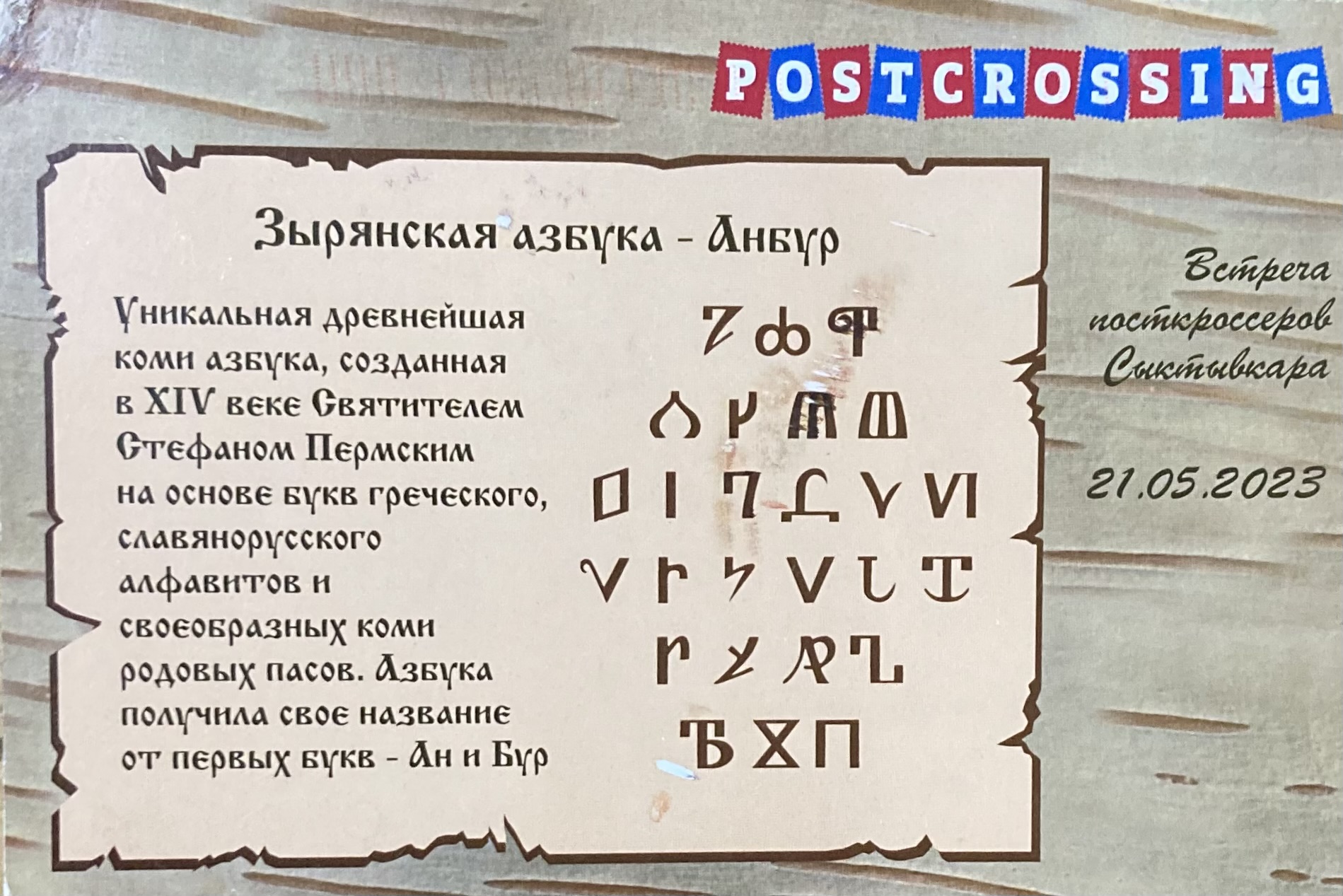 I got a postcrossing card today from Russia. The sender includes this information on the back:
On the postcard you can see the ancient alphabet of the Komi people. It’s called Anbur. This alphabet was created by St. Stephen of Perm more than 600 years ago. The first books that were written in these letters were the Psalter and the Gospel.
This beautiful script is written with the nib held on the horizontal, about 5 nib widths high.
27 February 26
The Destruction of the Night Sky
There are two proposals before the U.S. Federal Communications Commission right now that would do horrifying things to the night sky. Both are currently open to public comment through March 6 and 9, and I’m gearing up to submit a couple of comments. The FCC is the federal agency that regulates satellite launches in the United States, and they are now in the practice of rubber stamping an awful lot of these.
The first proposal is from a company called Reflect Solar that wants to put giant mirrors in space for the purpose of turning night into day for selected localities, in particular solar farms. They plan to start with an test satellite in 2026 with an 18 meter mirror, and then by 2030 have 4000 satellites in orbit at an altitude of 625 km. Eventually they imagine orbiting 250,000 satellites. The math for the amount of solar energy one can obtain this way absolutely does not work out, but even the 4000-satellite plan would be catastrophic for both professional and amateur astronomy. Visual astronomy would become an extremely risky activity, since accidentally glimpsing the reflected light in a telescope or binoculars could cause permanent eye damage.
Not to be outdone, everybody’s favorite archvillain Elon Musk is wanting to orbit up to 1,000,000 satellites for spaceborne AI data centers. There are presently 14,000 active satellites in space and low earth orbit is already getting crowded. One risk is Kessler syndrome — that is, collisions from space debris causing the generation of more debris in a chain reaction, rendering the entire orbital zone unusable. Another is impacts on atmospheric chemistry as tens of thousands of satellites burning up when they reenter may contribute to ozone depletion and climate change. Advocates of space data centers also tend to neglect the laws of physics. It is a lot harder to cool down a data center in space than on Earth, since due to the vacuum of space the only mechanism for heat transfer is radiation, not conduction or convection. (This is why vacuum thermoses keep their contents hot or cold.)
Both these proposals are now getting mainstream media coverage, such as in the New York Times and the Washington Post. The organization DarkSky International has a web page on how to comment on the proposals.
26 February 26
Wear your Melt the Ice Red Hats Today
 I have recounted my knitting several (by now six) red Melt the Ice Hats. Today commemorates the 1942 banning of red hats in occupied Norway by the Nazis. Seems apt.
My sister had a wretched time of it in the bank this morning. At least she was wearing her red hat!
25 February 26
Tecumseh and the Survival of Native Nations
I just went to a talk at the UC Davis Alumni Center entitled “Tecumseh and the Survival of Native Nations” given by the historian Kathleen DuVal. DuVal’s most recent book is entitled Native Nations: A Millennium in North America and won both the Pulitzer Prize for history and the Bancroft Prize in 2025, as well as a couple of other history prizes. She also got her history PhD at UC Davis in 2000, and her talk today was something of a homecoming — there was a contingent in the audience who knew her from her graduate school days here.
I have not yet read Native Nations, but it was clear from her talk that as a retelling of Native American history it emphasizes the individual identities of sovereign Native nations, a characteristic that continues to be important today. She illustrated this with a photograph from the Standing Rock protests in 2016 showing flags from all the tribes who had assembled together. Her talk today was about the visionary Shawnee leader Tecumseh who along with his brother the religious leader Tenskwatawa (often known as The Prophet) tried to build a unified Native confederacy to resist the incursions of white American settlers into the lands beyond the Appalachians at the beginning of the 19th century. Tecumseh was a great orator and many listened to him and the prophesies of his brother, but overall their call for unification did not win out over sovereignty. Tecumseh ends up dying fighting with the British against the Americans in 1813. Tenskwatawa moved across the Mississippi and dies in Kansas in 1836. But the Native nations persist, and by the late twentieth century Native Americans have three identities in varying degrees: that of their tribe or sovereign nation, that of being a U.S. citizen, and of being a Native American.
24 February 26
Taxes
 Everyone I’ve spoken to in the past few days is deep in the mire of sorting out their taxes. These are all people who have an external tax preparer, so the hours they are spending on this grim task are BEFORE a professional actually starts to work on them.
Makes me nostalgic for when I filed taxes in England: they sent me a statement, asked me to review it and let them know if I disagreed, and it was all done. Five minutes. The millions of dollars that are spent every year just so people can get their taxes filed — not counting the thousands, nay millions, of hours of thankless slog just to get them in — are a capitalist absurdity.
The drawings at right are of my siblings as we went through my mother’s tax records for the fourth? fifth? time today. Now to work on ours.