
15 March 26
Impressive In Every Telescope
 That is how Erich Karkoschka’s book Observer’s Sky Atlas describes the Orion Nebula, and I can verify this. I imaged it last night with my Seestar S50, and here it is after 13.5 minutes of imaging. The smaller reflection nebula in the upper part of the image is NGC 1975.
14 March 26
A Day at the Emergency Room
Last night I noticed some weird bright flashes in my peripheral vision (left eye). I knew enough to know that this is likely not a good thing and I called the duty nurse for instructions about what to do: got a bot. The other bot, the “nurse,” called me back four hours later at midnight and by this time I was in bed and groggy. I got up this morning and began a series of calls to find out, again, what I should do. I finally reached a real nurse who was very helpful and who urged me to go to the ER.
Which I did. I went to the UC Davis Medical Center in Sacramento by Lyft, not choosing to drive with an eye that may or may not be functioning well…
I received good, if slow, care. Whenever something bad happens it’s bound to be at the weekend or, worse, on a holiday. There were several people in there for eye-related issues. Given that my symptoms might have indicated a retinal detachment, which is definitely an emergency, they were perhaps a little cavalier about it.
In the event it was an age-related problem of the vitreous body pulling away from the retina, and the symptoms have subsided on their own. But I am to go back for a re-check.
Emergency rooms are a strange mixture of boredom and anxiety. I’m glad I had my knitting, my sketchbook, and my audiobook, all of which kept me occupied without too much of either feeling getting in the way.
I went home by way of the local yarn store and picked up a nice tape measure, which I really need and which didn’t break the bank. (I didn’t even look at the yarn, for extra brownie points.)
13 March 26
Backyard Ceanothus
 There is a ceanothus shrub just in our backyard right up against the wall of the house that is now in flower. I don’t know what variety this is, not being particularly up on my horticultural ceanothuses. (When I lived in Santa Barbara I knew the local wild species of ceanothus pretty well.) I sketched this with the Derwent Inktense pan color set — I like the way the colors turned out.
12 March 26
Sketching with a New Palette
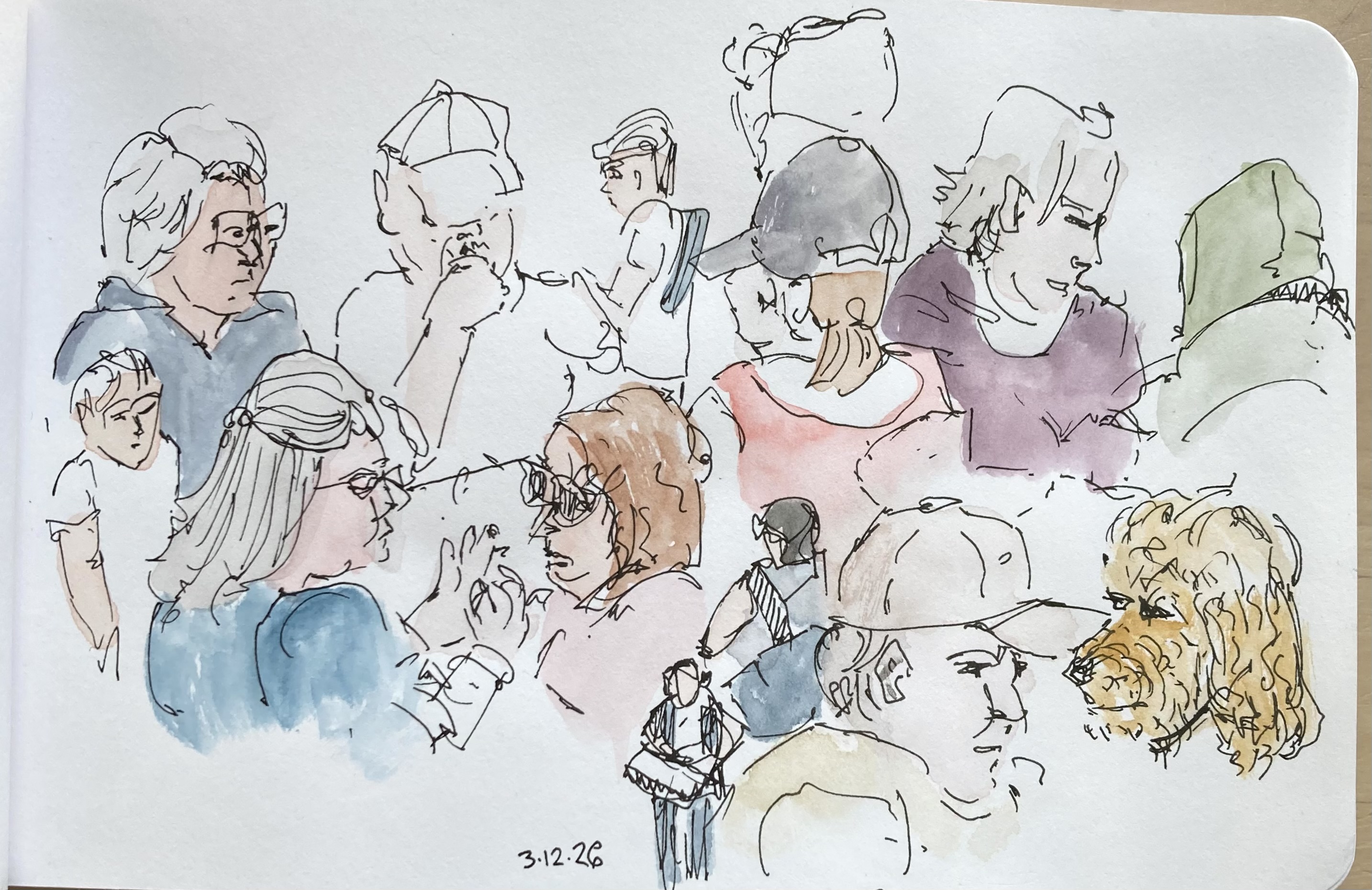 I recently got a new palette from Art Toolkit and was sketching people at the Upper Crust Bakery this morning… Caucasian flesh tones are hard, but I think the key is to water them way down.
11 March 26
The Thirst of San Francisco
I have been reading Imperial San Francisco by Gray Brechin, which is a history of the long shadowy reach of the development of San Francisco. It is an excellent book, and a good reminder that corruption of the elite did not begin with Donald Trump. Here are my notes on Chapter 2, which is about water development.
- The Sunol Water Temple was built in 1910 modeled after the Temple of Vesta at Tivoli northeast of Rome; its funder William Bourn had second generation wealth and a sense of civic responsibility.
- San Francisco has very little water in its territory; a financier named George Ensign got legislation to create private companies to claim water rights-of-way through eminent domain. Thus we get the Spring Valley Water Works.
- San Francisco County originally extended to the border of Santa Clara County, but in 1856 the legislature created San Mateo County. The city elite wanted San Mateo back. They diverted Pilarcitos Creek.
- Hermann Schussler becomes the chief water engineer at Spring Valley Water Works.
- William Ralston wanted an urban park but did not really like Frederick Law Olmsted’s suggested design.
- The civil engineer William Hammond Hall gets obsessed with building Golden Gate Park.
- Hermann Schussler builds an aqueduct from the Sierras to Virginia City, thus aiding one of Ralston’s rivals.
- Schussler recommended acquiring water rights to the Alameda Creek watershed.
- In a bold gambit Ralston acquires the rights to Alameda Creek, wanting to sell the water company to the city.
- In August 1875 there is a bank run on Ralston’s bank encouraged by William Sharon; Ralston is bankrupted and disgraced and dies swimming in San Francisco Bay.
- William Sharon (also senator from Nevada) manages to emerge from Ralston’s ruin with most of Ralston’s assets and few of his liabilities. He becomes one of California’s wealthiest men.
- Sharon dies in 1885. There is a spectacular estate battle involving a woman named Sarah Althea Hill, who claimed to be married to Sharon. Hill loses this case and eventually ends up in an asylum; much of Sharon’s estate winds up with Francis Griffith Newlands, Spring Valley’s attorney.
- Newlands takes up residency in Nevada and become congressman there. He starts to develop Burlingame as a luxury enclave for the elite of the West. Lots sell quickly there after the depression of 1890 ebbs. Hillsborough gets carved from Burlingame to become an even more exclusive town.
- The Hillsborough set is second-generation wealth, heavily intermarried and extremely secretive.
- But Hillsborough needs water for its estates and horses, not even Alameda Creek suffices.
- Newlands understands that the water has to come from distant sources, which requires taxpayer funding. James Duval Phelan, a fellow elite Progressive, becomes a proponent of this.
- Phelan is elected mayor of San Francisco in 1896, and wants to consolidate the Bay Area into “Greater San Francisco” a la the boroughs of New York. But this requires a great aqueduct.
- Phelan becomes fixated on Hetch Hetchy Valley on the Tuolumne River in Yosemite National Park.
- Newlands leads passage in Congress of the National Reclamation Act, launching the agency now known as the Bureau of Reclamation. This agency’s first project is in Nevada, not surprisingly.
- Down south, Fred Eaton, William Mulholland, and J.B. Lippencott quietly acquire water rights for Los Angeles at the expense of the farmers of the Owens Valley.
- Phelan’s claims for a reservoir within Yosemite National Park are thwarted by the U.S. Secretary of Interior.
- The 1906 San Francisco earthquake occurs. It is clear the city will quickly be rebuilt, and Phelan’s plan has a lot more support.
- The debate over Hetch Hetchy is bitter, pitting John Muir and the Sierra Club on one side and much of the Bay Area on the other side.
- City voters approve a $45 million bond issue in January 1910, but federal legislation for the dam construction doesn’t pass until December 1913. Hetch Hetchy does exactly what it is designed to do – raise land values.
- Michael M. O’Shaughnessy becomes San Francisco city engineer and leads the Hetch Hetchy project.
- Huge cost and time overruns on the Hetch Hetchy project, partly because the initial bond measure was lowballed to ensure voter passage.
- The water finally arrived in 1934. O’Shaughnessy had been stripped of power by his enemies. O’Shaughnessy dies in October, 18 days before dedication day for the water project. A new water temple is built in San Mateo County, the Pulgas Water Temple; it is a mile north of William Bourn’s estate, Filoli.
10 March 26
Swatching for a Cardigan
 Trying to decide what knitting to take on a trip is always a challenge: it should be portable, it shouldn’t be too challenging technically, but it should be interesting enough to be entertaining.
I’ve had Jennifer Beale’s Fort Amherst cardigan in my queue for a while now and this might actually fit the bill, despite the fact that it’s a sweater and lugging a sweater around while I’m knitting it doesn’t seem so smart. But it has an incredibly unusual construction: The long vertical cables are knit first, on their own, an 8-stitch pattern that goes on for 25 inches or so; then side cables are attached to them and knit down; then the fair isle strips are attached to the cables and worked in the round and steeked. All of this seems fairly straightforward and might just work. But because you’re attaching vertically knit pieces to horizontal ones, the row gauge as well as the stitch gauge is going to need to work in order to avoid some very complex math, certainly beyond my capabilities.
Which is where swatching comes in: I’m swatching double moss-stitch, the single cable ropes, and the stranded colorwork separately. I measure the swatches before blocking then soak the swatch, allowing it to dry flat after being gently rolled in a towel, and measure again, noticing the difference.
My lilac moss stitch swatch is going to have to be redone on a larger size needle; the cable is perfect as is, and I’m not sure yet about the stranded colorwork…
9 March 26
For Fun Or For Beauty?
Thanks to a link on MetaFilter, recently I watched a masterful long-form video by jazz bassist and YouTuber Adam Neely entitled “Suno, AI Music, and the Bad Future”. Suno is the technology company that has become the biggest powerhouse in AI music. A usual workflow with Suno is to give it some text prompts describing the characteristics of the music you want and perhaps some lyrics and then Suno will take that and generate a fully instrumented song for you.
Needless to say, Neely is not a fan.
Commercial generative AI is bad in ways which are different from other disruptive music technologies of the past, like MIDI sequencing and samplers, because there is a sociopolitical agenda behind its adoption. This agenda will be bad for musicians, it will be bad for music lovers, and it will leave us feeling more alienated and alone…Like any culture war, it’s a distraction from the real war, the class war. You see, there is a class of techno-capitalists who are currently using generative AI as a means of wealth extraction. They do this by circumventing intellectual property laws…
Fifty-nine minutes into the video, Neely links AI music to technofuturist movements past and present. He discusses the Italian futurists, in particular Filippo Marinetti who in 1909 pens The Futurist Manifesto. Nine years later he goes on to write the original Fascist Manifesto. Today’s technocapitalists such as Marc Andreessen view Marinetti as a patron saint. Theirs is the same worldview that produces abominations such as Reflect Orbital’s plan.
Suno describes their core values as being “Music, Impatience, Aesthetics, and Fun”. Neely would replace these values with Service, Patience, Craft, and Beauty.
Neely believes generative AI will cause music to split into two different art forms, just as theatre and cinema are different but related art forms. These will be live and recorded music, and he has a lot of hope for the future of live music.
8 March 26
Graphic Reportage
 In Making Nonfiction Comics, Eleri Harris and Shay Mirk talk about the power of reporting on events using comics. There are advantages: a loose sketch of someone is a screen to hide behind in case they fear investigation. But it also humanizes the whole process, and I’m glad I took a pen and brush along to yesterday’s gathering in Woodland.
There are so many things to make us upset and even despair about this administration’s recklessness in all areas of public life here and in disrupting the world, but doing something, anything, to stand up to it feels helpful.
7 March 26
No Forever Wars
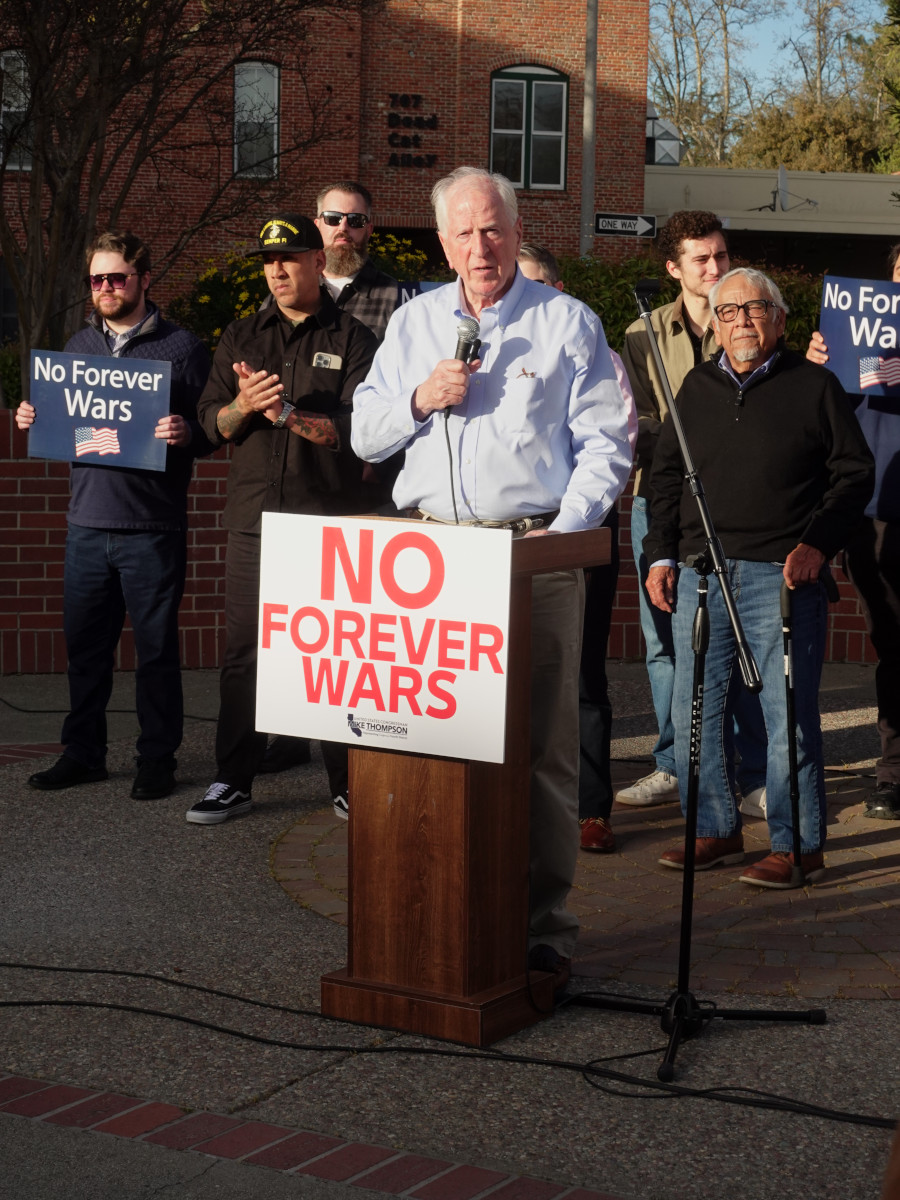 We went to an antiwar protest this afternoon up in Woodland that I believe was organized by our congressman, Mike Thompson. He is the individual speaking at the podium in the photo. Congressman Thompson served in Vietnam with the 173rd Airborne Brigade and was wounded there. Speaking with him today were four other veterans, one from the Vietnam War and three from the Iraq-Afghanistan wars. All of them saw wars that lasted over twenty years and do not want us entering another period like that. I am glad we got the chance to hear Congressman Thompson speak and that he is out in front on this issue, dreadful as it is.
Faine Greenwood on Bluesky yesterday expressed one reason why extricating ourselves will be hard:
“MAGA’s fundamental shared quality is a total lack of theory of mind for other people” is a theory that keeps getting validated by reality – look at almost every decision they’ve made in the war with Iran, and how they seem constantly surprised by the unanticipated actions of other parties. Strategy is fundamentally all about developing a sophisticated theory of the mind of one’s opponent. With MAGA’s Iran Adventure, guess we’re going to see what a modern war almost totally devoid of anything we’d call “strategy” looks like.
6 March 26
The Past Continuous
Several friends whose grasp of English grammar is better than mine have been unable to answer a question I have: What is the name of the construction in English, where the word “would” is used as a continuous past tense instead of as a conditional? Here’s an example I made up: “As a child, I would often go and play in a sandbox.”
Trying to figure this out, I remembered one of the most famous opening lines in all of literature, the first sentence in Marcel Proust’s A la Recherche du Temps Perdu: “Longtemps, je me suis couché de bonne heure.” I just came across an interesting discussion between Richard Howard and George Plimpton about different published and unpublished translations of this sentence, but none of them uses the “would” construction.
Which is what I would use, here: “For a long time, I would go to bed early.” It gives the sense of a repeated action happening over time, in the imperfect, though Proust doesn’t use the imperfect here, which, as Howard points out, is jarring: almost nowhere else in the seven volumes is the passé composé used in the narrative. The standard English translation for decades, Scott Moncrieff, reads “I used to go to bed early,” which is a different imperfect continuous…
Such questions keep me up at night, which is better than being kept up by stupid and illegal foreign wars.