
27 March 09
Shops Out Of Time
We went to Berkeley today for a family gathering and early birthday dinner and unexpectedly had a bit of time in the afternoon for some shop-wandering, ending up at two stores that though their contents couldn’t be more different, both seemed like reliquaries rather out of time. The first place was the Lacis Museum of Lace and Textiles. The friendly folks at the Albany yarn store k2tog directed Pica to go to Lacis to find some fine mercerized thread for lace knitting. This storefront and museum, which has been around since 1965, has a fantastic collection of materials, tools, and resources for textile crafts. But not Joann’s Fabrics sorts of crafts. Rather, these are for crafts that are arcane enough that we were both gobsmacked that anybody still practices these. There were the fifty-seven different sorts of tatting shuttles. The doll’s heads for making interesting tassel forms. The horn thimbles. The Battenberg lace kits. And a full range of corset-making supplies, including both plastic and metal stays; the place offers workshops as well and a DVD on corset-making. Pica found her thread, but the true prize was a specially-made wrist yarn holder, good I think for knitting socks while going hiking.
The second store was Al Lasher’s Electronics on University Avenue which has been in Berkeley since 1960 but I don’t think I’ve ever set foot in there before. Electronics components stores are very thin on the ground nowadays, the professional market for these long having given way to mail-order and now online places like Digikey and Mouser. Nevertheless, Al Lasher’s has somehow hung on, and judging from the numbers of customers passing through, still seems to be doing okay. One woman came in there for wiring supplies to resurrect a turntable she found on Craig’s List, the previous owner having been a photographer who didn’t actually play it but rather used it for a backdrop to a photo shoot. Some of the components I think have been in the store since the 1960s, or as they say on their web page, “we tend not to throw things away.” I particularly liked the two tube-testing machines up near one of the front windows (remember those, commonly found in supermarkets and hardware stores in the 1970s). A sign over these said these testers don’t really tell you that much, other than if the tube is shorted out or not, but all the tubes we sell at this store are good. I didn’t buy anything today, but the store has now been added to my places to shop in Berkeley list.
Today, by the way, is the sixth anniversary of Feathers of Hope!
26 March 09
21 March 09
Remembering Dorothea Lange
The Urban Sketchbook project is an important chronicle of a moment in our world’s history, I think. Partly because of its global scope — draw a sketch on the Tokyo Metro, in the Piazza del Duomo in Milan, or in Central Park, scan it and upload it and everyone in the world can see it.
A sketch from earlier this week bidding farewell to the print edition of the Seattle Post-Intelligencer (and the coming rush of more, including two major newspapers in Northern California) has got me thinking about earlier chroniclers of desperate times. I don’t think these scans of sketchbooks will endure beyond a decade or two, but the sketchbooks might. (The Archdruid made a powerful case this week for the endurance of one kind of technology: books.)
I am thinking about making a sketchbook (or several) for the sole purpose of chronicling the slide from prosperity (chimerical though it may always have been) to want. Sketching iPhones and then discarded circuit-boards. Rusting cars. Foreclosure signs and boarded-up shop windows, of which we have no shortage now in Davis, where the recession is otherwise fairly invisible (becoming less so daily). But it will also chronicle, I hope, people learning to make it through this by helping each other, learning simpler ways of doing things. Since everywhere I go I have a sketchbook with me, and since everywhere I go there are infinite things to sketch that tell this story, I don’t imagine being at a loss much.
It’s the invisibility becoming less so daily part I’d like to start following. Since I am no good with a camera I myself will do this with a sketchbook, but I invite you to join me with whatever medium you’d like — words, camera, pen, pastels, clay, video. I’m not volunteering to put these together on a website, but if you’d like to do that, let me know. I think at the very least we could offer this as a qarrtsiluni topic for consideration…
23 February 09
Drawing Davis
I’ve been meaning for some time to draw people’s attention to the staggeringly excellent Urban Sketchers blog, a place where talented artists around the world post, collectively, their sketches of urban life. This exciting project was probably inspired in no small measure by the Worldwide Sketchcrawl movement, which although not self-described urban has certainly featured a lot of urban settings. The work on Urban Sketchers, though, is extraordinarily high quality, and a welcome other window onto the world than the lens of a digital camera.
Long-time followers of Feathers of Hope know we both sketch, but these days I do mostly birds and Numenius does mostly cats. Another Davis sketcher, though, is a charter member of Urban Sketchers: Pete Scully.
Pete is featured in today’s Davis Enterprise. Big shout out to Pete! Keep them coming!
12 February 09
Kit Building
My Ultra RX-1 ultrasound receiver kit AKA the bat detector arrived yesterday. It joins my kit-building queue, behind a Elecraft dummy load kit and ahead of a SW-40+ QRP transceiver kit I recently ordered. The Elecraft kit is simple, about the same level of complexity as the crystal radio I put together a week-and-a-half ago ; I don’t expect to receive the SW-40+ kit for a couple of months so the bat detector kit is something to put together in the interim.
As Pica says, much of working by hand is putting pieces together: this is certainly true in electronic kit building where the exercise is to take a box of resistors, capacitors, ICs and so on and delicately yet precisely solder them on to a printed circuit board to make up a working piece of gear. The bat detector kit has 78 parts, many more than the dozen or so parts of the crystal radio kit. I need to figure out a system for keeping all the parts sorted (capacitors the size of grains of millet are awfully easy to lose). Egg cartons? Those plastic boxes to hold sewing bits and bobs??
Part of the appeal in learning to build these kits is opening up the black box. An electronic device gets transformed from being a mysterious gizmo that somehow does stuff to being something whose internals one understands, at least in broad outline. It is a great leap to go from the kit-building stage to actually being able to design these devices, but the tinkering and learning that goes along with kit-building is how you get there.
On a completely different topic, happy birthday Charles Darwin and Abraham Lincoln, both born 200 years ago today!
11 February 09
Construction
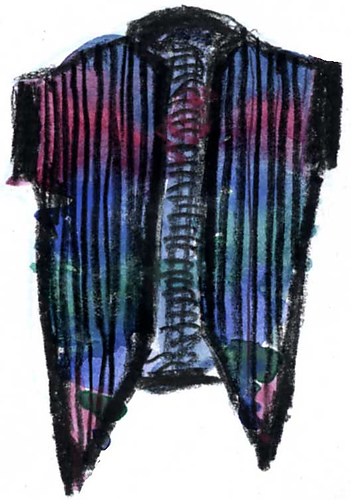 Taking this woodwork class (last week I glued the pieces of my breadboard together, tomorrow I should be planing and sanding as well as perhaps rounding corners) has reinforced to me how much working by hand involves putting pieces together, whether they be fabric to be sewn together, brush strokes, pieces of wood or metal, letter strokes, knitting pieces. It helps to look at a two-dimensional surface and be able to translate it into its three-dimensional glory.
I am finding myself mesmerized by shape, and color. The almond tree is blooming; that soft pink around the center, five perfect petals, surrounded by soft white, against a tangle of gray-brown with a brilliant cerulean behind it all… the chest and head of a house finch as it takes a bath in brown water with newly brilliant green grass behind it. This is stuff I see all the time, but I am newly alert to it again. Smooth on rough, orange on blue.
I’m a designer and I’ve been missing things. Sometimes it takes the gray of February to see them again.
18 January 09
Anar
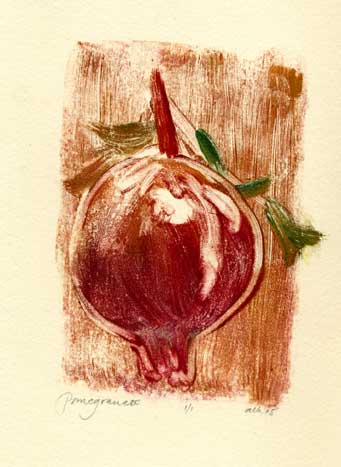
I did this pomegranate monoprint for the first issue of qarrtsiluni. It’s been sitting here, the non-digital version, waiting to burst, not knowing where to be sent.
3 January 09
Journal Rookery
 No one shall now accuse me of having a shortage of chronologically-kept notebooks. We went to the San Francisco Center for the Book today to take a course from Carolee Gilligan Wheeler on making the personalized daybook. Pica was particularly excited about this course, and since I was in much need of figuring out a planner system for 2009, we both signed up for the class. As seen at left, we ended up with two books apiece, with six signatures of 32 pages each, good for making a six-month daybook with a page for each day.
Oddly, I’ve never actually tried to keep a page-a-day planner, for keeping track of meetings, events, and grocery lists. My Hipster PDA effort minimized the chronological aspect of planning, and I’ve never been too interested in DayRunners or their ilk. Carolee’s course was good fun, and ensures that I will have the most unusual planner in the office. (We also learned why never to go to Prague in January).
This brings my collection of journals that I’m currently keeping to at least six:
- My sketch-of-the-day book — I’m now using one of the many blank books I produced during last fall’s bookbinding courses.
- The notebook I keep for work. Happily the campus bookstore now stocks Clairefontaine notebooks, so I’m using one of those, alas they stock only the lined, rather than gridded version.
- An ancient bird field notebook. I’m not very good at keeping field notes, hence it is old and in fact in need of rebinding.
- My logbook of all the radio contacts I make on HF (a gridded Clairefontaine notebook)
- Today at Arch Drafting and Art Supply I bought another gridded Clairefontaine notebook which I intend to use for keeping track of miscellaneous radio catches in the wild world of shortwave radio (e.g. pirates and spies hanging out on the lower half of the 6900-7000 kHz segment).
- The daybooks we made today.
Have I reached the journal event horizon yet?
16 December 08
Volunteer Potatoes
 Pica dug these potatoes up today from her vegetable garden after the above-ground bit got killed by a recent frost. She didn’t plant these; they grew from bits left in the ground from previous generations of potatoes. I sketched these using Graphitints in a blank-book-of-mine-turned-journal.
11 December 08
Bird Book
 Yesterday was the Yolo Audubon Society’s annual Fall Drawing and Bird Identification Workshop in preparation for Sunday’s Christmas Bird Count centered on Putah Creek west of Winters. In addition to the grand prize (a framed print of a Terry Isaac bird painting) we were all encouraged to donate prizes for the event. I made a blank book and decorated the cover by calligraphing the names of the birds on Yolo Audubon’s Watch List for the county.
Cold winter weather is coming, just in time for Sunday’s count. Our portion takes us up to the top of the Blue Ridge mountains, north of Putah Creek. There are rumors we might even get a snow flurry or two up there.