
10 October 08
Different Strokes for Folks
Here are two noteworthy bikes for this week. The first bike is a prototype that would be good for our emergency preparedness efforts. The second bike we saw Sunday when we worked the Princess Promenade event. This quintuplet (scroll to the bottom of the page of photos) was not officially part of the event but it caused me to do a double-take when I saw it go past one of the rest stops.
5 October 08
Princess Promenade
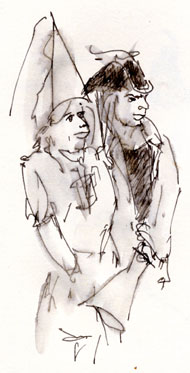 The second annual “Princess Promenade” — a bike ride for women and girls to try and get them to exercise — was held today along the American River Parkway in Sacramento. Numenius was a bike radio mobile and I was a shadow radio operator for the director, which meant I saw a lot of pink tutus and tiaras, saw gals coming back in saying this was the furthest they had ever ridden, got to witness the horror of a teenager who had thrown her retainer in the trash which had then been emptied and had to tell her I didn’t know where they’d taken the bags. She really was prepared to paw through dumpsters…
As I write the Red Sox and Angels are tied at four. Hoping the Sox put this one away tonight…
4 October 08
First Rain
The first storm of the season has come through today, producing some sprinkles this afternoon and evening, with more rain expected tomorrow. Sunday it should be clear, which is good because we are scheduled to help out with radio support for a bicycle event along the American River Parkway in Sacramento that day.
Looking at the local National Weather Service web page, they are highlighting the CoCoRaHS (Community Collaborative Rain, Hail, and Snow Network) program, which is a citizen science effort to collect precipitation data all across the United States. California has just entered this program this month, which first got started with a pilot effort in Colorado in 1998 and is now taking place in 36 states. All one needs to participate is a standardized low-cost rain gauge and the commitment to measure it every morning.
1 October 08
New Dish
 The pomegranate tree I planted a couple of years ago has born fruit. Two fruits, to be precise. One of them was split open today: you KNOW we had to eat it.
I had some squash cooking in the solar cooker — it was cloudy this afternoon which got in the way of success, here, but got it started. Add to this the farro (heirloom wheat; emmer is a good substitute) I cooked like barley and the sorrel I parboiled down, and done. A little basil found its way in there. The pomegranate’s tartness was offset by the sweet squash; the sorrel’s light lemony taste did away with the need for a dressing. I wish we’d had a little salty cheese but maybe next time.
30 September 08
Bioblitz 2008
This weekend I went out to the spot I surveyed in last year’s bioblitz nearby along Putah Creek and did another species tally. As before except for the birds I can’t comprehensively identify the species I see, but here’s a species list:
Birds:
- Black phoebe
- House wren
- Turkey vulture
- Red-shouldered hawk
- Red-tailed hawk
- Scrub jay
- Nuttall’s woodpecker
- American kestrel
- Yellow-rumped warbler
Butterflies
- Acmon blue (Plebejus acmon)
- Orange sulphur (Colias eurytheme)
- Cabbage white (Pieris rapae)
Other insect:
- Praying mantis (Mantidae) (gravid: she looked at me inquisitively)
Plants:
- Narrowleaf willow (Salix exigua)
- Oregon ash (Fraxinus latifolia)
- Eucalyptus sp.
- Black mustard (Brassica nigra)
- Wild oats (Avena fatua)
- Ryegrass (Lolium perenne)
- Milk thistle (Silybium marianum)
- Yellow starthistle (Centaurea solstitialis)
- Curly dock (Rumex crispus)
- Rough cocklebur (Xanthium strurmarium)
- Western flat-topped goldenrod (Euthamia occidentalis)
- Annual fireweed (Epilobium brachycarpum)
- Chicory (Chicorium intybus)
29 September 08
Blogging the Apocalypse
Well, there’s only one S&P 500 company whose shares rose in value today. One.
PS: these guys rent our fields to grow seed…
25 September 08
Entering Stage Two
So if you aren’t already worried…
Dimitri Orlov is an author currently residing in Boston who lived through the collapse of the Soviet Union and has recently written a book entitled Reinventing Collapse: The Soviet Collapse and American Prospects. The book describes what an American economic and societal collapse might be like based on his Soviet experiences. I haven’t read it, but should be able to grab it from the library soon.
Anyway, Orlov just announced that we’re leaving Stage One (financial collapse) of his five stages of societal collapse and are moving on to Stage Two, commercial collapse. Soon we’ll be missing being in Stage One, he says.
22 September 08
Bookbinding
 We’re starting to accumulate a small pile of books we’ve bound. I am quite enjoying the paper in the “Ideal Sketchbook” — Kelly Classic — for pen and ink. I think this may become my main bird sketchbook.
Numenius has been dazzling me with his new binding skills. Headbands and everything. I have no idea where this is leading but we’re both enjoying it. It’s companionable and that’s unusual for what is often a solitary activity.
Our trip to Art Ellis in Sacramento and lunch at Tapa the World (they catered Chris and Karen’s wedding — we were impressed then; we were impressed again on Saturday) yielded the following conversation at the next table:
“Mauritania. Sand. Lots of sand.”
“Do you get robbed there?”
“No, I got mugged in Rio. Machete.”
“I know a guy who got mugged in Rio by machete.”
“Really? Who?”
“Christian.”
“Christian left Rio a few hours before I got mugged on the beach by machete.”
“You’re kidding! You mean he took your story?”
21 September 08
New Technologies In Food Storage
 We are overrun in butternut squashes. I haven’t been studying Sharon Astyk’s posts on food storage very assiduously, but keeping the squashes in a dog crate we have lying around seems like a good idea.
19 September 08
Left Unsaid
Before my mother moved back east a couple of summers ago, she handed me bags and bags of things she wasn’t taking with her but didn’t want to throw away. These included improbable numbers of bottles of moisturizing lotion; they also included all my letters home — since I first went to boarding school in 1973.
I know they must have made us write home weekly, but I was still shocked by the sheer number of them, and by their mostly uniform vacuousness, which continued on into university and beyond. They’re painful to read and mostly I haven’t. But they lurk…
I finished Geraldine Brooks’s March last night, a novel that starts out with the Little Women father writing home. It has been a horrific day, a day in which he, a green army chaplain, has tried (and failed) to save a wounded man from drowning as they retreated in terror from a confederate counterattack. He is wracked with pain and cold and shame and fear and guilt yet none of this makes it onto the page: he writes about the cooking fires around him and the beauty of the sky. The truth of that day — and many other terrible truths about many other days, truths that likewise never made it onto the pages that are sent with love and remorse about the deception — the truth of that day finally emerges as Marmee visits her “very ill” husband in hospital and tries to save him from his demons. She is transformed in this novel from a milquetoast goody-two-shoes into a raging spitfire with a terrible temper (and how we love it: tell it like it is, Marmee), and she feels anger and betrayal at the lies that have been flung her way. Yet when she tries to write home to her daughters, she is faced with the same dilemma: tell the truth and cause pain and anguish, or spare them from it and lie. And then live with the consequences of your lies.
Choices, these are. At the time, it doesn’t seem so momentous. “I’ve started smoking” is a truth I felt able to divulge in a letter home, difficult though it was, leading to a reminder my grandfather had died of emphysema; “I lost my virginity in the darkroom on Saturday” is one I left out. It reveals to me, again, how difficult parenting must be: choosing between honesty and wanting to protect your young. Of course my own omissions can be explained in terms of teenage rebellion, but looking through these letters, there’s more.
If I had been encouraged, or decided on my own, to share with my parents the struggles I was facing — wanting to fit in, wanting to be “cool,” feeling the pressure (of course this would have involved acknowledging it, which was far from the reality) — it may have been possible to write the letters with the integrity that, in hindsight, I wish I’d had. And it’s possible I might have made different choices, guided by parental wisdom and love and, perhaps, honesty.
My grandfather — the one who died of emphysema — was a man for whom lying was close to a crime; it was certainly a sin. He raised my mother and uncle to share this view. Yet, looking through his own letters home during World War I, I see the same reticence to reveal the truth in letters in as Mr. March’s. “I’ve had the grippe but some poor fellows have it much worse” is the only mention I’ve found in any correspondence anywhere from family members that touches on the great flu pandemic of 1918. It is left to my imagination to fathom what he was really seeing, because in tents in western France with thousands of soldiers, many of them ill and dying, it can’t have been something you’d want to see, ever.
Much has been written on the impossibility of language to convey some things so horrific most of us would rather they remain unsaid. This is the project of many films about the holocaust: say the unsayable, because it is the truth, speak it even though you don’t find the words. Truth becomes a driving imperative. We recognize it when we see it — if we’re lucky.
At a time when most of us expect lies of all our leaders, even those at the highest level, when outright untruth or misremembering or failure to remember or I’ll take the fifth or other permutations of culturally sanctioned lying from the top down, lying that has led to, for example, people still dying in Iraq — now is the time to take baby steps to learn how to tell the truth again. It can start with the innocuous things. I didn’t, in fact, make my bed this morning. I got a less than stellar performance review. I made some stupid mistakes in the stock market. We can then progress to “I did have sex with that woman” and “we knew all along there were no weapons of mass destruction.” From there, perhaps, when there are real consequences inherent in the truth we tell, we might make wiser decisions in the first place…