
15 February 09
Rainy Departure
We got up very early, before 5, for our assignment to provide radio support to help out the City of Davis in hosting the start of the Tour of California, the race starting at noon. It’s quite windy when we head out, a strong breeze from the southeast in advance of the coming rain. I put on my full raingear garb — tights, jeans, rain pants (by now quite ripped and in need of replacement), my heavy weather boots, synthetic fleece sweater, mittens, neck warmer, hat, and rain jacket over which I put the orange volunteer t-shirt, all of which is needed because we end up spending the next six hours standing outside in the rain. (At least we got a nicer looking t-shirt than most of the volunteers, due to the technicality of supporting the City of Davis rather than the Amgen Tour itself.)
Our post was the City Hall parking lot, about 5 blocks from the starting line by Central Park. This was set aside for VIP and overflow media and race staff parking. I was over on A Street, one block further away from the race start than the B Street entrance to the parking lot where Pica was stationed, and it turned out to be a pretty lonely outpost. Only one or two cars ever parked on my side of the lot. (As the coordinator of our radio ops put it later on, I guess VIPs melt in the rain). Pica at one point wanders to my side to share the rumor, later verified, that Lance Armstrong’s time trial bike had been stolen. The weather throughout the morning is a mix of wind and light and medium rain.
At 11:30 we’re given the clearance to go off-duty and I start heading towards the race starting point to meet up with Pica. My route takes me through where all the team buses are parked: a chaotic melange of cycling fans, race team staff, and cyclists making the final adjustments to their garb and setting off on their bikes to the starting point. We take up position somewhat behind the actual starting line, and don’t see that much, a brief look at a big pack of cyclists moving on out. It was however quite cool to be standing right opposite the Astana team car and looking into it, rather like finding oneself six feet from a major league dugout and seeing the manager ponder the handwritten roster. We start wandering back towards our car, and hear over the radio that the riders have made it west past the point where they can actually start racing.
After dithering about what to do for lunch, we end back home and get online to check on the live action at cyclingnews.com. The Spanish rider Francisco Mancebo has gone off on an early attack and has taken a substantial lead (at one point over 10 minutes) on the rest of the peloton. We settle in for a nap. Charlie is very confused by our behavior today, tries to rouse us a couple times, gives up, but on waking I find him dozing cuddled up next to me.
I get up at 4:30 and check the race play-by-play. Much excitement! Mancebo is still leading, but only by a minute or so, and the race is into the final circuits around the city of Santa Rosa. The major contenders for the race, led by Astana (Armstrong and Leipheimer’s team) have been in hot pursuit of Mancebo and their elite group of about 17 riders are about a couple minutes behind Mancebo. They don’t bridge the gap though; Mancebo wins the stage and takes the overall tour lead.
It’s a fantastic start to the race. Had the weather been good, what probably would have happened is that the peloton would have arrived in Santa Rosa together and there would have been a bunch sprint at the end, to be won by the likes of Tom Boonen. The lousy weather however favored a breakaway and the peloton was loath to ride it down, having their hands full with maneuvering in the rain and lots of mechanical difficulties. In the end, the heavy hitters in the peloton had to take action, blowing the field apart: the main peloton finished over 5 minutes behind Mancebo.
Tomorrow the riders leave Sausalito toward a finish in Santa Cruz, heading first of all over the Golden Gate Bridge. And more rain is coming.
14 February 09
Amgen Tour of California: Prologue
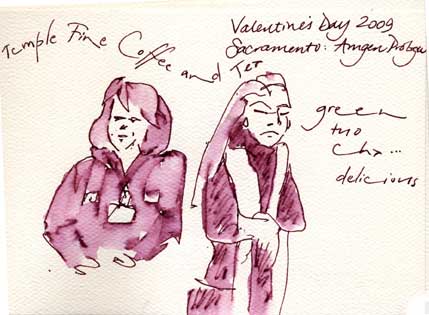 We took the train over to Sacramento this morning along with hundreds of other people to see the start of the Tour of California, which turned out to be the most efficient way to do it… The course circled the State Capitol, a tight, under-three-mile sprint that was longer than sprinters like but not long enough for the long-haulers.
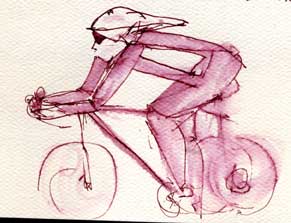 The riders came by every minute or so, preceded by a motorcycle proclaiming their name and chased by a team car (almost always a Subaru Outback), another motorcycle, and the applause and cheers of the crowd. I think this was a very sophisticated crowd, one that gave reigning Tour de France champ Carlos Sastre a special ovation (he has the flu, though, and will be content to finish the race apparently). Obviously many people were out to see Lance Armstrong in his big comeback (local shops have flyers in them proclaiming “Armstrong Rides Again”), but that wasn’t all.
It was a great day, and the rain just about held off. Tomorrow we are working rather than being mere spectators and it is expected to be pouring rain and howling wind. Getting dressed for an assignment that starts at six am and will go on until at least 1:30 will be challenging, but I think layers are the order of the day. We will be City Hall Alpha and City Hall Bravo, respectively.
12 February 09
Kit Building
My Ultra RX-1 ultrasound receiver kit AKA the bat detector arrived yesterday. It joins my kit-building queue, behind a Elecraft dummy load kit and ahead of a SW-40+ QRP transceiver kit I recently ordered. The Elecraft kit is simple, about the same level of complexity as the crystal radio I put together a week-and-a-half ago ; I don’t expect to receive the SW-40+ kit for a couple of months so the bat detector kit is something to put together in the interim.
As Pica says, much of working by hand is putting pieces together: this is certainly true in electronic kit building where the exercise is to take a box of resistors, capacitors, ICs and so on and delicately yet precisely solder them on to a printed circuit board to make up a working piece of gear. The bat detector kit has 78 parts, many more than the dozen or so parts of the crystal radio kit. I need to figure out a system for keeping all the parts sorted (capacitors the size of grains of millet are awfully easy to lose). Egg cartons? Those plastic boxes to hold sewing bits and bobs??
Part of the appeal in learning to build these kits is opening up the black box. An electronic device gets transformed from being a mysterious gizmo that somehow does stuff to being something whose internals one understands, at least in broad outline. It is a great leap to go from the kit-building stage to actually being able to design these devices, but the tinkering and learning that goes along with kit-building is how you get there.
On a completely different topic, happy birthday Charles Darwin and Abraham Lincoln, both born 200 years ago today!
11 February 09
Construction
 Taking this woodwork class (last week I glued the pieces of my breadboard together, tomorrow I should be planing and sanding as well as perhaps rounding corners) has reinforced to me how much working by hand involves putting pieces together, whether they be fabric to be sewn together, brush strokes, pieces of wood or metal, letter strokes, knitting pieces. It helps to look at a two-dimensional surface and be able to translate it into its three-dimensional glory.
I am finding myself mesmerized by shape, and color. The almond tree is blooming; that soft pink around the center, five perfect petals, surrounded by soft white, against a tangle of gray-brown with a brilliant cerulean behind it all… the chest and head of a house finch as it takes a bath in brown water with newly brilliant green grass behind it. This is stuff I see all the time, but I am newly alert to it again. Smooth on rough, orange on blue.
I’m a designer and I’ve been missing things. Sometimes it takes the gray of February to see them again.
8 February 09
Höllentour
Yesterday we saw the documentary Höllentour [English title Hell on Wheels] to get us psyched up for the upcoming Tour of California. This is a German film that follows one team (Telekom/T-Mobile) during the 2003 Tour de France. The team had a good though not outstanding Tour and the film focuses on the sufferings of the riders on the team. Andreas Klöden breaks his tailbone in a fall early in the race and withdraws halfway through; the sprinter Erik Zabel who was previously indomitable, winning six consecutive green jerseys from 1996 to 2001, finds himself coming up third or fourth in all the big sprints; Rolf Aldag wears the polka dot jersey for a day and comes down with a cold in the mountains; and Alexander Vinoukorov, though he wins a stage in the mountains, cannot best Jan Ullrich and Lance Armstrong and finishes third overall. As a cycling-mad priest says in the film: there are two sorts of suffering, negative suffering and suffering which occurs through great efforts. The latter is positive, ennobling suffering.
5 February 09
Social Media
I’m about to head out to a social media forum at UC Davis. The idea is that there is a need to understand ways to communicate with college applicants if you want to attract them to your campus, but there are many other ways the technology can be useful to university work, and I want to find out more about those sort of things…
Being a social person I’m interested in social media but have resisted, for a long time, signing on to things like MySpace and Facebook, because, well, I have two blogs, they are already getting neglected.
And then Ravelry came into my life.
Ravelry is a social network for knitters and crocheters that this morning stands at 281,975 members. Lest this sound completely innocuous and old-lady-ish, I should fess up that among the 25 or so groups I’m a member of (some of them genuinely dedicated to bits of knitting and fiber arts) out of the by now thousands of groups (some are outlined here ), several are shall we say not particularly old ladyish. An IVF doctor, interested in a sudden spike in traffic directed to his blog from Ravelry, discovered not just one but TWO groups of knitters and crocheters who are childfree by choice, one of them a great deal more vociferous about it than the other, which at least tolerates the presence of self-professed parents (“parenttrolls” are apparently a feature of CFBC groups on the web). The Lazy, Stupid and Godless group not only tolerates but encourages profanity (“twatweasel” is the most interesting word to have entered my lexicon since my twenties, I think).
I will be interested to see what transpires at this forum. But I doubt they’ll be discussing much knitting.
(A phenomenon I’ve encountered though is that people don’t tell you they’re on Facebook. If they are, they’ll find you; if you aren’t, you don’t get it, and they’re not going to waste their breath. No such restraint exercises itself among Ravellers, though.)
1 February 09
Crystal Roots
The tradition of building one’s own equipment is as old as the hobby of radio. Originally this was by necessity, but the tradition still continues, especially in the building of low-power and often quite portable transceivers. I like the notion of going hiking with a rig packed into an Altoids tin and making a Morse Code contact or two with it, so this angle of the hobby appeals to me. There is no shortage of high quality kits to put together as well.
One does have to know how to solder to build these things, which hitherto has been an stumbling block for me, but last weekend I took the plunge and bought a 25-watt soldering iron, and managed to solder a couple of wires onto an RF connector. This weekend I moved onto an actual kit. This was a very simple crystal radio kit put out by The Xtal Set Society. A crystal radio is a very simple radio receiver, quite popular in the early days of broadcast radio in the 1920s, that derives all its power from the energy in the radio wave, no batteries or amplification is involved.
I built the kit pretty quickly yesterday evening, but didn’t manage to hear anything on it last night. So this morning I took it out and tested it with a better antenna and ground. With a bit of tuning, I could hear tinny voices from its special earpiece put well into my ear. Amazing! The radio is unpowered, remember. I was picking up KHTK 1140 AM, a Sacramento sports radio station. I even heard a bit of the Sacramento Kings’ game (not that they are worth listening to for very much this season.) Changing to the lower tuning band of this radio, I also heard KSTE 650 AM, a Sacramento news/talk station.
It’s all quite fun. More kits await me.
28 January 09
Pre-Felting: Socks for a Giant
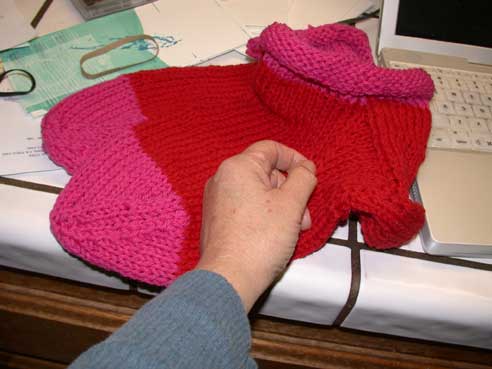 I’m taking a woodworking class in order to be able to build simple things (like bluebird boxes or a cold frame for my tomatoes and peppers). Carpentry is not unlike knitting, bookmaking, or dressmaking. Cut or make the pieces and put them together. Adornments optional.
25 January 09
A New Count
Today we participated in the first ever UC Davis winter bird count. Andy Engelis, who heads up the Museum of Wildlife and Fisheries Biology, had the idea to start this count of the 5,300 acre campus (the largest campus of the University of California system), modeling it on the Christmas Bird Counts. This first edition got off to a great start, with about 50 participants (I figure that many of these folks have been suffering from Christmas Bird Count withdrawal and needed their fix.)
We got to do the bit nearest our house; five of us walked the portion of campus east of Old Davis Road and south of the railroad tracks, birding along Putah Creek and in and behind some of the Vet Med field buildings. The most exciting bird was the Purple Finch that we tried very hard to turn into a Cassin’s Vireo based on its call and song, which faked both Pica and me out before Pica finally got a good look at it.
There is a lot less territory to cover on this count than on Christmas Bird Counts, which are based on a 7.5 mile radius count circle, so our count was over by noon and we all convened at Steve’s Pizza in town for our compilation lunch. Some of the good birds seen included a White-Throated Sparrow, a Chestnut-Backed Chickadee, Lark Sparrows, and an immature Golden Eagle. The number of bird species seen in total by everyone today was 102. We all had fun, and are looking forward to next year’s edition!
22 January 09
It's Raining, Oh It's Raining...
The soil laughs, muddy.
But it must have irked the skunk
Under the bathroom.