
22 May 10
Friday Is For Climbing On The Roof
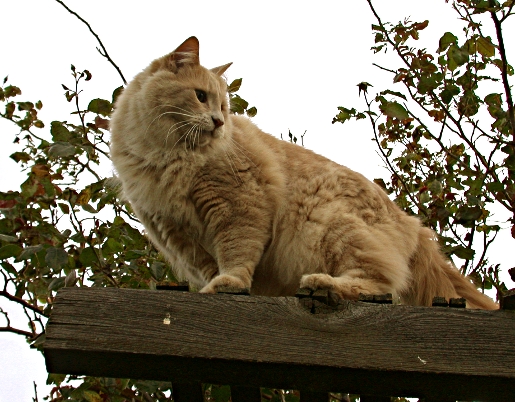 And so was Tuesday and Wednesday. Charlie has been a scalawag this week. He’s quite snug on the bed right now though.
We’re off to the Maker Faire tomorrow! We expect to see all sorts of wacky goodness, from two-story high ray gun rocket ships to knitted Klein bottles.
19 May 10
A Visit to Sacramento
 Racing off to the station this morning on my bike, I got on the train to Sacramento to represent the Oiled Wildlife Care Network at State Scientist Day, an event where 3,000 children come to the State Capitol to see scientific initiatives by California.
 Water, pollution, lead, of course oil, endangered species, geology — I wasn’t able to visit all the booths but it was a good sampling and there was lots of enthusiasm.
 Interacting with kids doesn’t come easily to me (there’s a reason I never had any) but this was an oft-repeated schtick, what happens to animals that get caught in oil, what we can do to help… the parents and teachers engaged more closely in the conversation because, I’m assuming, the oil spill in the Gulf of Mexico is present on their minds. It’s on ours, too: my colleague Mike’s been there for three weeks, trying to set up the marine mammal and turtle response (well cataloged on the owcn blog ).
 People: people who were short, people who were dressed up as bears (Smokey and Warden Grizzly were two I spotted), and this one guy dressed in 500 plastic bags.
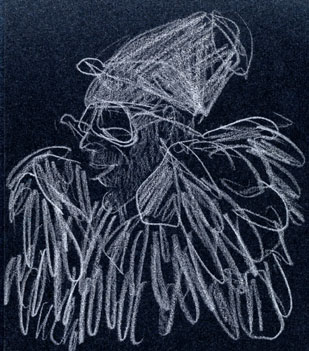 We had a smattering of rain and it was, at length, over. I sketched. I took the train back to Davis, biked back to the office into a headwind with the miraculously recovered OWCN banner on my back. (It’s heavier than you’d think.)
18 May 10
May Flowers, May Showers
Saturday we provided radio support once again for the Davis Double Century. The weather was very mild this year, with highs not much above 80 degrees F. In part because of the mild weather the riders had a relatively easy time of it, and not too many had to be sagged back to Davis. The riders even got a dose of fog climbing into the mountains of eastern Napa County. Pica drove the entire course and then some as a sag vehicle; she was impressed to see so many wildflowers still out. It’s been an odd spring, with brief periods of rain every week or so. I meanwhile stayed behind at start/finish and worked at radio net control, and was especially pleased to see that the GPS radio tracker I had built was working well in Pica’s vehicle, and I was able to follow her progress via the APRS software we had running at net control.
Today was the second stage of the Amgen Tour of California, the stage starting in Davis and ending in Santa Rosa. Last year’s first stage also started in Davis, but the race was in February. It was pouring that day, and rained off and on throughout the week. So the race organizers moved the race to May in part to get better weather (never mind the conflict with the Giro d’Italia). I was amused to note when I went out to watch the peloton start to ride out of town that it was sprinkling. The riders must not know what to make of Davis weather.
15 May 10
Up Early, Even For Me
Today is the Davis Double Century. It’s too early here even for kingbirds. I must leave the house in an hour, having drunk enough tea to keep me going on a 200-mile course with many zigzags back and forth between rest stops (I’m driving, providing radio support, not cycling, but still). It looks like it won’t be too hot, meaning fewer heat exhaustion cases, but there’s always something, and it’s best to be prepared. Hope I am.
Today is also the 27th Worldwide Sketchcrawl. Can’t believe there have been that many. I won’t have much chance to sketch today but will try at a couple of the rest stops: cyclists are good drawing subjects, plenty of muscle definition to be had. And they all line up in exactly the same way for water and Gatorade and peanut butter sandwiches and bananas and potatoes and soup and coffee and muffins, staggering around on cleats, wondering how the hell they’re going to get up Resurrection and wondering whether this was really such a good idea. They’re a cheerful bunch, though, and this is such a well supported ride that it’s a good one for the “maybe I can make its.” Unfortunately for the support people, sometimes those ones maybe can’t, and need shuttling around. And their bikes… but then I get to meet really interesting folks and chat on the way to the next rest stop.
I’d like to put in a word here for an artist I admire greatly and whose work I’ve followed for some time now. Debby Kaspari of Drawing the Motmot lost her house and her studio on Monday in a tornado. She, her husband Mike, and cat Gizmo are all fine, but they have lost all their possessions. (I just saw in an update that after sifting through the rubble they were able to find Debby’s banjo and Mike’s guitar intact; I burst into tears when I saw this.)
There’s an art supply whip-round going on through Facebook through friends. If you have paper or paints or pencils or anything you think she could use, please check it out. There’s a paypal link too.
Right. Off to don the Second Ugliest Tshirt In The World and check in with Net Control. KI6IMU, Sag 10, reporting for duty…
7 May 10
Into The Merry Month of May
The Whole Earth Festival is this weekend on the Quad on campus. This is the 41st year it’s been run, and we’ve attended a good many of them in the 11 years we’ve been in Davis. By now the Whole Earth aesthetic is quite ingrained in us, and we were able to satisfy the annual need for it with a brief session this evening. (I may have to return on Sunday for the annual chocolate-covered banana however).
May has turned into quite a hectic month for us. The Whole Earth Festival starts off the events of the month. Tomorrow we are headed to Berkeley to meet friends and then in the evening we are going to West Sacramento to catch a River Cats game. A week from tomorrow is the Davis Double Century for which we are scheduled to provide radio support. The following weekend is the Maker Faire in San Mateo; we will be going down on the Saturday, and expect to be overwhelmed as we were last year.
No wonder I need a vacation. Which I am taking this upcoming week! Time to catch up on projects before I get to the Maker Faire…
4 May 10
Pondering on a Podcast
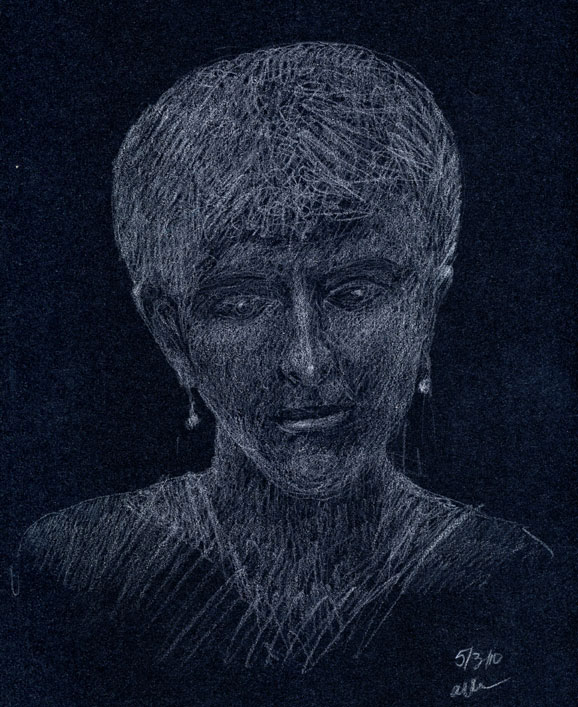 I spoke with my friend Dave Bonta on the phone yesterday. He was recording. Click here
for the results…
30 April 10
How You Know You're Not A Hockey Fan
I was tuning around on the AM broadcast band last night when I run across a match on 750 kHz — Vancouver was playing, I figure it must be the NHL playoffs. It’s late in the match. It sounds like they’re playing Portland. One player gets two yellow cards and is out of the match. There’s a free kick, a header, and three minutes of stoppage time. The cognitive dissonance is great. I didn’t know hockey was so much like soccer.
Afterwards I look up the teams. The Portland Timbers versus the Vancouver Whitecaps. Division 2 Professional League soccer (a temporary league, lasting just one season, we’re told). The broadcast was from the station KXL, in Portland, Oregon.
25 April 10
Birdathon/Sketchathon

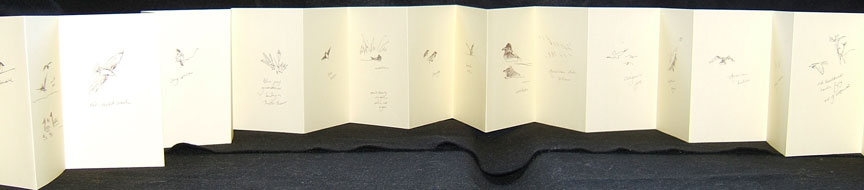
I’m pooped. Between the walk into the campus arboretum yesterday and today’s walk to Pedrick Road from the house, and the three blisters I have that tell me I must have walked at least eight miles, and the pages and pages of the Moleskin accordion-fold notebook that are now full bar the final page (though why they use paper that will hardly take a pen, let alone a light watercolor wash, is beyond me…), I think I’ve finished.
Worst miss: American robin. Birds I heard but couldn’t see to draw: wild turkey, orange-crowned warbler, both towhees. Most unexpected bird: American white pelican. Bird I kept trying to avoid but ultimately failed: European starling. Most spectacular save: hearing Canada geese outside as I was getting out of the shower, grabbing a towel and my pen and notebook and running outside to draw them as they flew west-southwest. (I later saw a pair with three goslings on the creek and added them to the page with the hastily-drawn flyaways.) Birds I saw but wasn’t quite fast enough to draw before they flew off: Eurasian collared dove (a first for our yard and a first for my 2010 walkabout), Western tanager. Booby prize for the bird I think I’ll never be able to draw well no matter how many times I try: Bullock’s oriole.
 Oh, and the not-a-bird that stopped me dead in my tracks: the river otter in the Arboretum. I hadn’t seen them since New Year’s Day. It was about 6:30 am; I think you just have to be really early.
Total number of birds sketched: 59. I had hoped for 60. But I think I’ll call it a day. If you offered to sponsor me, thank you; if you would still like to support Yolo Audubon in this birdathon, please feel free. You can still pledge the composite list or any one of the participants. More sketches are over on Bird by Bird.
23 April 10
Happy 40th Earth Day!
I remember the first one. I was in elementary school, and somebody organized us to pick up trash around the schoolyard — the school on top of the hill, with an upper and lower playground separated by a small slope planted with acacias and other trees. This session was before school started in the morning, and I was a little worried about making it to class on time.
A random Earth Day 2010 initiative that I like: the organization iFixit.com which is known for providing people with the resources, both informational and physical parts, to repair their Apple hardware, today announced a much more ambitious goal, to teach every person on Earth how to repair every thing they own. Their platform is an online set of repair manuals that anyone can edit in wiki-like fashion. Reduce, reuse, recycle, and repair: the fourth term in that mantra gets left out all too often.
18 April 10
Birds and Boozers
Yesterday we went out to our Breeding Bird Atlas blocks and finally got a couple of confirmed breeding birds, plus a whole lot of probables, including a hooded oriole, red-shouldered hawk, and great-horned owl. We have been lucky to meet someone in Esparto who not only has a fabulously overgrown yard, well-stocked bird feeders, and a good diversity of birds that visit them regularly, but who is also a good birder and is willing to keep an eye on her patch for us.
Back to Davis, and Picnic Day. I volunteered to run Net Control for the first UC Davis Amateur Radio Communications group — folks wandering around Picnic Day (more than 100,000 people) were invited to report incidents that were not worth an emergency 911 call but should still be noted.
Most of the incidents yesterday involved alcohol. There was a roof party on B Street (off campus) where a young woman got seriously injured. There were reports all afternoon of alcohol-related incidents, a couple of them very serious. It seems a shame that Picnic Day has become such a magnet for people intent on getting paralytic, but there you go.
Net Control out.