
2 September 11
Catching A Supernova
I saw the second supernova in my life last night. This would be SN 2011fe, which was discovered on August 24 by an automated sky survey at the Palomar Observatory. It is in the galaxy M101 (the Pinwheel Galaxy), which about 21 million light years distant, Two things are unusual about it. First, I believe it is the nearest supernova to occur since SN 1987A (a mere 168,000 light years away, back in 1987). Second, thanks to the automated observing network, it is the youngest type IA supernova ever observed, caught within 12 hours of the explosion. The supernova is destined to be one of the most studied such events for this generation of astronomers
I first heard about the supernova last Friday or Saturday, planned to look for it on Saturday, but was foiled by the presence of haze and smoke from a brush fire 20 miles distant. I have only seen one supernova in a telescope before, back in 1998 — I think was SN 1998bu in the galaxy M96, which got to about magnitude 11.8 in brightness. We were living halfway up the mountain behind Santa Barbara, a place with much darker skies than where we are now — I have great trouble seeing 12th magnitude stars in my 7” telescope here. So I looked on Sunday, and had no luck, cursing the bright skies here.
So I looked again last night, it being important to look before the moon gets too bright in the evening sky in the next several days. First looking through the eyepiece I thought it would go well. It did. When I had hopped to the correct star field there was a suspicious object. Was it the supernova? Or perhaps it was the 11.7 magnitude comparison star on my star chart? Comparing the geometry of the stars with those on the star chart it looked more like the former, but it wasn’t until I found a pair of stars at the upper part of the field pointing at the supernova on the chart did I confirm it. The supernova was now not at all difficult to see with direct, rather than averted, vision. A look at this light curve shows what has happened: between Sunday and Thursday the supernova brightened from about magnitude 12 to around magnitude 10.7. Wow. No wonder it was now pretty easy to see. I’ll be following it over the next several weeks, though the moon will make this difficult for a couple weeks
And now to look for a comet! I just heard about Comet Garradd today: it sounds like it is pretty easy to find.
31 August 11
White Waterfalls
Driving back from the Sierra on Monday — into the sunset, as we had driven into the sunrise; at least our reward was the green flash — we passed a Bridal Veil Falls. There must be hundreds of waterfalls so named throughout North America.
We had walked in 3+ miles only to find out we had way overshot our trailhead, and had to double back. We found our party — a group trapping an alpine relative of rabbits named a pika — and proceeded to follow them around glacial boulder-falls trying to photograph them. Two colleagues, two students: this was the perfect setting for photos that were to illustrate “training,” something I’m called upon to do a lot in my work. (Good thing, because they didn’t catch any pika, though we did see one and heard several.)
At some point during the day, though, it hit me. In earlier centuries, I’d be “going blind.” I used to have better than 20/20 vision, could identify a hawk at enormous distances, read roadsigns that would leave fellow travelers incredulous. Now the white waterfall descends on my right eye and will follow on my left.
I don’t mind, much. Not as much as I thought I would. For one thing it’s an easy outpatient surgery these days, but this is part of what it is, growing older. I shouldn’t expect to have the eyes of a 16-year-old, where something I spotted could cause Francisca to exclaim “Hay la vista que tienes, Dios te la bendiga.” No: whatever surgery they perform will never return me to those times. At this point, according to my opthalmologist brother-in-law, it’s all about minimizing decline. Gone, gone, gone beyond: gone beyond beyond.
Waterfalls. I have a new appreciation.
27 August 11
Co-op Sketchcrawl
 Thanks to the organization of Pete Scully, we’re back to doing monthly sketchcrawls in Davis. Today we sketched around and about the Davis Food Co-op, a good location, with plenty of shade and outdoor tables. On weekends the co-op sets up an outdoor grill for chicken and sausages on the spot; the first sketch at left shows the grillmaster (the red blob at upper left is the co-op’s iconic tomato sculpture).
Turning around the other way from my seat on the co-op patio, I painted the watermelons for sale (sketch at right). 
At the back of the co-op is a railroad line with a couple of sidetracks. On one of these sidetracks is a set of a couple dozen train wheels and axles. I don’t know why these are stored here, but they are sketched below. 
22 August 11
Melons, Squashes, Beans, Okra, Tomatoes, Feral Chard, &c
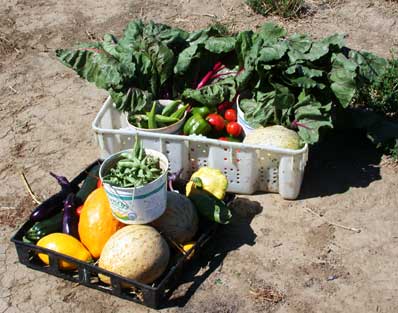 I can’t keep up. The squirrels are going to eat the melons unless we harvest them and the beans hide behind every leaf. The okra is getting bigger than is good for its being appetizing.
Very late tomato season this year, but now it’s making up for it…
15 August 11
Sunday Challah
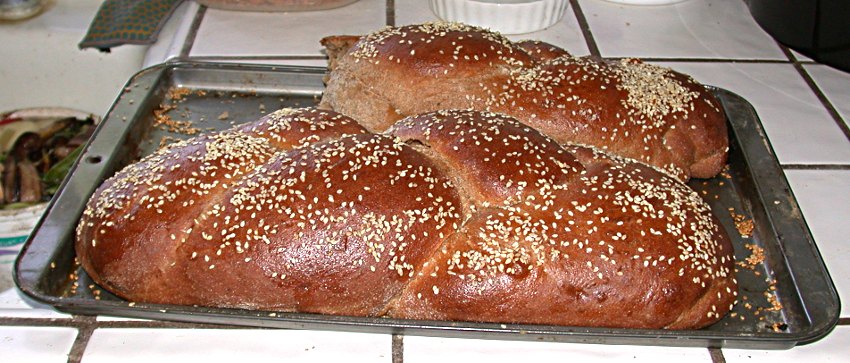 Now that I’m back from vacation in Pennsylvania, I’m continuing on with my project to work my way through the recipes in the Laurel’s Kitchen Bread Book. Today I baked their whole wheat challah recipe. Despite it being entirely from whole wheat flour, it tastes amazingly like challah. There are four eggs in the dough, and it was incredibly sticky to work with.
5 August 11
The Golden Thread
Just like studying a new language is a portal to a different culture, so is studying calligraphic hands. This week we’re studying a few of Western ones in chronological succession, to discover how (and guess why) hands morphed from rounded Romans to compressed blackletters to slanted and graceful Italics.
This is a study of the letter “o” and its shifts through time, what Sheila Waters calls a golden thread. It’s difficult and long hours and learning how to build up a discipline. I’ve decided to go home and study them all again for a much longer period, using original manuscripts rather than what contemporary calligraphers, even if they’re masters, have interpreted them as being.
Back to my rotunda, but before I go—there’s a sheep breeder up the road. She has, oh no, covered fleeces…
26 July 11
Cabinet Cat
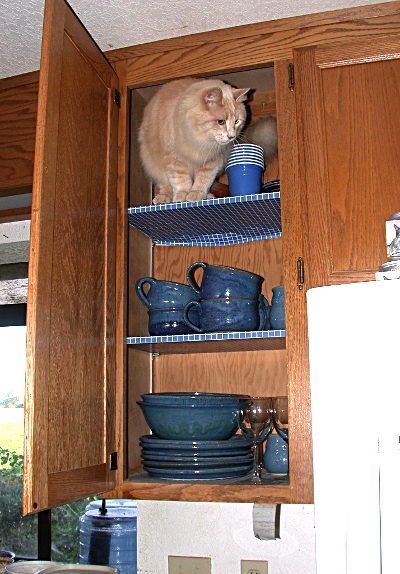 Not to be confused with Ceiling Cat or for that matter Debt Ceiling Cat.
It’s a good thing the wine glasses are on the bottom shelf.
21 July 11
Well, well, well...
… I love learning new words, but I never thought I’d learn one while watching the live Yahoo UK text feed for the Tour de France. We’ve been riveted. The Tour is at a critical stage where there are four contenders, one of them, gasp, French. But he’s a gurner. He grimaces on the mountain stages, apparently more than others on this grueling 3-week hellride. Well worth a gurn or two if you ask me.
Gurning is a time-honored tradition, celebrated by competition in the oldest fair held in the United Kingdom dating back to the reign Henry III in the thirteenth century. It means making faces. Gurners often disfigure themselves by, say, having all their teeth removed, the better to swallow their noses.
Really. See. Here.
18 July 11
Enthralled
Not having a TV, we always roam the town looking for venues to watch major sporting events. This afternoon we ended up at International House Davis to watch the Women’s World Cup final; they had advertised in the newspaper a couple days ago that they would be hosting viewing the event. They clearly are not as practiced in showing sporting events as the sports bar down the road, and Comcast was flaking out on them today, so they resorted to showing the ESPN3 internet feed. This was hardly high-def, and had the annoying habit of several times freezing at critical junctures, including the winning penalty kick! But the video feed sufficed.
We went to see the match without a strong rooting interest, mostly hoping just to see a good game. It didn’t take me long to figure out I was pulling for Japan; after the barrage of shots they weathered during the first few minutes it was clear they would be playing the role of the underdog. The game turned out to be as exciting a soccer match as I’ve ever seen. For the underdogs to equalize once, then twice, and finally win on PKs is great drama. I left very happy for Japan. Both teams are good, good teams and played their hearts out. What more does one wish to see in sport?
3 July 11
Our Local Fibershed
I went over to Robin’s this morning to talk about her Jacob sheep display for the upcoming State Fair. While I was there I noticed the beautiful Fibershed map on the wall. This features a map of wool, cotton and other fiber producers within about 100 miles of San Francisco and notes whether they are dyers, weavers, and so on.
 I conducted my first natural dye experiment on Thursday, and was enthusing to Robin about it. She pointed me to Rebecca Burgess’ new book, Harvesting Color, a treasure in itself but one that strongly encourages use of local plants for dyes (and, even better, INVASIVE ones: French broom, here I come). I’d still like to plant a dye garden, though, that would include indigo and madder and coreopsis and marigolds and sunflowers. Don’t need any coyote brush though, we already have that!!
Foxfiber is a grower of organic cotton up in the Capay Valley, definitely on my list of places to visit in any Fibershed tour.
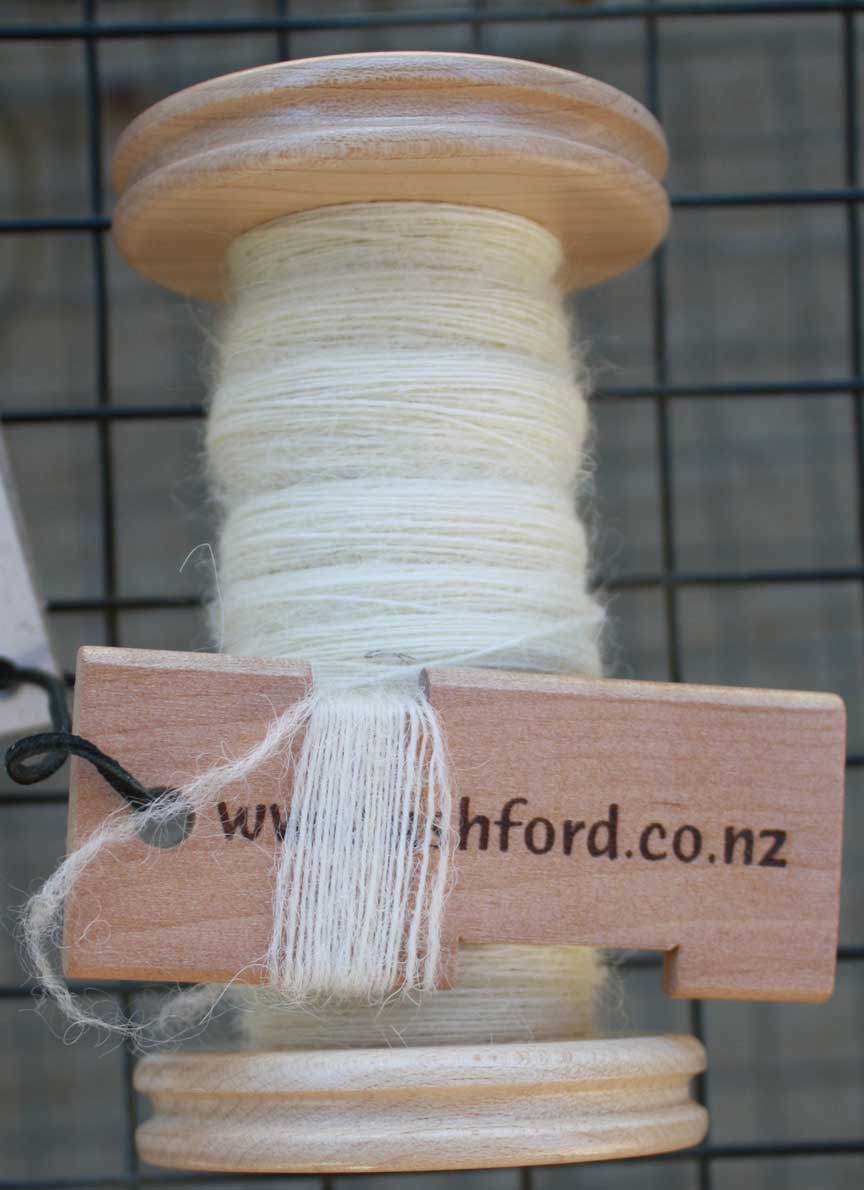 It’s the Tour de Fleece. I’m spinning my first fleece, one of Robin’s Jacobs, a ewe named Summer (how appropriate). It’s 101 degrees outside. Spinning is cooler than knitting, people…