
14 March 13
Off on a Journey
 I write from Albuquerque where I’m visiting a cousin who drove me to 10,000 ft to see three species of rosy-finch, two of which were life birds.
The train is full of things to do. I’ve been sketching like a fiend and seem never to do as many as I’d like, but there will be a good stack of pages when I’ve finished. Everyone is so friendly on the train, I’ve met some really interesting people and this is just getting started.
Connectivity is minimal though so posts will be scant.
8 March 13
As Spotted From The Bus
I went on an outing to San Francisco today, ending up at the Legion of Honor museum after taking the train to Emeryville, the Amtrak bus to the Financial District, and the 38L bus out Geary to the Outer Richmond district. The following were some noteworthy items spotted from the buses:
- A truck labeled “Matthew International – Casket Division” (note – although Matthew International is traded on the NYSE, they do not mention their casket division anywhere near their home page)
- A restaurant: Volcano Curry of Japan
- Another restaurant: Five Happiness Restaurant (why five? why not four, or six?)
- The Right Way Market and Deli
- Two closed down old movie theatres on Geary: the Alexandria, and the Bridge. The marquee on the Bridge said “SO LONG, AND THANKS FOR THE POPCORN”
- The Anti-Saloon League (established 1920)
- In fading paint on the side of a building: “E. M. O’Donnell Copper Works”
3 March 13
New Adventure
My last day of work will be Tuesday. I’ll get on a train the following week and travel across the United States seeing friends and family along the way, taking my time about it. There’s something so appealing about a hugely long train trip to mark a new phase in your life. Distance. Moving forward, ever forward. Even when you’re coming back.
I’m going to make a big change professionally and hope to use this break to get my head in the right place for that. Stay tuned!
20 February 13
It's Lambing Season
 I went over to Meridian Jacobs this afternoon to sketch the first of this year’s lambs, which were born last night. Their mothers were very wary of me and stamped the ground, but I sat on a bucket quietly and made no sudden movements, and they settled down and started eating or just resting.
 Robin had put fresh straw out in all the indoor pens and the sheep were all comfortable and snug. It’s astonishing that creatures not yet 24 hours old think it’s an appropriate thing to do to jump vertically, because they were all trying it, the lambs. Their suckling isn’t very vigorous yet but they have the tail waggle down for sure.
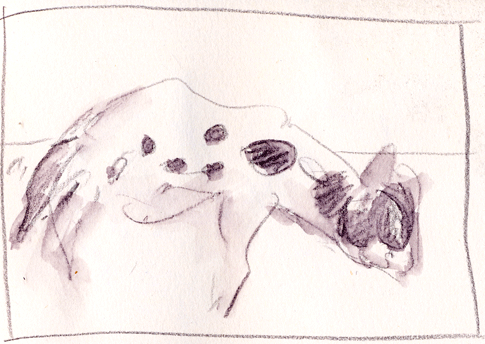 Three sets of twins… lots more ewes will be lambing over the coming days. Robin’s going to be busy. Glad I got the chance to head over there and sit quietly…
2 February 13
Bike Forth
For some reason I’m very hard on pedals, and they never seem to last more than several seasons on my bike. We had a New Year’s Day brunch to head to a month ago, and planned to cycle there. Not long before leaving I realized that the right pedal was basically about to fall apart, and most likely would not last the 18 mile round trip to the brunch. Luckily I spotted an old right pedal I had saved from an earlier iteration of pedal replacement, so I replaced the broken pedal with the old pedal, and we went on our way.
The replacement pedal, being old, decided to fall apart early this week, the body of the pedal tending to slide off the axle. This was not going to work for my commuting for very long, so on Wednesday after work I headed over to Bike Forth to rummage through the parts bins and hopefully ride off with a working pedal. Bike Forth is a DIY repair shop that is run by the Davis Bike Collective and is housed just east of downtown. Their collection of parts salvaged from innumerable bikes is large, and if one doesn’t need fancy replacement equipment for a fancy bike, it’s a good place to go to try to fix one’s bike. A member of the collective is on hand during the hours it is open to provide repair tips and to collect a modest donation for the time spent in the shop and parts used.
I found a suitable pedal readily and quickly swapped it for the broken pedal — it couldn’t have been an easier bicycle repair. After 10 minutes and a $5 donation I was on my way. Not all bike problems I want to try to repair myself, but for those I know I can fix, it’s great having this option in town.
27 January 13
Sketchcrawl
 On Saturday we joined the Let’s Draw Davis crowd for a sketching outing in and around central Davis. There seemed to be a fuchsia flashmob going on, which I failed to draw. (When I asked one of the fuchsia-clad participants, they denied a flashmob; maybe it was just such a beautiful day everyone wanted to dress brightly.
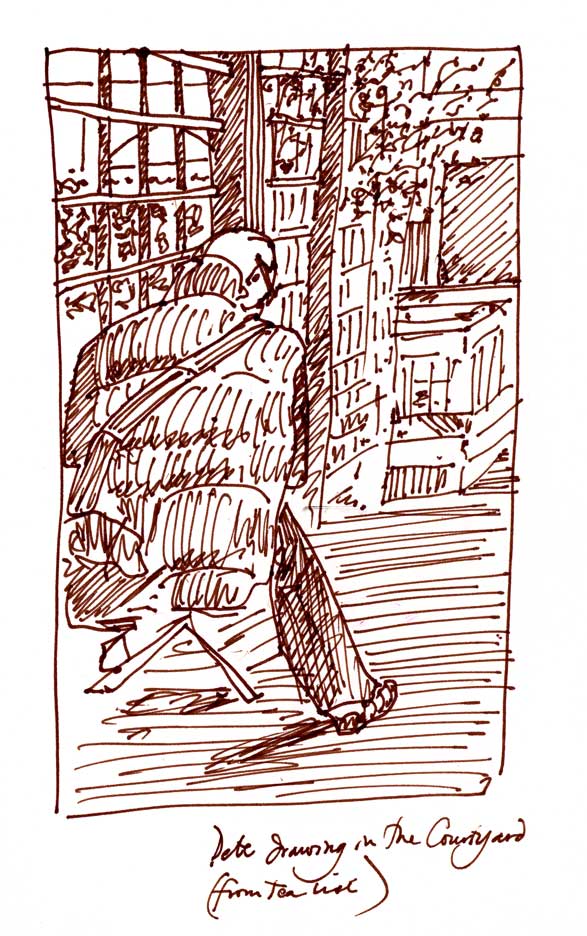 I sketched Pete Scully sketching in the courtyard where the Tea List has a few tables outside, but mostly it was good to feel the sun on my face. I didn’t use any color on the paper, though, just the sepia fountain pen on paper that will not take any kind of wash. Next time I’m going in color.

14 December 12
A Mathematical Dabbling Duck
This has been a good week for me in terms of learning a bit of math. At work I’ve been posed with a question that turns out to be an instance of the set covering problem, and this has taken me on a whirlwind tour through a bit of graph theory, computational complexity, and integer linear programming. (Of the latter, for months now we’ve traveled past a sign on campus announcing a workshop on mixed integer programming, not knowing that it would be my fate to learn enough of the stuff to contemplate setting up the formulation of such problems on a computer.)
I’m not great at math, but I do enjoy mathematical thinking. I do a lot better when I am able to see a problem in visual terms, and tend to stumble when faced with an onslaught of lots of notation. It is nice that we’re in an era where there are lots of excellent books at all levels about math being written that are aimed at non-mathematicians. Right now I’m slowly reading through Cristopher Moore and Stephen Mertens’ massive but highly-touted tome The Nature of Computation. The study of computational complexity is profound and deep stuff, and even if I don’t follow most of the details there’s a lot I can get out of the book.
8 December 12
New University of California Logo: Infantilizing the Academy
 Curious timing for the release of the new University of California’s branding campaign: Friday afternoon, and Friday afternoon during skiing season, when it may well have gone unnoticed by many.
In twelve hours there were 5,000 signatures on a petition to withdraw the new logo. Comments have been exasperated, some have been hilarious, almost all of them have been unequivocally negative.
It’s a difficult design task, to come up with a logo (this isn’t a replacement, the university seal has never been a “logo,” but formed part of a mark that included the motto “Fiat Lux”) that encompasses the land-grant mission across ten campuses, that draws on a tradition of academic excellence that includes 59 Nobel laureates. I’m not sure I would have been up to the task. That said…
My issues? The logo looks like one more suited to a children’s book publisher, specializing in under-three-year-old fare. (Not to mention the spiral C swirling down the drain, which at least is honest.) It’s like a radioactive millipede. Call me an old fart, but I still think university branding ought to involve some sense of gravitas, something that reflects the tradition and importance of the academic endeavor. Unless you’re peddling bought degrees to illiterates. This logo mocks the exorbitant fees charged of undergraduates. If I were one of them, I’d be seeking a transfer. Now.
This logo is like one of those sadly ill-advised uniform changes of baseball teams in the 1970s. Is this what we want? People laughing their socks off in forty years over the “ten worst university logos of all time,” which this would surely top? The rotund “c” does harken back to an earlier time, to be sure, but perhaps not one we should be all that enthusiastic about replicating: 1970s mass-culture design, finally breaking free of helvetica’s black-and-white austere totalitarianism of 60s high culture, playfulness much loved by Dunkin Donuts (note the interesting spelling, maybe we should copy that, too) and burger establishments, it’s a shameless dumbing-down.
As a member of the University of California community, a venerable public institution under fire, reeling from years of budget cuts, whose state just mere weeks ago voted to TAX ITSELF in order to save its infrastructure of education from complete devastation, I am disappointed. I’m actually quite angry. I’m signing the petition. Not that I think we have any chance whatsoever of stopping the purveyors of watered-down Ikea-like dreck from completing the task of rendering the university irrelevant; I’m just sad to think they’d do it so blatantly.

December 17, 2012: The University’s Office of the President has withdrawn the logo in the face of the opposition because it’s causing “a distraction.” Defensiveness (and there’s plenty of it) aside, they should be commended for paying attention.
7 December 12
Twitter After Two Days
Last Saturday there was a thread on MetaFilter comparing Twitter and Facebook, linking back to among other things a piece by MetaFilter founder Matt Haughey on why he loves Twitter but barely tolerates Facebook. I am not now on and am not likely to sign up for Facebook in the foreseeable future, but the arguments in the piece for why Twitter can be a lot of fun made sense, so I’ve decided to give it a whirl. Several observations after a couple of days:
- The Internet is in the constant habit of repackaging old wine in new bottles. The Wikipedia page for microblogging under “related concepts” says that “in the Finger protocol, the .project and .plan files are sometimes usedmaking for status updates similar to microblogging.” Change the verb there to were used and you might have something there — that particular protocol was used in a far more innocent age of internetworking. Much more recently, we have RSS. A lot of the niche Twitter fills (rapid aggregation of news) is also carried out by RSS, but Twitter seems to have displaced RSS for a lot of users.
- If everybody and their grandmother literally is on Facebook, the proportion of active Twitter users still seems pretty low. Many organizations that one would expect to have a Twitter feed have yet to adopt the platform.
- That said, at least in my fields of interest, enough experts are actively posting links to new content via Twitter that it is clear that the platform is quite valuable in keeping track of professional developments.
- I really like the fact it’s not much effort for me to play too. I see a blog post I like, I tweet it, and make a pithy comment.
- It may be rare to find, but 140 characters or less of text can express the sublime.
5 December 12
An Adventure in Felting
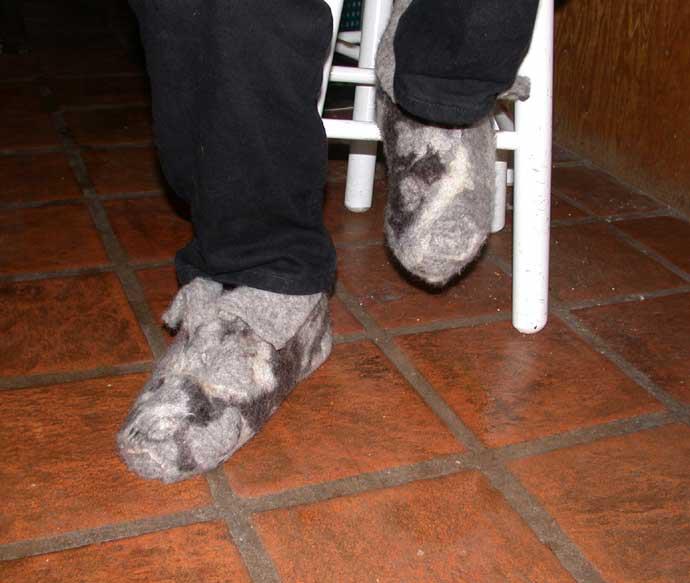 At the Fibershed Symposium in November I was entranced by Some felt at Robin Lynde’s booth: the surface was unmixed, unsorted pieces of a Jacob fleece. I was having visions of making myself a jacket from this beautiful fabric.
When you process wool there can be a lot of waste. I don’t like to throw away my drumcarding or combing waste, but up till now have just been hanging on to it. Well, a wet felting session over at FARM 2.6 gave me the perfect opportunity to try out the technique on a small scale.
We made a resist for slippers using boots as a template (felting shrinks the wool considerably, so rubber boots are a good model). I made these slippers for Numenius using Suffolk as the first two layers and ending up with Jacob on the surface.
Felting is a lot of work and requires some upper-body strength! I decided to add to the punishment by kneading some sour dough afterwards last night…