
13 October 25
Puzzles
 My mother collected postcards from wherever she went throughout her life, and used them in her latter years to send notes to people where she lived — notes about who has the bridge scorepad, or enclosing some of her recent writing, or just happy birthday. She offered me a huge stack of postcards when I was there last year, which I took happily (Postcrossing is a passionate hobby of mine).
There were lots more, though, which I picked up and deposited in the box I was sending back to Davis last week. One was partially written to “Pete.” I think I know who Pete is: her date at a dance, the only person tall enough to dance with her, or maybe he wasn’t, but he later went on to work for NASA or somewhere fancy. She was traveling around Europe with her friend Marianne, and this postcard is of the Place de la Concorde in Paris, black and white, serrated edge. In her cryptic style (which got ever more cryptic as the decades passed), she writes: “Dear Pete – Am ver’ sorry I haven’t written in such months but what I have to say would burn up the page – so I’ll tell you all about the rivers valleys and sunsets again & let you guessabout the rest. We have been to Nice which is ideal for peoples like you – there are islands all over & you can sail between them till you get out into the Mediterranean” [text ends abruptly here, though more than half the available space is left, no address is written in]. I’m guessing the year is 1954.
I don’t think she liked Pete much, and I’m wondering if this was a draft of a dear John postcard, which I can’t imagine her sending, because that’s like breaking up with someone by text (which everyone including the mail carrier can read). I wish I could ask her about this, but this is my life now: wondering about things (mostly trivial) I could have asked but never did. Whoever you are, Pete, I hope you found a good life partner, someone who respected and valued you. And I hope you respected and valued them.
12 October 25
Fruit Bowl
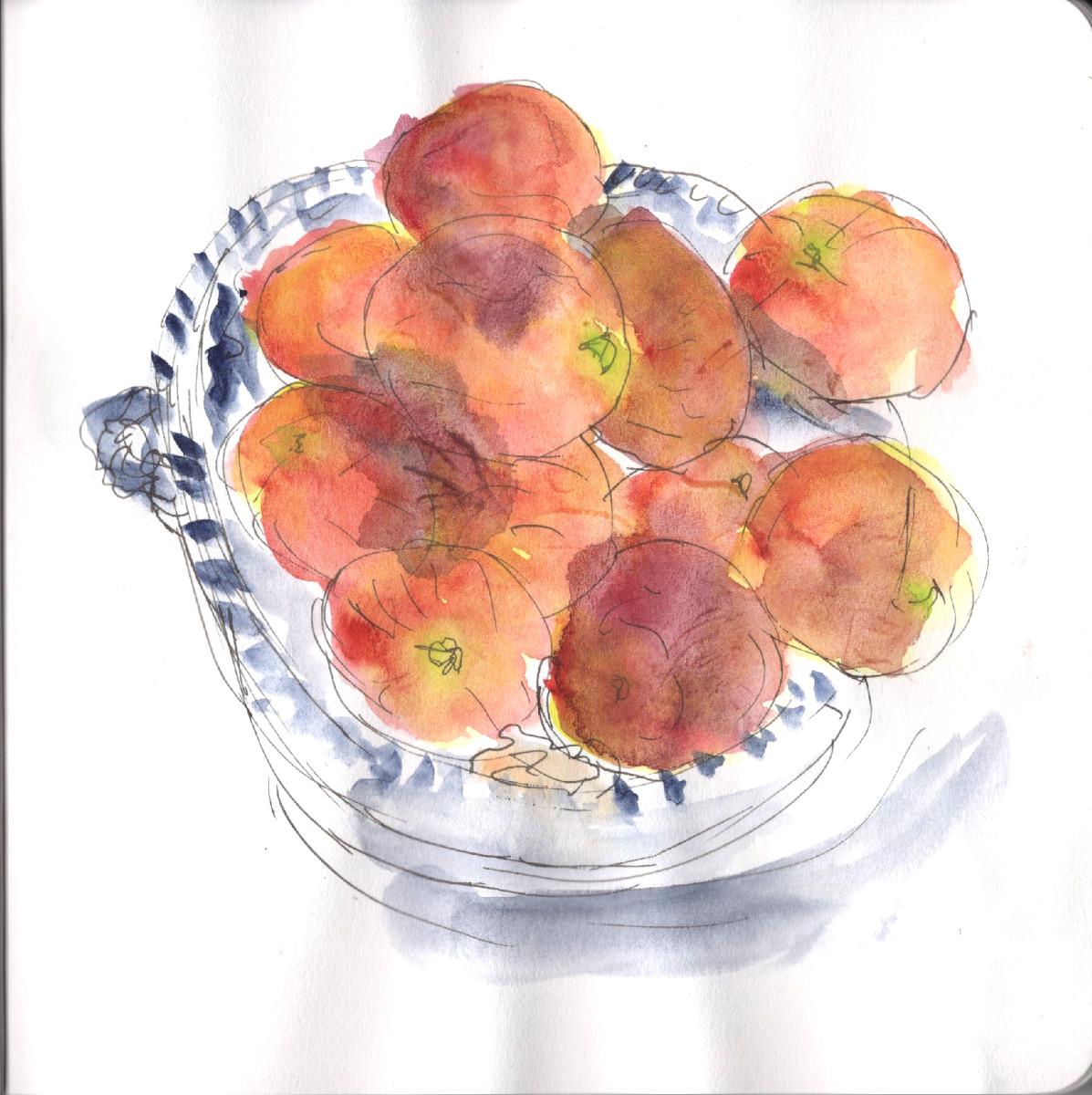 We have a complete set of 24 of the Derwent Inktense paint pans, and I have been testing them out a bit. Here is a sketch of some apples in a fruit bowl using the Inktense pan colors.
11 October 25
Unpacking
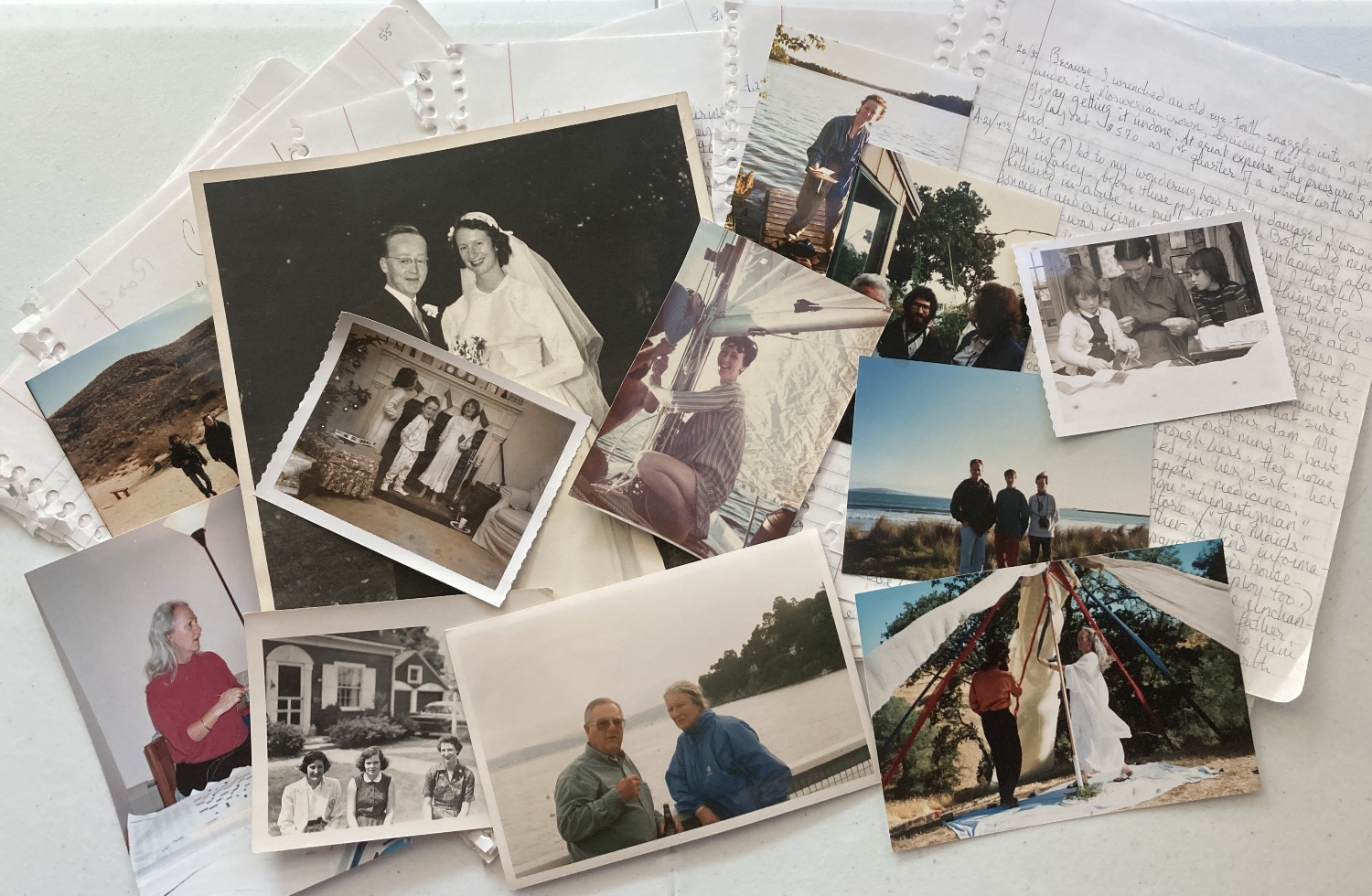 When I was at my mother’s with my siblings, we went through literally thousands of photographs. Some of this was while she was still alive, a fun trip down memory lane, camping in Spain or visits to our boarding schools in England and then many photos of California once she and Dad had moved back. She usually got two sets of prints of every roll of film she took, and she took lots of rolls (she must have culled a lot of my father’s photos a long time ago).
I’m not sure what to do with what I brought back, a tiny sample of photos mostly of her and of me, but it was another exercise in memory, nostalgia, and yes, loss. I am waiting to go through the writing of hers that I brought back, since I did a lot of that while I was still in Maine, recycling or shredding a lot of duplicates or writing by others.
Curation and archiving is an interesting activity, especially when you’re not sure what the purpose is. I will let these things sit a while until I’m more clear (she did ask specifically that I read, and then shred, some of her journal writing).
10 October 25
Tis The Season
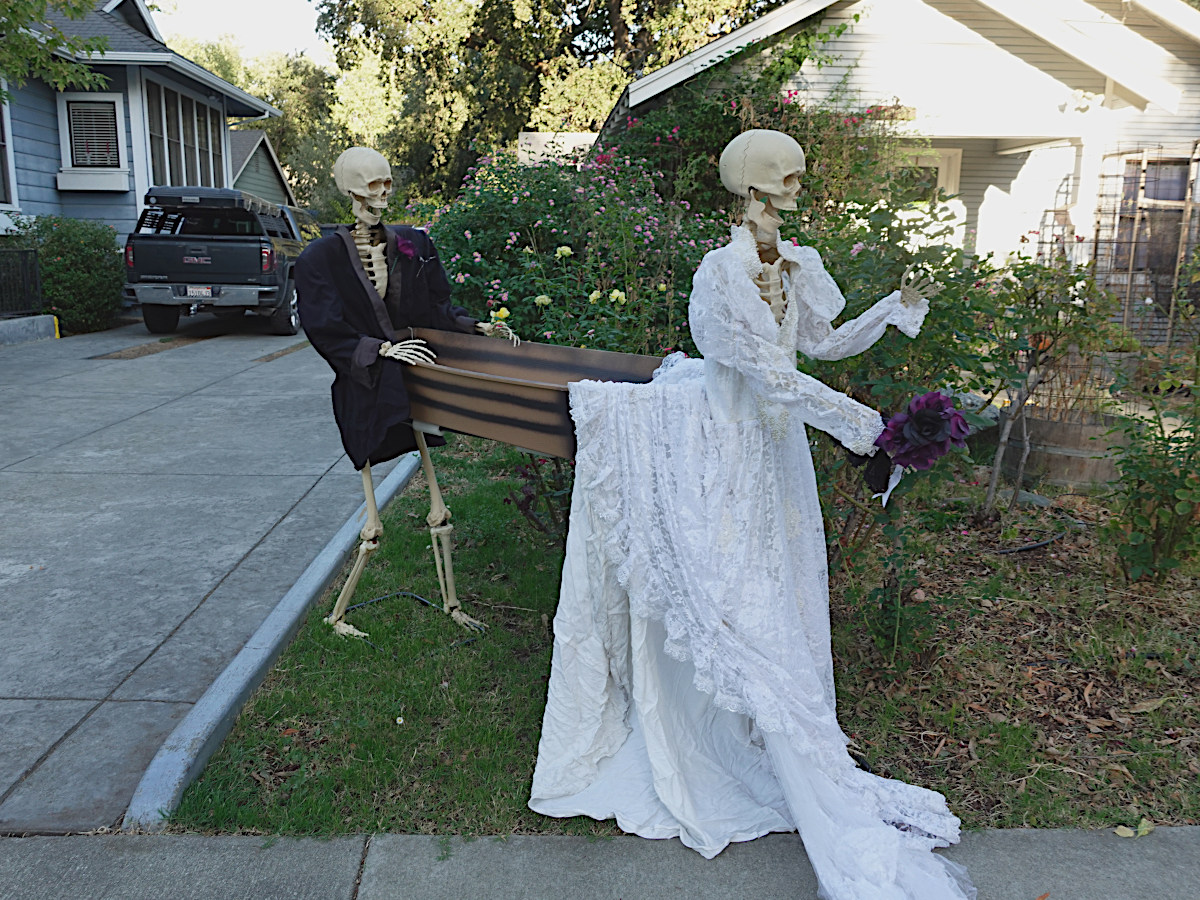 In October I inevitably take lots of photos of Halloween decorations. Here is a photo of a couple of skeletons that I met on a recent walk.
9 October 25
Zettelkastening Comics
I was interested to read Numenius’ blog post from yesterday. I am drawn to movable pieces, whether written or drawn, and wonder how this might help in construction of a comic.
An important feature of a comic is that there be sequential panels, whether or not anything is written on them. But the number of panels, their size relative to each other, and even where they appear (cliffhangers work better if positioned at the bottom right hand of a recto page, at least in Western traditions, for instance), can all be worked through if ideas and panels are assembled as movable pieces.
I have a lot of index cards and at least three projects currently in the works on cards, held together with rubber bands. None of them is very large which helps. But this is giving me a lot of ideas about how to work, specifically with how to structure thought.
8 October 25
A Zettelkasten Adventure
A major part of my eighth grade English class was being taught how to write a research paper. In my recollection, there were two big elements to what we were taught: the first element was developing a formal outline for the content, with topic sentences for each major and minor point, and the second element was a system of notetaking using notecards, where we would write out individual ideas and quotes from our sources on separate notecards and later be able to sort them into an order that made sense for writing out the paper. In retrospect, I don’t think this notetaking system differs much from what nowadays goes by the name of the Zettelkasten method.
(I was quite happy with how my research paper turned out, by the way. I was very interested in World War One aviation then, having spent a lot of time playing the boardgame Richthofen’s War, so my paper was on fighter tactics in World War One. I was pleased because I knew enough to be looking at original sources, especially pilots’ memoirs.)
There are lots of variations on the Zettelkasten method, but a couple points seem key. First, each notecard contains a single atomic concept. Second, there is an indexing system in place to allow individual notecards to link to other notecards; that is, it’s a hypertext system.
Some of the practitioners of the Zettelkasten method in the analog era would accumulate massive collections of notecards, for instance the German sociologist Niklas Luhmann created a Zettelkasten of about 90,000 notecards which he used in writing 50 books and over 600 articles. The digital era makes the process much easier, with a number of different software systems available for creating Zettelkasten, and if nothing else one doesn’t end up needing to get cabinetry to store all the notecards.
I have just started a new Zettelkasten since I have many research ideas but am a long way from turning these into essays and the like and need to be taking a lot of notes. (A current research project is learning about empires and the rise and fall of the nation-state.) For now I am using a software package called Zettlr, though there others I might explore as well. I’ve used Zettlr previously to help me write my last paper when I was working at the university. One thing that is nice about Zettlr is that it integrates well with citation management systems such as Zotero, which I have been using for many years.
With this Zettelkasten I am beginning a new practice: make sure to write a couple notes into it every day. This could be taking notes on an essay or paper, interesting quotes, or just general thoughts. We’ll see where this all goes in a little while.
7 October 25
Lessons From My Mother On How To Die
a) understand exactly what you want
b) communicate this, over months or years if necessary, to your loved ones. Repeat.
c) continue to learn your options because they change over time and over your health condition(s)
d) keep a sense of humor about it all
e) filing? damn the torpedoes… (actually, no. Don’t damn the torpedoes. Mum’s filing system must have made sense to her, but we are continuing to find surprises)
f) try and keep your marbles; it expands your options (see item c) above)
g) write your own obituary. Ask for help if this seems overwhelming.
h) be clear about who you want to be present, and almost more importantly, who you DON’T want to be there. Appoint a gatekeeper if necessary.
i) let there be ice cream.
What I wish:
Is that she hadn’t told us all not to cry. As Gandalf says, “not all tears are an evil.”
6 October 25
Jazz Band
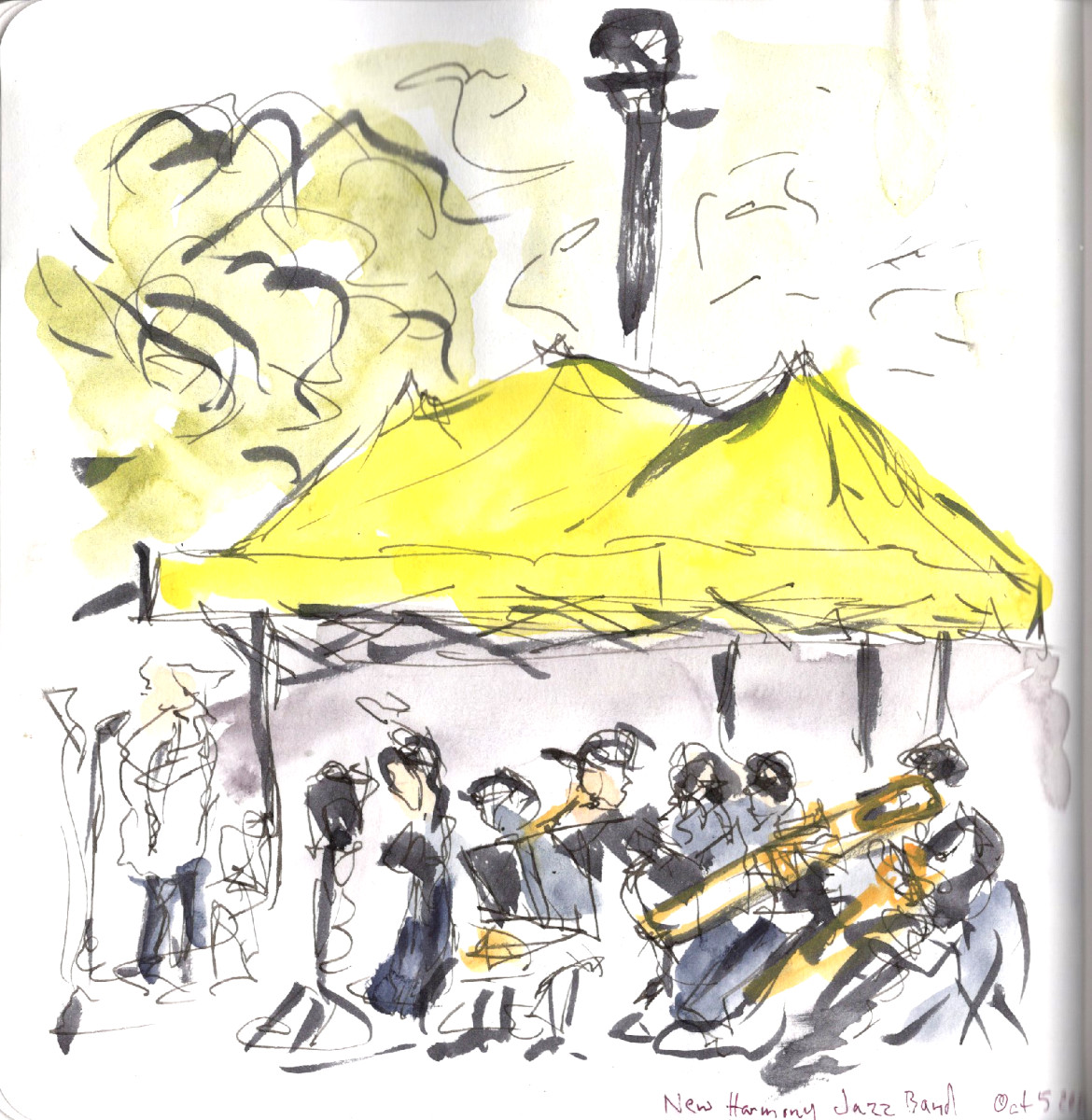 This is my urban sketch for this past Sunday. I went over to Central Park where the biweekly Davis Craft & Vintage Fair was taking place. The local New Harmony Jazz Band was playing at one end of the fair, as they often do.
I am getting used to sketching in this 7”×7” sketchbook. It’s a little bigger than what I’ve been sketching in previously, but this lets me be freer with the sketches. I like the combination of fountain pen fine line work with a gray Pentel brush for bolder ink strokes. I am still pleased with the Derwent line and wash kit. It was nice to have that bold Inktense yellow handy for the tent canopy. And I figured out how to mix skin tones with the paint pan set: I used a combination of poppy red with the mango Inktense colors.
5 October 25
The Call of the Loon
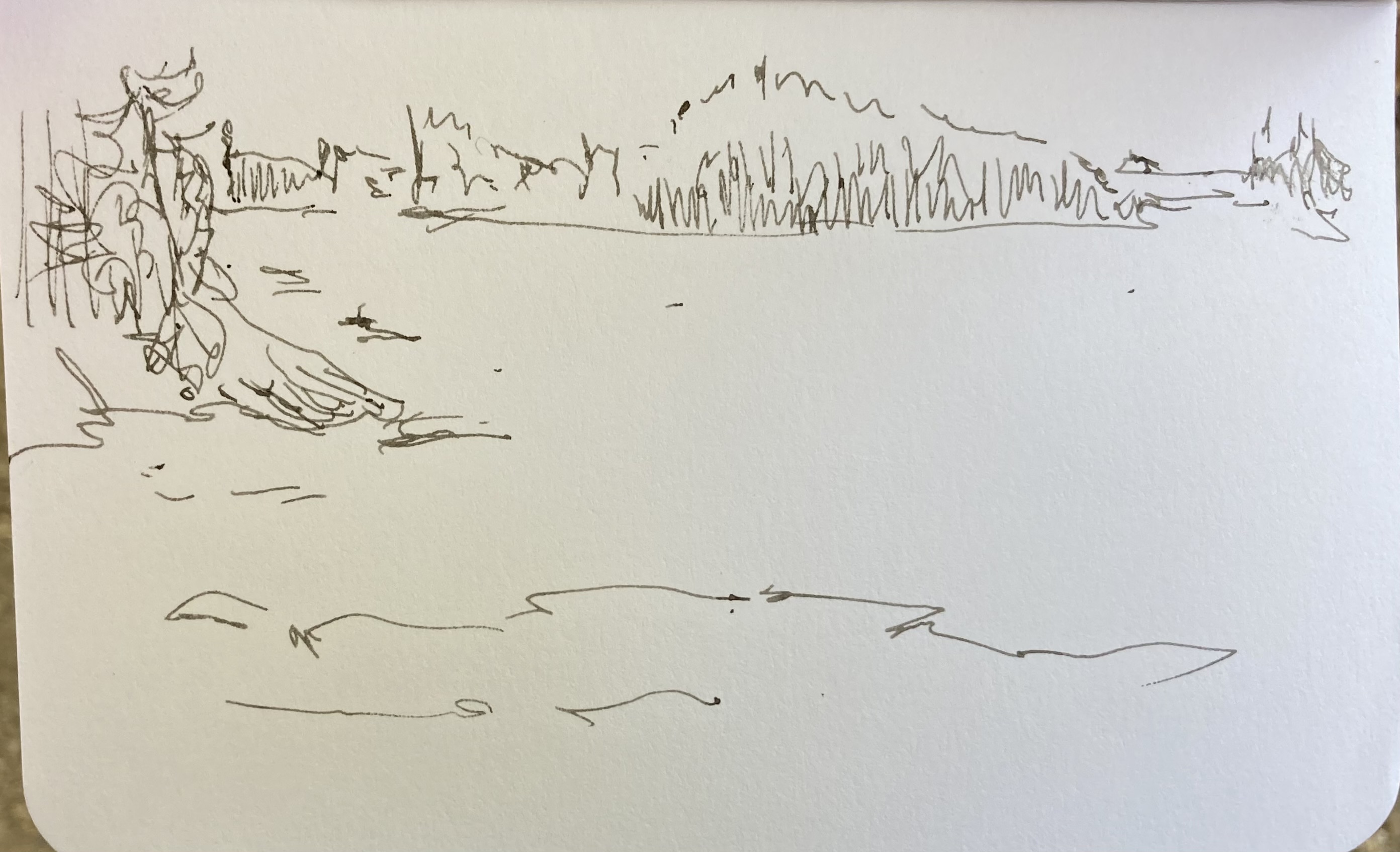 This past week has been very busy with getting things packed up, distributed to various places, visits to lawyers and accountants and funeral homes, all the kinds of things that need to be done and nobody much feels like doing.
We did take a break, though, on Friday morning, to distribute mum’s ashes along with the remaining ones of my father. As we walked silently back to the car, a couple of loons began to call.
Mum kept her sense of humor to the end: writing “sayonara” on her calendar to all future doctor’s appointments, she really left on her terms and on her schedule. I will be making a donation to Maine’s Death With Dignity foundation.
4 October 25
Discovering A Prophet
I had a meaningful Yom Kippur this week, and through some supplemental reading (the group the Halachic Left’s collection of essays for this year’s High Holy Days) I discovered a Jewish theologian I need to dive into, namely Marc H. Ellis. He was one of first people to develop a Jewish liberation theology, especially in the context of Palestine. The notion that Jewish liberation can only come about through the liberation of the Palestinian people is a theology that traces back to Ellis, who started writing about these themes in the 1980s. (He died in June 2024).
It is not surprising I have not heard about him before; his work has been shunned by mainstream Judaism. This essay by Zev Mishell introduced me to him. I particularly like his concept of “Constantinian Judaism”, which is to say that Judaism is now a religion of empire. There was also a series of remembrances of Ellis written up in Contending Modernities, a web publication from the University of Notre Dame.
Lots to read as always.