
23 October 25
Can't Get You Out Of My Head
One of the things I noticed about my last few days with my mother was how often she brought up the name of “the Colonel,” the husband of her Aunt Eleanor, who had rowed over to great-grandpa Sam’s boat with a shotgun saying he was taking Eleanor to marry.
This man was volatile, irascible, and in his later years blind, and my grandmother went to his house regularly to tend to him after Eleanor died of breast cancer. My mother once told me the story of how he had tried to kill her when they were all staying at a house in Acapulco — she was so frightened she jumped out of the window into the scorpion-infested night and pounded on her parents’ window. Whether this actually happened or not is irrelevant: she was deeply traumatized and this man occupied space in her head up until the end.
Would therapy have helped her? Who knows? She was so fond of one of her cousins, Henry, but seeing him necessarily meant being in the company of the dreaded Uncle Edwin. Who insisted that his staff answer the phone with “the Colonel’s residence, this is the maid speaking.”
We are no strangers monstrous men. One of them is even president. But let’s not give these reprobates any more power by allowing them room in our heads. Mum, I wish you could have been free of this. I never met the guy but I hate him on your behalf…
22 October 25
Pondering Neo-feudalism
As I remarked in the notes on my imagined board game, I am drawn to the term “neo-feudalism” to describe the set of transitions that are underway now. This is despite “feudalism” not being a term very much in vogue among medievalists these days. (David M. Perry and Matthew Gabriele discuss this here, referring to a classic article from 1974 by Elizabeth AR Brown that reviews how the concept of “feudalism” has never been very well defined and does not account for the great variety of medieval social systems across time and space.)
I think my use of the term “neo-feudalism” refers more to economics rather than a social system. It’s not the relationship of mutual obligations between lords, nobles, and vassals that is being replicated now. Rather it is much more akin to land ownership by nobles who capture the wealth of serfs..
In short, I believe that capitalism as an economic system is coming to an end now or has already ended. (When people write about “late capitalism” they don’t seem to mean this, rather their usage is more like “the system in its current incarnation”) One writer who believes this is the economist Yanis Varoufakis, who has come up with the concept of technofeudalism. In his view, tech companies function like modern feudal lords. They make their money via rents rather than producing goods. For instance, Apple makes 30% profit (or something like that) from producers and consumers just for the monopoly privilege of selling apps on their app store.
A second argument is not one that Varoufakis makes, but seems clear to an environmental scientist. One of the oldest sayings in environmental science is that “you can’t have infinite growth on a finite planet”. The upcoming decades will be the ones where we hit profound limits to growth. Tom Murphy discusses the physical limits in a 2022 paper in Nature Physics. For instance, our energy use has been increasing at a tenfold rate over the past century, and this rate simply cannot continue (in four hundred years we’d be boiling due to waste heat). There is also a limit to which economic activity can be decoupled from physical activity.
But a capitalist economic system is primarily about one thing: return on investment. If growth is no longer to be had, the financial system will necessarily start to break down. To be replaced by some other economic system that no longer is demanding returns of 3, 4, 5, 8 percent and so on. I don’t know what this new system will look like, but it seems it will be a lot more static than what we have now. An economic system based on capturing rents rather than producing goods. “Neo-feudalism” seems evocative, if nothing else.
21 October 25
Alone Again
One of the central tenets of The Artist’s Way is that you take yourself on a weekly “artist’s date,” which is basically spending two hours, alone, doing something you like to do. The idea, as I understand it, is to make time for fun and not be beholden to the wishes of others.
I took myself off to Mishka’s, a coffee shop some blocks from our house (there are certainly lots of closer coffee shops, at least five, not counting Starbucks which seems to have closed down), but this one makes excellent coffee, has a great European vibe, and has a lot of outdoor seating. I got my cappuccino and worked on a project for an hour or so and then went across the street to the Avid Reader, our local independent bookstore which changed hands a few years ago and is now one of the gems of Davis.
Intensely social, I have not often sought my own company, but it turns out I like it. Maybe this is a function of age or that we all got used to isolation during COVID or something else, but I am finding myself planning other ways to spend fun time alone. I have to go to Berkeley next week; this is an excellent opportunity to spend a couple of extra hours doing something fun: it’s about building a restorative practice.
20 October 25
Perceptual Crisis - The Board Game
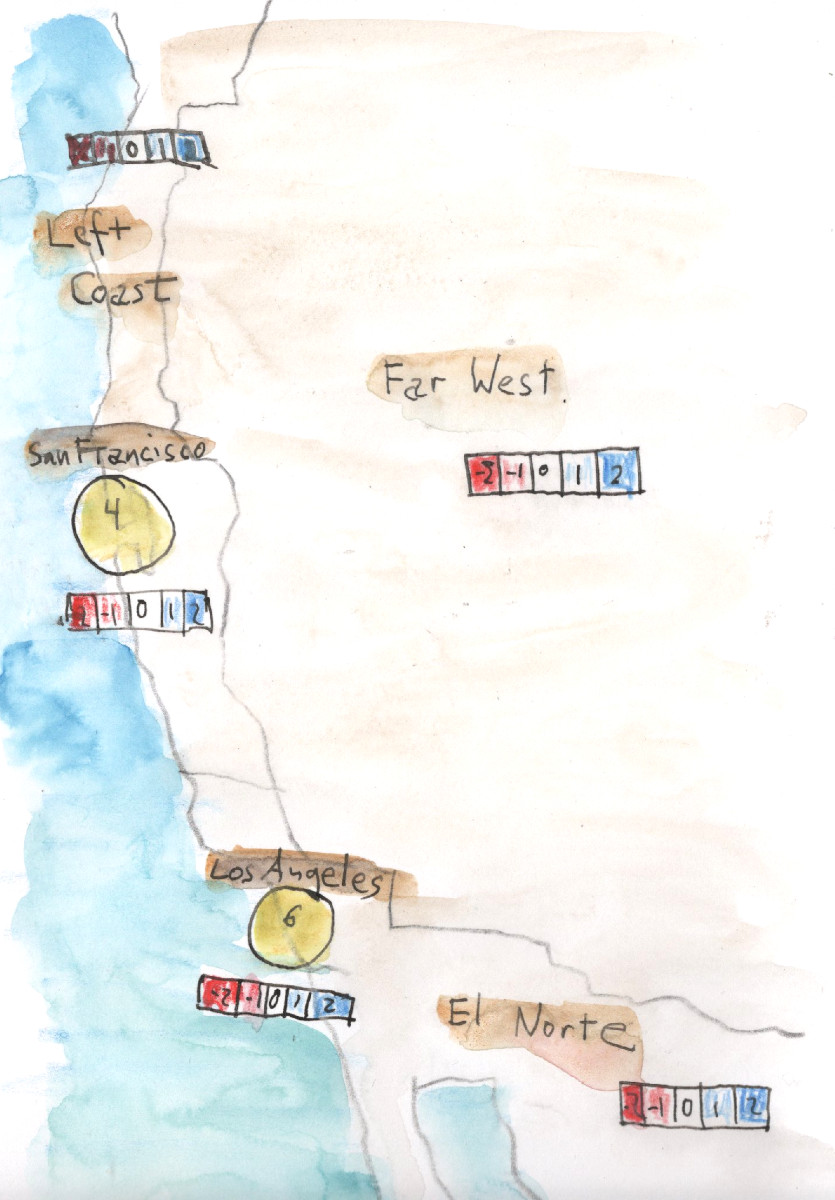 I am not a board game designer and the thoughts below do not constitute an intent to design such a game, but I am wondering what a board game about the current political situation in the United States might be like — let’s name the game for now Perpetual Crisis.
There are lots of board game antecedents to draw upon, even in the fairly limited space of United States political history. One example is This Guilty Land, designed by Amabel Holland, which is about the political struggle over slavery in the antebellum United States. One player’s role is “Justice”, and the other player’s role is “Oppression”. Another game of note is Votes For Women, which is about the campaign for women’s suffrage starting in 1848 and running until 1920 with the passage of the 19th Amendment. A much more tightly defined game is 1960: The Making of the President, about the presidential election of 1960 (Kennedy vs. Nixon).
Also of interest are COIN games (short for COunter-INsurgency), which are a series of simulation games covering asymmetrical conflicts such as insurgencies and often featuring up to four factions. (An example of a COIN game is Cuba Libre, about the 1956-1959 Cuban revolution, with four factions being the Batista government dictatorship, the syndicate aka the mob, the student protestors aka the Directorio, and the Fidel Castro-led guerillas.) A lot of the mechanics I’m imagining for Perpetual Crisis comes from COIN games.
I think Perpetual Crisis would be a two-player game though. One side would be those striving for a liberal multicultural democracy, the other side would be the white supremacist neo-feudalists. (I recognize that feudalism is a concept very much in disfavor with actual medievalists these days, but neo-feudalism does seem to capture both the rural power base of far-right farmland owners as well as the technofeudalism of the Silicon Valley types.) The sketch map shown at right for the board is very much inspired by COIN games. This would be an area control game with the areas being a combination of culture regions of the United States as well as major cities. (Here I am drawing from the 11 culture regions put forth by Colin Woodard in his book American Nations; the regions on the sketch map are the Left Coast, El Norte, and the Far West). Having major cities as separate areas to control in addition to the culture regions helps capture the rural-urban political split.
The horizontal five-box tracks on the sketch map hold a token to track the sentiment of each region or city. This ranges from +2 (strong democratic sentiment) to -2 (strong neo-feudalism). As players take actions in the game, the sentiment tokens will shift left and right on the tracks. I could also keep the COIN mechanism of players pulling cards from an event/action deck during each turn. Shuffled into the deck would also be cards representing special election turns, with the outcome of the election causing changes in the abilities of either side. The result of the election would depend in part on summing up the sentiment of the populations of both the culture regions and the major cities. (The numbers 6 and 4 on the sketch map indicate the population of Los Angeles and San Francisco respectively).
COIN games feature a quite asymmetric palette of actions to take depending upon the faction, and that works well in this framework. For instance Vote Suppression or Political Violence would be a couple of the actions the neo-feudalists could take, whereas the democracy side might have Rally or Get Out The Vote as two possible actions.
So what is happening right now in game terms? The neo-feudalists are carrying out Terror actions in Chicago and in Portland. I don’t think those actions are degrading democratic sentiment in either of those cities, but it may be strengthening neo-feudalist sentiment in other culture regions. The actions are also reducing capacity on a resource track, due to the negative economic impacts of deportations and suppressing immigration. Meanwhile, No Kings 2.0 could be represented by the play of a Nationwide Rally event card. This might increase democratic sentiment by a point in several regions or cities.
That is just a start in imagining this game. There is probably a place in the game for several resource tracks that work at a nationwide scale e.g. one tracking propaganda levels, another economic health, and another being quality of governance. So in each turn players could take actions that affect the nationwide resource tracks or those that impact specific regions or cities on the board.
19 October 25
Alone in a Crowd
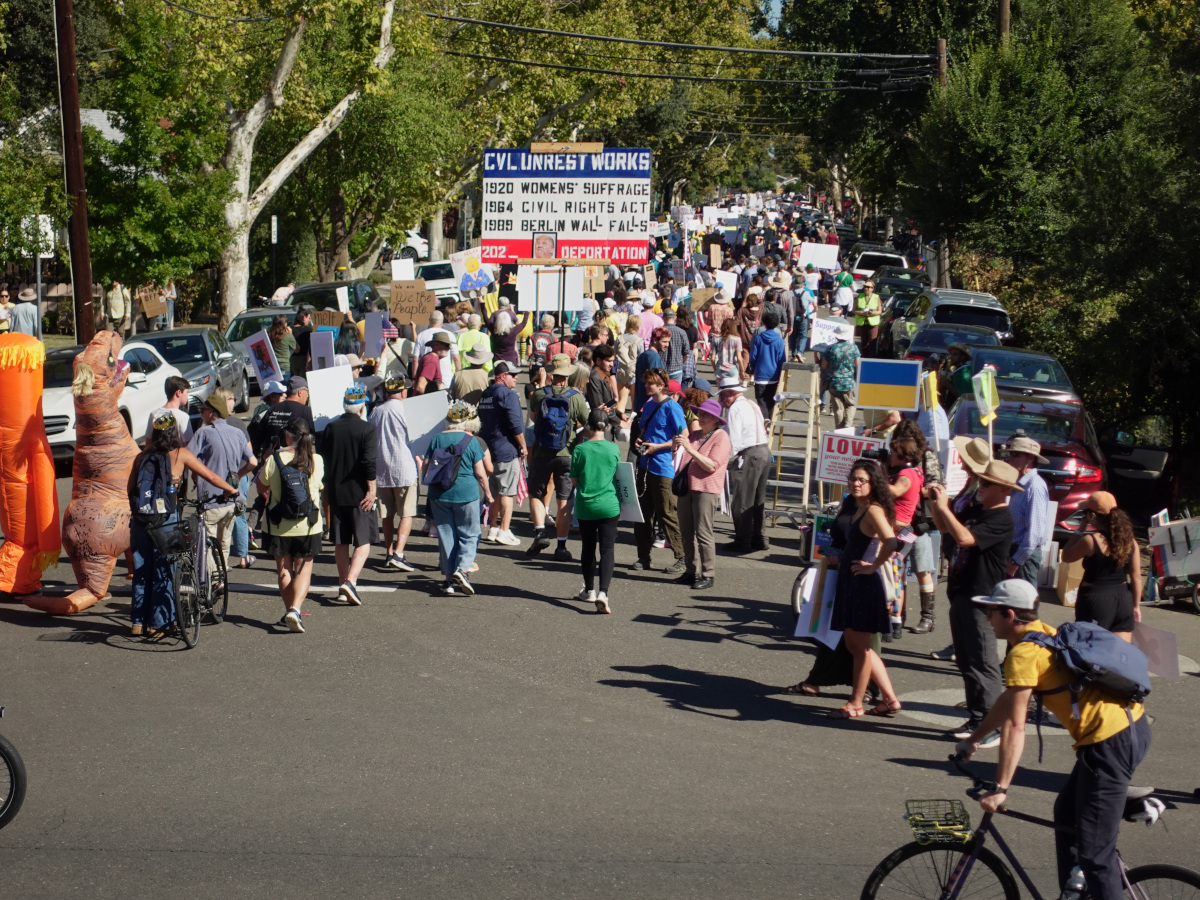 As Numenius mentioned yesterday, we attended the No Kings rally in Davis. He peeled off early from the march, but I stayed on almost until the end. I did see people I knew over the course of the couple of hours that I attended, but mostly I was surrounded by people I didn’t know.
There is something very comforting about being alone yet in a crowd. I am someone who has always sought the company of others, but I’m learning, in my advancing years, to enjoy my own company. Maybe this is why people like to study in coffee shops: to be there, surrounded yet alone. It’s a particularly urban experience I think.
18 October 25
No Kings 2.0
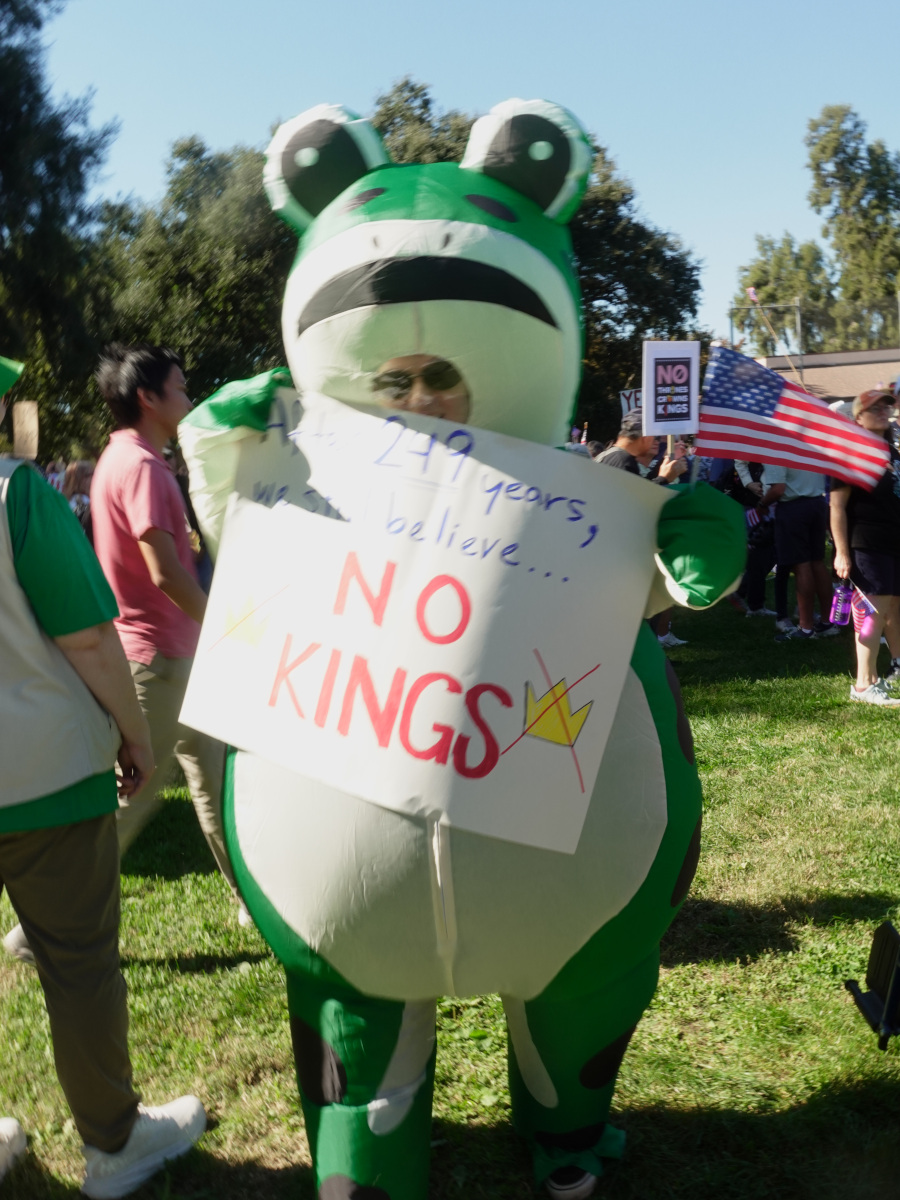 We went to our county’s No Kings 2.0 protest which conveniently took place within walking distance for us. I am still getting over COVID so I participated wearing an N95, and didn’t do the entire march. It was a very good crowd; I saw an estimate of 4,500 people.
The goofy-eyed inflatable frog has become an icon of the resistance in the past several weeks, and I saw several of them at today’s protest. Going after Portland might have been a strategic mistake by the administration, as Portland’s penchant for weirdness has generated a lot of good resistance iconography for everyone to use. Sarah Jeong wrote an interesting essay several days ago about the significance of the frog, and how it has been an effective counter to the aura farming of the militarized federal agents.
The Frog is ludicrous. The Frog makes no sense. The Frog is a viral symbol of resistance against the Trump regime, and the key to understanding what has happened to discourse in the second Trump presidency.
17 October 25
Tasks Left Undone
I know everyone talks about all the bureaucracy and paperwork associated with a loved one’s death, but I guess I thought we managed to get most of it done while were all in Maine.
Ha.
I spent a good three hours on the phone today with my siblings and various other entities, mostly to confirm that an account had been closed or at least that there was nothing left in it.
Mum tried so hard to leave everything neat and tidy for us, but when the companies she dealt with changed their names or changed ownership so many times she lost count, it has ended up being a bit of a muddle.
After the cat threw up a hairball I decided I’d had enough and took myself off for a brisk walk. I recommend it.
16 October 25
A Good Drying Day
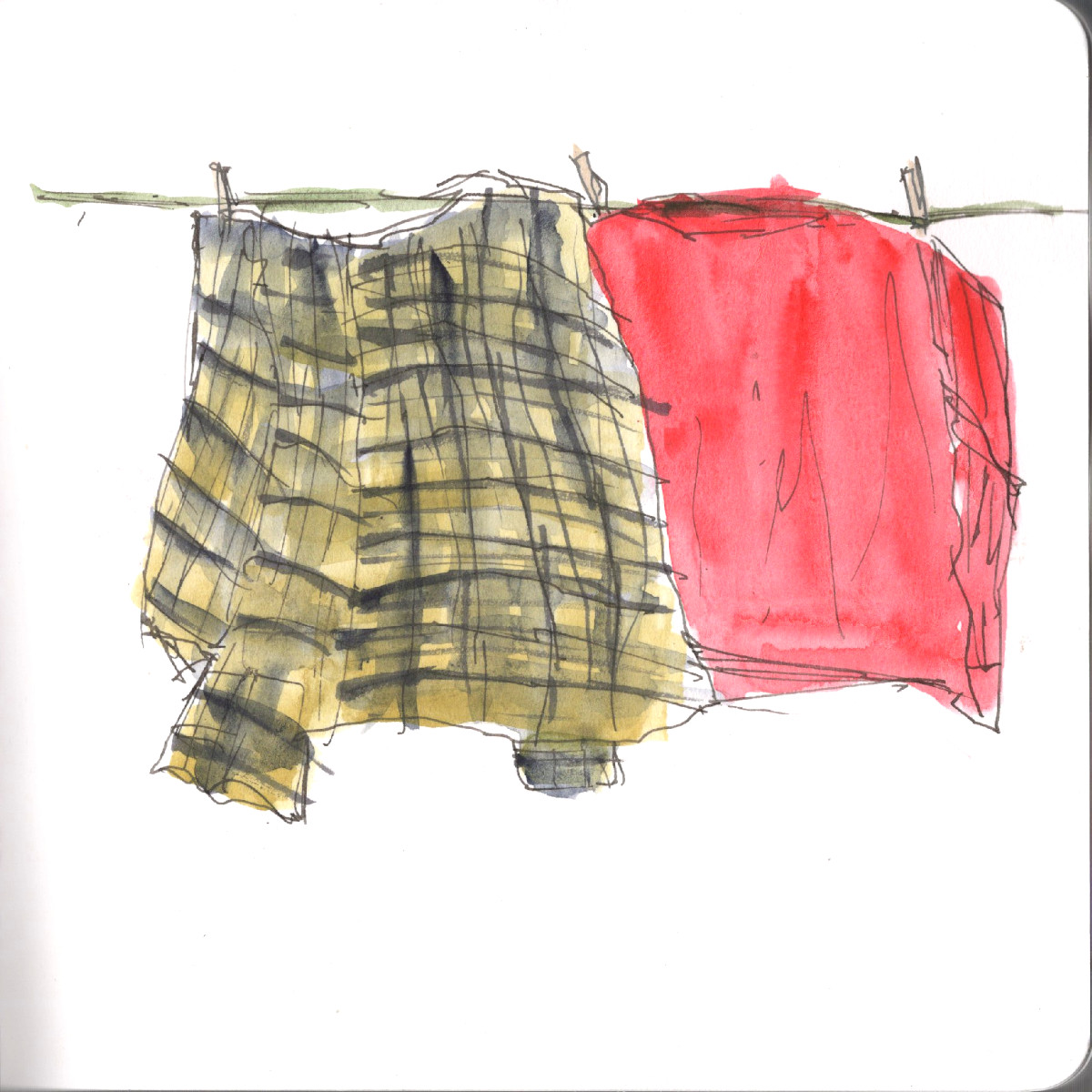 We’ve gotten a fair amount of rain the past several days (1.30”), but today was a good drying day for laundry. Here’s my pajama top and a t-shirt, sketched with Inktense pan colors.
15 October 25
The Artist's Way
Since my mother died I’ve been journalling a lot, early morning, three pages, morning pages style. There is a lot to process and writing the same old stuff over and over is a) helpful, b) kind to my friends, c) a palette cleanse for the day.
I tried doing the Artist’s Way back when I was living in Cambridge, Mass, and again in Santa Barbara, and got stuck (like so many people) in the middle. I liked the morning pages and I even liked the artist date, though I rarely did it, but it seemed like a Reaganite version of self-actualization with some new age gobbledegook thrown in for good measure. But I can journal, so I’ve been doing that since I got home, first thing in the morning like a good little artist. Rewriting what happened with my mother and the time I spent in Maine has at least spared my friends the endless repetition of it all…
But then a couple of videos about the Artist’s Way popped up on my YouTube feed and I decided to watch one of them. Like me, they balked at the God references; like me, they were half-assed about the artist dates. But they said they got a lot of value out of it anyway, and this has made me wonder whether stopping wasn’t a form of self-sabotage.
So I’m not sure I’m recommitting but I’ve read through chapter 1 and this time had a whole load of critics and many, many more champions to name. (I even wrote some cringy affirmations.)
My issue isn’t that I don’t think I’m an artist, though I genuinely don’t have aspirations to have my art hang in galleries. I like to make things and give them to others. My issue is that I value all of this so little that I don’t make time for it. This is what I’m going to be focusing on over the next however many weeks it takes. Stay tuned…
14 October 25
Meditations On Probability
After almost six years since the start of the pandemic, I finally caught COVID. Since Pica and I are two of those rare people who still continue to take infection risks seriously (e.g.. we avoid indoor gatherings, and are scrupulous about masking in public indoor spaces), I have been pondering the nature of rare events. Or given enough repetitions of a low probability event, it is not surprising to see it occur eventually.
Here is the timeline. Pica spends three weeks back east with her family, During this period I am not venturing out much, except for walks and a weekly trip to the grocery store. Pica returns on Saturday 4 October. Because she passes through the infectious soup that is modern air travel, we follow an isolation protocol for five days: she sleeps in the spare room of our next-door neighbor, and doesn’t come inside our house without being masked. (The weather is nice, and we can eat outside happily).
On Tuesday 7 October one of our two cats Esme starts sneezing a good bit. I wonder if she picked up a leurgy from Pica’s luggage still sitting in the living room.
On Thursday 9 October I feel a touch like I’m catching a cold, and by the morning of Friday 10 October I am clearly crook with what feels like a mild cold. Pica meanwhile Thursday tests negative for COVID, and we exit our isolation protocol. I’m wondering if I picked up a cold from Esme, who was still sneezing a lot. Though on Saturday I read that cat-to-human cold transmission doesn’t in fact occur.
On Sunday it still feels like a mild cold but since I had a dental appointment on Monday I decide I had better test for COVID. Oops. The antigen test comes up positive, as does repeating with another test kit from a different manufacturer.
Based on the timing of things, it was likely I was infected sometime between Saturday October 4 and Monday October 6. The possibilities I come up with are all low probability events:
a) On Saturday I went to the co-op to pick up some groceries. But the co-op is well-ventilated, and I am masked with an N95.
b) On Sunday I pick up takeout burritos from Chipotle. But this is a two minute task, and I am wearing an N95.
c) I pass through somebody’s infectious plume on one of my walks. Perhaps this was when I was sketching the jazz band on Sunday.
d) Somehow Pica’s return introduced COVID to the house, although she’s been asymptomatic throughout. Fomites on the luggage?
As for Esme, cats do in fact get COVID, and there has been at least one documented transmission event of COVID from cats to humans. I don’t think that’s what happened here though. She is not sneezing now, and is leaping up the walls with high energy.
I am isolating now in the spare room, and feel quite fortunate that I got my annual COVID booster almost three weeks ago on 18 September.