
12 November 25
Bodega Bay
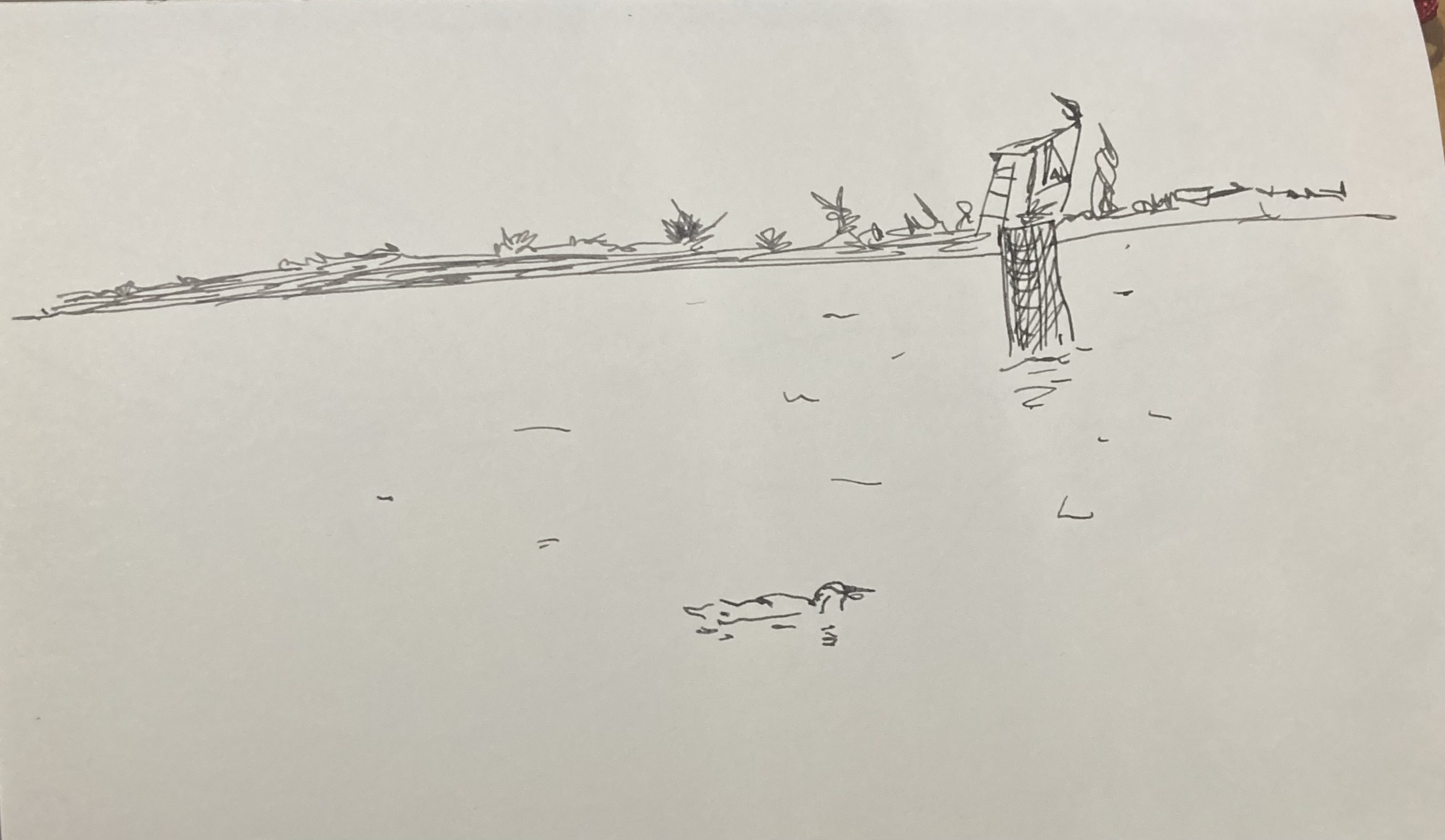 I made a solitary pilgrimage to Bodega Bay yesterday, where my parents lived for some years before my father died and my mother moved to Maine to be near my sister’s family. Mum and I had spread some of dad’s ashes over the cliffs on Bodega Head; she walked on the Head most days while she lived there, communing with the ravens and oystercatchers. I wanted to add some of her ashes to the mix, 26 years later.
I hadn’t thought about the impact that Veterans’ Day would have on the bustle of this little seaport, but I should have. There were people and cars everywhere. I made my way to the spot where we had spread Dad’s ashes but got overcome with vertigo and crouched down in the iceplant by the cliff edge, unable to move a step closer. In the end I put her ashes in the vegetation; I apologized to her for being scared. It wouldn’t help anyone, though, if I lost my footing and fell stupidly…
There was no way I was going to find somewhere to eat with the gathering throngs so I went out on the balcony at the Tides inn to do a sketch or two… A loon was fishing near the dock. Loons had been calling across the Bay when we set her ashes down in Maine. It closed the circle a bit.
There is still a mum-shaped hole in my being, which I imagine will never really go away. I’m so glad we got closer in the last 20 years, and especially in the last five…
11 November 25
Patterns of Liberation
About four years I was doing some literature research on information and communications technology for sustainable development and came across the writings of Douglas Schuler, a computer scientist now retired from Evergreen State College in Washington, who works on democratic technology. He is most noted for the 2008 book Liberating Voices: A Pattern Language for Communication Revolution, published by MIT Press. I revisited this book today and it seems a good work to share in our present moment. As the title suggests, it is inspired by the highly influential 1977 book A Pattern Language: Towns, Buildings, Construction by architect Christopher Alexander. Liberating Voices takes a similar approach to the latter book and provides a catalogs of patterns helpful for positive social change.
The physical book for Liberating Voices seems hard to find but much of the content is replicated in the website the Public Sphere Project. In particular, there is a section specifically on the Liberating Voices pattern language. Several examples of these patterns include Linguistic Diversity, Participatory Design, Intermediate Technology, and Voices of the Unheard. There are 136 patterns listed in the original Liberating Voices publication and these are summarized in a set of cards here. Patterns which others have submitted are also listed here.
It looks like the Public Sphere Project has gone dormant for now but many of the patterns described there for social change are timeless, and it is well worth reviewing the set for ideas on how to act.
10 November 25
50 Years Ago Today
… A freighter carrying iron ore was sunk on Lake Superior in hurricane-force winds.
I don’t follow the shipping news and even if I had I’d never have heard of this particular tragedy if it weren’t for a song by Gordon Lightfoot, the Canadian musician who died in 2023. The Wreck of the Edmund Fitzgerald is a masterpiece of storytelling and melody.
Every year the Mariners’ Church in Detroit tolled its bells 29 times to commemorate the lives lost on the freighter. After Lightfoot died they changed it to 30.
How we as humans choose to memorialize our dead is an interesting question I’m pondering as I’m planning a trip to Bodega Bay tomorrow to have my own memorialization of my parents…
9 November 25
House of the Perpetually Setting Sun
Pica has been subscribing to Netflix for the past few weeks mainly to watch the new season of “The Great British Bakeoff”, and yesterday I took advantage of the access to view the new movie directed by Kathryn Bigelow, “A House of Dynamite”. This is a nuclear war thriller about the response of the United States government to the detection of a single ICBM of unknown origin on a suborbital trajectory leaving the Pacific to strike the continental U.S. This covers a period of about 18 minutes between detection and impact, which makes for a quite short movie in real time. Bigelow’s intent in the movie is to show the reactions of the key people involved in the crisis, and she accomplishes this by following different sets of people in three different retellings of the 18 minutes. The first part follows the duty officer in the White House Situation Room (played by Rebecca Ferguson) as well as the crew of the anti-ballistic missile base in Alaska trying to shoot down the ICBM. The last part focuses on the response of the President of the United States, played by Idris Elba. Narratively I didn’t find that this structuring of the story worked well. The first portion was quite exciting, but in passes 2 and 3 it grew tedious. The strongest performance in the movie was from Rebecca Ferguson, but her story ended in the first portion.
The movie was good, not great, more didactic than memorable cinema. We certainly learn about the impossibility of communication among decision-makers under a crisis of such a short timespan, and the doubtful utility of the present-day anti-ballistic missile system (“hitting a bullet with a bullet” is the phrase they use in the movie). My favorite movie in the genre of nuclear war films still remains “Dr. Strangelove”.
8 November 25
1,000 Postcards
 I started Postcrossing in summer of 2021. I’ve written before about how this has been a fun way to travel vicariously and to connect with people from many different cultures (many of them German, since Germans are mad about postcards, which has been great for my language learning).
They don’t count the postcards you’ve sent until they’ve actually been received (some of them never arrive, sadly — I have 15 “expired” postcards on my list of traveling postcards, and there have been many more but they take them down at some point). I just received notification that the postcard pictured at right, Wayne Thiebaud’s painting of women’s shoes, arrived — that makes 1,000.
Yes, it’s an expense. Yes, it’s a bit trivial, what with the state of the world and all. And yes, for that brief moment between when I ask for a new address and one appears on my screen, a world of possibility opens. (There’s also the eager trip to the mailbox to see if any postcards have arrived for me; this week, I got cards from Albania and Serbia, both of them new origin countries.)
7 November 25
Reaching For The Sky
I am watching a multipart documentary now about the Sagrada Família in Barcelona. This series is being released weekly on the YouTube channel betevé; I am viewing in Catalan with Catalan subtitles for language input practice. The church has been under construction for 143 years now and as the end of October it is the tallest church in the world. The series has many interviews and lots of good imagery ranging from recent drone flights to historical photos from the beginning of the 20th century. A few thoughts:
- I marvel at the continuity of the detailed craftwork over 140 plus years. It is a direct link with the wonderful craft traditions flourishing in Barcelona and Catalunya in the latter half of the 19th century.
- On a completely different tack, I have started a book entitled Capital’s Grave: Neofeudalism and the New Class Struggle, by Jodi Dean. As the title suggests, it is a very left-wing analysis of contemporary socioeconomics. One of the points she makes early on is that being a worker is not a source of identity anymore, since people don’t see social production and collective energy emerging from their efforts. This is the exact opposite of what working on the Sagrada Família must be like.
- The Sagrada Família is now the most visited location in Spain, with over 4.8 million visitors in 2024. This sets up a paradox — how does one arrive at a reverential state in a space that is so crowded, despite all the spiritual affordances that are built into the architecture?
6 November 25
Tule Fog
 Years ago, when Numenius and I took a haiku class with Maria Melendez, she read us a poem she had written. I can’t remember the first line exactly but it went something like this:
Out-of-towners ask,
What the heck is a tule?
Fog caught on thousands.
In those days tule fog (a tule is a species of rush found in the winter wetlands of the Central Valley, much used by the original human inhabitants of this area, especially for baskets) was a regular occurrence. It would rain, there would be two or three mornings of thick fog, and then it would get sunny again until the next storm. Nowadays tule fog is rare, the result of a changing climate.
We did get a good rainy day yesterday, and we got a good thick tule fog this morning, and I decided to walk over to the Arboretum. By the time I got there the sun had burned off the fog, though it was still pretty drippy. I came across a small flock of turkeys across from the Mondavi Center. I am determined never to leave the house without something to write or draw on (and with), so I made a quick sketch of these guys, posted at right.
5 November 25
Elections With Cuban White Beans
I am quite heartened by the results of yesterday’s elections — the victory of Zohran Mamdani in the mayoral election in New York City stands out but Democratic candidates did spectacularly across the board. It was sad to see the high level of racism and Islamophobia in the mayoral race from sectors I’m supposedly in alignment with, but the voters of New York City as a collective got past that.
I first heard about Zohran Mamdani last spring leading up to the June primary, and soon discovered a fact about him that made me like him a lot. Six or so years ago as an aspiring rapper he made a rap video with the actress and cookbook author Madhur Jaffrey that was a tribute to grandmothers. Madhur Jaffrey is in high esteem in our household and every week we cook between one and three recipes from her cookbooks. This week’s recipes are the following:
- Aromatic Cuban White Beans and Pumpkin Stew (Tuesday’s soup)
- Green Beans with Mushrooms (tomorrow’s dish)
- Bean Curd with Fresh Coriander (our standard Friday night fare — we simply call it tofu-cilantro).
I wish that the Republican candidate Curtis Sliwa had managed to push past Andrew Cuomo and come in second, but it was not to be. Sliwa is a cat person and currently has six kitties: at the height of the pandemic he was rescuing abandoned cats and one point had 17 living in his apartment. Trump disparaged him for his plans if elected to turn the mayoral mansion into a cat rescue site.
Three months ago independent journalist Marisa Kabas summed up the race this way:
why is this mayoral election different than all other mayoral elections?
in all other mayoral elections, we get to see andrew cuomo lose but once. but in this mayoral elections, we get to see him lose twice.
Mamdani will have many powerful people against him trying to thwart his agenda, but he has already done something quite significant. Today he named Lina Khan to be the co-chair of his transition committee. Khan is a brilliant young legal scholar who was the chair of the Federal Trade Commission during the Biden administration and was one of Biden’s most leftwing appointees. As an antitrust regulator, she was the terror of many of the large tech firms including Amazon and Meta. Naming her is a great choice by Mamdani.
4 November 25
Loving Handwriting (Again)
Calligrapher Tom Gourdie wrote in Improve Your Handwriting that any handwriting that deteriorates at speed is useless. I remember working through his book when I was at university in the UK — basically he was advocating for a monoline italic, where some letters are joined but others aren’t, depending on where they sit in the word — the aim always being efficiency/speed without sacrificing legibility. (This is different than the cursive children are/were taught in the U.S., where every single letter is supposed to be joined up, a legacy of Spencerian/copperplate and modified and developed into the Palmer method, now largely discarded as students, if they write by hand at all, mostly print.) My own handwriting was transformed under Gourdie’s gentle prodding and I still write like this; in fact seeing handwriting from when I was at school is jarring to me now.
There is nothing like the tactile pleasure of writing with a good (not necessarily expensive) fountain pen on good, smooth paper. I am a fast typist. I am also (undiagnosed) ADHD, and could type out complicated philosophical ponderings while thinking about my shopping list. Writing by hand slows down my monkey brain and demands sequential thought. (When word processors came into common use in the late 1980s, the average length of book manuscripts went up by a third, at least those submitted to the Harvard University Press where I used to work; when cutting and pasting is easy, people do it instead of thinking through their ideas beforehand.)
Various studies have shown that there is different cognitive process between writing and typing, and that writing wins the cognitive battle, as described in this recent paper:
Handwriting activates a broader network of brain regions involved in motor, sensory, and cognitive processing. Typing engages fewer neural circuits, resulting in more passive cognitive engagement. Despite the advantages of typing in terms of speed and convenience, handwriting remains an important tool for learning and memory retention, particularly in educational contexts.
bq. —Marano et al., “The Neuroscience Behind Handwriting: Handwriting vs. Typing — Who Wins the Battle?” (Life (Basel), February 2025).
There’s more, of course. I recently realized that most of the jobs I’ve done in my life can already, or will soon, be done by artificial intelligence, a sobering thought. I have already disengaged from popular social media outlets because my drawings, such as they were, were being used without my permission to train AI. I am in no doubt whatsoever that every key stroke I make is somehow being monitored, studied, and spat out into an algorithm for something. So far, they haven’t figured out a way to track what I’m writing by fountain pen, though there are certainly pens available that can convert handwriting to typewritten text as you go.
3 November 25
Zettelkastening Away
I am almost a month into my project of writing into a Zettelkasten and am quite pleased with how it is going. When I initiated it I didn’t know where to start so I just began with an article near the top of my Vivaldi browser reading list and took notes on it. I think this first article was an excellent piece in The Guardian by Shaul Magid entitled The Zionist consensus among US Jews has collapsed. From there the following themes have emerged in my Zettelkasten note-taking:
- American Jewry following the Gaza war
- The rise and fall of the nation-state
- Post-growth economics
- Neolithic history.
So how do I get to taking notes about Neolithic history? Thinking about Zionism leads me into pondering the nation-state — I need to revisit what Hannah Arendt has to say about nation-states in The Origins of Totalitarianism — and in turn I discover a piece from 2018 by Rana Dasgupta also in The Guardian entitled The Demise of the Nation-State. Dasgupta will have a book coming out next year on the same theme, and he put together a related reading list for the upcoming book.
The first book on Dasgupta’s list is Against the Grain: A Deep History of the Earliest States, by the political scientist James C. Scott. He makes the argument that when agricultural grains emerged in the Neolithic as a major food source, they proved easy to tax and this led to the first states being coercive rather than voluntary assemblies. Anyway, I read Scott’s book in the middle of October, put it aside, and last week I decided I had better take notes on it for the Zettelkasten before I return it to the library.
It is a much bigger project to take notes on a book than an article and I need to work out the best methods for doing so. It will depend on the book of course: for Against the Grain I am proceeding chapter-by-chapter. But I am astonished with how much more I am retaining when I write down notes rather than just reading the book and moving on. And the ideas from books can lead in so many directions.
When Pica went to Berkeley last week my stepmother suggested that Pica write a book as a memoir. And she thought that I should write a book as well. I am a long way from knowing what such a book would be about, but I can now confidently say that Zettelkastening is the way to get there.