
21 November 25
Line and Wash and Soy Sauce
 As remarked upon previously, for Friday dinners we almost always have a tofu-cilantro stirfry over rice. But we were out of soy sauce and had to pick up a new bottle this morning. It made a fine subject for a sketch. I did this with my fude fountain pen and Schmincke pan watercolors. I tend to use waterbrushes for my sketches instead of actual paintbrushes but today I used the latter — it’s a good practice. One gets a lot more control with real paintbrushes but they are harder to work with in the field.
20 November 25
A Somber Anniversary
 I was at boarding school in England when I heard the news that Francisco Franco, the head of Spain since the bloody civil war (1936-39), had died. My first thought was “oh no, does that mean the country is going to plunge back into war? Will mum and dad be okay?” My second thought was, “Good. May he rot in hell.”
The country DIDN’T erupt in violence, but it was a close-run thing; only the intervention of Franco’s protégé, the new King Juan Carlos, averted a military coup. Millions of documents cataloging the innumerable crimes by the regime over 40 years were destroyed. And the Amnesty Law, the so-called Pacto del Olvido, ensured that the people who had committed those crimes were absolved of any consequences.
Very few Spanish people who were born after 1975 have much of an idea about any of this; the “olvido” has been entirely successful. So much so that far-right elements are once again gaining ground in Spain as they are elsewhere in Europe.
I explored this topic more fully in a 6-page comic that was published in Troubled Histories (2024), Sequential Artists Workshop.
It seems completely pointless to say “never again.” Yet it must be said. Not in Spain, not in Germany, not in Gaza. Let’s stop doing this, people.
19 November 25
Journey Into the American Revolution
We watched the first episode of Ken Burns’ new documentary about the American Revolution this afternoon. The series consists of six two-hour episodes so like most of Ken Burns’ documentaries it is a serious effort both to watch and of course to produce — this documentary was a decade in the making.
The first episode presents the years leading up to the war, starting in 1754 just before the Seven Years’ War and ending in 1775 after the battles of Lexington and Concord. So far the documentary is excellent. Documenting the 18th century is a challenge for filmmakers since there is no archival footage, recordings, or photographs to draw upon but so far they are bringing the era very much to life with landscape footage, period illustrations, maps, interviews with historians, and many voiceover readings of texts from the period. (They have a star-studded cast of voice actors). It is clear that the filmmakers want to highlight the role of marginalized peoples — I was pleased that in this first episode they had interviews with at least three Native American scholars.
The series is quite timely. We are in a period of great division over what our country ought to be, so it is good to take a deep dive into its origins.
18 November 25
Brush Lettering Workshop
 I attended a short workshop today — more of a demonstration, really — on how to do brush lettering with different brush tools. I’ve tried it in the past with limited success but I think Mike Gold’s tip — work slowly between strokes — really hit home. I couldn’t resist drawing the Anna’s hummingbird outside and was beside myself when Mike said “Always draw a bird.” (I don’t need telling twice.)
Not sure how to use this so my holiday cards might get some fancy lettering this year…
17 November 25
Cats with Fude Pen
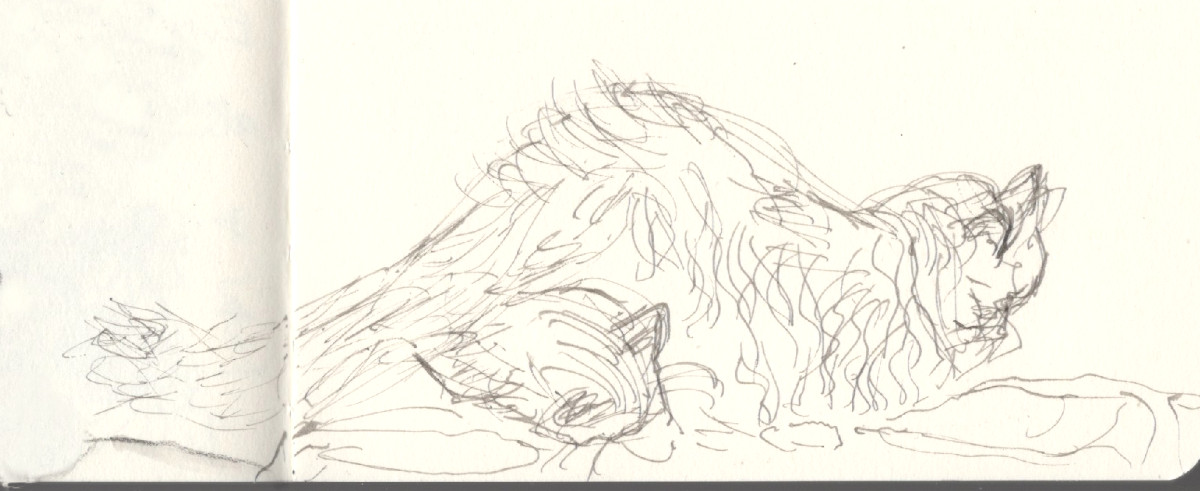 Now that the temperature has turned cool the cats are snuggling up more together and this afternoon they were uncomfortably trying to occupy the same cat bed. Esme is on top of Winston in the sketch here at left.
I have sketched the cats here with my Sailor Fude pen which I just resurrected today. This is a bent-nib fountain pen that is designed for Japanese calligraphy and is easily manipulated to give very thin to quite thick lines. I have loaded the ink cartridge with De Atramentis Urban Gray ink which is waterproof, though I don’t use any wash in this sketch.
16 November 25
Sleepless Planet
 I had the first of my four Comix Activism classes on Saturday. This class is being taught by Maureen Burdock, author of Sleepless Planet (and Queen of Snails) and this first session was on Health Justice and Graphic Medicine, a topic I’m particularly interested in since it intersects with my work on End-of-Life Issues.
Comics work well for activism: they are democratic, inexpensive, widely accessible, and can operate happily outside capitalist consumer culture. Maureen called the “portable empathy machines.”
I particularly like her take on insomnia since she’s suffered from it since she was a child and has tried just about everything to address it — and there’s no one quick fix, bur rather, it must be approached holistically. (It’s also very common for post-menopausal women to suffer from it, which has certainly been my experience.)
The comic at right was drawn during our initial warm-up exercise, whose prompt was “draw your day” — Maureen is in Europe so her day was coming to a close, but mine had just started!
15 November 25
Second Street Sketchcrawl
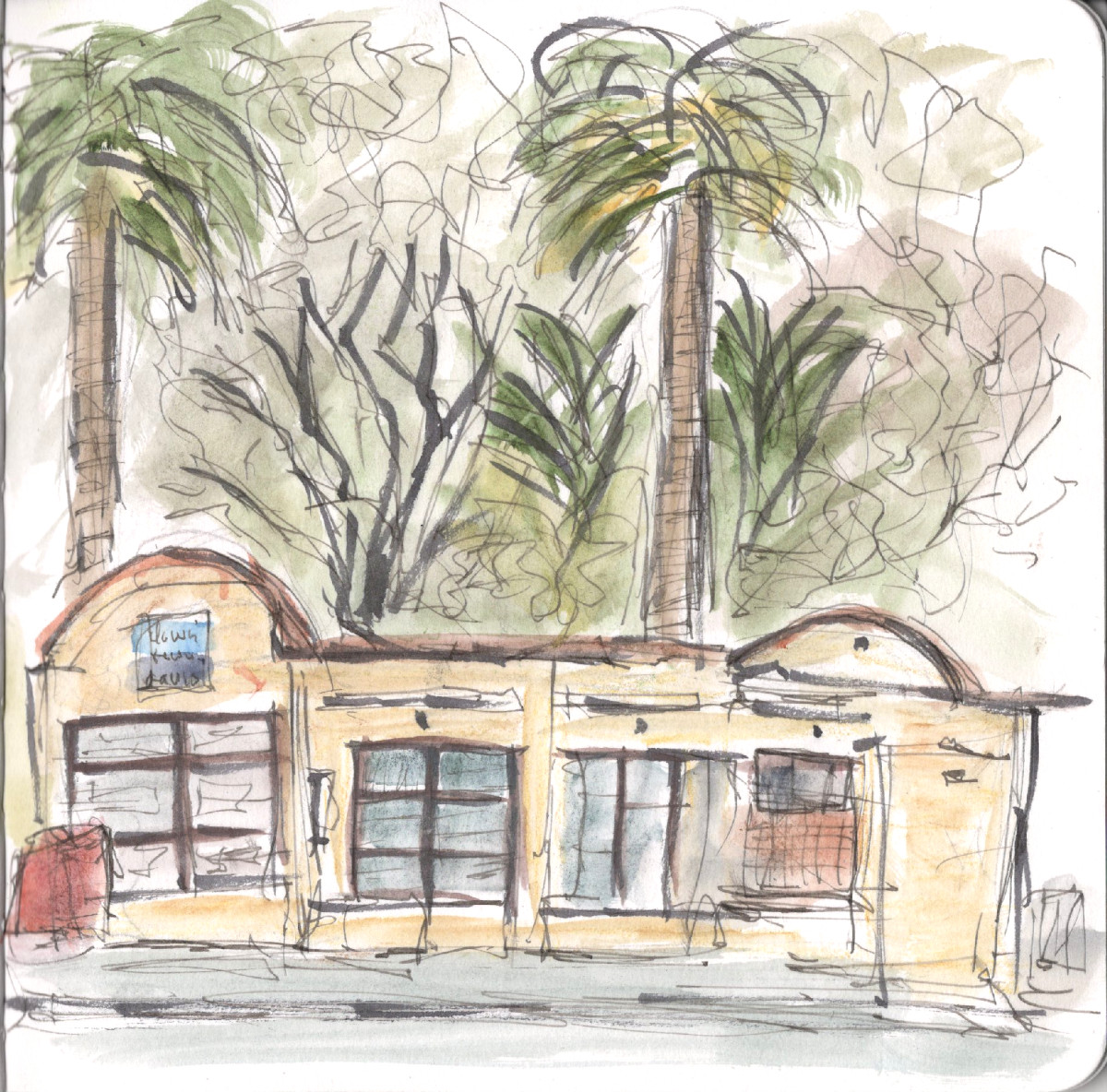 Today we went to the sketchcrawl that took place in downtown Davis in the morning. We all met at Second Street and G Street but I immediately sauntered east one block to a spot closer to the train station. This sketch here is of a smaller building nearby that serves as the Amtrak bus depot. I did one other sketch today; I looked the opposite direction from where I was sitting for the first sketch and focused on the colorful entrance to the Mexican restaurant there, Tres Hermanas. This sketch was to experiment with a small set of Neocolor II aquarelle wax pastel crayons.
After the sketchcrawl ended, Pica and I had lunch at Tres Hermanas with a friend of ours. We both had vegetarian quesadillas.
14 November 25
White Rose
 I was curious to read about the white rose as a symbol of Russian feminist resistance this morning on the profile of a man in Germany to whom I was about to mail a postcard. Not knowing its history, I assumed it was a new Russian symbol. (I knew it as a symbol of Yorkshire vs. the red rose of Lancashire, from the Wars of the Roses, and of course as a symbol of the need for beauty in the lives of working people in the anthem Bread and Roses.) Imagine my surprise, though, at hearing the white rose mentioned again in my German class later on today by a Russian who now lives in Austria, talking about the resistance movement in Germany during World War II. One group of five dissidents in Munich called itself Weiße Rose and was captured in 1942 by the Gestapo, imprisoned, and executed. The anthem “Die Gedanken Sind Frei” was written a century earlier and was required to be invoked over the decades as repression and authoritarianism took their successive places in German history.
I am about to embark on a course tomorrow, Comix Activism, taught by an artist who was born to German parents and who has now moved back to Europe. The United States is no longer a safe place for her. It’s time to wield symbols and pens to resist oppression…
ETA Saturday morning: I forgot. I also caught a reference to the White Rose on Feli from Germany’s YouTube video from several years ago. Google is watching me… White roses to you, Google.
13 November 25
Transcribing Catalan With My New Workstation
Thanks to the Easy Languages folks, I learned the power of target language subtitling of video content in language learning, and this has been a big part of my Catalan studies. The Easy Languages approach is to do double subtitling e.g. for Catalan this is subtitles in both Catalan and English. But it is also very helpful to watch videos that are singly subtitled in the target language, e.g. Catalan subtitles for Catalan video, and I have watching these where I can find them. The YouTube channel Català al Natural does this specifically for language learning, and as I’ve described earlier I have watched many episodes of the TV series El Foraster this way.
But most of the Catalan content on YouTube has no subtitling available, which limits its utility to a beginner in the language. What to do? I came up with a plan for adding automated subtitling to the video content, and tried this out yesterday with much success. The workflow is as follows: a) download the YouTube video to my workstation b) run speech-to-text software over the audio channel of the downloaded video and c) add the transcribed text as subtitles as one watches the video stored locally.
This approach came together very easily using my new workstation. The details are as follows. First, I used the program yt-dlp to download the video from YouTube. The next step is the speech-to-text conversion. I used Whisper here, which I believe is the best open source speech-to-text converter, at least that is what I gathered from working with the AI institute a year-and-a-half ago. This is software from the belly of the AI beast, coming from the company OpenAI. It is multilingual, and Catalan is one of the better performing languages in the software. The output from this program consists of transcribed text with timestamps. Finally, I watched the video in the program Celluloid, which turns out to be smart enough to take the text-with-timestamps and overlay the text on the video as subtitles at the right times.
It greatly helps the accuracy of the transcription not to have to do it in real time, as the software can take advantage of looking at the language context around the current timepoint to produce a better transcription. My new workstation is very helpful here, having a graphics card with 12 GB of VRAM memory. It still takes a while: it was transcribing at a rate of about 4x real speed (that is, a 12 minute video was taking about 3 minutes to transcribe). The output seems very good, though as a beginner in the language I am not the best one to judge.
I tested this system today with a couple of recent videos from VilaWeb, and was pleased with how it helped. I might try experimenting with double subtitling a la Easy Languages, since I think that is supported by the video playback software after some fiddling.
12 November 25
Bodega Bay
 I made a solitary pilgrimage to Bodega Bay yesterday, where my parents lived for some years before my father died and my mother moved to Maine to be near my sister’s family. Mum and I had spread some of dad’s ashes over the cliffs on Bodega Head; she walked on the Head most days while she lived there, communing with the ravens and oystercatchers. I wanted to add some of her ashes to the mix, 26 years later.
I hadn’t thought about the impact that Veterans’ Day would have on the bustle of this little seaport, but I should have. There were people and cars everywhere. I made my way to the spot where we had spread Dad’s ashes but got overcome with vertigo and crouched down in the iceplant by the cliff edge, unable to move a step closer. In the end I put her ashes in the vegetation; I apologized to her for being scared. It wouldn’t help anyone, though, if I lost my footing and fell stupidly…
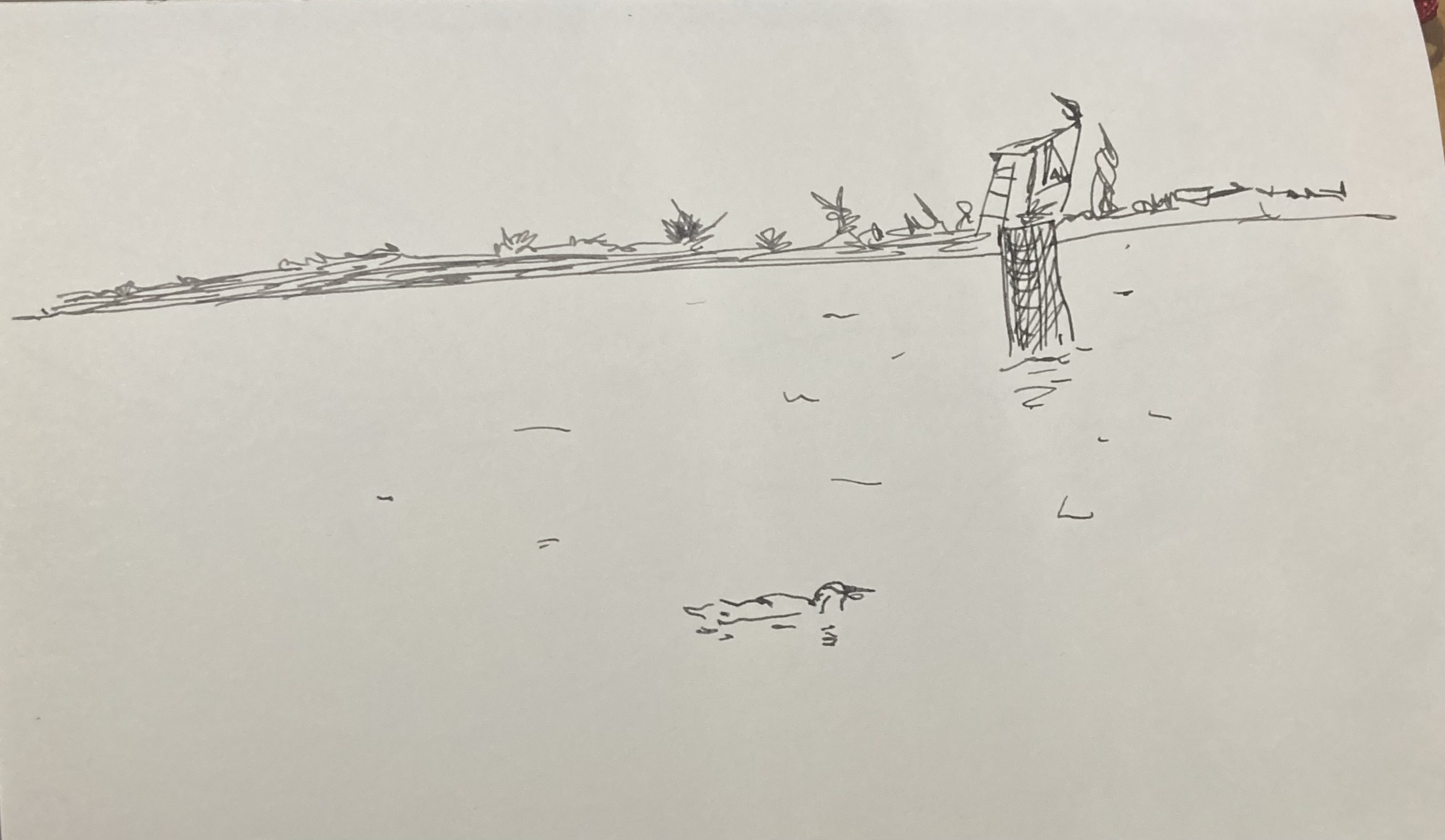
There was no way I was going to find somewhere to eat with the gathering throngs so I went out on the balcony at the Tides inn to do a sketch or two… A loon was fishing near the dock. Loons had been calling across the Bay when we set her ashes down in Maine. It closed the circle a bit.
There is still a mum-shaped hole in my being, which I imagine will never really go away. I’m so glad we got closer in the last 20 years, and especially in the last five…