25 April 26
The Tyranny of The Work
Western classical music is a really strange thing when one takes a broad enough view of it. There is no other musical tradition that I am aware of that insists upon fidelity to a strict written score, and eschews improvisation in the whole. A couple days I ran across an English musicologist named Daniel Leech-Wilkinson who has battled the implications of this strangeness. He has recently put together an open-access ebook entitled Challenging Performance that lays out his contentions. To quote from him
Why is it so important now to start to perform classical scores differently? In sum:
Because to believe that there is broadly one correct way to perform a classical score is mistaken ethically, historically, and factually.
Because the policing of conformity by gatekeepers that is required to enforce this mistake—to prevent it being noticed, exposed and challenged—denies performers full credit for their arguably equal contribution (with composers) and a just financial reward for their contribution; and denies them the right and ability to be innovative or even significantly creative.
Leech-Wilkinson has a background in studying medieval music, where one by necessity has to be creative with interpretations — there is extremely little information to rely upon in the musical notations we do have from the medieval period. I noticed that he wrote a book published in 2002 entitled The Modern Invention of Medieval Music: Scholarship, Ideology, Performance and immediately wanted to read it. Happily, I have access to an efficient interlibrary loan service and a copy of the book arrived for me via ILL late this afternoon!
23 April 26
Sant Jordi
April 23rd is St. George’s Day, which in Catalunya is the occasion of a massive festival centering on the giving of books and the giving of a rose. Sant Jordi has evolved into a massive street fair in Barcelona.
Numenius and I celebrated by going out to lunch and then going to our local independent bookstore and buying each other a book. He got a copy of The Serviceberry: Abundance and Reciprocity in the Natural World by Robin Wall Kimmerer; my pick was Christian Cooper’s Better Living Through Birding: Notes from a Black Man in the Natural World. A couple of friends came over later in the day and more books and flowers were passed around.
I am feeling more and more immersed in my Davis life after my trip; tomorrow I’ll finish unpacking and tidying up the kitchen table which looks like a bomb hit it.
22 April 26
Earth Day At 56
Pica had a catch-up conversation with her sister this morning, who mentioned that both she and her son separately went out to pick up trash at a couple of events for Earth Day. This brings to mind my memory of the very first Earth Day in 1970. I was 7 at the time. The event drew the attention of our elementary school teachers, and at a break in the schoolday we went out and picked up trash on the wooded slope between the upper and lower playgrounds of the school. I’m glad this is still a tradition.
22 April 26
A Tale of Two Kites
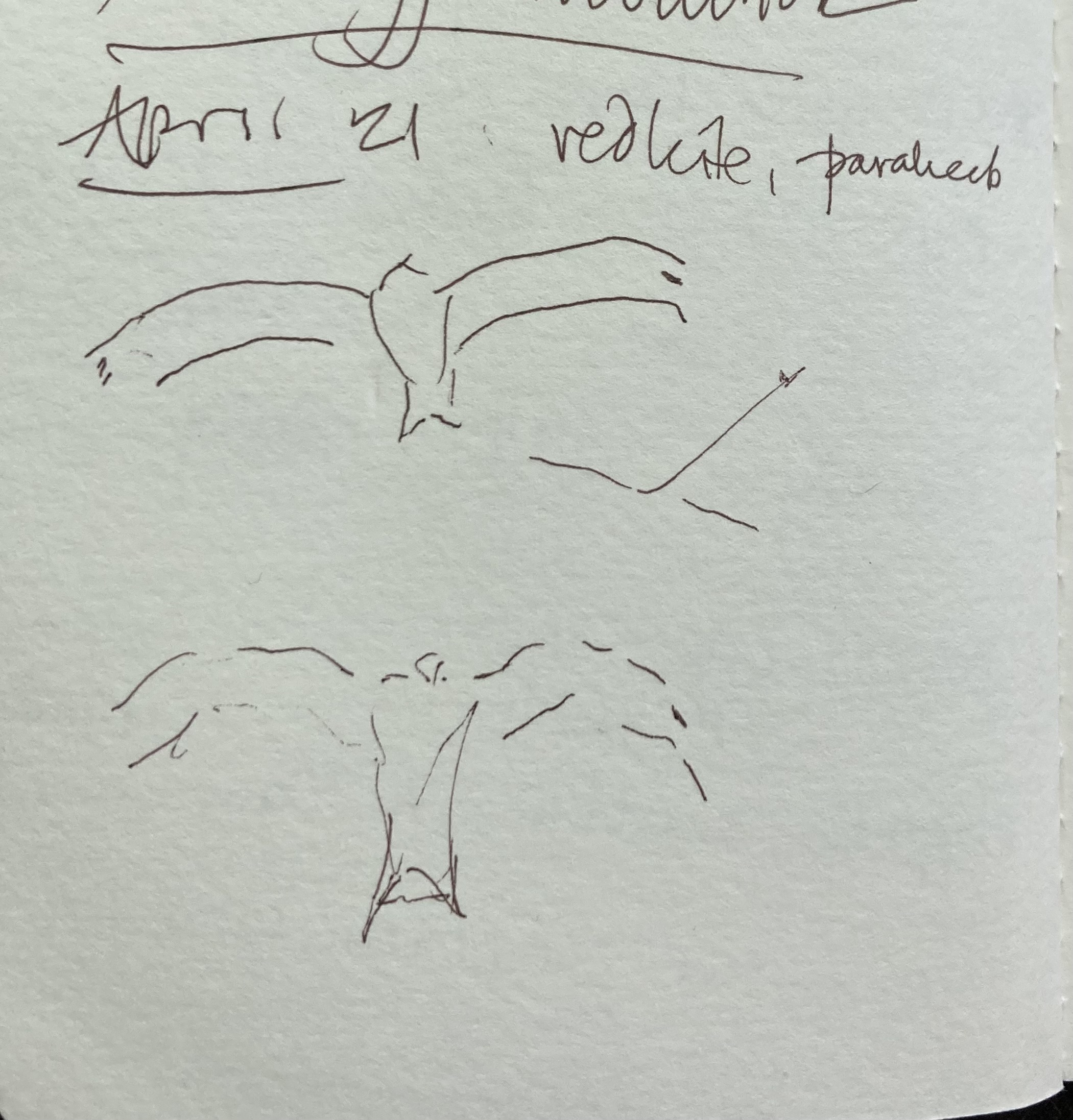 I was sitting outside my hotel near Heathrow Airport yesterday morning. A pair of red kites was soaring overhead in the flight path of landing planes. Seventeen hours later I spotted a white-tailed kite hunting next to San Pablo Bay from the train.
A lot of hours sitting around. Glad to be home and glad to see some good rain here!
20 April 26
Ad Mortem Festinamus
 A wonderful music book just arrived for me containing 105 medieval melodies scored for alto recorder which I am now starting to learn. A lot of these songs are familiar to me but it is good to have such a compilation. I’m practicing the song Ad Mortem Festinamus which is this delightfully bouncy tune that belies the topic of its lyrics, all about us hastening unto death so we had better stop sinning. It has been recorded fairly often; here is a live performance by Jordi Savall and Hespèrion XXI.
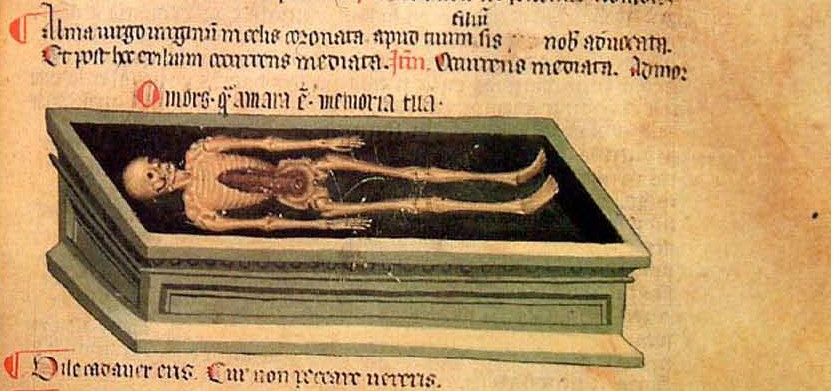
The lyrics and the melody for Ad Mortem Festinamus are contained in the Llibre Vermell de Montserrat, a manuscript that was compiled at and still resides in the monastery at Montserrat. This manuscript contains nine other songs with musical notation. The illumination at left is from the second page of the text and music for the song.
19 April 26
Walking Around Worcester
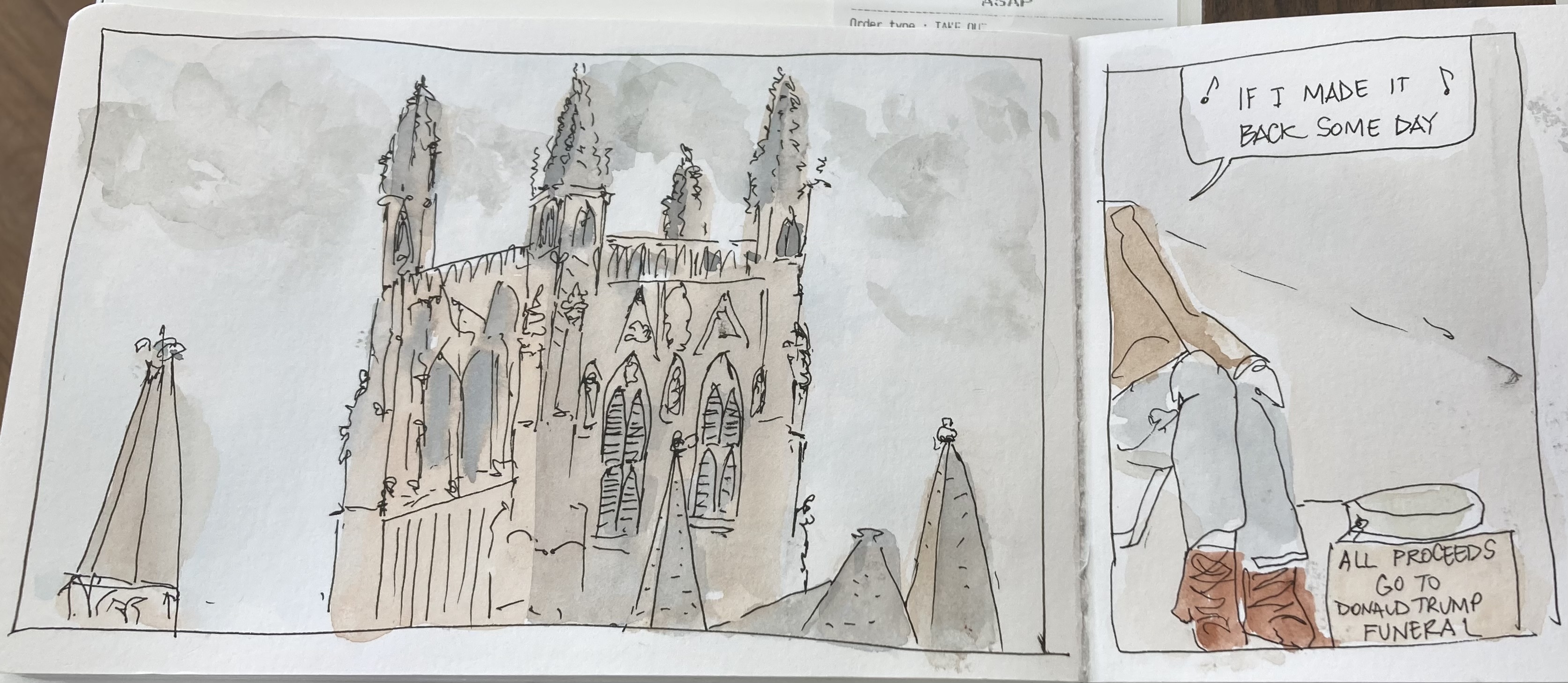 When I was at university in Birmingham I came to Worcester a couple of times with my godmother to go to the market, which at the time (early 80s) sold fabric, not much of it and not particularly nice, but it was fun to explore. I/we never made it over to the cathedral, though, which I did yesterday with my godmother’s grandaughter (and my niece, long complicated story).
The cathedral was first founded in the year 680 by the Saxons. In 983 it became a Benedictine monastery before starting time in its present incarnation under the Normans. King John, of Magna Carta and Robin Hood fame, is buried there, and by 1400 it was pretty much as it is now, barring the damage sustained during the English Civil War and occasionally misguided Victorian renovation efforts, but it is an outstanding example of English gothic architecture (like King’s College Chapel in Cambridge or Salisbury Cathedral). I’m sorry I didn’t pay more attention to this kind of thing when I actually lived here.
Later we walked past the busker pictured at right. Such a great sign, and so very productive for him!
18 April 26
Picnic Day Parade
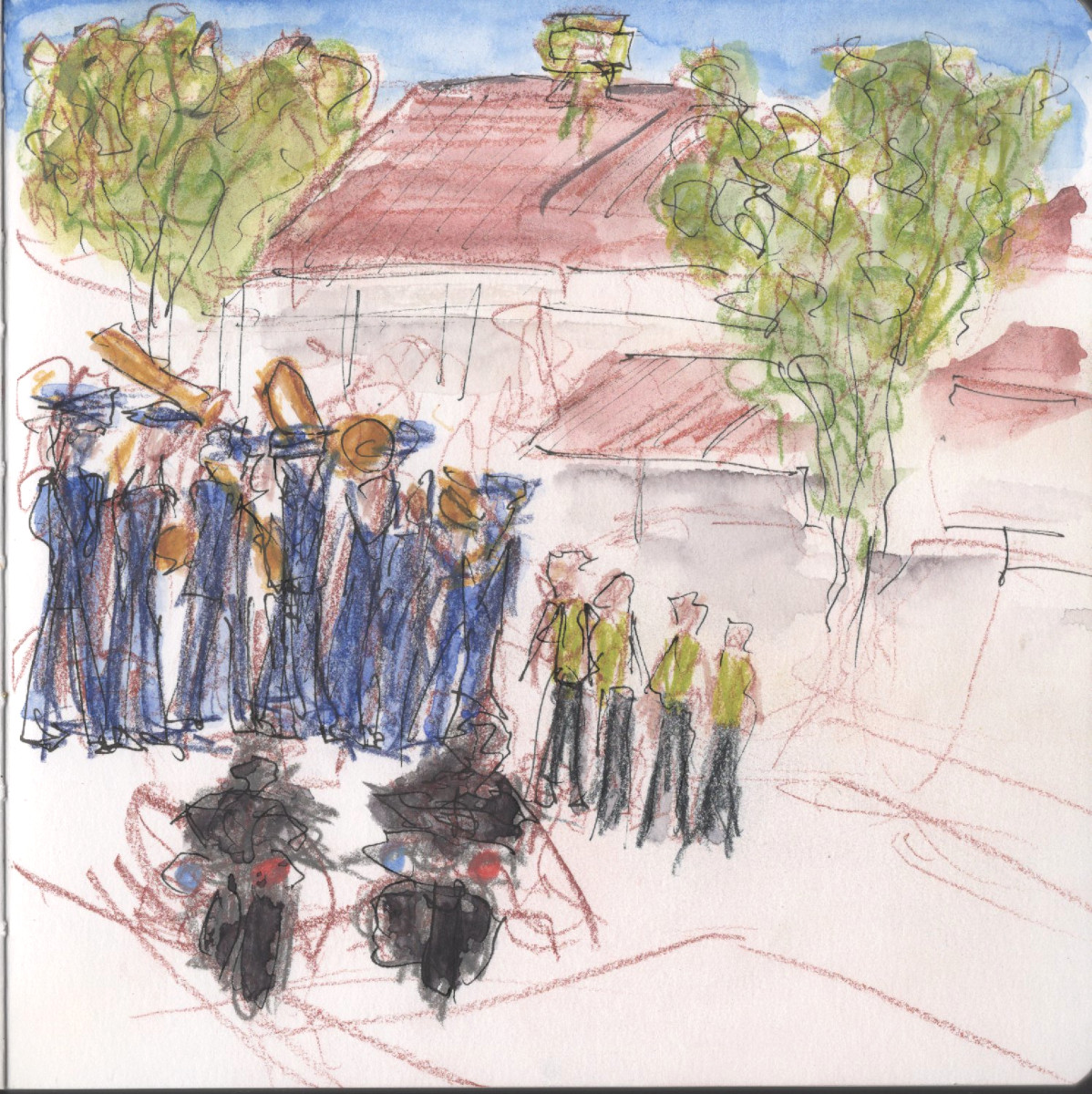 Today was Picnic Day, which is the annual student-run open house event here at UC Davis that draws tens of thousands of visitors to the campus and town. Events range from fashion shows to weather balloon launches to dachshund races. In recent years I’ve avoided the huge crowds on campus but have gone to see the parade which kicks off at 10:15 in the morning and does a loop downtown several blocks from our house.
I decided I’d try to sketch the parade and here is the result. When I was watching the parade I sketched only with a sanguine drawing pencil but took some reference photos too. Back at home I added color with more Derwent drawing pencils and watercolor wash.
17 April 26
Catching up with Old Friends
I arrived in London yesterday afternoon and made my way to the Cortauld to meet up with two college friends. I’d seen them since our school days but not much and also not recently. We saw the special Seurat and the Sea exhibition which was astonishing. I’m afraid my feet have decided they’ve had enough and made sure I didn’t give the paintings the full attention they deserve, but I was very glad I went.
I spent the night at Carol’s in Kingston south of London and saw Richard, her husband, a fellow birder and someone I hadn’t seen for 40 years. We’re all older and grayer, but it was fantastic to catch up.
Today I made my way to Stratford-Upon-Avon to see two other friends and meet up with my niece, who then drove me to her house in Worcester.
Staying in touch with old friends is an interesting exercise… Do you because they were your BEST friends or because they, and you, are good at staying in touch? I think at this point my Christmas card list is well winnowed down. And whatever past I’ve shared with the friends I saw, we still have plenty of points of connection, well beyond cataloging recent minor or massive medical issues (Martin said once you’re in your 60s you’re in Sniper Alley, which seems sadly accurate).
I did a lot of drawings but haven’t yet colored them in, see below…

16 April 26
Delphiniums Arrive
 The planter box in our backyard has been taken over by delphiniums, which are starting to bloom now. This is sketched with Derwent drawing pencil, a 0.1mm fineliner, and watercolor wash.
15 April 26
Beethoventown
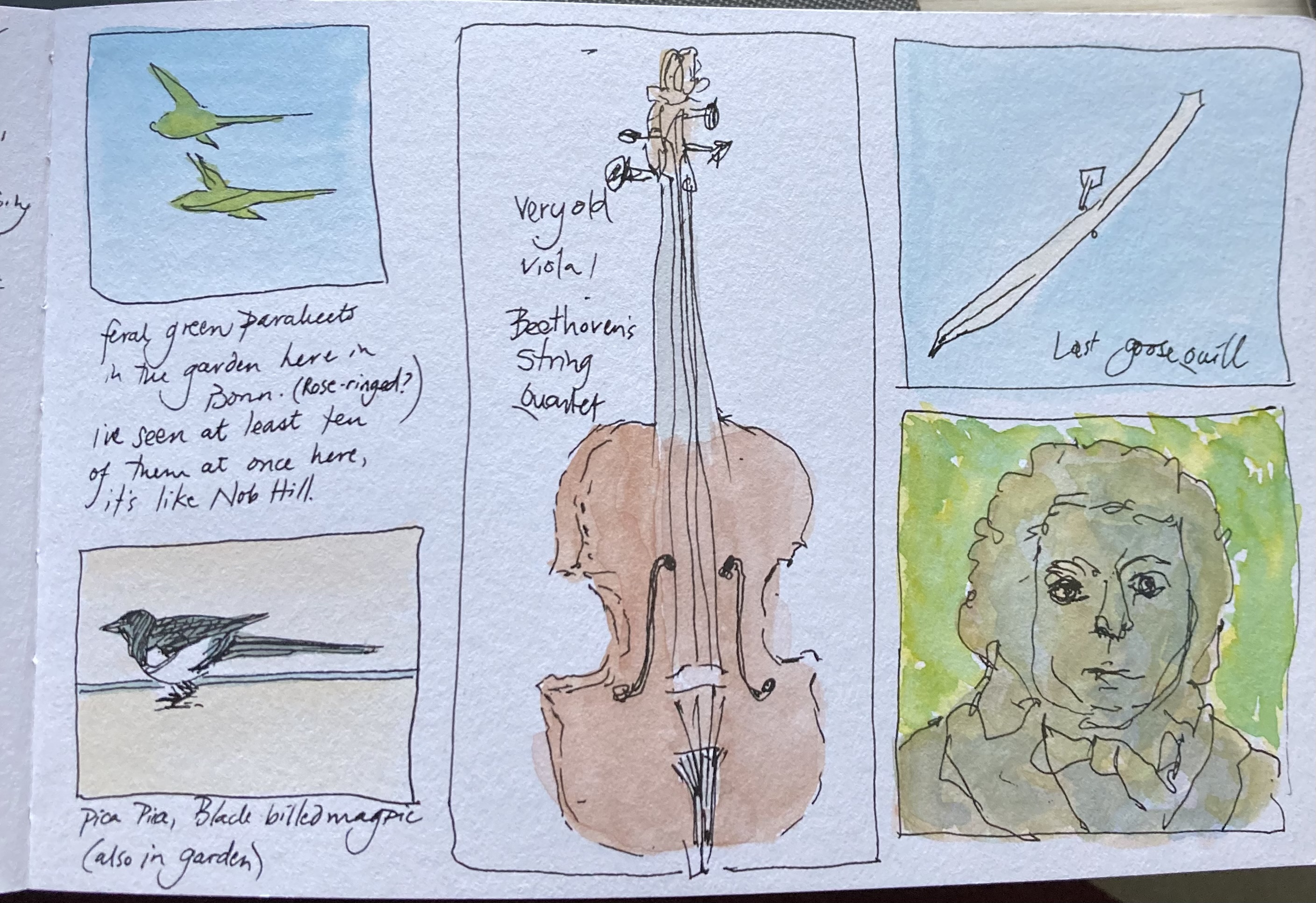
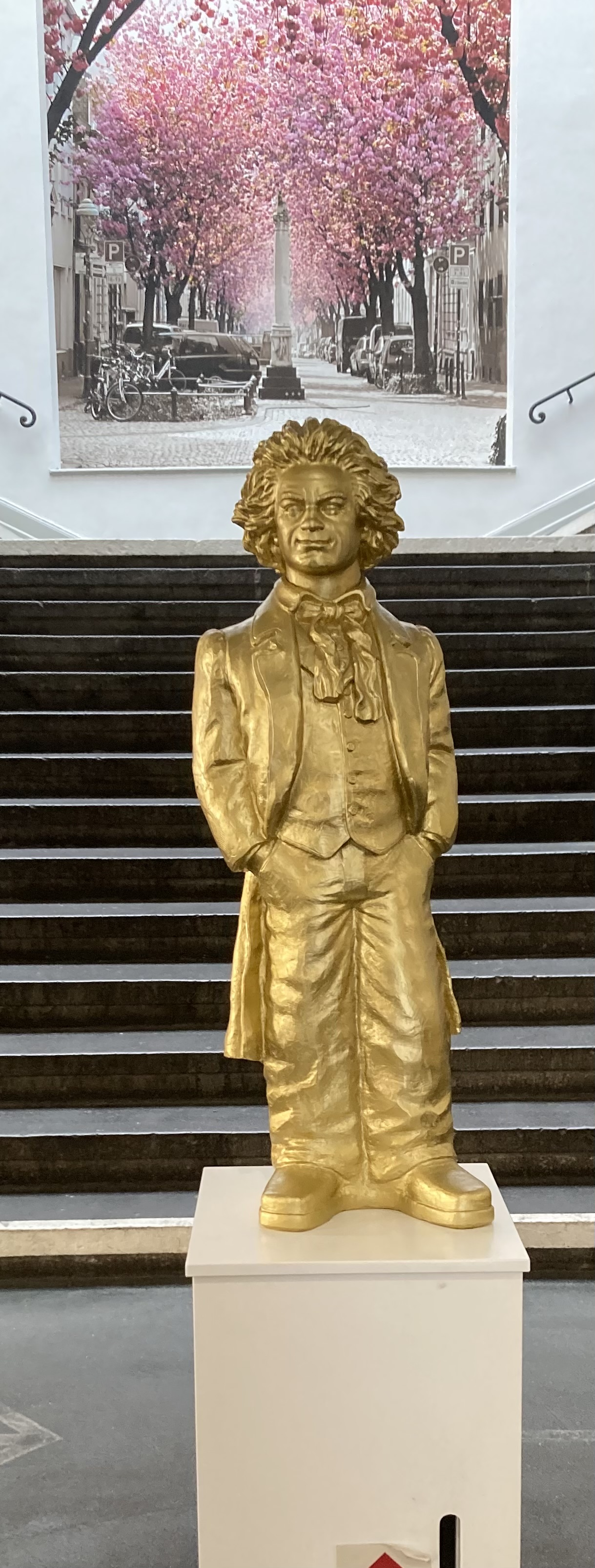 Bonn isn’t about to let any visitor leave without knowing that its most famous son, the composer Ludwig von Beethoven, was born here. There is obviously the Beethovenhaus which I visited today. There is a Beethovenstrasse, a Beethovenhalle, a Beethoven Gymnasium, a Beethoven Park. Shop windows of everything from Apothecaries and Antiquarians to Restaurants and Tobacconists feature his bust, his statue, or the modified smirking one at right, complete with falling-down trousers; a copy of this sits opposite me in the garden of the basement flat where I’m typing.
What impressed me about the museum visit was just how many images had been made of this composer, in an early nineteenth-century masterclass in image curation. Multiple busts, drawings, paintings, but also his correspondence with adoring literary admirers, who stoked the fire of his burgeoning fame.
I was especially entranced by Beethoven’s “last quill” — as you see below, there are no annoying feathers that seem de rigueur in period films but which get in your nose and are quite impractical, as well as being irresistible to moths. Beethoven’s quill was able to hold a fine line and live up to multiple parings, and his working and re-working of pieces was displayed in a pentimento-style buildup. (It reminded me of how Numenius and I first met online over 30 years ago now, a conversation about goose quill knives for calligraphic purposes.) Beethoven’s goose was almost certainly a greylag, which are ubiquitous along the Rhine. Of special interest to me is the length of the central slit, much longer than I was taught to cut, but if might also be damage from a later time; 200 years is an astonishing length of time for a quill to survive, assuming they’re not fibbing about it.
I leave this lovely cherry-blossomed city tomorrow for the UK and friends and relatives. I’m not sure if I’ve been able to do as much chatting with strangers as I’d hoped, but with bronchitis having walloped me, I think it’s okay.