
4 May 26
Saving California Science
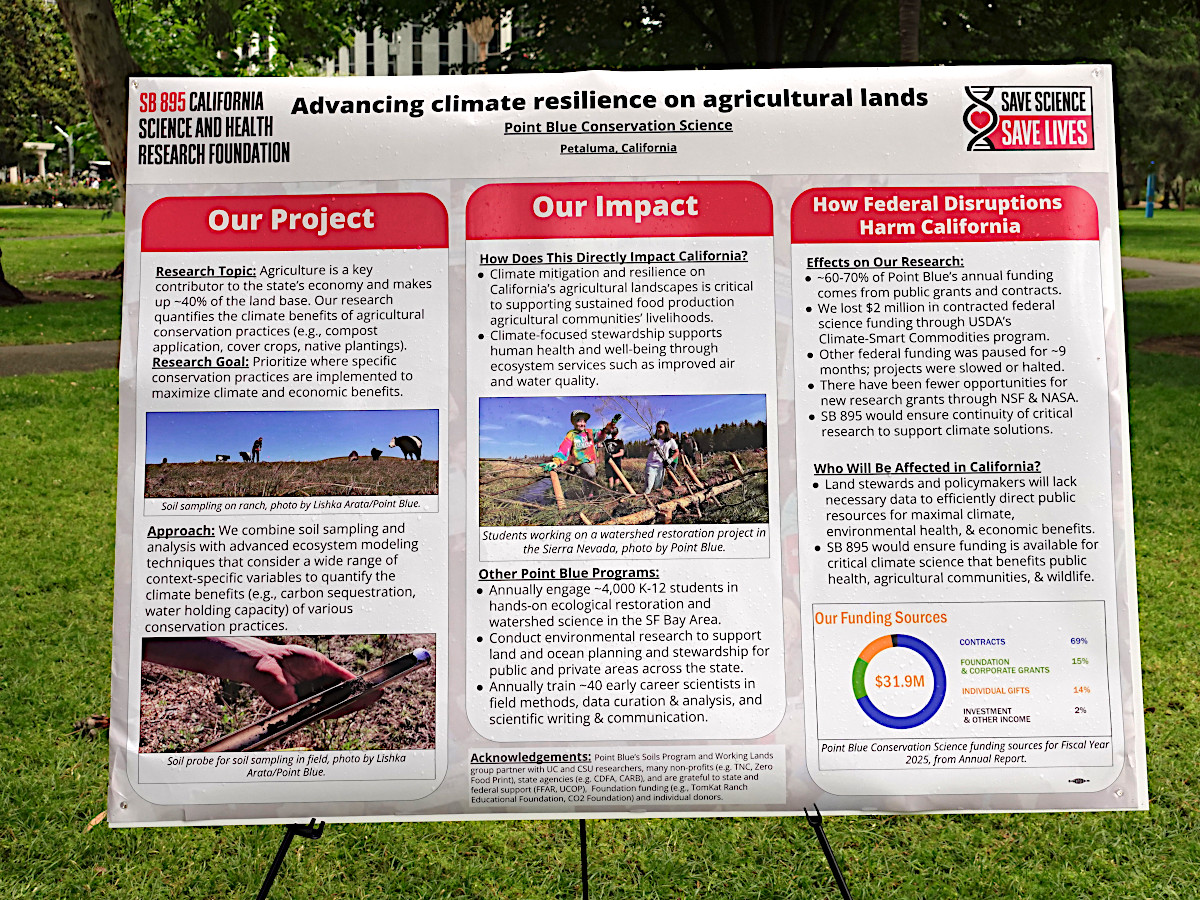 I caught the tail end of a rally in Sacramento today in support of California state senate bill SB 895, which would put a $23 billion bond measure on the November 2026 ballot to create a California Science and Health Research Foundation. This would essentially be California’s version of NSF and NIH (the National Science Foundation and the National Institutes of Health), needed since federal funding for science has been decimated by the actions of the Trump administration.
I meant to attend most of the rally, but it was not where I expected it to be on the west side of the State Capitol Building which is where every other rally at the Capitol that I’ve been to has been. Instead, there was the surreal sight of hundreds of police officers in formal garb, with several troops of them mounted on horses, attending the annual memorial event for California peace officers fallen in the line of duty. No science activists were gathered on the west side of the building, nor on the north or south side of the building, and the east side of the building is now under heavy construction of a new capitol annex. After a long while I looked at the web page of the state senator sponsoring the bill (Sen. Scott Wiener), and discovered the rally was taking place at the State Capitol Rose Garden, several blocks to the east past all the construction.
I missed the speeches, but fortunately these are up on YouTube already (especially see Sen. Wiener at 21:25 and Shawn Fain at 52:27). Over at one side of the rally area there was a gallery of scientific posters highlighting research that has been cancelled by the loss of federal funding. The photo at left is a poster from Point Blue Conservation Science describing how they lost $2 million in USDA funding from their Climate-Smart Commodities program. The termination of that same program was the funding loss that led to my retirement last year.
The senate bill now has broad support including from universities in the state and labor organizations (Shawn Fain who spoke at the rally is the national president of the United Auto Workers, which represents 60,000 University of California employees). I think there is enough support to get the bill through the legislature, though the timeline is short. The bill would then need to be signed by Governor Gavin Newsom, but he is an agent of chaos when it comes to signing liberal legislation. The measure would then have to be approved by the voters of California, who may or may not be in a stingy mood in November. It is both a lot of money, and not very much compared to what has in past times come from the federal government.
More information about the initiative is at the site Save Science Save Lives.
3 May 26
In Praise of a Good Grammar
 I’ve said before that I was very pleased when not one person in Germany instantly switched to English when I opened my mouth. But I did find myself getting frustrated when I made obvious stupid errors — not stupid in themselves, but stupid in that I KNOW both tea and coffee are masculine, not neuter, in German and I consistently turned them into neuter nouns. Another error I make a lot is to use the dative rather than the accusative case (German has a lot of adjectives that ONLY take either the accusative or dative case, but a number can also take either, depending on context).
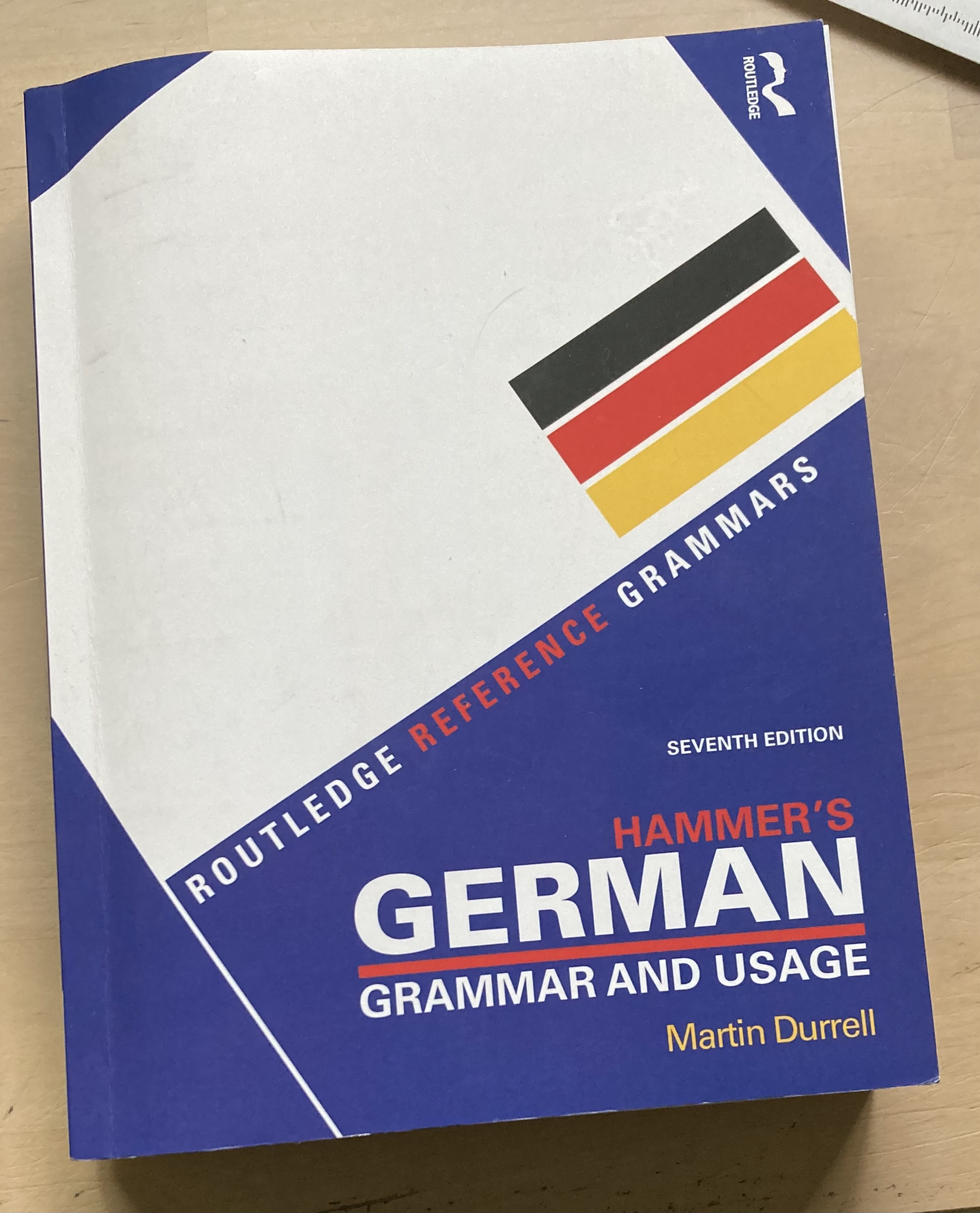
The one I found myself getting most agitated about, though, was using the incorrect form of a past participle (this is sort of an easy one to fix: just study them from a verb book and learn them). I turned to my trusty Hammer’s German Grammar and Usage to look this up, and was reminded that German has two participles that don’t exactly match onto present and past (they call them, instead, Partizip I and Partizip II).
This is such a great book. Clear descriptions, good examples with citations when useful. A lot of people hate using a grammar when they’re learning a language, but I like to be given the why of usage. Proponents of comprehensible input say it’s not necessary, that the grammar will seep into your brain with enough external content, but my brain isn’t as plastic as it was sixty years ago and I’m happy to do my bit to keep Routledge in business… (by the way, that first syllable is pronounced as in a boxing rout not root).
2 May 26
The Palette Expansion Challenge
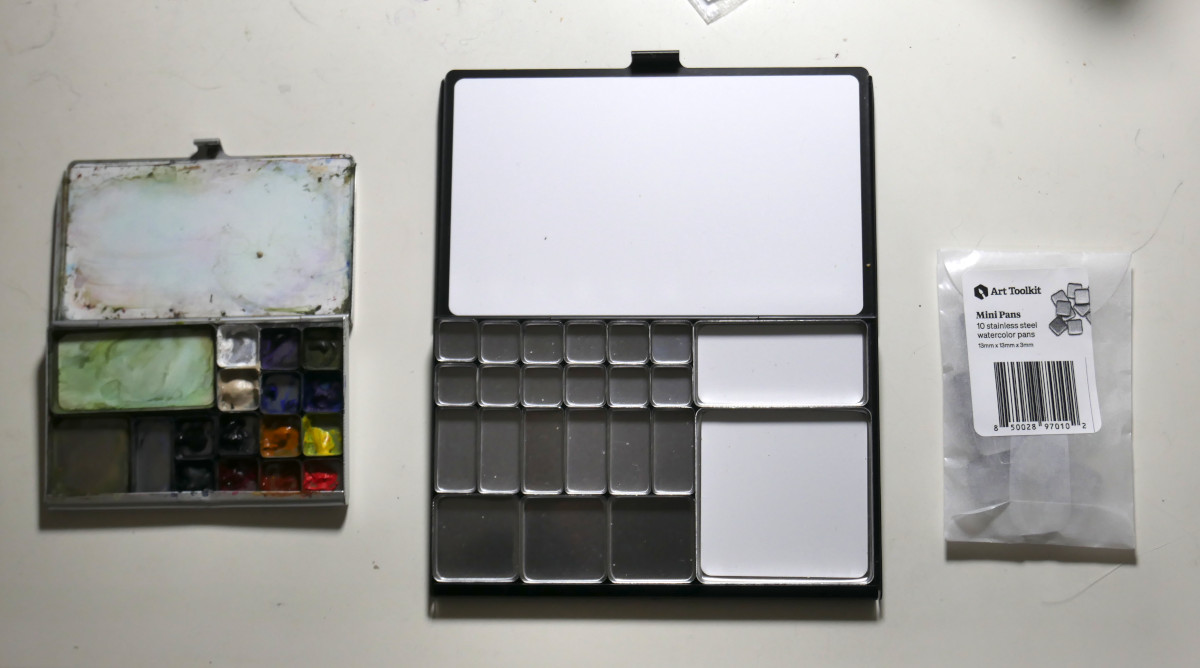 A while back I discovered the credit card-sized paint palette boxes that are available from Art Toolkit which is a small art supply company in Port Townsend, Washington. I have been using their Pocket Palette for several years now as it fits nicely into my field art supply pouch. As can be seen in the lefthand side of the photo, I have loaded it up with 14 different watercolors. I’m wishing for more colors in my palette, so some weeks ago I ordered the largest palette Art Toolkit sells, the Folio Palette (in the middle in the photograph), and together with additional minipans (as seen at right in the photo) I figure I can get up to 30 different colors in the palette. But what do I choose? My bigger Schmincke paint box is giving me ideas. Raw umber, certainly. Perylene green, most likely. Purple magenta? It comes handy when painting the lamb’s ears flowers in our yard. Figuring out the tube watercolors I’m going to order is a good challenge.
1 May 26
Worm Comics
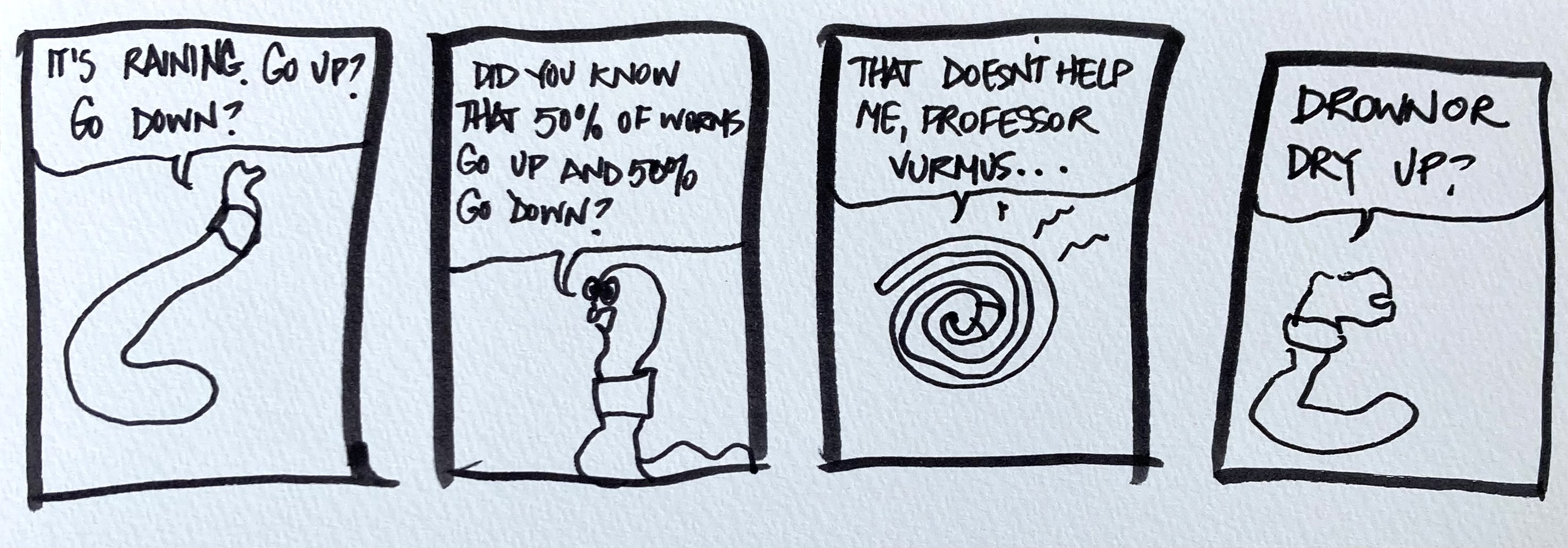
During a walk this morning I saw a worm, struggling on the sidewalk. I couldn’t stop myself; I picked it up and threw it into the grass. I’ve done this for years (during the big El Niño year in 1997-98 I had an article published in the Santa Barbara News Press about being a worm rescuer).
This evening during the SAW Friday Night Comics Workshop Sarah Maloney had us making dialog between two worms; the above is my effort.
30 April 26
Neighborhood Iris
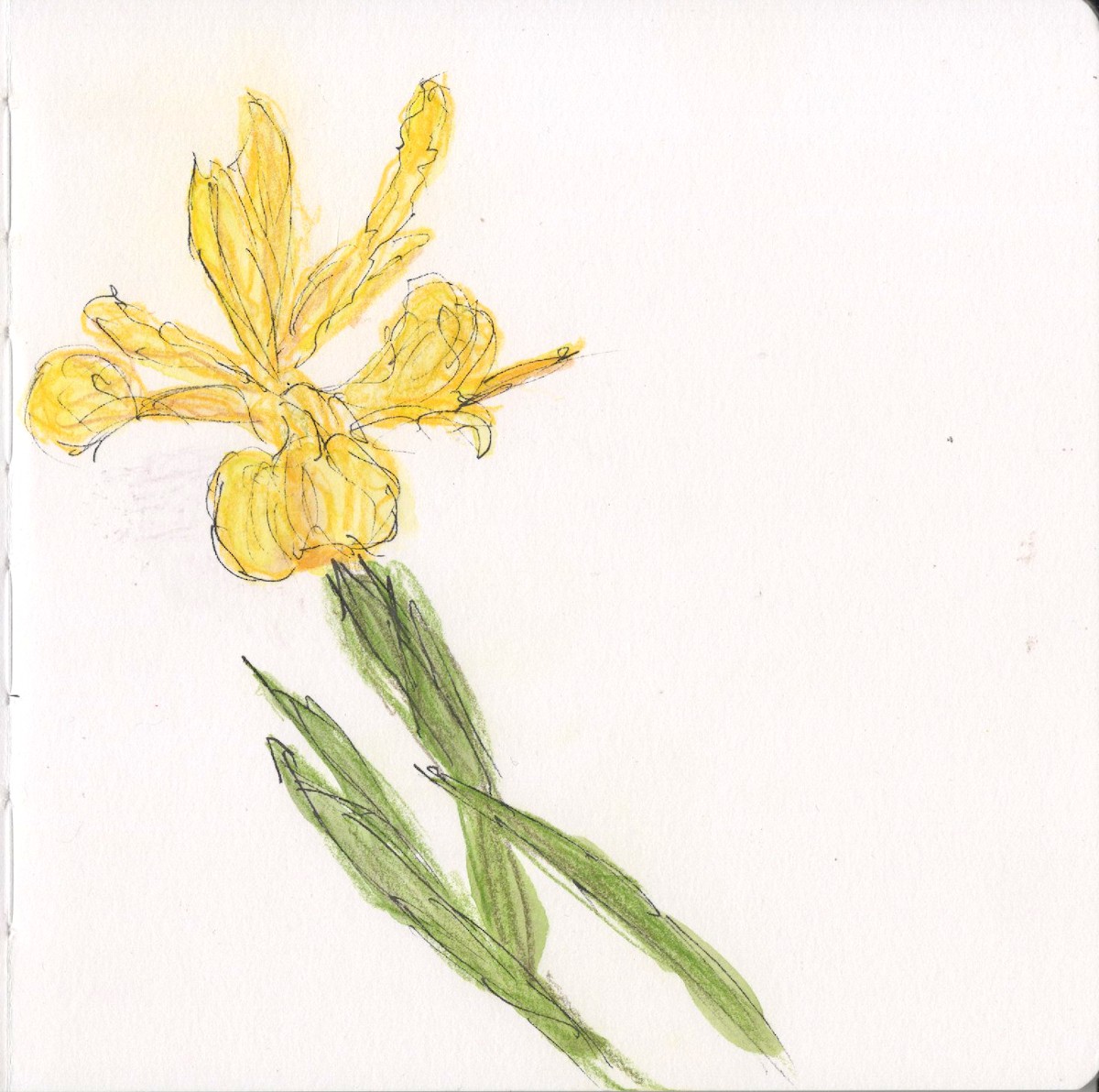 There is an alleyway east of our house that runs for a block and has lots of good plants growing on its edges. Today I sketched this iris using Derwent drawing pencils, watercolor wash, and black ink linework.
29 April 26
On the Loudness of Americans
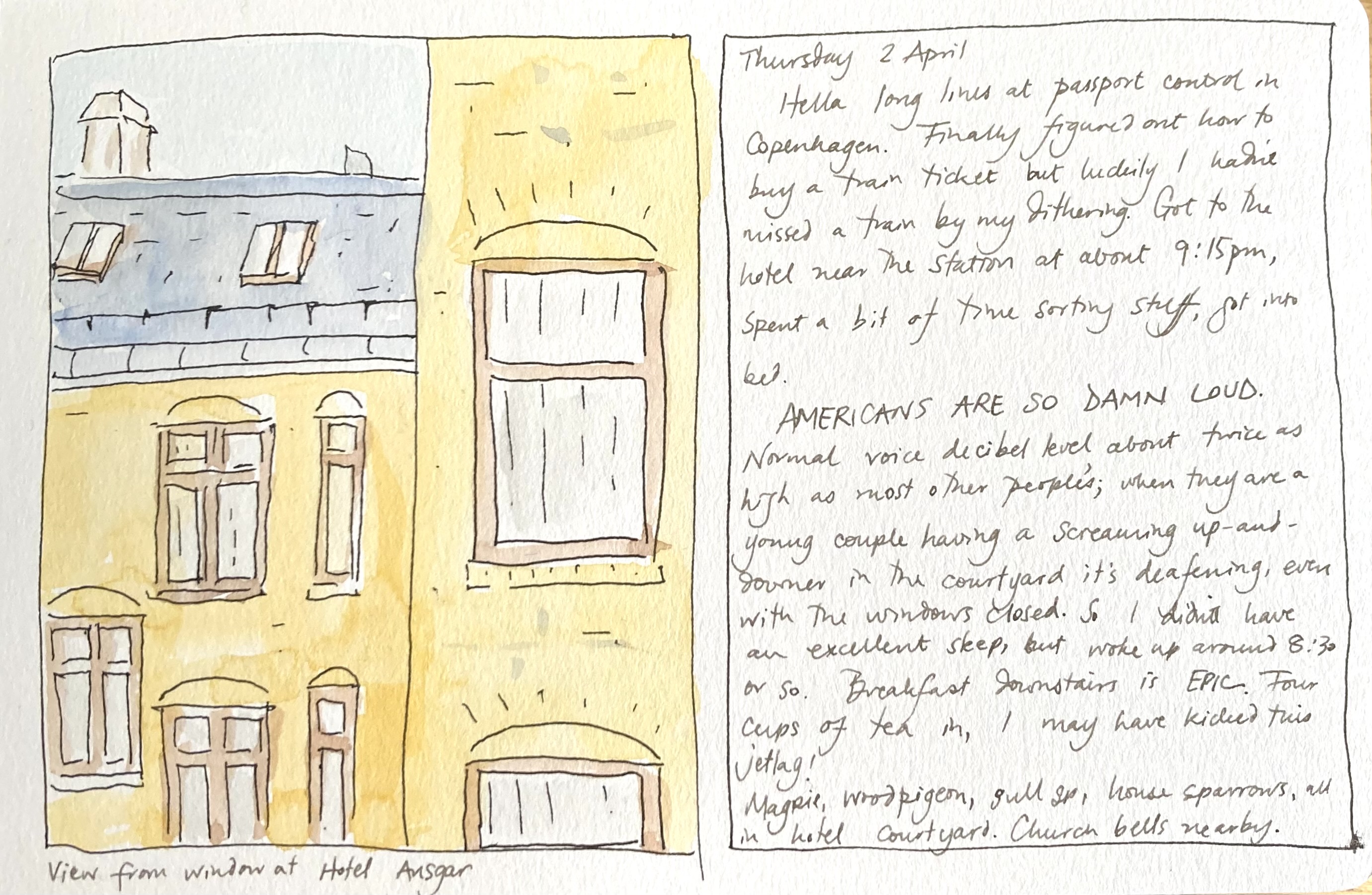 On the first night of my recent trip I arrived in Copenhagen (a long, long day: a train ride, a BART ride, a transatlantic flight, a second flight within Europe, a long line at Danish passport control, another train ride into the city: you get the idea). I was exhausted, wanting nothing more than to fall into bed in a hotel room which was way too hot. So I opened the window.
An American couple was having a very loud argument. Were they in their own hotel room, or in the courtyard? I couldn’t tell, but after a few minutes of this I was very tempted to stick my head out the window and yell “don’t you think they hate us enough already?” — I didn’t, but it did occur to me that I’ve always thought of Americans abroad as loud, brash, uncultured, and basically stereotypically and obliviously throwing their weight around the world in the same way we do politically. Of course not ALL Americans behave this way, the same way that not all men are harrassers or rapists, but it just takes one loud encounter to reinforce the stereotype. And it left a sour taste in my mouth.
Curious about the actual decibel level of American speech I chanced upon this recent article from the Santa Barbara Independent by Julianne Tai which looks at the phenomenon. It’s really a question of perception. I think a better way to approach the question is really to educate young Americans about the perception of Americans in other countries and look at ways to gently thwart it… which requires that they travel (already a tall order) and then that they travel respectfully.
28 April 26
Yellow Onion
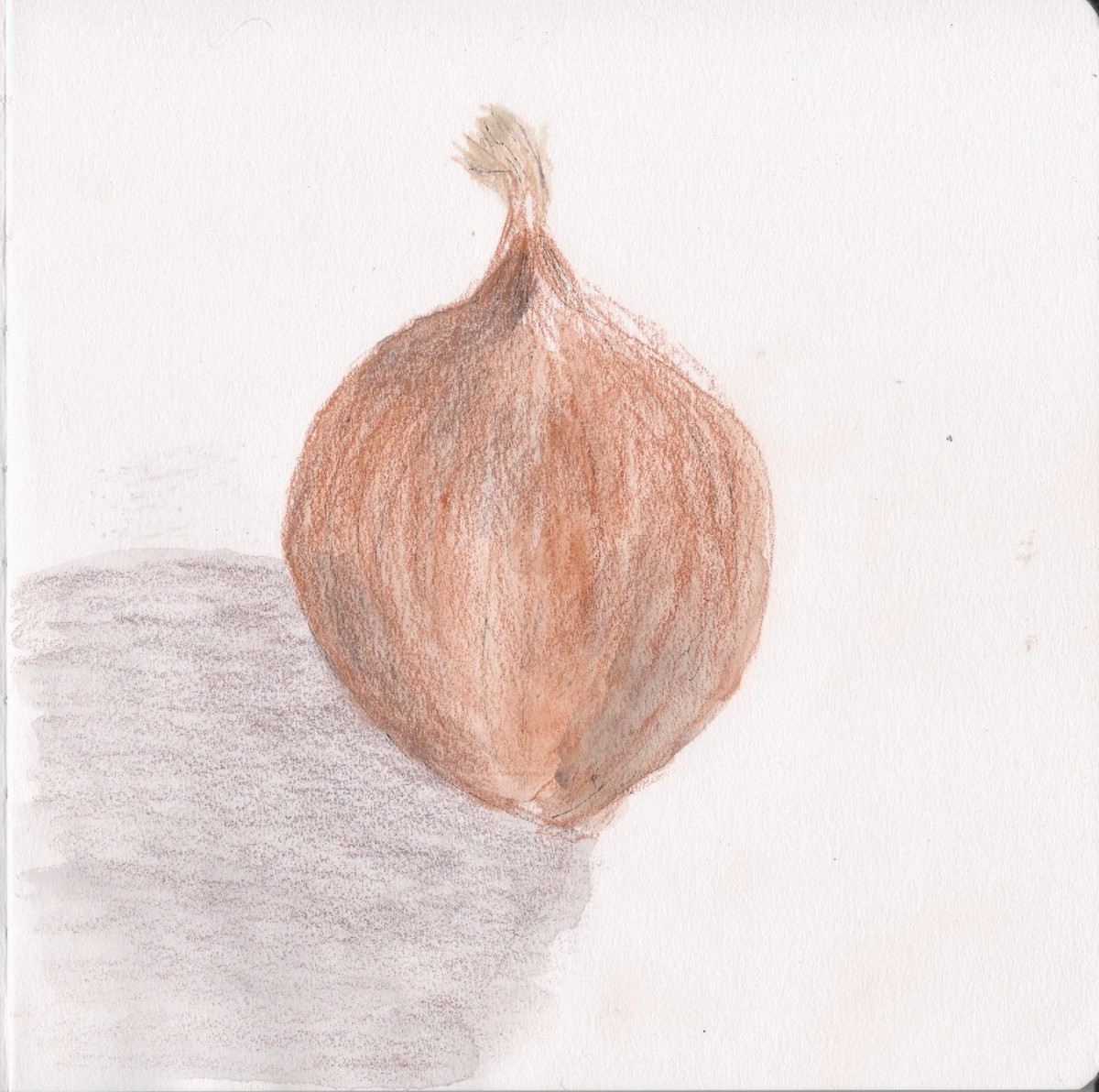 This onion is from our grocery run this morning, and is sketched with Derwent drawing pencils, watercolor wash, and a bit of extremely fine black ink linework.
27 April 26
Colored Pencil Afternoon
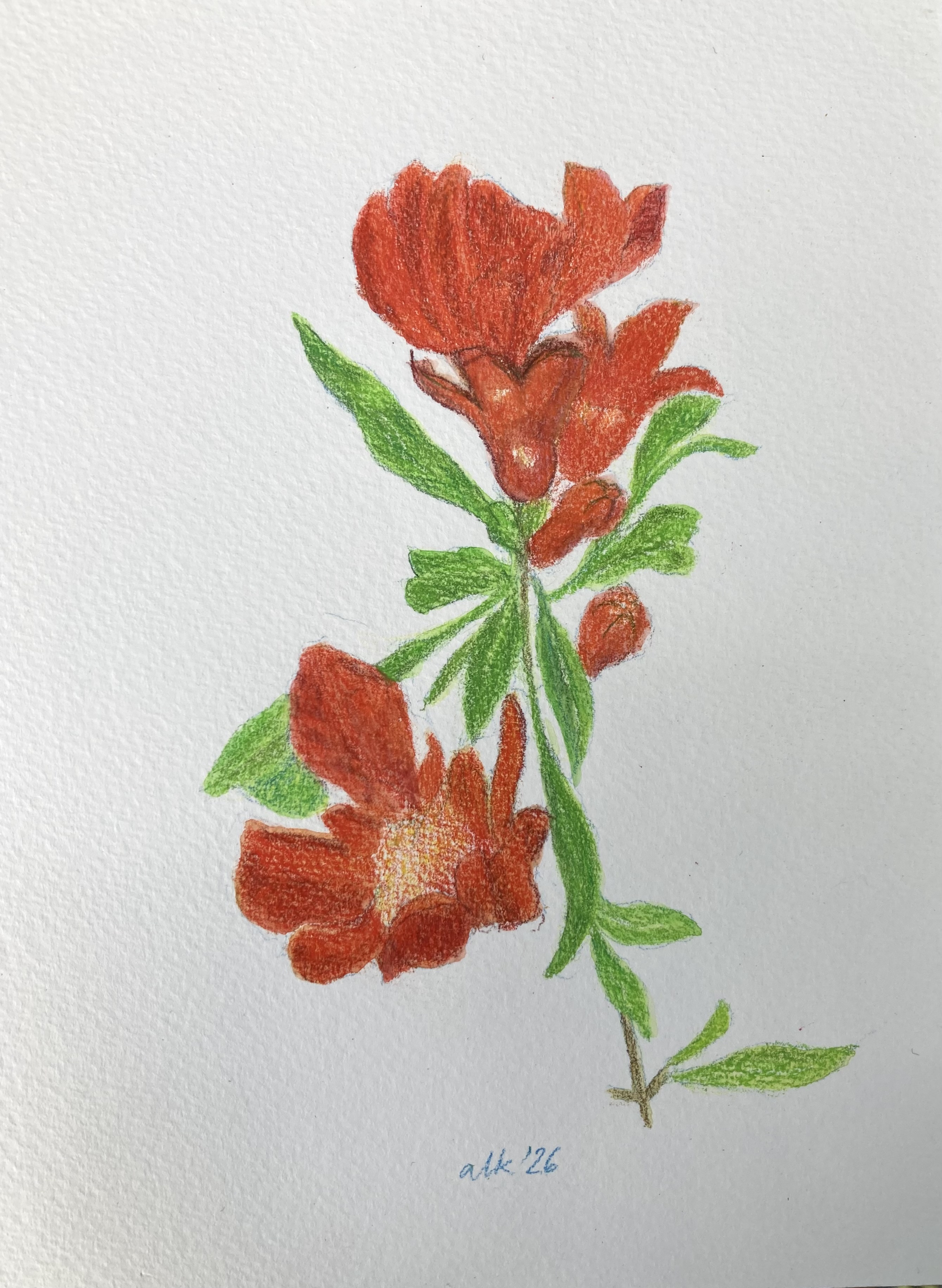 I’ve been wanting to do a long colored pencil drawing for a while. I got back from Europe a week ago and the pomegranate tree is now in full bloom. It’s a tricky color to replicate: a very warm red which is almost off-gamut.
I did this drawing in two stages: first, with Caran d’Ache watercolor pencils, which I wet after several layers; second, additional multiple layers of Prismacolor. I’m not sure I know what I’m doing — but it’s a very meditative process and I’m glad I had a go.
26 April 26
By The Railroad Tracks
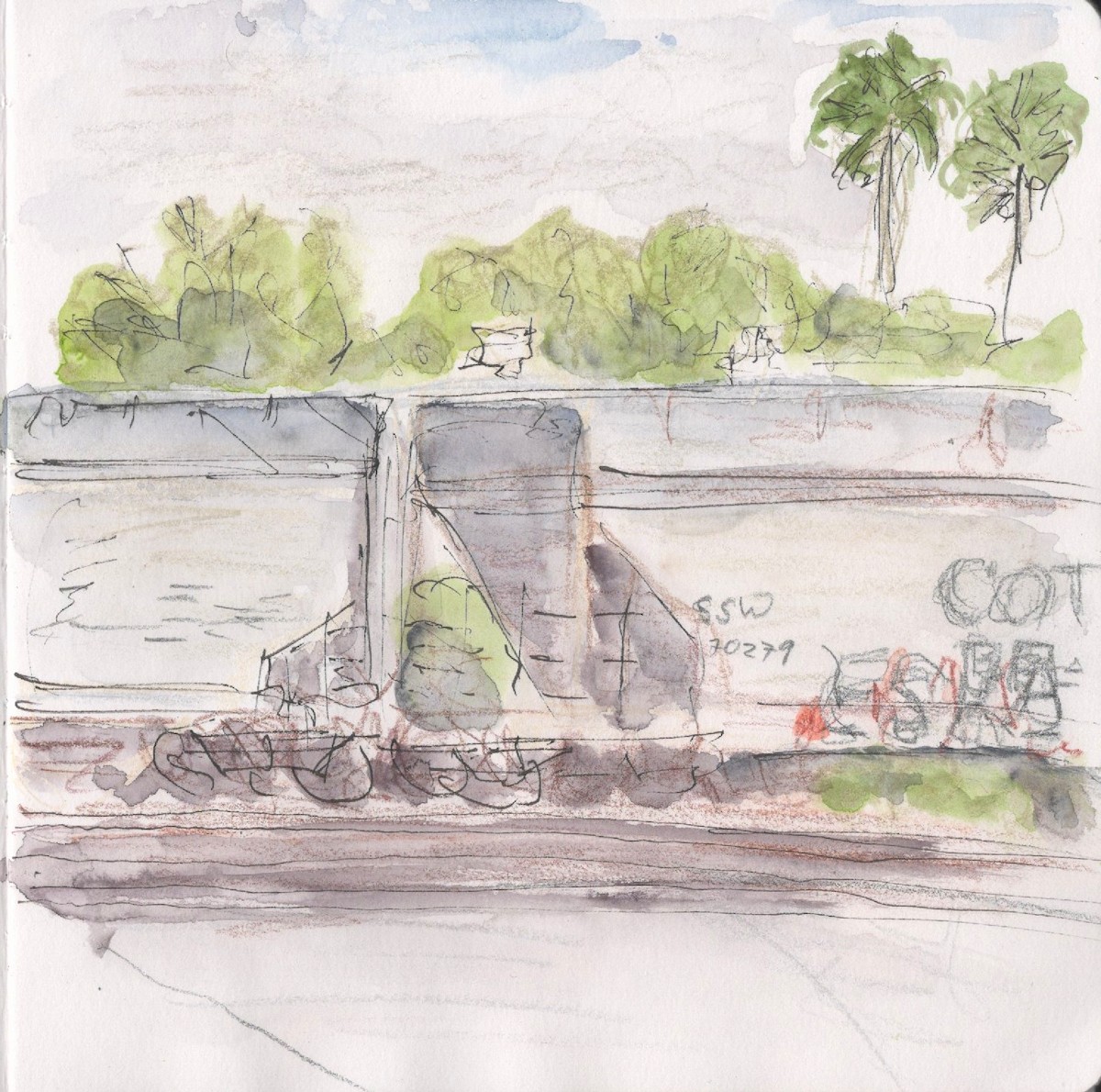 For my urban sketch today I went over towards the Davis Food Coop and admired the railroad cars along the tracks just east of the coop. I think railroad cars are interesting both to photograph and to draw. This was sketched with Derwent drawing pencils, fineliner black pens, and watercolor wash.
25 April 26
European Birds
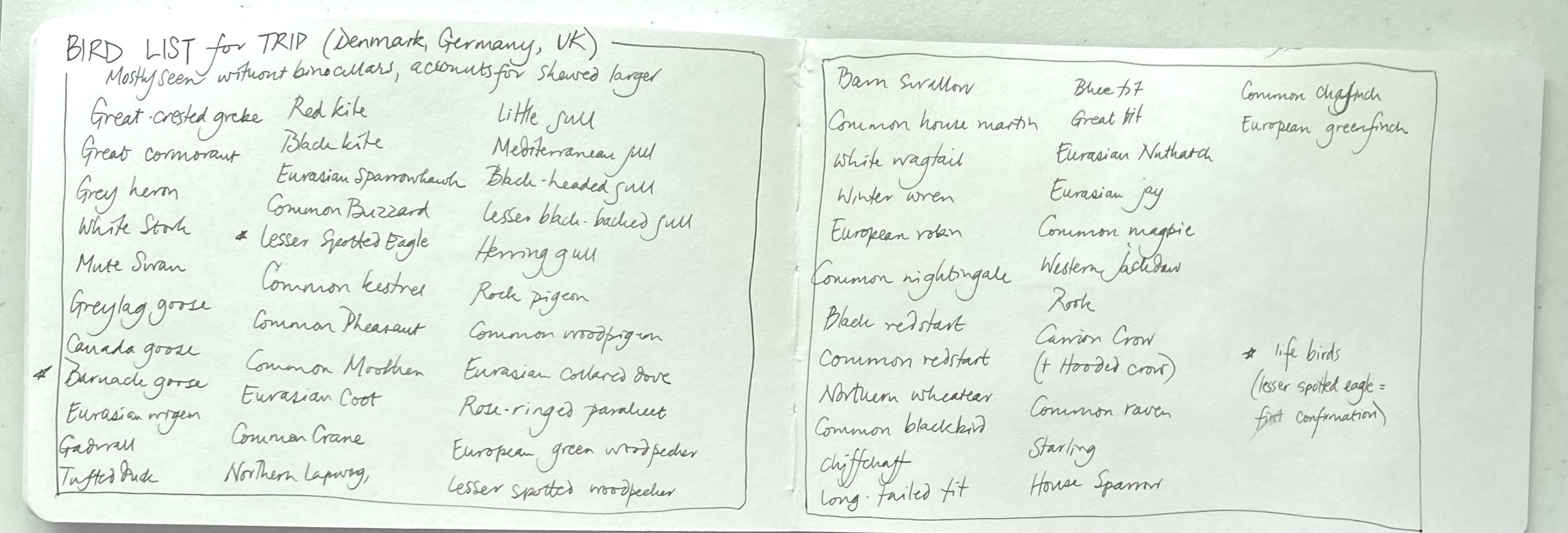
I was able to take a pair of Numenius’ binoculars (Pentax Papilio) with me on my trip. This was very much not a birding trip, though my friends Jennifer and Harald organized a day of birding in a large wetland south of Copenhagen, where I actually saw my life Barnacle Goose (a whole field of them, actually).
When your birding is done mostly from train or bus windows, your list is going to skew very much to the larger birds. I did see some old friends, including Black Redstart, Wheatear and Dunnock. I am almost certain I saw a Lesser Spotted Eagle growing up in Spain but I did confirm it on the bus ride to Freiburg.
For not being a birding trip, I think I got a pretty respectable list.