
12 December 06
Making Sense of Gobbledegook
Finally, some long-needed new proofreaders’ marks from Eve Corbel. Via Language Hat.
In other news, speaking of gobbledegook, we may be hitting some snow this weekend as we do our Christmas Bird Count along the ridge at Mount Vaca:
MODELS SEEM MORE IN LINE WITH THE DETAILS OF A TRANSITION BACK TO A MORE AMPLIFIED PATTERN OVER THE WEEKEND. THIS MAY DRIVE A STRONG STORM INTO THE REGION THIS WEEKEND. 18Z GFS NOW BRINGS A SEPARATE WAVE ACROSS THE FAR NORTH THURSDAY NIGHT BEFORE THE JET AND ASSOCIATED PRECIPITABLE MOISTURE PLUME TAKES AIM AT OUR AREA BY FRIDAY NIGHT. THIS SYSTEM MAY HAVE A DEEP MOISTURE TAP... STRONG DYNAMICS AND CYCLOGENESIS. 18Z AND 06Z GFS DEVELOP A SURFACE LOW SOMEWHERE ACROSS THE AREA... EITHER OVER SOUTH CENTRAL CALIFORNIA OR IN THE GREAT BASIN. THIS COULD BE A MAJOR SNOW PRODUCER
11 December 06
Mapping Food Coops

I’ve wanted to know where all the food coops are in the United States for some time so I made a map, shown here at left. To do this I screenscaped the addresses for all the food coops in the Cooperative Grocer Directory and then used the functionality at geocoder.us to change the addresses into latitudes and longitudes which I could then plot on a map. This is still a draft map: my first pass at geocoding only got about 80% of the food coops located (about 220 of them). Minnesota, Wisconsin, and Vermont win the prize for the most cooperative states.
10 December 06
Another Long Walk Through the Desert to the Mountains
On September 11, 1973, the first democratically elected Marxist president in the world, Salvador Allende, was killed. Augusto Pinochet’s U.S.-supported coup ushered in one of the most violently repressive regimes the world has ever shuddered to see (so it mostly shut its eyes. For this, we will pay a price, I think, as we will pay a price for Darfur, and Rwanda, for Bosnia, for Auschwitz).
When I worked at the Latin American Centre in Cambridge in the early 1980s, I often met Chilean refugees. They were respectful, intelligent, torn apart by what was happening at home. Mostly they didn’t talk about it. There was an international network of people who worked hard to find them somewhere to land, to have a safe place, maybe even to find meaningful work (difficult, though, in Thatcher’s Britain). They made empanadas to bring to potlucks. A pocket of potatoes, a pocket of Andes. Who knows what they had escaped; who knows what they lost, away from home. Not even they will ever know, probably.
Various attempts have been made to bring Pinochet to justice in the past ten years. They have all failed. Now, he’s dead.
In the vein of “L’enfer c’est les autres,” I hope the “autres” encountered by Pinochet on his final journey through the desert of black sand are those who will call him to account. Like Milosevic, he has escaped sentencing in this life…
8 December 06
Twenty-Seven
![Graph of RC [Runs Created] with age](http://www.magpienest.org/images/165.jpg "Graph of RC [Runs Created] with age") Brian Sabean, the general manager of the San Francisco Giants, has got to go. Now that we’re well into the off-season, I’ve been dabbling in a bit of sabermetrics — what can I learn from analyzing a database of player statistics that goes back to 1871. As something of a warmup, I started to look at player performance as a function of age. After concluding I needed to look at a single cohort of ballplayers, I chose all batters who were born in 1957 (all of whom have stopped playing by now).
Brian Sabean, the general manager of the San Francisco Giants, has got to go. Now that we’re well into the off-season, I’ve been dabbling in a bit of sabermetrics — what can I learn from analyzing a database of player statistics that goes back to 1871. As something of a warmup, I started to look at player performance as a function of age. After concluding I needed to look at a single cohort of ballplayers, I chose all batters who were born in 1957 (all of whom have stopped playing by now).
The graph at left is a doubly-averaged concoction. The y-axis measures Runs Created, which is an estimate of the total number of runs that a batter contributes to the team over the course of the season. What I did to produce the graph was to plot for each of the batters in my cohort RC against age and then fit a linear regression model with a quadratic term against the plot. This model generates a graph that is an upside-down parabola, the maximum of it falling at the age of the batter’s peak performance. I then took the equations for the entire set of batters, and averaged their coefficients together in turn, to produce the graph here, which is a composite look at the batting performance across the entire cohort.
The peak of the graph is at age twenty-seven. After I did my little analysis, I was gratified to read that Bill James came up with exactly that value for age of peak performance twenty-five years ago. Beyond that, players start going downhill, or as Bill James put it: “most players are declining by age 30; all players are declining by age 33.”
As Steven Rubio has pointed out, the San Francisco Giants aren’t exactly in a youth movement. This off-season they have so far signed or re-signed Ray Durham (age 35), Dave Roberts (age 34), Rich Aurilia (age 35), Bengie Molina (age 32), Pedro Feliz (age 31), the pitcher Steve Kline (age 34) and of course Barry Bonds (age 42). Sigh. With that lineup, the Giants’ winning ways (this past season their record was 76 and 85, 11.5 games out of first place in the division) are surely going to continue. It’s not even 2007 yet, and my hopes for next season are pretty dim.
6 December 06
What to do When...
I’ve been attending a two-day training on Emergency Communications. It’s been fascinating. I deal with the media as part of my job but usually only tangentiallly; there are professionals on campus whose function it is to do this and we have a truly wonderful person who has been good at getting the word out about the work of the Wildlife Health Center. Since much of it is newsworthy, what with West Nile Virus and oil spill and mountain lion attacks and avian flu, reporters and cameras are part of the horizon.
But the training I’ve just done will equip me, in the event Sylvia is out sick or on vacation or dealing with another emergency or the same emergency if it’s big, to handle the media on my own. In any emergency they’re often on the scene just as the emergency responders are getting there. They need a person to keep them informed, to keep them getting enough so they keep out of the way. I can certainly participate in a large-scale campus or city-wide emergency.
The scenario we were given was that a jet airliner crashed into the Mondavi Center for the Performing Arts. Inside, speaking to a packed house, was Senator John McCain. The building was flattened. Our brief was to set up a Joint Information Center, allocate functions to everyone in our group, and come up with three messages as well as a system of dealing with the converging media city.
Rumor control was obviously a big part of the job, which means someone needs to monitor the news constantly. (I didn’t volunteer for that part. Ugh. Not owning a television almost really disqualififes me from participating in such an exercise…) During the drill we were interrupted constantly by updates and by breaking news flashes alleging terrorist attacks.
The Mondavi Center is about 250 yards from Mrak Hall, where the news service is located. We might have a situation in which the communications efforts for an entire crisis is handled by people who are satellites.
It was interesting, exhausting, and showed up a few gaps in our system. This is why you do drills….
——
On a separate note, Tim Lindgren of The Where Project writes of a fascinating book, The Economics of Attention by Richard Lanham. The idea is that “the new economists are the artists, the designers, the rhetoricians because they are the ones best equipped to deal in the cultivation of human attention.” Tim talks about Darfur and how his attention (and with a few notable exceptions) that of the West is firmly turned elsewhere. A genocide is happening on our watch in Darfur, he says. Are we paying attention?
3 December 06
Messiah With B Mesons
We went on a day trip to Stanford today — we were invited down by our friends Ian and Katrin to hear her sing with the Stanford Symphonic Chorus in their holiday concert. They performed Dvorak’s Mass in D major followed by excerpts from Handel’s Messiah. The concert was in Stanford’s Memorial Church, an impressive venue right at the heart of campus. Afternoon choral performances are great concerts to go to, and we had a lot of fun at this one.
Beforehand, we met an old friend of mine who is working on his doctorate in experimental particle physics and is now doing his research at the Stanford Linear Accelerator. His graduate program is actually at the University of Wisconsin, but the experiment he’s working on is one of these massive high-energy physics collaborations that involves some 80 different academic institutions.
2 December 06
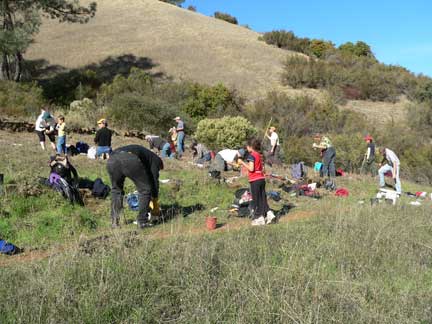 Our morning was spent once again in Cold Canyon. This time we met up with about forty people, at least ten of them under ten (go Girl Scout Troop 1952) to plant native grasses at the homestead, a nice hike in to the canyon of about 1-1/2 miles.
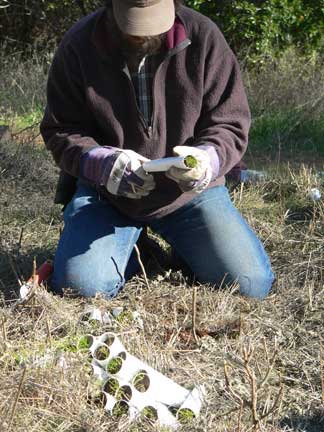 There were 600 grass seedlings to plant as well as quite a few native shrubs and trees (toyon, lotus, gray pine). With 40 people, though, the time passed quickly. Numenius has so far avoided messing about too much in the garden but he was well into it today. We were joined by about 5,000 hatching ladybugs. It was an excellent party.
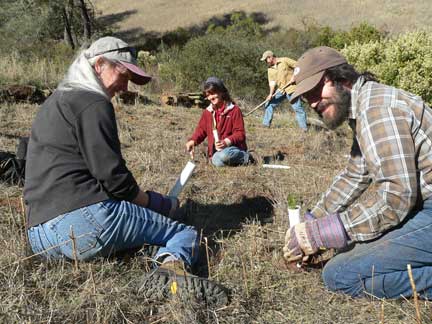 One of the great pleasures of the day was running into three separate friends. Andrea, in the middle here at left, had some wonderful news to share with us. She’s a lurker on this blog so I won’t embarrass her but hey, gal, congratulations to you and Steve. It was great to see you.
1 December 06
More Index Cards
The hipsterPDA experiment continues to go well, though I’m behind on doing my weekly review. Here’s a Japanese perspective on index cards as a productivity tool, though apparently index cards are hard to find in Japan.
30 November 06
Books
Modal Minority has started an interesting exercise: an inquiry into the best books we read in 2006, regardless of when they were published. I’m still thinking about this.
Today I received word of an interview by my former boss and mentor at Harvard. (Thanks Sue.) This interview reminds me why it’s important to remember that not all the best books were published last Tuesday. On Lindsay’s list of books he’s most proud of having published, I worked on well over half. It doesn’t mean Harvard has published nothing of note since I left ten years ago, but I’m glad some of those great books didn’t get relegated to the dustbin of publishing history…
29 November 06
Digestive Table
Those folks who have trouble getting their dinner leavings outside to the compost pile might want to consider building a digestive table. This project, designed by artist Amy Youngs, is a vermicomposting system built underneath a round dining table — she terms this a “ a convenient, personal waste processing system built into a table.” Construction plans are provided on her site.
(From World Changing)