
24 April 07
Grouse Grand Slam
We’re back from our birding expedition to Colorado — a 10-day, nearly 2000-mile tour of the state focusing on the 7 species of grouse native to the state. The annotated itinerary:
Day 1 — We arrive in Colorado Springs and meet our carmates. It starts to snow.
Day 2 — We meet the rest of the group (16 people total, plus leader) and head off towards Elkhart, Kansas driving the last leg through a blizzard. In the evening we see the first of our target grouse, the lesser prairie chicken, visiting the lek site in preparation for the following morning.
Day 3 — The first day of our typical routine: up at 4:30 AM or something like that for a trip out to the lek site in the dark to watch the birds displaying before dawn. Lots of snow on the ground — it is very cold sitting in the car with open windows. We see 8 lesser prairie chickens displaying. We then head back to the motel for breakfast followed by a day of general birding.
Day 4 — A second try at the lesser prairie chickens, this time at a different site, followed by a drive to Wray, Colorado to see greater prairie chickens. Their lek interestingly is in the middle of an alfalfa field on a cattle ranch.
Day 5 — Before dawn we watch the greater prairie chickens display, about 35 birds total, at quite close distances. We head east through the Pawnee National Grasslands where after much effort we see McCown’s longspurs, a pair of chestnut-collared longspurs in breeding plumage, and a pair of mountain plovers. We spend the night at Greeley just east of the Rockies.
Day 6 — We travel through the Front Range to reach the small town of Walden in preparation to see greater sage grouse on their lek, and check out the lek site in the evening, the sage grouse cooperating with a partial display then.
Day 7 — Pica and I nearly oversleep and miss the 4:15 AM departure to see the sage grouse, but we get our warmest clothes on in record time and join the trek. We are thankful the grouse have no interest in hijacking our vehicles because they outnumber us and are certainly testosterone-laden enough to succeed at doing so. Off to Hayden via a lunchtime stop in Steamboat Springs, but we have little time for shopping, heading to the hills north of Hayden for a fruitless search for the dusky grouse. After this I sneak off to the local public library and look up some of the mammals we’ve seen already, including the thirteen-lined ground squirrel and the yellow-bellied marmot.
Day 8 — It snows overnight. With the help of a local guide we see a dusky grouse on his favorite spot in the hills, and a few sharp-tailed grouse on their lek spot, but they are mostly hunkering against the cold and we don’t see their display. Off to the mountain passes to look for white-tailed ptarmigan, but in two separate tries we fail to see any, the second time not reaching the site on account of too much snow.
Day 9 — Our third and final try at the white-tailed ptarmigan. We go to Loveland Pass, elevation 11,990 feet, and search the ridges on both sides. Two of our party ascend just high enough to spot a couple of birds, and we hurry up to their position despite the altitude. It is the literal high point of my birding career, looking at these white snow-footballs of birds at 12,280 feet in elevation.
We then travel east in preparation for our final grouse species, the Gunnison sage grouse.
Day 10 — Up at 4 AM for a 4:25 departure to the Gunnison sage grouse spot. Along with the lesser prairie chicken, the Gunnison sage grouse is the rarest species we see on the trip, and there is precisely one spot in the world from where this sage grouse can be viewed. Our preparations go well, and we are treated to a display that lasts well over an hour. After breakfast back in town, we start start wending our way back to Colorado Springs.
Day 11 — We fly back home, leaving the motel at 5 AM. The kitties are happy to see us upon our return!
11 April 07
Flowers as Characters
 “Numenius, you know you don’t like pelargoniums? Well, I feel the same way about mallows.”
We were walking at the Tilden Bot Garden on Saturday in the rain which N. insisted was heavy mist.
“The ones I don’t like are Alstromeria,” said Joe. “They’re cheap. They’re the Britney Spears of flowers.”
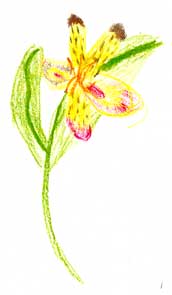
At left is an alstromeria drawn by my niece when she was seven and sent to me. Since I don’t get many drawings from my sister’s kids, this one has been on my wall since. But I see Joe’s point: they have the aesthetic best suited to little girls heavily into anything pink and delicate (which T. no longer is, spending hours and hours these days hanging around the horse barn).
I had hoped the black-and-white columbine Ron gave us to plant last fall would have flowered by the time we left for columbine country (Colorado) tomorrow, but you’ll have to wait for a drawing of that one for when we get back in ten days. Aquilegea hybrid, var. Magpie.
9 April 07
Budburst
Project Budburst is a new citizen science effort to monitor plant phenology — that is, the timing of biotic events such as leafing or flowering. In an era of climate change, tracking phenology is an important part of ecological monitoring.
This spring is the pilot for this project, and next year they will kick it off in full. They have a list of 59 species across the continental United States they are monitoring. It’s a bit of an eclectic list. I’d like to see them add my local phenological favorite: western redbud (Cercis occidentalis).
8 April 07
Salty Balty
The Giants won one game this week. They played six games — at home. Tomorrow they set out on the road.
Giants fans are miserable, already, one week into the season. Hard to see how anyone could be more miserable than Salty Balty, who calls in regularly to the postgame wrap, bemoaning the geriatric lineup and calling for heads to roll — a refrain that was taken up by caller after caller.
Today I did more gardening than I probably should have, given how my back is feeling, but it was fun to listen to the game (though not fun to hear them lose).
Peppers, chiles, leeks, fennel, squashes — all went in today (all the melons went in yesterday). It may be a little early. Oh well. We’ll see… Maybe Salty should take up gardening.
7 April 07
Botanic Garden
 We met Ron and Joe at the Botanic Garden in Tilden Regional Park in Berkeley on a drizzly morning today. The Botanic Garden is exclusively devoted to California native plants. I realized as we went through the collections that I don’t think I’ve been there since I took my classes on California plants in 1992 back in grad school at UC Santa Barbara. The plant species seem to be a lot more familiar than when I was there last.
Ron and Joe related that this garden led to the origin of the California Native Plant Society, which is the most important organization for the conservation of the California flora. The garden dates to 1940; in the early 1960s there was a plan to expand the 9-hole golf course across the road over the garden. Local citizens objected, and the organization that grew out of this eventually became the CNPS.
Above is a sketch of Trillium angustipetalum, a plant collected from Humboldt County. It is in the lily family, but as Chris Clarke relates , who knows what that means any more.
6 April 07
5 April 07
Blogger Bioblitz
Jeremy Bruno of The Voltage Gate has come up with an excellent way to participate in the National Wildlife Federation’s National Wildlife Week. He has announced the First Annual Blogger Bioblitz, “where bloggers from across the world will choose a wild or not-so-wild area and find how many of each different species – plant, animal, fungi and anything in between – live in a certain area within a certain time.”
This is not meant as a hard scientific project, rather it’s a fun way to “highlight little pockets of biodiversity across the world.” This event runs from April 21 – April 29. For the first couple days of that period we’ll be on a birding trip far too fast-paced to serve as a bioblitz, but after that I should be able to find some nearby nook to survey.
4 April 07
Geezers and Young Ladies
I got referred to on the air on Monday night as a “young lady,” something I haven’t been called for years, and probably only ever by my father. But it’s standard radiospeak for “woman ham,” even if the woman in question is 95. Strange and patronizing, though not altogether unpleasant — like learning morse code, it just feels jolly retro.
We attended a meeting last night of the local ham group. I was, as usual, the only woman there. They were kind and argued about this antenna and that battery and why something wasn’t working (all total gobbledegook) and I felt acutely self-consciously alien. (This is a good thing: not a problem to be reminded that this is an experience most African Americans, say, have not just in meetings, but ALL THE TIME, here in Davis. Damn but it must wear you down. Oh. Then try doing calculus…)
There’s a certain sense in radio gatherings — many of these guys are gray, some of them hams from the 30s — that I’m hanging out with clones my grandfathers. One, in particular, is 85; got his license as a teenager in 1938, went to Berkeley. Like other hams in those days, all Tom’s equipment was stuff he had made himself, flinging wires out from the second-floor of his boarding house for antennas.
Also like other hams in those days, and still today, Tom sent out cards to those with whom he made contact, listing the time, frequency, his call sign, report of signal strength and clarity — a QSL card. These cards are often a wonder (more often, a curiosity) of graphic design and in aggregate they can tell a ham’s life story. (One such story was the basis for Danny Gregory’s Hello World.) Tom had never kept any of these first cards, but one showed up in a box of QSL cards that were heading for the dumpster from an estate sale when they were rescued by Rob, who recognized Tom’s call sign. Tom and his card were reunited.
More stories from Alien Radio Planet will follow, I’m sure…
2 April 07
Opening Day
None of our teams won today (the Giants open tomorrow), but the new season is underway! In this thread I learned that Detroit Tigers broadcasting great Ernie Harwell would open up the new baseball year with a verse from the Song of Songs:
For the autumn has passed and the rain is over and gone. The flowers are seen in the country, the season of the songbird arrived, and the sound of the turtle-dove is heard in our land.
1 April 07
Spencerian Weekend
I just got back from a two-day intensive workshop in Spencerian script. This is really the only truly American calligraphic hand, reaching its heyday in 1860 or so. It differs from its copperplate predecessor by having more oval shapes than round, a smaller x-height, some truly quirky capitals, and much less thick-thin variation.
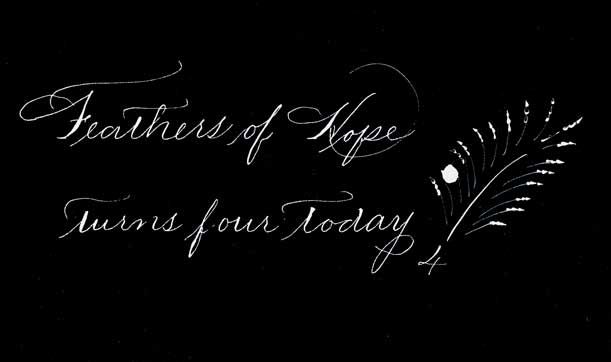
I’ll post my final project tomorrow when I gather my wits. But it was about Feathers of Hope turning four today… The blotch you see on the feather is, well, a blotch, Dr. Ph Martin’s Bleedproof White, to be precise. I’m still learning this. But you get the picture…