
5 May 07
Anticipation
Never mind silly things like home run record chases, there’s nothing in baseball quite like the anticipation of seeing a much-heralded prospect make his major league debut. On Sunday Tim Lincecum is scheduled to start for the Giants in their game at home against the Phillies, taking the place of Russ Ortiz who has been put on the disabled list. Lincecum was their first-round draft pick in 2006 and so far this season he has been mowing down batters at Triple-A level, allowing just one run in 31 innings pitched, for an ERA of 0.29. How well will he adjust to the big leagues? Will he get fazed on Sunday by the likes of Ryan Howard and Jimmy Rollins??
3 May 07
Le Cru et le Cuit
How do you feed a cat? This was a question I asked, literally, when four five-week-old feral kittens ended up in our bathroom, badly in need of feeding. I had never owned a cat. Since I work with a lot of vets, all of whom have pets, I got a lot of advice quickly. This brand is middle of the road, fine, better than this one but not as expensive as this one, top of the line. Mush up the kitten food with water, really make sure they’re getting plenty of fluids. No, you don’t need to supplement milk; at five weeks, they’re practically weaned.
I went to a talk last night at the Co-op about feeding your pets raw food. Diego’s been vomiting again, and this is worrying me since the hypoallergenic food he was prescribed by the vet was recalled just before we got back from Colorado due to the melamine pet food scandal. (I am really, really glad we always mixed it up with a lot of different dry foods, all of them wheat- and corn-free; if he was exposed, it was to tiny amounts.)
There was a lot of interest, predictably, in the wake of the melamine thing (one horrifying thought is that all the tainted food is now going to be combined with hog feed, here or abroad, and there’s no way to stop it or even trace it under current regulatory practices. This poison is headed for the human food chain, folks…). Postscript: actually, it already has: see this story
This is a vegetarian household. Cats are carnivores. Kibble’s easy, but what the hell is in it? (A hint: if it says “beets” it means “sugar.”) And why on earth is Hills filling its expensive white-coat-sanctioned food (think Clinique of the pet world) with corn, something as humans we should be eating a lot less of, but is basically indigestible for carnivores? Got it in one: it’s cheap. (Just like buying wheat or rice gluten from China is cheap. This has been a personalized crash course, for me, in the consequences of a global economy…)
I don’t know if we’re moving towards feeding the cats raw food or not. (To Numenius’ great dismay I did buy a bit with my friend Mary, beef heart with chicken; the cats turned their noses up at it this morning.) But I’m definitely interested in learning more about animal nutrition. One place I won’t look, probably, is any school of veterinary medicine whose funding for nutrition research comes primarily from the pet food company with the white coats. Sad, since I work for one of the most prominent such schools in the country…
1 May 07
Sag 10
We’ve received our assignment for helping out with the radio communications during the Davis Double Century 200-mile bike event, which is two weeks from this Saturday. First, we’re off to run the radio station at Rest Stop 1 at the bright and early hour of 5:30 AM. That’s all right, we’ve had plenty of practice of getting up at oh-dark-thirty during our Colorado trip. We then change gears, go mobile, and start following the course, having turned our Honda Element into a radio-equipped sag wagon (“Net control, this is Sag 10.”), and finishing our duties around 5 in the afternoon. A long day, but hardly as long as what the riders end up doing.
30 April 07
Chivvying Along the Chopping
They irrigated today.
This means they flooded the field, flooding our driveway. We are in a drought year; there’s water out there for the taking. Not a moment to be lost!
So while Numenius chopped onions, parsley, mint, tomatoes (not ours, yet), and feta for a tabouleh, I started hauling water from the ditch onto the various bits of the garden. The new wildflowers, planted and peeking, probably too late—need extra care (it’s hot now); the fennel; the eggplants; the leeks; the garlic; the parsley; the onions; the butternut squashes; the watermelons, zucchini, canteloupes; what’s left of the beets and carrots and chard and mustard; the lettuces and peas; the artichokes, now brilliant purple and splendid; and the marigolds I’ve planted near the tomatoes to deter nematodes.
I’ve bought two Spanish plastic baskets, ones I grew up seeing used in fields, but that are now available at Peaceful Valley Farm Supply, in recycled plastic. Their advantage is that they can haul dirt, veggies, and water — and because they’re flexible, they’re easy to fill in a ditch.
I was called inside at 8:30 with totally failing light to participate in the Yolo Ham net, which took ten minutes — during which time I became acutely aware of the extent of the caked mud on my jeans. Mud Glorious Mud.
29 April 07
Putah Creek Bioblitz
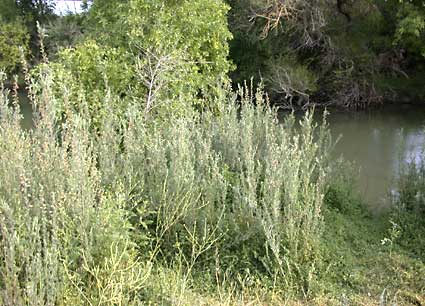 At the end of Blogger Bioblitz Week, I finally got out to my spot and did a bioblitz survey on my own. This is an exercise in humility: I do well at identifying birds, passably with vascular plants, reasonably well at reptiles and amphibians, but fail when it comes to identify insects or any other invertebrates. A proper bioblitz involves a team of skilled naturalists, but the main aim for the blogger version was to have fun, and so I did.
My spot was a bank of Putah Creek not far from home, located at N 38.5177° W 121.7616°. The upland portion was dominated by non-native grasses and weeds, primarily wild ryegrass Lolium perenne. Near the stream itself was a stand of narrowleaf willow (Salix exigua) with occasional Oregon ash (Fraxinus latifolia). I surveyed plants and birds, the latter anything within about 50 meters of my spot, including overhead and across the creek. I kept my eye out for dragonflies and butterflies, but only saw two of the latter and one of the former, and wasn’t able to get close enough to have a go at looking them up. My favorite identification was wild licorice (Glycyrrhiza lepidota), which I figured out after a browse through the photo library at CalFlora. My species lists follow:
Birds:
- Swainson’s hawk
- Western kingbird
- Snowy egret
- American crow
- Tree swallow
- Red-shouldered hawk
- Ash-throated flycatcher
- California towhee
- Turkey vulture
- Scrub jay
- White-faced ibis
- Bushtit
- Northern oriole
- Mallard
- Black-headed grosbeak
Vascular plants:
- Salix exigua (narrowleaf willow)
- Fraxinus latifolia (Oregon ash)
- Convolvulus arvensis (bindweed)
- Brassica nigra (black mustard)
- Lolium perenne (ryegrass)
- Centaurea solstitialis (yellow starthistle)
- Avena fatua (wild oats)
- Medicago polymorpha (California burclover)
- Eucalyptus sp.
- Vicia sp. (vetch)
- Plantago lanceolata (plaintain)
- Geranium dissectum
- Silybium marianum (milk thistle)
- Rumex conglomeratus (dock)
- Glycyrrhiza lepidota (wild licorice)

28 April 07
Tu/Usted
Susan writes about the tu/usted familiar/formal usage of the second person pronoun in the village where she and her sweetie spend half the year in Mexico. I’m interested in this because the usage seems fluid, local, and changing constantly.
When I returned to Spain after many years away, about four years ago, I was stunned by how complete strangers now used the “tu” form to each other. (I looked like a gringa or, to use the Old World form, a giri, and it wasn’t until I opened my mouth that they, once they got over their stupefaction, danced in multiple ways around the tu/usted maypole.) But usually one person sets the rules: either by establishing “nos tuteamos, ¿vale?” or simply by assuming that a “tu” will not be considered rude. (I did notice that nobody said “tu” to my mother while we were there for a wedding last year unless they had known her VERY WELL when she lived there. Perhaps there’s a certain age above which it’s never considered okay beyond the family.)
I had a sad occasion to call Madrid on Wednesday to order flowers — the mother of the groom died suddenly on Tuesday night. (Auntie Margaret, I hope there’s lots of good hot tea milk not cream, and toast and marmite, wherever you are now.) The local florist, Carlos, was from Ecuador. (This is definitely a new face of Madrid: the influx of Latin Americans, willing to do all the work that Spaniards etc. etc.) We discussed colors and the layout (the US usage “arrangement” is translated to “arreglo” in Ecuador but in Spain the term is “centro,” so once we got through all that we communicated quite well. I certainly used “usted” but I suspect that makes me a bit quaint. Carlos showed no sign of discomfort with it, though. I think the key here is to be attentive to the comfort level of the person you’re talking with…
Susan says that in contrast to the morass of Spanish usage, she understands the French usage of tu and toi and vous, but again I think it might be more nuanced. For instance, my boss in an insurance company in Paris in the early 80s was from a minor Belgian aristocratic family. She called her father “vous” on the phone and would never, ever dream of calling God “tu” — so when I attended her sister’s wedding in the Loire it was a chaotic, hilarious mishmash. The 12th century church was full of people who a) rarely went to mass, and didn’t know the vernacular prayers at all, having learned them in Latin pre-Vatican II; b) were aristocrats, and used the “vous” form loudly and proudly; c) were commoners who mumbled along with the “tu” voiced by the priest. But in the street, even in the early 80s, people of my age would never call me “vous” — it would accord me a status I hadn’t earned and didn’t expect.
I expect I’d be surprised, again, if I were to alight in Paris today, as Leslee is doing: but in this as in many things I suspect there are clear distinctions of region, urban/rural, class, and colonized versus colonizer. Of course it’s very hard to form any clear sense of how this is evolving on brief visits… Care to weigh in at all, Nicole? Jonathan? Beth, with a French Canadian perspective?
27 April 07
Which Side Of The Road?
A third of the world’s population drives on the left, according to this definitive reference. A map and list of countries is here.
26 April 07
Dappled Things
There was a snake under the peach tree yesterday — a gopher snake. It was trying to get a little sun. It had a fat bulge in its belly, undoubtedly the gopher that had been shaking through the Mexican primroses earlier this week.
I went out this evening to try and find it again; it was in the same spot, lazily flicking its tongue, checking us out.
Snakes have a hard time in ag lands. I wanted to tell it to invite its friends, to have lots of babies. I have no shortage of work for snakes… including the inflatable rattler at work that needs to be brought home so it can guard my lettuces.
25 April 07
Baseball Accounting
The site Cot’s Baseball Contracts tracks information about Major League Baseball contracts, based on unofficial but public sources. Here for instance is the page on all the San Francisco Giants players.
24 April 07
Sketching Our Way Through Colorado
 This trip had always been billed as one where you freeze. You have to get to the leks about an hour before the birds do, then sit there, quietly, while the weather does whatever it’s going to do. (I quickly learned to snag the motel bedspreads to wrap up in for this long wait, the famous Heure Bleue, the time of day when most deaths happen, when the edge of day and night is as sharp as the frost on the windshield, inside.)
 And then you hear them, long before you can see anything. In the case of the greater prairie-chicken, here on the right, what you hear is a three-interval boom, not unlike the golden-crown sparrow’s in pitch, but very different in timbre. (Think descant recorder duo versus cello.)
 The trick now is to get your hands to work well enough to wield a pen. I made a huge number of sketches in the dark, trying just to capture the essence of these birds. I’d try to work the sketches up quickly at breakfast before we had to saddle up again. You have to work fast and there’s no time for detail…
 It was easiest for the greater sage-grouse, since they were so close to the car. We could hear their feet on the ground outside the window. We could hear the intake of air as they filled their sacs, knocking them together in an audible Dolly Parton parody. And as the sun grew closer to rising, we could see the filoplumes on each male’s head, rising and falling with the dance.
 Our tripmates mostly had small digital cameras, which they wielded to greater or lesser success through scopes or binoculars. (Our ptarmigan victory salute, for instance, can be seen here ). Paul had a good digital SLR; I’ll look forward to seeing some of his shots. But to learn the bird, learn its lines, its feathers, its stance, its essence, I’d rather sketch: these birds are now etched into my head.