
5 June 07
Rangers Motor On
In what is becoming an annual tradition, we brought Indian takeout to join our friend Donna this evening at a Davis Little League game. Donna’s husband Rick coaches the Davis version of the Texas Rangers. This year’s edition of the Rangers is much improved, and we witnessed a tense playoff game. It was do-or-die for both teams, and the Rangers pulled it out, winning 5-2 in the 6 inning game.
4 June 07
Santa Fe
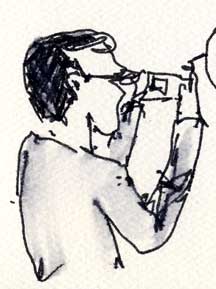 Well, I’m back. The Santa Fe Science Writing Workshop was all I hoped for and more — a gathering of interesting, interested people. I hang around such types often but it’s been a long time since I found myself with fifty people who were so very curious about everything — from the instructors to the full gamut of freelancers, public information types, journalists, and students (including one undergraduate).
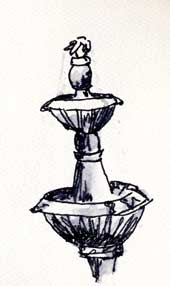 Our time started out at the Santa Fe Institute, a hotbed of interdisciplinary brilliance. We heard (not necessarily understood, you understand) talks by Bette Korber on a vaccine for HIV and Eric Smith on the origin of life and then attempted later on in the day to come up with an article lede for one of them. Our small groups numbered about ten; my group was facilitated by the inimitable Charlie Petit, formerly of the San Francisco Chronicle, now of Knight Science Journalism Tracker.
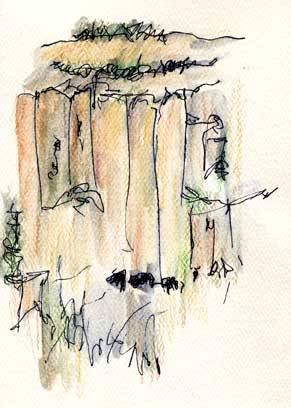 Santa Fe is a beautiful small city, but I was eager to get into the surrounding countryside. We took a trip to Bandelier National Monument, an archeological site where we ran into the bear I mentioned a couple of days ago.
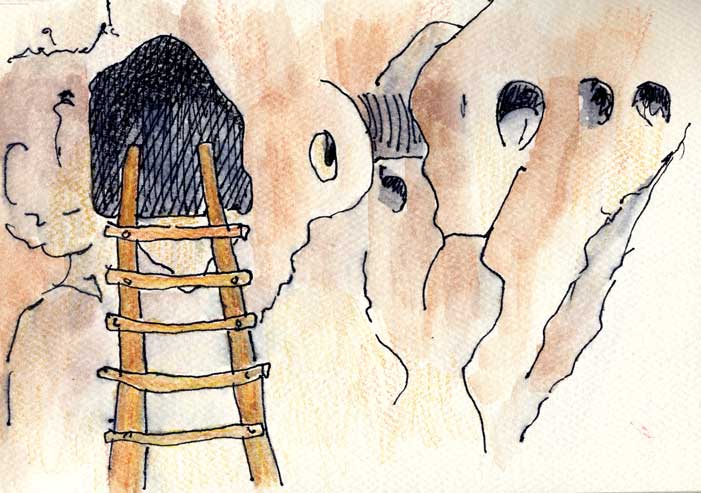
It was lush and green after a wet spring in New Mexico. Birds were singing. I kept confusing warbling vireos with one of the red finches — Cassin’s at this altitude? (managed to leave my binoculars at home in the rush to get to the airport) — but had no trouble with the abundant and gorgeous violet-green swallows.
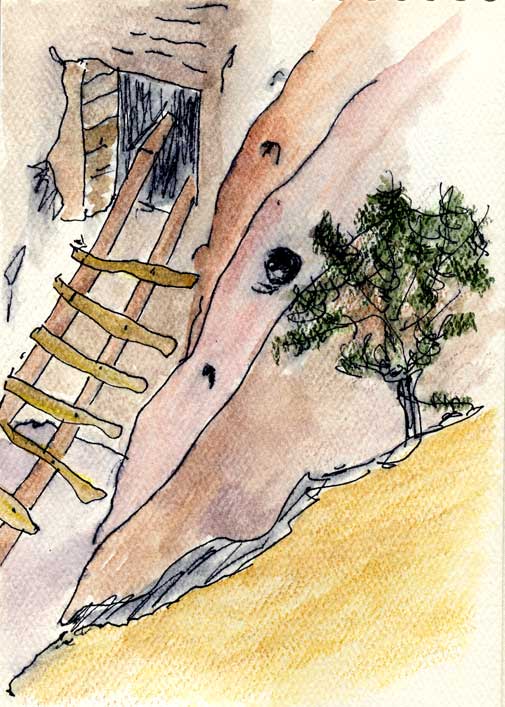 Our intrepid reporters climbed in and out of holes by means of ladders while others of us took photos or sketched them doing this.
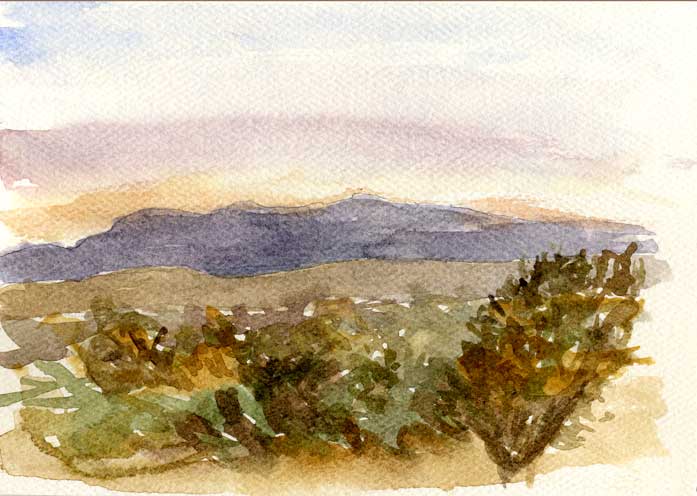 The final night was spent at the home of one of the instructors, where we got the chance to watch the sun and Venus go down and the moon and Jupiter rise. This is a good state for skygazing.
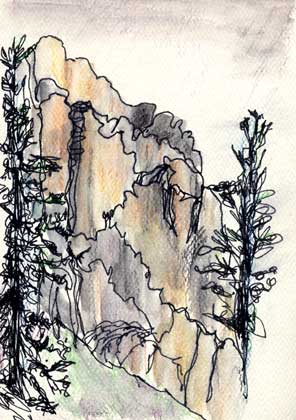 Finally I spent a night with my cousin in the Jemez mountains, about eight miles above the town of Jemez Springs. She lives very near the Valles Caldera Numenius visited last year. We were able to catch up and go for a couple of hikes. The storm brewing pictured here spawned a couple of tornadoes and I was glad to get out of Albuquerque in a different direction than the storms were heading…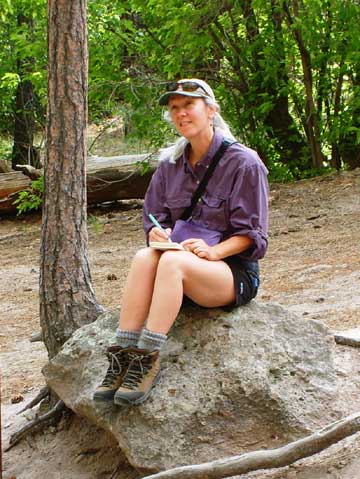
4 June 07
First Flower
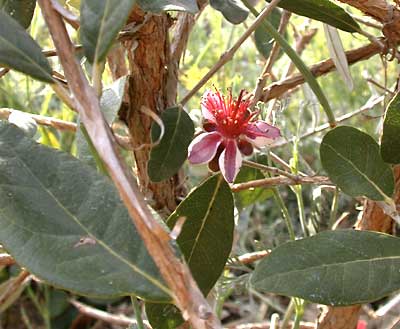 Pica got back from her writing workshop today so I am off watering duties for now. This morning I noticed that one of the guavas is now bearing blossoms! Pica planted these guavas not long before a prolonged hard freeze this winter. We shepherded the guavas through the cold spell by covering them with gardening fleece so it is especially rewarding to see those blossoms now.
31 May 07
Bear at Bandelier
I’ve been immersed in the Santa Fe Science Writers workshop this week. It’s intense and I’ve learned a lot.
This afternoon we went to Bandelier National Monument, our first extramural excursion. Poking around the petroglyphs was a black bear cub. His mother was nowhere to be seen but later on we learned from the rangers that he’s alone — and though he’s thin he’s managing to find food, of sorts.
I made some sketches I’ll post when I get home…
30 May 07
Google May Be Spying On Your Cat
Their new street-level mapping view is clearly a threat to felinity, as this poor tabby discovered.
(From Boing Boing.)
27 May 07
Red Sox Nation: Davis
There are lots of Red Sox fans in the Bay Area. This shouldn’t be too surprising: whenever New Englanders decide to escape their winter slush and summer mugginess, a destination of choice is San Francisco or nearby, because of plentiful work (often tech-related) and compatible politics. Whenever the Red Sox are in town to play the A’s, an avalanche of blue caps with red “B’s” on them converges on the Coliseum. We unite with A’s fans and Giants fans (and just about everyone else) in our hatred of the New York Yankees, in much the same way the rest of the world… oh, never mind.
More surprising, perhaps, is the high incidence of Boston fans here in Davis. Yet hardly a day goes by when I don’t see the familiar cap, blue long faded to gray, which gives me an immediate (and never unwelcome) opportunity to say “Go Red Sox” and launch into an immediate enthusiastic exchange of pleasantries with a perfect stranger about how the Yankees are now 12-1/2 games back.
(That’s twelve-and-a-half games back, people. It’s already Memorial Day. If they keep this up they’ll miss the playoffs. For the first time in a very great while. It’s delicious. We Red Sox Nation folks have been known to dance jigs in parking lots over this, gingerly in some cases.)
Yolo County residents have a new reason to cheer the Sox, now: 23-year-old Dustin Pedroia, the star of nearby Woodland High, hit another home run today for Beantown in the ninth inning and is distinguishing himself handily at second base. The guy who delivers the mail at work, a longtime Yankees fan but born and raised in Woodland, is having to reconsider his loyalties…
I’ll be heading to Santa Fe tomorrow for a week-long workshop. I have no idea how easy it will be for me to blog, so I’ll leave you in Numenius’ capable hands (which I have overburdened already with gardening duties) till I get back, unless you hear otherwise.
25 May 07
Here Come The Triffids
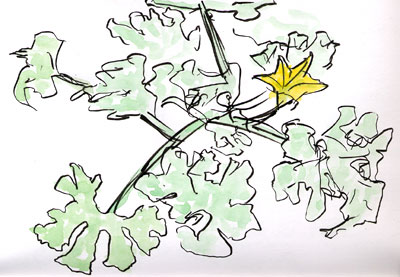 Pica’s zucchinis are starting to bear fruit.
23 May 07
Four More Feral Kittens
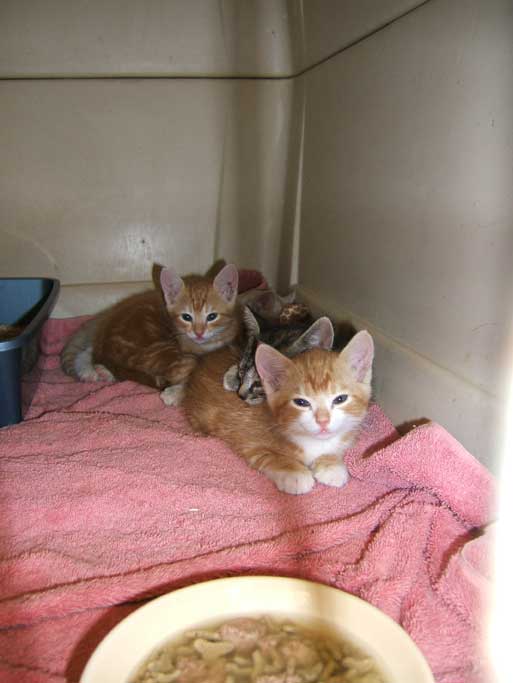 As Numenius said, we ended up catching four kitttens outside the Wildlife Health Center on Friday evening. They are staying in the office, where they are being socialized, fed, pampered, and getting ready for their new homes.
Feline Lifeline has put out a plea for kitten foster homes — it’s the season. So if you feel like a mega kitten fix for about three weeks or so, please leave a comment, and we’ll put you in touch. Or contact a similar organization in your area. Let’s get these guys out of the ecosystem…
22 May 07
Fire Season
It has come early here, it would seem. In addition to the fire downstream from Lake Berryessa on Saturday that changed the route of the Double Century, today there was at least three grass fires around the Davis area. One was to the west of Pica’s office, somewhere near I-80, which drew a fairly massive response but was quickly contained. Another was to the north of town — I saw the smoke plume being blown south. We are now in a period where we will have several days of strong warm breezes from the north.
21 May 07
States I've Visited
create your own personalized map of the USA
or check out ourCalifornia travel guide
Oklahoma doesn’t really count but we did drive over the line into the northwest panhandle from Kansas last month and started keeping note of the birds we saw there, so if I technically have a (small) Oklahoma bird list (it contains two species of grackle, burrrowing owl, horned lark, and starling), I’ve been there.
The gaps look strange. Indiana was missed because my mother and I went north in Michigan for the Kirtland’s warbler while we were driving across the country in 1996 and took the ferry to Wisconsin in the pouring rain with a bunch of Mennonites who looked bemused at the karaoke spectacle. Utah? that’s a different kind of trip, and will be undertaken when we’re ready for serious immersion in genealogical records…
Thanks to Steve Rubio for this link.