
24 May 26
Craft Fair
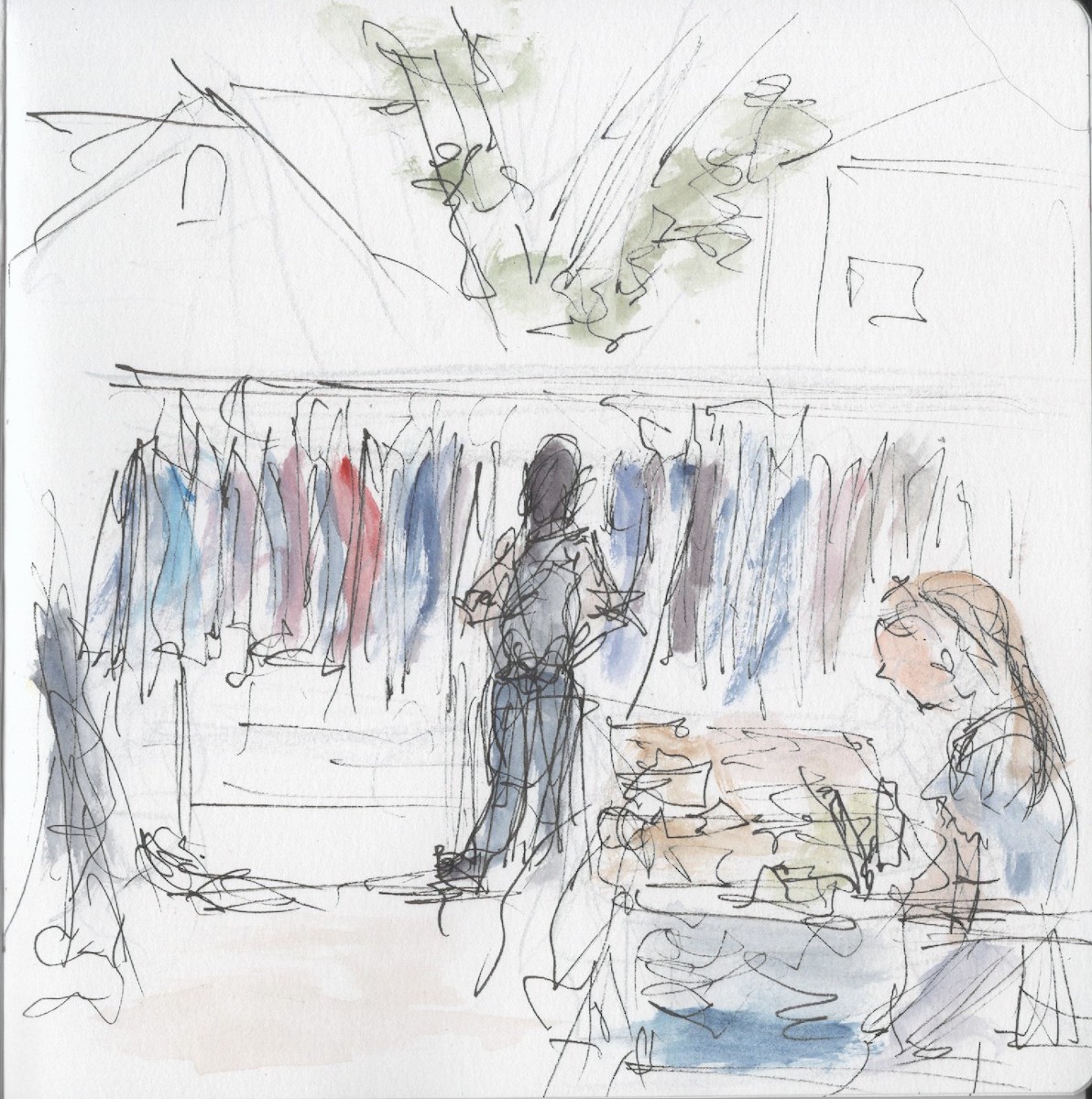 On Sundays twice a month the Davis Craft and Vintage Fair takes place in Central Park. It is pleasant to wander through, and there is almost always live music at one end of the concourse. Here is a sketch from today of one of the stalls.
23 May 26
Getting Back to the Work
I’ve been stalled a bit on my project about my mother’s death, partly because I went away and partly because, well, it’s hard. Today in Comics Coven we worked a bit on containers, but all I could think about was how much my mother tried to disappear all her life, how little of a burden she wanted to be (even after her death, she didn’t want us to grieve, which isn’t really the dying person’s call: grief is part of life). I am thinking of her as a silhouette. A silhouette in a doorway.
22 May 26
Drying Days
 It reached 95° F today with 26% relative humidity. These are good drying days. But if you are neither a) drying your clothes on a line outside or b) a watercolorist this may be an unfamiliar concept. How rapidly do wet materials dry given the present combination of relative humidity and wind speed? It doesn’t seem to feature in weather websites in the United States, though I did a Kagi search on “drying days” and came up with a laundry drying guide for London. Today’s weather there was rated “Superb”.
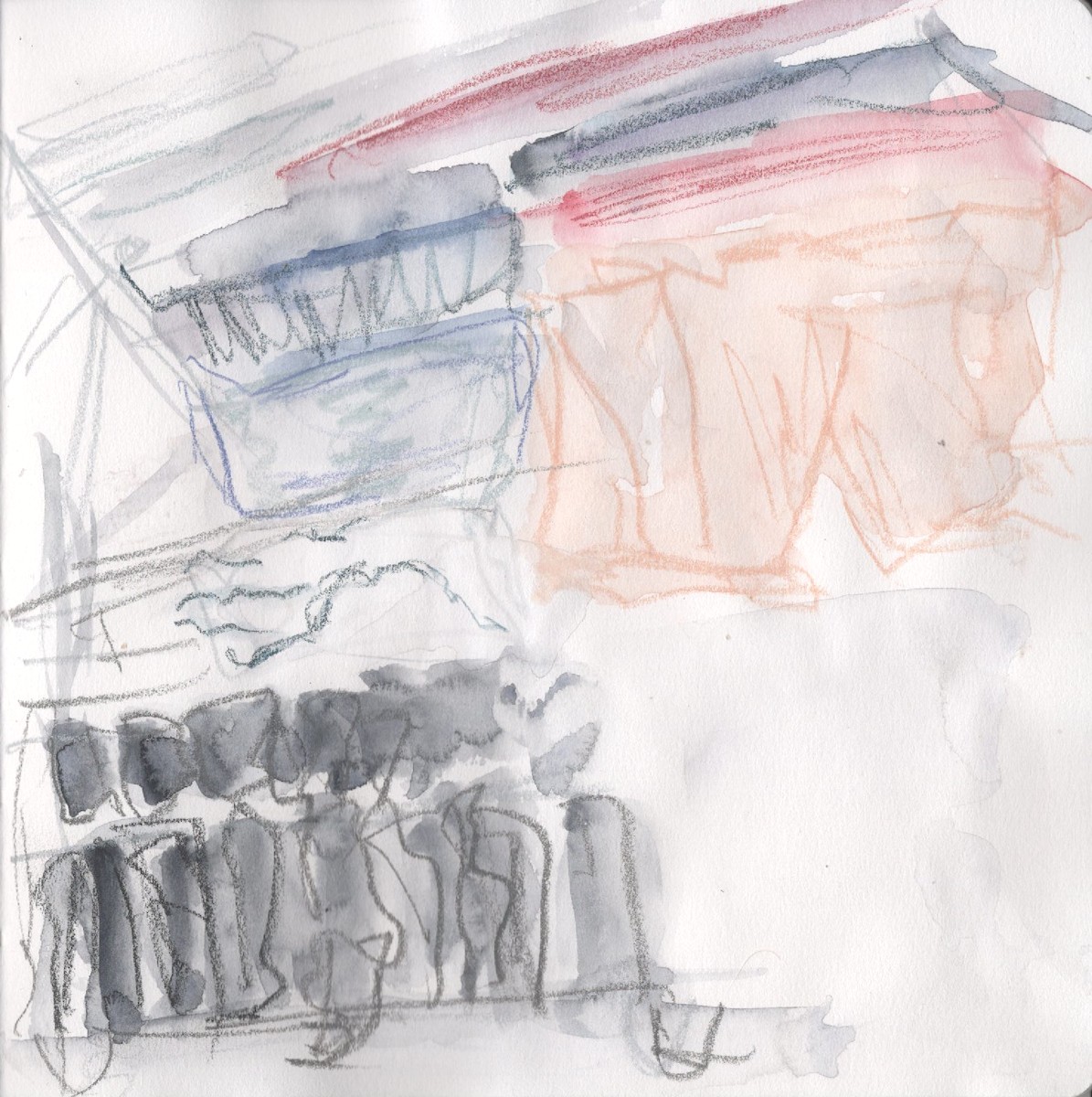
I am now trying sketching experiments with layers where I am painting first with loose watercolors, and then drawing over the watercolor with my Derwent drawing pencils. This calls for good drying days, since the paper needs to be perfectly dry before drawing on it. Here is a sketch I did earlier today in this manner of our laundry on the drying rack.
21 May 26
Very Simple Knitting
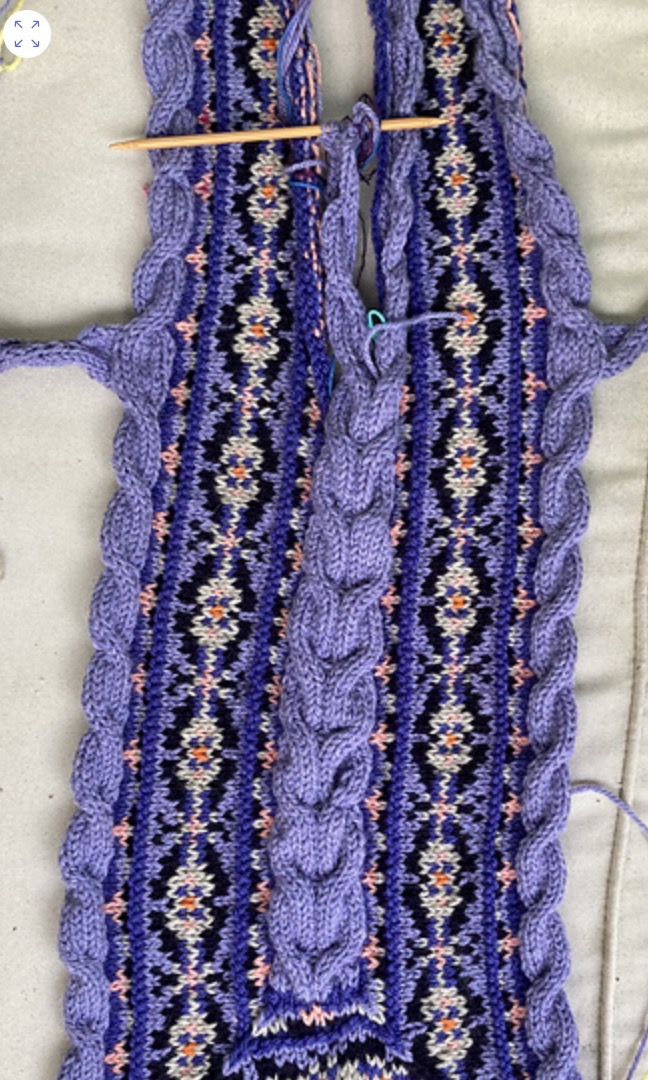 I was in the middle of knitting an extremely complicated cardigan, pictured at right, when I left for Europe at the beginning of April. This is an unusually structured piece with cables going over the shoulders, where stitches are picked up and then a stranded colorwork panel is worked, double moss-stitch forms side panels and sleeves, which also feature the cables and a smaller stranded panel going along their length. I’m knitting this with a worsted-weight yarn and it’s lovely but I’m finding it difficult to resume my work on it. (Note to self: don’t start a complex project when you know you’re going to be going away for a while; it’s now too hot to be knitting a heavy project.)
There are several knitting designers who are deeply influenced by the knitting cultures they grew up in yet who have managed to bring a contemporary feel to their designs. Ysolda Teague, a Scottish designer based in Edinburgh, has produced fascinating designs that draw on the traditions of her culture but are always unmistakably modern. I’m reminded of her Blank Canvas pullover which I’ve knit, which gives a well-fitting design in multiple sizes and encourages knitters to customize it freely. (One of the problems a lot of contemporary knitters face is their fear of modifying patterns either to suit their taste or individual bodies, resulting in a lot of sweaters that don’t get worn.)
Petite Knit is the brand of a Danish designer, Mette Wendelboe Okkels. This designer has taken a lot of flak for charging as much as she does for designs that are really very simple — no unusual stitches, no flamboyant shapes, just timeless, classic pieces (mostly sweaters) that highlight gorgeous, top-quality yarns. But simple doesn’t mean easy to design, and the care and effort that has obviously gone into each piece is a lovely testimony to the clean Scandinavian esthetic embraced by Petite Knit. (I’m of the opinion that designers deserve a fair price for their labor and get screaming angry when people find workarounds to paying for a pattern. It’s stealing, people. If you don’t want to pay for a pattern there are lots of free ones available on Ravelry.) Rosemary and Pines Fiber Arts looks into how Petite Knit took over the knitting world in a video here.I’m knitting Ysolda’s Musselburgh hat — my fifth — for a friend and I have cast on the Petite Knit Maggie Cardigan. Both of these are straightforward, stockinette projects. This is my first top-down sweater and a lot of concentration is required for the shaping around the shoulders, but once I reach the armpits, it will be very simple. (And, in this case, easy.)
20 May 26
On New Music
Microtonality is having a moment. I am late to this trend, but two days ago I discovered the Québécois rock band duo Angine de Poitrine who is now all over the internet. Back in February, the Seattle radio station KEXP posted a YouTube video of a set the band did at a music festival in Rennes, France in December. This video rapidly went viral, and as of this writing has 14.8 million views on YouTube. Clearly the band has tapped into something in the public’s consciousness, but what?
The first thing one notices on the video are the Dadaesque costumes — masked figures in black and white polkadots with especially long noses. The conceit is that they are alien timetravellers, brothers named Khn and Klek de Poitrine. Klek is the drummer, and Khn plays a double-necked combination bass and guitar. Look closely at the bass-guitar combo and one will notice rather a lot of frets on the two necks.
The costumes may be what draw people to look at the band, but the music is what is compelling and new. The reason for the large number of frets is that it is a microtonal instrument, and the frets are spaced in quarter tones. The band plays microtonal math rock, the latter meaning there are a lot of complex time signatures and polyrhythms. And the two musicians are really good: they have been playing together since they were teenagers. Khn uses a live looper to layer different bass and guitar lines together in sequence, which seems like quite a feat of hand-foot-toe coordination. Despite the complexity of the music, it remains accessible with a strong groove.
Commentary on the band is its own subgenre on YouTube. Some of this commentary goes into music theory: there are videos looking at the microtonality, and other videos analyzing the polyrhythms. There is other discussion about why this band has gone viral. One thread that comes up a lot is that the band has put things together in a way that could not have been done by AI. Despite being alien timetravelers, what they have done is a profound act of human creativity.
19 May 26
Overnight Visitor(s)
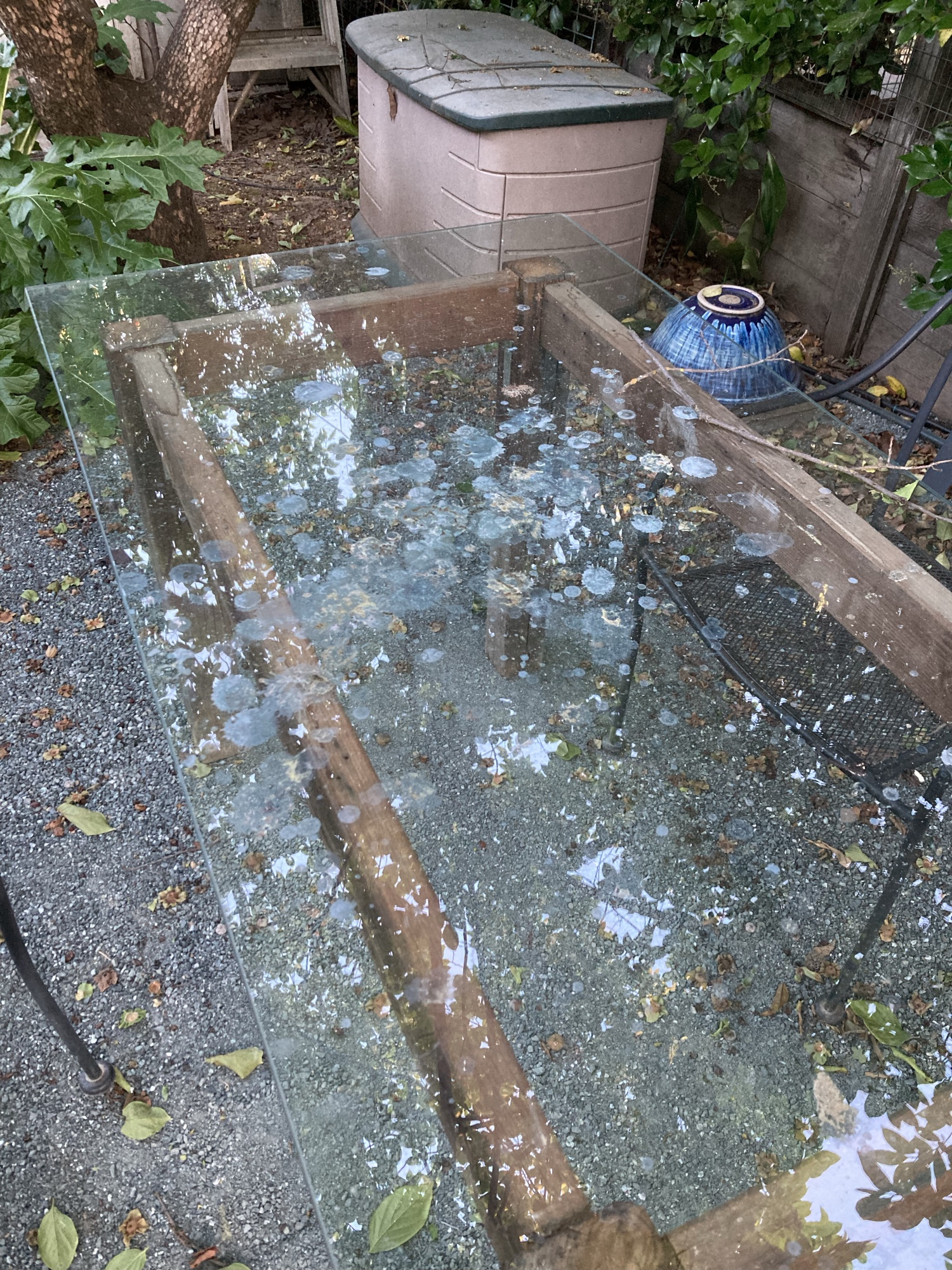 When I went outside this morning, I saw that this table, which was clear last night, was now covered in large bird droppings.
I didn’t sleep well (back spasm) and I got up well before dawn. I heard a great-horned owl calling outside. (This isn’t unusual; we have barn and great-horned owls nesting in the neighborhood.) But this is a lot of droppings for one owl in one night. My guess is that there were young owls sitting in the persimmon tree, getting fed by an adult. The fact that there was no evidence of food indicates that it was probably regurgitated for the young.
I’m glad there are enough mature trees where we live to host these species along with nesting Swainson’s hawks.
18 May 26
Redemption In A Walnut Orchard
Last weekend I watched the Errol Morris documentary from 2003 on Robert McNamara, The Fog of War. I followed this up with listening to a podcast interview from 2022 with his son Craig McNamara, which was produced not too long after Craig’s memoir of his difficult relationship with his father came out, entitled Because Our Fathers Lied after a line in a poem by Kipling.
Craig’s journey landed him not very far from here. In fact his interviewer, Michael Dimock, is somebody I have worked with: Michael is a regenerative food system activist who leads a group called Roots of Change. Craig became an organic farmer who has a walnut orchard near Winters, about 25 km west of Davis. Craig’s response to the Vietnam War as a young adult was in 1969 to wander south: he spent several years traveling through Latin America, working on subsistence farms, eventually ending up staying for a while on Easter Island. Agriculture got into his bones, and he returned to California and enrolled in UC Davis to get formal training in the agricultural sciences. He later bought the land and orchard near Winters with his father coming in as a financial partner.
This is one of these stories whose arc is multigenerational. After Robert left (or was fired from) his position as US Secretary of Defense he becomes president of the World Bank for 13 years, and meets with many heads of state all over the globe. Such travel does not make for a grounded life, but his son discovered such grounding on a bit of land near Putah Creek. The generations continue on there: Craig’s children Emily and Sean are both partners in the organic farm.
17 May 26
A Hot Wind
During our sketchcrawl yesterday it was very windy; today it was worse, so much so that it knocked out power in downtown Davis for six hours. Unlike where we used to live, this is not a big deal, because at least we still have water when the power goes out. We settled into reading and knitting, there being plenty of light available. I finished Christian Cooper’s memoir, Better Living Through Birding: Notes from a Black Man in the Natural World. If you recall, Cooper was the man who was faced with weaponized racism while birding in Central Park on Memorial Day in 2020, just for asking a woman to leash her dog per the rules. (This turned out to be the same day that George Floyd was brutally killed by police officer Derek Chauvins in Minneapolis while his fellow officers looked on.) It’s a great book whose intersectionality unexpectedly includes birders. I recommend it.
The power outage meant, however, that the German class I’d booked for 5 pm, which relies on good wifi, got missed. The topic was “Eine Grafik genauer beschreiben” — since this topic interests me I’ll have to figure out a way to re-book it.
16 May 26
Sketchcrawl With Waffles
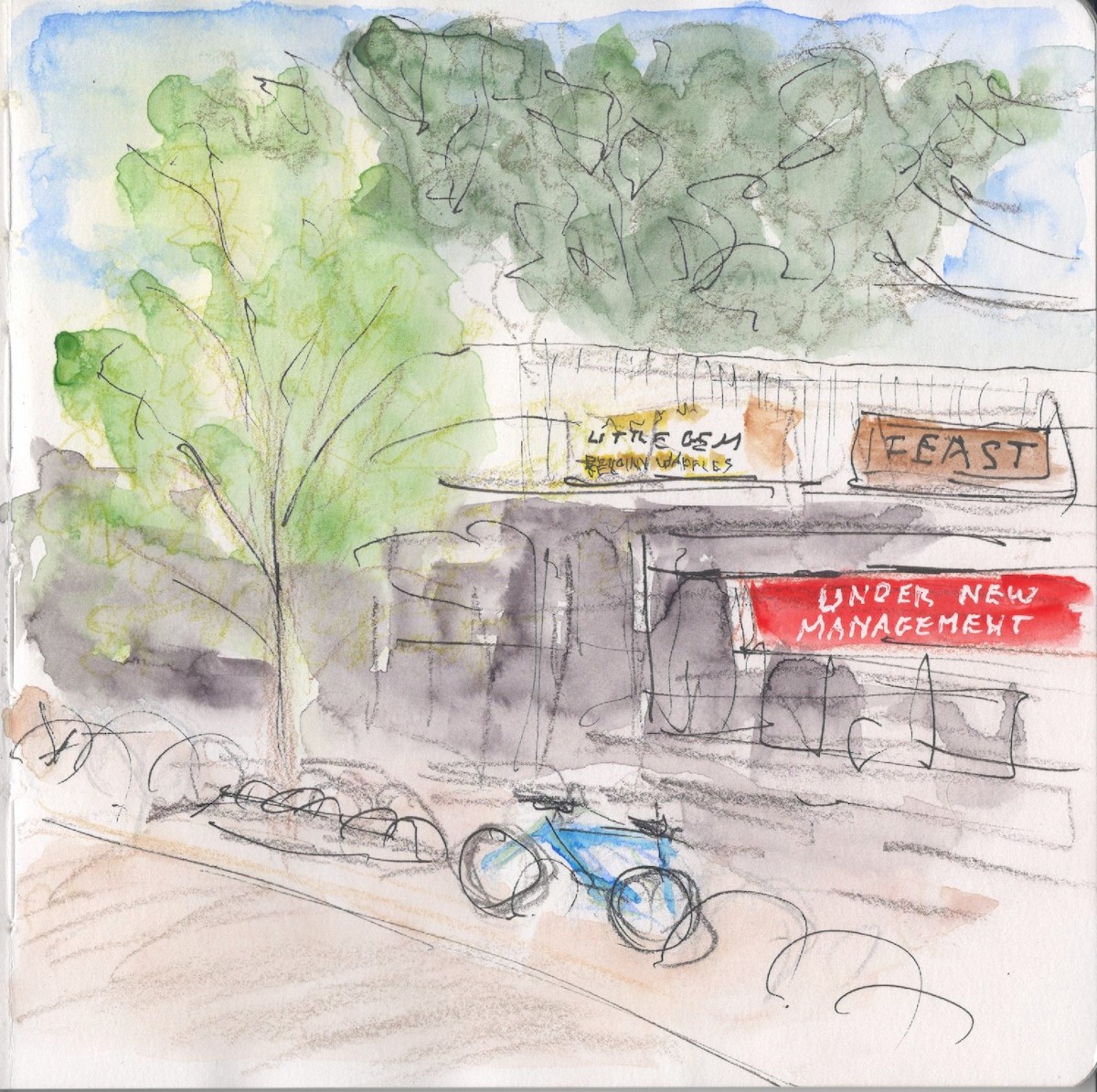 As Pica related previously today we had a sketchcrawl meeting at 3rd and A Street in Davis. Pete Scully who organized the sketchcrawl said he likes sketching along A Street since it marks the border between campus and there is a lot of interesting activity at this boundary. He also remarked upon the arrival of the Little Gem Belgian Waffles shop; he quite liked the one in Berkeley but hadn’t eaten in this one yet.
I sketched the restaurant from the other side of 3rd Street and then crossed over A Street into campus to sketch the Social Sciences and Humanities Building aka The Death Star. Pica meanwhile tried one of the waffles and found it yummy.
15 May 26
Sketchcrawl Tomorrow
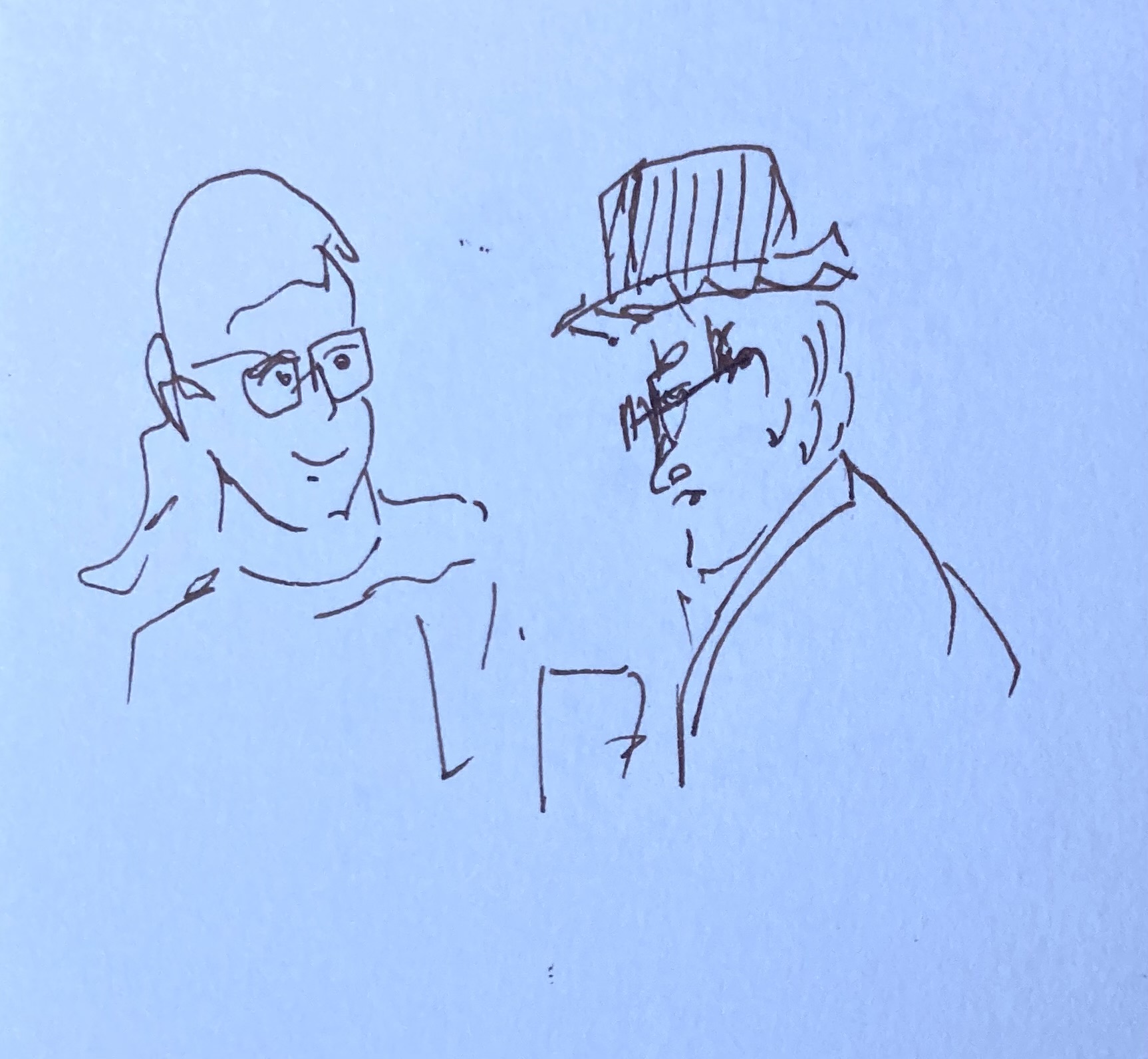 The Let’s Draw Davis urban sketchers has been for over 20 years (not sure exactly, but we participated in the very first one along with one other person, Pete Scully, who is now a personage on the worldwide urban sketchers scene).
I always mean to draw things other than people during these sketchcrawls, but it’s the one time when you can draw your fellow sketchers without getting weird looks (the couple in my drawing figured out I was drawing them and I think it made them uncomfortable, which is sad).
I’m going to take the minimal kit I took with me to Germany: fountain pen and tiny watercolor palette from Art Toolkit.