
27 March 14
Pollinators in the Garden
Last week we attended a workshop put on by the California Center for Urban Horticulture on Gardening for Pollinators. A full morning of talks followed by a trip to the Honey Bee Haven, followed by a trip to the Arboretum Plant Sale (for the record, we bought a manzanita, three Spanish lavenders, a giant buckwheat and an ericameria). All but the lavenders should grow into large shrubs that qualify as four feet, and the lavenders should end up filling that slot.
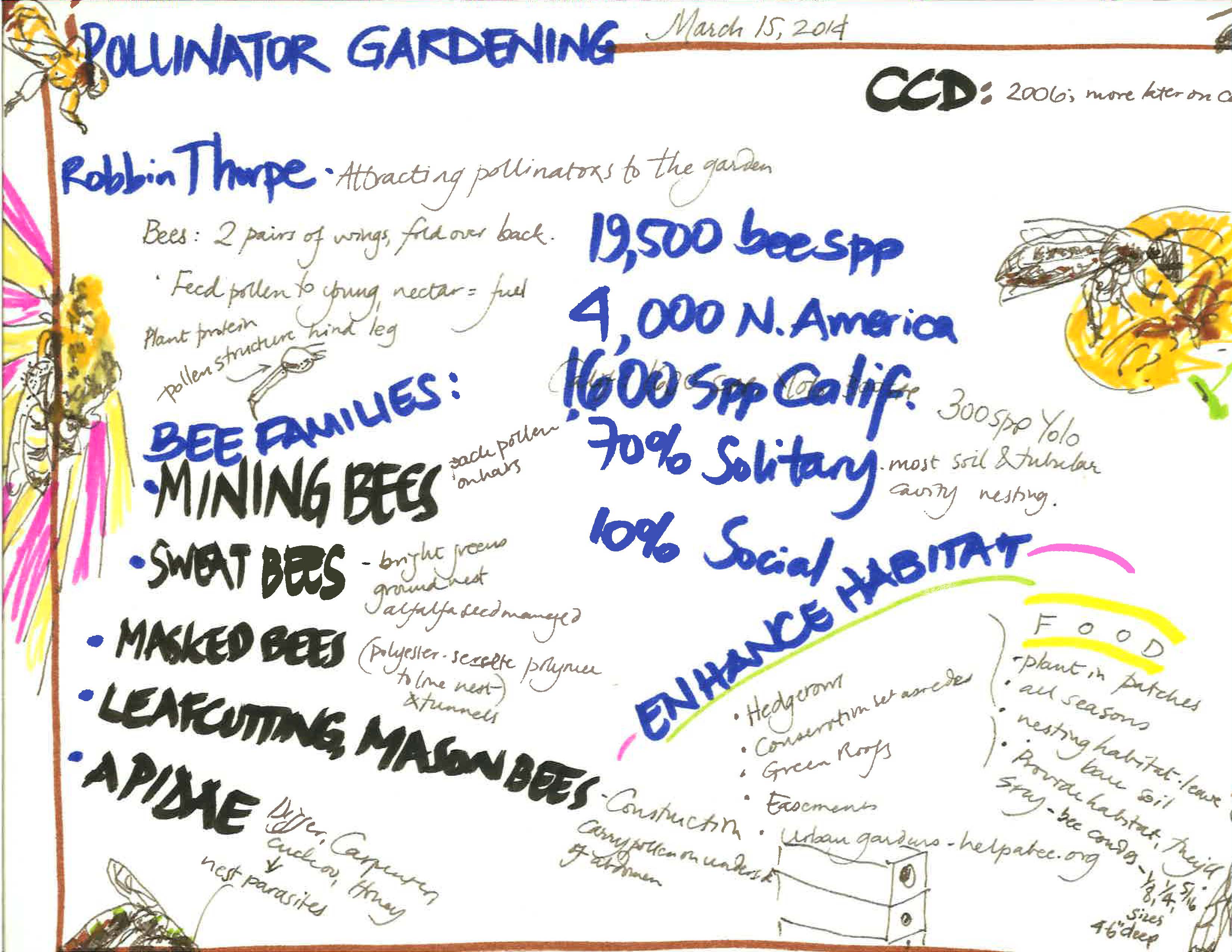 I’ve written a blog post for the ANR Green Blog that provides more background, but here are the big take-homes for me from the workshop…
- Planning for succession blooming (in the Central Valley, that means late winter through fall)
- Putting plants in clumps at least 4 feet long if possible (honeybees, especially, like to specialize)
- Putting in plants that provide both nectar and pollen (nectar is fuel for adult bees, pollen is protein for the young)
- Using native plants where possible; they’re drought tolerant and have what our native bees need
- Avoiding most-toxic pesticides and herbicides
- Providing a clean source of water (a slow-dripping tap on a sloped surface is ideal; bees like to drink from very shallow sources)
- Providing cavity nest holes in wood for carpenter and other bees
- Leaving some areas of gardens unmulched for ground-nesting bees
15 March 14
Megadroughts
Our rain gauge stands at 6.21 inches for the water year (in California, precipitation is measured from October 1 through September 30, since it is a Mediterranean climate), which is about at 38% of what we’d expect to this date. And there is not much more of a rainy season left. Some say we’re on pace for the driest year since 1580 and discussion has begun on whether we’re entering a megadrought.
The paleoclimatic history of California is a fascinating story which I am just starting to read up on. (I’ve just started geographer Lynn Ingram’s recent book, The West without Water: What Past Floods, Droughts, and Other Climatic Clues Tell Us about Tomorrow) In the past several millenia, the Pacific Southwest has seen droughts lasting decades to upwards of a couple centuries. One of the more dramatic pieces of evidence comes from geomorpologist Scott Stine’s work at Mono Lake. In 1941 Los Angeles started diverting water from its tributary streams, causing the water level in the lake to fall some 50 feet, which exposed a lot of lakebed. When hiking across the lakebed at one point, Stine found dozens of tree stumps. Jeffrey pines do not grow in the middle of lakes, and the conclusion follows that the lake level was much lower in the past due to prolonged drought. Radiocarbon dating on the tree stumps showed that these trees came from two periods of drought, one lasting about 140 years ending about AD 1100, and the other lasting at least a century ending about AD 1350.
It is interesting how megadroughts illustrate an aspect of climate change that is independent of anthropogenic global warming (there was not much in the way of greenhouse gas emissions in the 13th century) that is nevertheless quite worrisome. Megadroughts have occurred recently enough so that they are clearly part of the general pattern of climatic variability in California at this point in geological history. Unlike a millenium ago, the past century-and-a-half has been fairly benevolent in terms of California’s climate. How would we cope now with a 140-year long drought?
19 January 14
The New OpenStreetMapper
I didn’t expect I’d launch into 2014 with a whole new hobby. Towards the end of winter break, I bought an 7” Android tablet, the Google Nexus 7. I was not entirely sure what I would do with it, but since it has a GPS chip, it didn’t take long for me to start exploring mapping applications for it. This led inevitably to OpenStreetMap.
OpenStreetMap is a project that has been around almost 10 years; essentially it is the equivalent of WIkipedia for worldwide street mapping. In other words, it is a massive crowdsourcing project to build a quite detailed map database for the world that’s freely available as open data. (There’s an excellent recent blog post entitled simply Why the world needs OpenStreetMap.) I’ve known about the project for a long time (in fact its founder once gave a talk about it to our lab group), but had never signed up to contribute data. Buying the tablet closed a loop for me, since I could now go on walks, pull out my tablet, and check a recent copy of the map to see if there were unmapped details I should record.
 What does one map? Anything and everything. Looking at the map, I quickly found that neither the California Raptor Center nor the network of trails on the other side of the creek from our house were in there, so I set about mapping them. And now these features are in OpenStreetMap! The figure show the trails I’ve added; they’re the tracks marked in dashed red lines just north of the creek.
It’s amazing amounts of fun. It helps that I’m a map geek already, but walking, exploring, and maps, what could be better?
12 January 14
Lichens!
 Numenius and I attended a workshop yesterday put on by the UC Davis Center for Plant Diversity and the California Native Plant Society (Sacramento Chapter). Pam Kirkbride taught the workshop, which was a morning of lecture and practice keying (at which I have very little experience; Numenius has much more) followed by a field trip to just over the Napa County line, where lichens are far more diverse and numerous since it’s just inside the fog belt.
I had learned a little about lichens in connection with natural dyes at my spinning retreat with Judith Mackenzie in 2012. I learned a whole lot more yesterday — the various forms of lichens, their unique symbiotic biology (they are a relationship between fungi and algae), their sensitivity to pollution and other environmental stressors… and their great beauty. This was my first time using a dissecting workshop and now I want one.
I came home with some Ramalina (Spanish moss) I found on the oak woodland floor. I’d like to try it out on some white yarn I have. Lichen dyes don’t need a mordant because of their acidic chemistry. I’ll update when I have something to show!
9 August 13
The Nevada City Riddle
We’re going on an outing tomorrow for our anniversary, want to head towards the Sierras, and have come up with the idea of going to Nevada City for a short hike followed by lunch in town. Nevada City is not a town either of us knows much about, so the question becomes what do we do for our little spot of tourism?
After a brief look online I found myself headed to the campus bookstore to look in a guidebook for the Sacramento-Gold Country region to get a better sense of the town. Upon reflection this is curious. We’re in Year 22 of the World Wide Web, we’re told from many quarters that print is dead, long live the screen, yet my sense is that it’s easier to find reliable local knowledge about a place in a book than readily online. The first pages that come up in a search are for the city government (good if you need a building permit, not so much if you’re trying to get a sense of the place), the chamber of commerce (avoids playing favorites among the businesses), and then digging a little further one comes across reviews in services such as Yelp, but these are easily gamed and always have the air of the outsider about them.
By now the Internet has ossified into a number of structural forms that are changing on a fairly long time scale (5 to 10 years), and for whatever reason there is a big gap between on-the-ground local knowledge and virtuality. In Davis we are lucky to have the Davis WIki which is a knowledge base to which many locals contribute. Though the Davis Wiki has a few progeny, the list of such communities is quite short and the sense is the Davis Wiki and its ilk are the exceptions that prove the rule.
For now, we’ll find a short trail near town, and then have a wander downtown. Walking is always the best way to learn anyway.
18 March 13
Underway on the Rails
 I’ve been away for a week now and have seen hundreds of miles of country, some arid, some snowy, such as it is here in Tyrone, home of Via Negativa’s Dave Bonta.
Travelng by train is a curious mix of fast food convenience, nineteenth- century nostalgia (several stations in Illinois had hosted debates in which Lincoln was a participant), and the feeling that you’ve entered a fifties-style diner where a group of locals is sitting around shooting the breeze, but by virtue of having boarded the train, you are automatically a member of the group.
Several people pointed me to a recent New York Times article about train travel in the US. Most of what’s in the article has rung true for me, though I think every single passenger on every train I’ve boarded since last Tuesday could have written a different version of that article.
Nice to have two nights at Dave’s. I’ll be on my way to Boston tomorrow via Philadelphia. I’ll travel through my mother’s childhood and adolescence, feeling their force with none of the details that memory catches like butterflies, rising on a warm spring day. I am not sure what my own childhood train memory trip would look like, but I’m about to follow my mother’s.
8 March 13
As Spotted From The Bus
I went on an outing to San Francisco today, ending up at the Legion of Honor museum after taking the train to Emeryville, the Amtrak bus to the Financial District, and the 38L bus out Geary to the Outer Richmond district. The following were some noteworthy items spotted from the buses:
- A truck labeled “Matthew International – Casket Division” (note – although Matthew International is traded on the NYSE, they do not mention their casket division anywhere near their home page)
- A restaurant: Volcano Curry of Japan
- Another restaurant: Five Happiness Restaurant (why five? why not four, or six?)
- The Right Way Market and Deli
- Two closed down old movie theatres on Geary: the Alexandria, and the Bridge. The marquee on the Bridge said “SO LONG, AND THANKS FOR THE POPCORN”
- The Anti-Saloon League (established 1920)
- In fading paint on the side of a building: “E. M. O’Donnell Copper Works”
3 December 12
Deluge
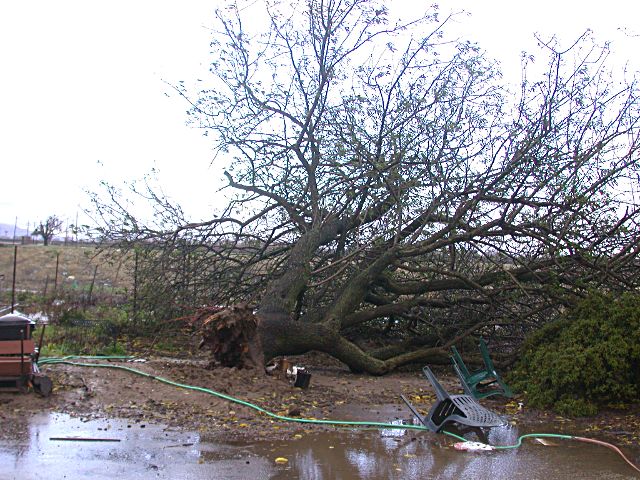 Lots of rain lately! From last Thursday the 29th to Sunday morning, we got 4.07 inches of rain in three tightly spaced storms, the warm air not producing much snow in the mountains. We had a casualty though. On Sunday morning Pica looked out the window and saw that the almond tree fell over. We evidently slept through the crash; the weather station log said that the wind speed got up to 31 MPH early in the morning. We’ll miss the tree, especially for the sweet harbinger of spring when it blooms in February before leafing out.
28 July 12
A Day At The Fair
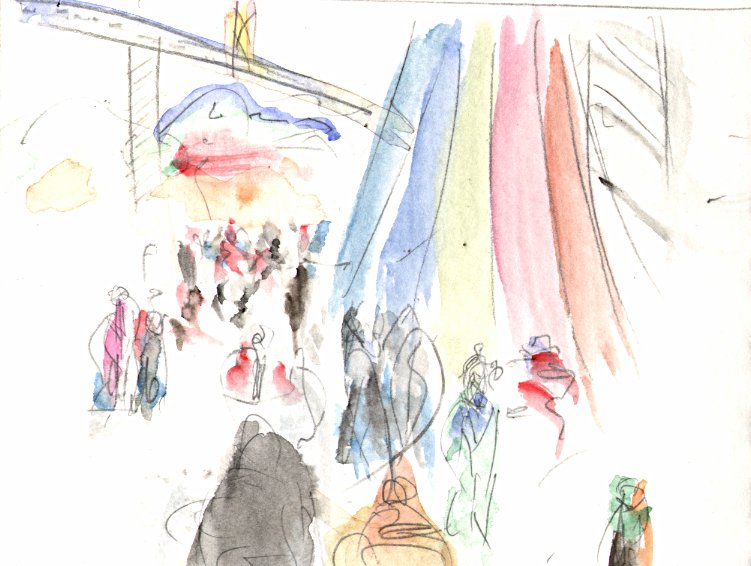 We went to the California State Fair today because Pica was helping Robin Lynde of Meridian Jacobs sheep farm with her stall in the livestock hall. Pica spent much of her time drum carding wool at the booth, an activity which a lot of people were curious about, and I was free to wander all about the fair. After doing an initial pass through the exhibit halls, I started sketching, beginning at the western end of the fair, where all the rides are (at left) and ending back in the livestock hall (see below at right).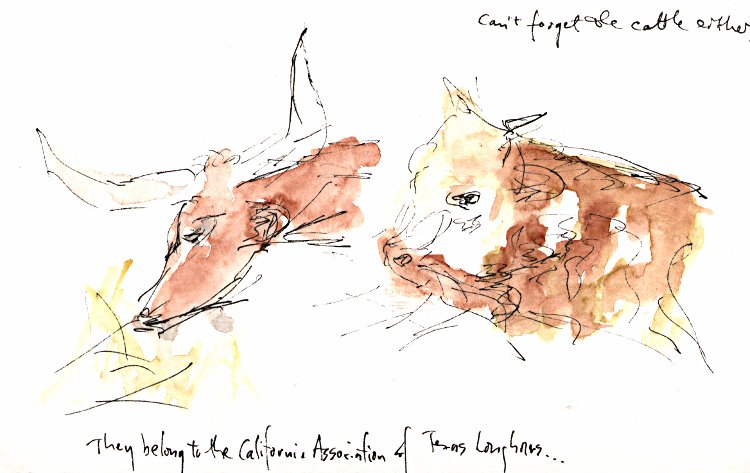
27 June 12
More Gray Foxes
 So the gray fox family is doing well. Five pups, now about 12 weeks old. I was able to catch the male this evening as he was guarding the whole territory. They make a funny kind of bark, like a terrier but much deeper, growling in there somewhere. (Below is a photo of the male barking at me.)
Having wild creatures like this so close to an urban area is thrilling but also worrying — too many cars going way too fast. For now, they seem fine.
