
9 June 07
Balloons Of Spring
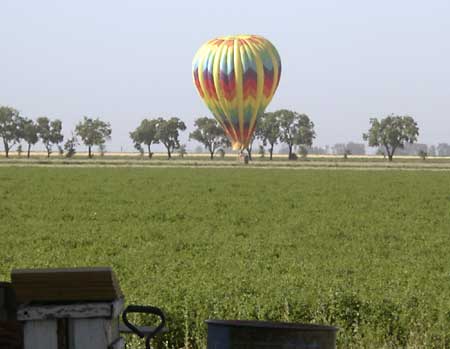 I have yet to figure exactly where these balloons are based, but they seem to launch from near Woodland which is about 12 miles from here on clear, calm early mornings in spring and early summer. I think there are four balloons in their fleet. Usually they drift south. Yesterday they landed nearby, one of them landing in the field directly to the south.
4 June 07
Santa Fe
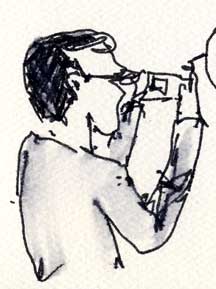 Well, I’m back. The Santa Fe Science Writing Workshop was all I hoped for and more — a gathering of interesting, interested people. I hang around such types often but it’s been a long time since I found myself with fifty people who were so very curious about everything — from the instructors to the full gamut of freelancers, public information types, journalists, and students (including one undergraduate).
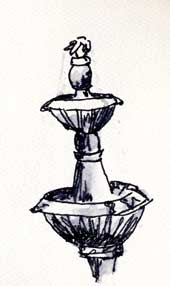 Our time started out at the Santa Fe Institute, a hotbed of interdisciplinary brilliance. We heard (not necessarily understood, you understand) talks by Bette Korber on a vaccine for HIV and Eric Smith on the origin of life and then attempted later on in the day to come up with an article lede for one of them. Our small groups numbered about ten; my group was facilitated by the inimitable Charlie Petit, formerly of the San Francisco Chronicle, now of Knight Science Journalism Tracker.
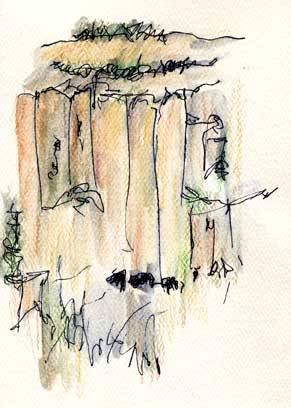 Santa Fe is a beautiful small city, but I was eager to get into the surrounding countryside. We took a trip to Bandelier National Monument, an archeological site where we ran into the bear I mentioned a couple of days ago.
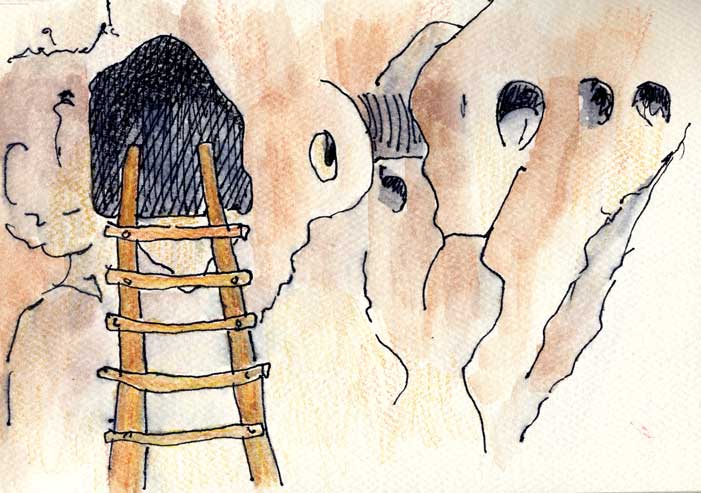
It was lush and green after a wet spring in New Mexico. Birds were singing. I kept confusing warbling vireos with one of the red finches — Cassin’s at this altitude? (managed to leave my binoculars at home in the rush to get to the airport) — but had no trouble with the abundant and gorgeous violet-green swallows.
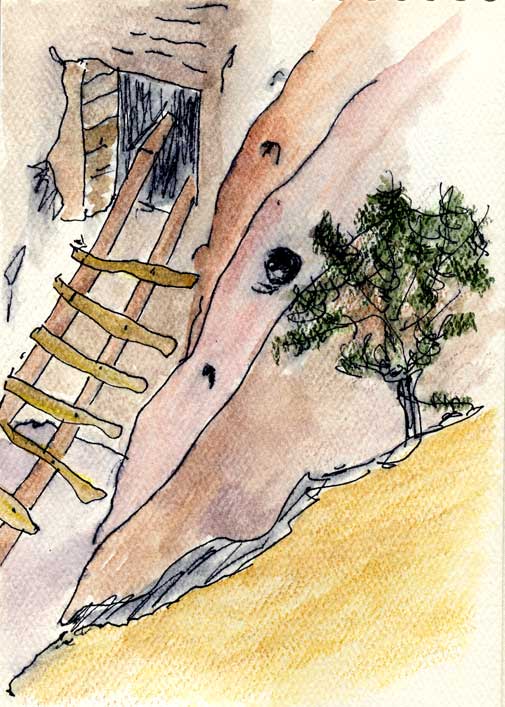 Our intrepid reporters climbed in and out of holes by means of ladders while others of us took photos or sketched them doing this.
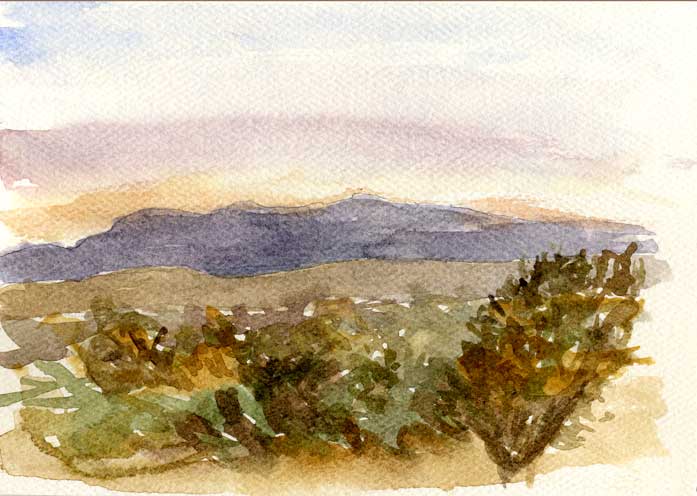 The final night was spent at the home of one of the instructors, where we got the chance to watch the sun and Venus go down and the moon and Jupiter rise. This is a good state for skygazing.
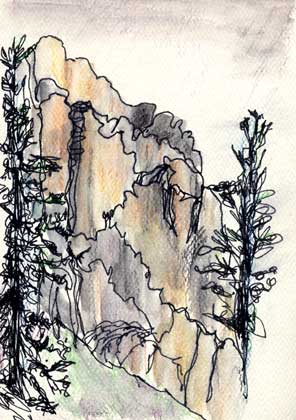 Finally I spent a night with my cousin in the Jemez mountains, about eight miles above the town of Jemez Springs. She lives very near the Valles Caldera Numenius visited last year. We were able to catch up and go for a couple of hikes. The storm brewing pictured here spawned a couple of tornadoes and I was glad to get out of Albuquerque in a different direction than the storms were heading…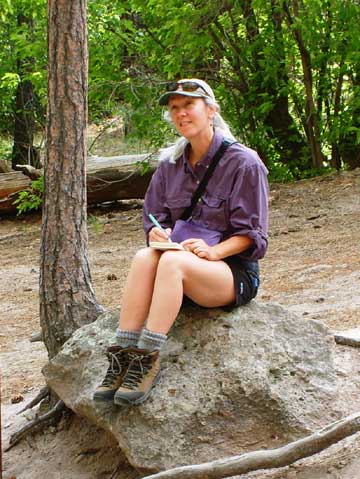
22 May 07
Fire Season
It has come early here, it would seem. In addition to the fire downstream from Lake Berryessa on Saturday that changed the route of the Double Century, today there was at least three grass fires around the Davis area. One was to the west of Pica’s office, somewhere near I-80, which drew a fairly massive response but was quickly contained. Another was to the north of town — I saw the smoke plume being blown south. We are now in a period where we will have several days of strong warm breezes from the north.
11 May 07
Wiki Across The Causeway
A couple of Davis transplants over the causeway to Sacramento were inspired by Davis’s best online institution, the Davis Wiki, and have started the Sacramento Wiki. It’s still young in its life — let’s hope it grows to be as successful as the Davis version.
10 May 07
Morning Mudpie
I’ve planted okra
[dead fish my father said]
and corn and squash
in dung
[my nails are black]
and my friends are bracing
for the onslaught
of curcubitaceae
[he hated those too]
to come and
as I dipped a pointed pen
into walnut ink
this morning
a Swainson’s thrush
exhausted from a night of dodging
cellphone towers
slammed into the
[unwashed] window
and bounced into
the leeks
I wrapped it in
[I hoped] a premature
shroud and
hoped and
yes
!
it rose up
after a time
into the mulberry
where the Wilson’s warbler
and Bullock’s oriole
and black-headed grosbeak
wove a trio of
Spring
in the
Central
Valley.
Postscript, 1:48 pm, Thursday: a Swainson’s thrush just flew into my window at work. It seems fine, flew into the locust tree… I wish I knew a good way to stop them from doing this. I never wash the windows, so that’s not really the problem.
8 May 07
Going To The Horses
Embedded in many sidewalks around Portland, Oregon are rings for tying up horses. The equine species no longer figuring much in Portland’s transportation plan, these rings were mostly forgotten until artist Scott Wayne Indiana tied a toy pony to a ring in the Pearl District. Thus was born the horse project — dozens of toy horses may now be found hitched up all over Portland.
29 April 07
Putah Creek Bioblitz
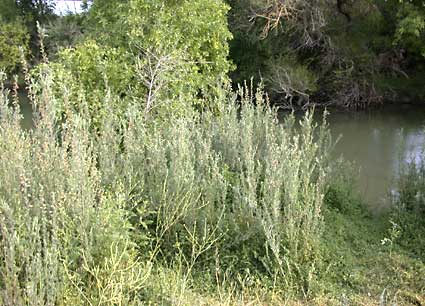 At the end of Blogger Bioblitz Week, I finally got out to my spot and did a bioblitz survey on my own. This is an exercise in humility: I do well at identifying birds, passably with vascular plants, reasonably well at reptiles and amphibians, but fail when it comes to identify insects or any other invertebrates. A proper bioblitz involves a team of skilled naturalists, but the main aim for the blogger version was to have fun, and so I did.
My spot was a bank of Putah Creek not far from home, located at N 38.5177° W 121.7616°. The upland portion was dominated by non-native grasses and weeds, primarily wild ryegrass Lolium perenne. Near the stream itself was a stand of narrowleaf willow (Salix exigua) with occasional Oregon ash (Fraxinus latifolia). I surveyed plants and birds, the latter anything within about 50 meters of my spot, including overhead and across the creek. I kept my eye out for dragonflies and butterflies, but only saw two of the latter and one of the former, and wasn’t able to get close enough to have a go at looking them up. My favorite identification was wild licorice (Glycyrrhiza lepidota), which I figured out after a browse through the photo library at CalFlora. My species lists follow:
Birds:
- Swainson’s hawk
- Western kingbird
- Snowy egret
- American crow
- Tree swallow
- Red-shouldered hawk
- Ash-throated flycatcher
- California towhee
- Turkey vulture
- Scrub jay
- White-faced ibis
- Bushtit
- Northern oriole
- Mallard
- Black-headed grosbeak
Vascular plants:
- Salix exigua (narrowleaf willow)
- Fraxinus latifolia (Oregon ash)
- Convolvulus arvensis (bindweed)
- Brassica nigra (black mustard)
- Lolium perenne (ryegrass)
- Centaurea solstitialis (yellow starthistle)
- Avena fatua (wild oats)
- Medicago polymorpha (California burclover)
- Eucalyptus sp.
- Vicia sp. (vetch)
- Plantago lanceolata (plaintain)
- Geranium dissectum
- Silybium marianum (milk thistle)
- Rumex conglomeratus (dock)
- Glycyrrhiza lepidota (wild licorice)

24 April 07
Sketching Our Way Through Colorado
 This trip had always been billed as one where you freeze. You have to get to the leks about an hour before the birds do, then sit there, quietly, while the weather does whatever it’s going to do. (I quickly learned to snag the motel bedspreads to wrap up in for this long wait, the famous Heure Bleue, the time of day when most deaths happen, when the edge of day and night is as sharp as the frost on the windshield, inside.)
 And then you hear them, long before you can see anything. In the case of the greater prairie-chicken, here on the right, what you hear is a three-interval boom, not unlike the golden-crown sparrow’s in pitch, but very different in timbre. (Think descant recorder duo versus cello.)
 The trick now is to get your hands to work well enough to wield a pen. I made a huge number of sketches in the dark, trying just to capture the essence of these birds. I’d try to work the sketches up quickly at breakfast before we had to saddle up again. You have to work fast and there’s no time for detail…
 It was easiest for the greater sage-grouse, since they were so close to the car. We could hear their feet on the ground outside the window. We could hear the intake of air as they filled their sacs, knocking them together in an audible Dolly Parton parody. And as the sun grew closer to rising, we could see the filoplumes on each male’s head, rising and falling with the dance.
 Our tripmates mostly had small digital cameras, which they wielded to greater or lesser success through scopes or binoculars. (Our ptarmigan victory salute, for instance, can be seen here ). Paul had a good digital SLR; I’ll look forward to seeing some of his shots. But to learn the bird, learn its lines, its feathers, its stance, its essence, I’d rather sketch: these birds are now etched into my head.
24 April 07
Grouse Grand Slam
We’re back from our birding expedition to Colorado — a 10-day, nearly 2000-mile tour of the state focusing on the 7 species of grouse native to the state. The annotated itinerary:
Day 1 — We arrive in Colorado Springs and meet our carmates. It starts to snow.
Day 2 — We meet the rest of the group (16 people total, plus leader) and head off towards Elkhart, Kansas driving the last leg through a blizzard. In the evening we see the first of our target grouse, the lesser prairie chicken, visiting the lek site in preparation for the following morning.
Day 3 — The first day of our typical routine: up at 4:30 AM or something like that for a trip out to the lek site in the dark to watch the birds displaying before dawn. Lots of snow on the ground — it is very cold sitting in the car with open windows. We see 8 lesser prairie chickens displaying. We then head back to the motel for breakfast followed by a day of general birding.
Day 4 — A second try at the lesser prairie chickens, this time at a different site, followed by a drive to Wray, Colorado to see greater prairie chickens. Their lek interestingly is in the middle of an alfalfa field on a cattle ranch.
Day 5 — Before dawn we watch the greater prairie chickens display, about 35 birds total, at quite close distances. We head east through the Pawnee National Grasslands where after much effort we see McCown’s longspurs, a pair of chestnut-collared longspurs in breeding plumage, and a pair of mountain plovers. We spend the night at Greeley just east of the Rockies.
Day 6 — We travel through the Front Range to reach the small town of Walden in preparation to see greater sage grouse on their lek, and check out the lek site in the evening, the sage grouse cooperating with a partial display then.
Day 7 — Pica and I nearly oversleep and miss the 4:15 AM departure to see the sage grouse, but we get our warmest clothes on in record time and join the trek. We are thankful the grouse have no interest in hijacking our vehicles because they outnumber us and are certainly testosterone-laden enough to succeed at doing so. Off to Hayden via a lunchtime stop in Steamboat Springs, but we have little time for shopping, heading to the hills north of Hayden for a fruitless search for the dusky grouse. After this I sneak off to the local public library and look up some of the mammals we’ve seen already, including the thirteen-lined ground squirrel and the yellow-bellied marmot.
Day 8 — It snows overnight. With the help of a local guide we see a dusky grouse on his favorite spot in the hills, and a few sharp-tailed grouse on their lek spot, but they are mostly hunkering against the cold and we don’t see their display. Off to the mountain passes to look for white-tailed ptarmigan, but in two separate tries we fail to see any, the second time not reaching the site on account of too much snow.
Day 9 — Our third and final try at the white-tailed ptarmigan. We go to Loveland Pass, elevation 11,990 feet, and search the ridges on both sides. Two of our party ascend just high enough to spot a couple of birds, and we hurry up to their position despite the altitude. It is the literal high point of my birding career, looking at these white snow-footballs of birds at 12,280 feet in elevation.
We then travel east in preparation for our final grouse species, the Gunnison sage grouse.
Day 10 — Up at 4 AM for a 4:25 departure to the Gunnison sage grouse spot. Along with the lesser prairie chicken, the Gunnison sage grouse is the rarest species we see on the trip, and there is precisely one spot in the world from where this sage grouse can be viewed. Our preparations go well, and we are treated to a display that lasts well over an hour. After breakfast back in town, we start start wending our way back to Colorado Springs.
Day 11 — We fly back home, leaving the motel at 5 AM. The kitties are happy to see us upon our return!
9 April 07
Budburst
Project Budburst is a new citizen science effort to monitor plant phenology — that is, the timing of biotic events such as leafing or flowering. In an era of climate change, tracking phenology is an important part of ecological monitoring.
This spring is the pilot for this project, and next year they will kick it off in full. They have a list of 59 species across the continental United States they are monitoring. It’s a bit of an eclectic list. I’d like to see them add my local phenological favorite: western redbud (Cercis occidentalis).