
22 June 09
One Million Giraffes
Ola Helland had a bet with his friend Jørgen that he’d be able to receive one million giraffes by 2011. Hand-drawn giraffes. Why not send him one? Click here.
9 June 09
Christmas Lights In June
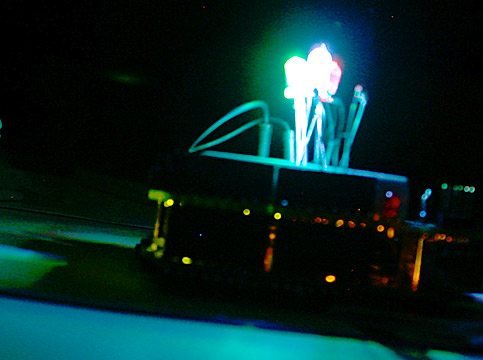 I’m well into my list of projects inspired by the Maker Faire. First up was building a TV-B-Gone. This is a device that can get you excommunicated from sports bars mighty quick: it acts as a universal remote off button to turn off TVs in public places that are harassing you. (We don’t have a TV to test it out on, so I don’t know if it works yet).
Second, I am starting to play with the Arduino physical computing platform. This evening I had fun blinking different colors of LEDs on and off, as can be seen at right.
6 June 09
World Drawing Day!
It’s World Drawing Day, where we’re going to try to get one million drawings online… I’ll be posting here my efforts from throughout the day.


I’ve also posted a couple of bird sketches on Bird by Bird.
31 May 09
Steampunk Tofu
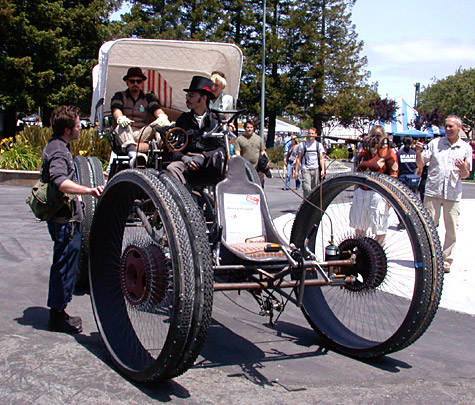 We traveled to the Maker Faire today, carpooling down to San Mateo with Virginia and her daughter’s friend Courtney. It was, in a word, overwhelming. Far too much to see in a single day, probably too much to see if we were to go both days. It seemed like every geeky-crafty-hands-on subculture in Northern California and then some were represented at the fair. Everything from workshops teaching people how to do SMT soldering to demos on making tofu. Pica was given a lesson in how to spin on a spinning wheel. I marveled at all the LED blinky things people had made with Arduino microcontrollers.
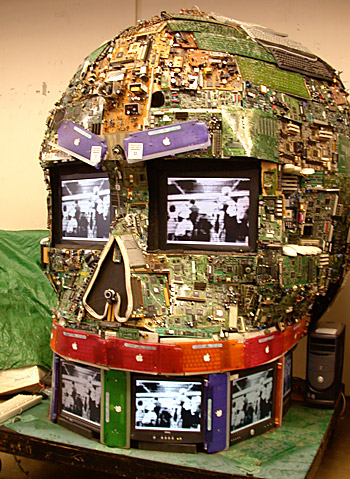 What was neatest about the fair for me was seeing all these DIY subcultures intermingling: the three-story-tall robotics folks, the rocketry types, the grow-your-own-mushroom folks, letterpress folks (the San Francisco Center for the Book had a booth where they were getting people to do a bit of letterpress), telescope mirror grinders, any number of fiber arts folks, and happily enough the ham radio crowd (Pica and I both wore our call sign hats).
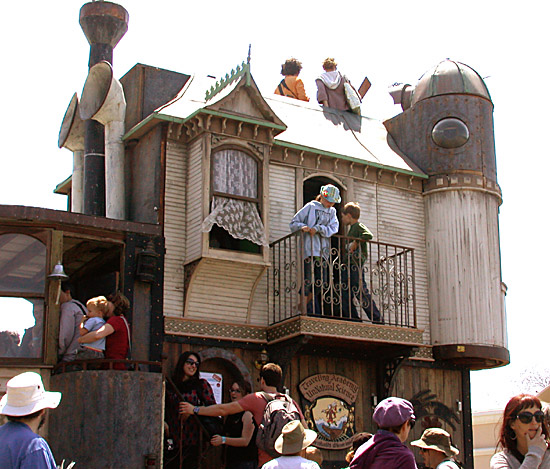 We were struck most of all by the steampunk folks. I’ve been aware of steampunk as a genre of fantastic literature imagining alternate Victorian technology, but didn’t realize steampunk has become something of a cultural movement. They had their own little section of the fairgrounds, purveying elaborate leather masks and brass goggles. Across the way, the St. Clair Aeronauts were dressing in
what we imagine a Royal Zeppelin Airmail Crew of 1883 would look like. At our table, we have parchment paper, envelope patterns, stamps, pen and ink, and glue. People can come to the table and write letters to their friends. My crew then delivers these letters.
(Virginia tried to send a letter that way to her daughter, without initial success.) In a way the steampunkers remind me of the Society for Creative Anachronism folks (who had a presence at the fair today, though I never ran into them), both craft-making sorts who like to dress up in period costume. It’s interesting though that the SCA came around in the late 1960s and looked towards a mythical preindustrial past, whereas steampunk is a 21st movement that is reimagining earlier days of industrialization. 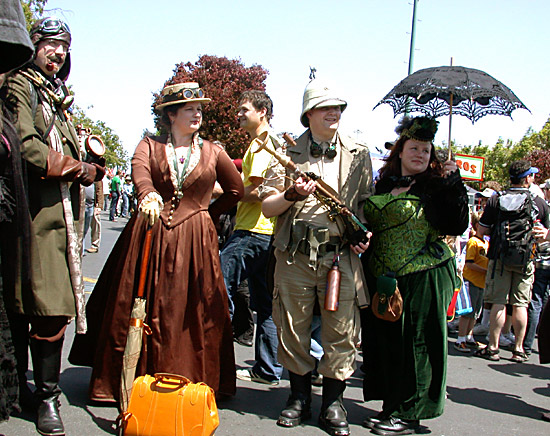
We all had a great time today. And I return home with projects! Of the radio and electronics ilk. I didn’t pick up any bits for these today, but I have lots of ideas to follow up on.
29 May 09
Going to Meet the Makers
We’re off to the Maker Faire in San Mateo tomorrow morning. This is the annual gathering of creative types who make stuff — kind of like Burning Man with a point, but without the dust, wind, and gratuitous nudity.
I’m going to look for the spinners, the bookbinders, the printers. Numenius has his own agenda and we’ll be taking radios to coordinate.
The Shy Turtle is a good example: using technology to teach children how to respect nature.
22 May 09
A Million Drawings
 World Drawing Day is coming up… June 6th, help us put one million drawings online! They don’t have to be masterpiece: go out and sketch and have a blast. Then scan and post your drawings, and report them.
I may user this occasion to start my new sketchbook. I’ve been thinking about what to do with it. Time to stop thinking and start drawing…
11 May 09
Bistro Nagini
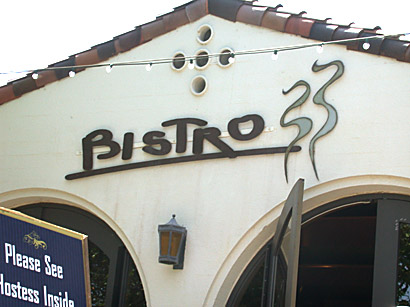 At left is the sign for a rather poncy restaurant in downtown Davis. There are some things you shouldn’t do to threes.
26 April 09
At The Local Airport
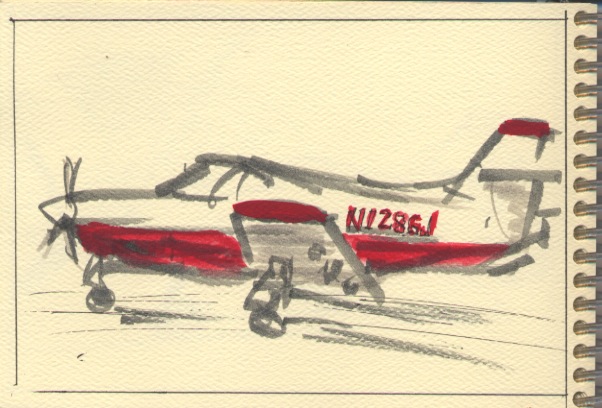 UC Davis is the only campus in the University of California system to have its own airport (though UCSB is quite close to the Santa Barbara commercial airport). For the past few years, the University Airport has held an open house in the spring; aviation buff that I am, I try to go to these, usually doing some sketching while there. At today’s open house, I sketched this Rockwell 112A, manufactured in 1975. A note on the sketch: I used gouache here — I recently built up a little paintbox of different gouache colors and this seems to be a good complement in the field to my box of watercolors.
11 April 09
A Birthday Sketchcrawl
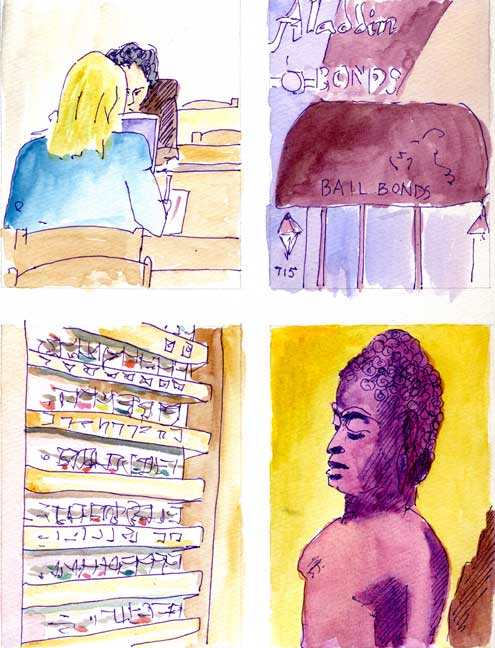
 Today was the 22nd Worldwide Sketchcrawl; it was also Numenius’ birthday. We arrived at the Capitol in Sacramento at 10:30 and were asked more than once whether we (two of us) were the anti-bank bailout demonstration. Well, we were, I suppose, subverting the dominant paradigm, that of digital cameras. Raise your right fist full of pens, people.
 We went for a quick hot chocolate to the Temple Cafe (open 365 days a year, equal opportunity to all religions) and moved on to the library, where we spent a pleasant hour or so browsing and sketching. On to Art Ellis for some watercolors, rice paper and bookcloth (N took a quick detour to the electronics store), and we ended up at the Crocker Art Museum for a look at the Buddhas exhibition which was excellent and is now in its final week (it ended up being, for me, a crash course in the history of Buddhism, well worth it for that reason alone, but some of the pieces were stunning; I particularly loved the calligraphed palm leaves).
Home, and Thai Nakorn for dinner followed by yoghurt at Cultivé. What a day. A purple day: I used a purple Micron for my sketches for the first time, and azaleas were in profusion…
A post-script: Jobs we’d hate to have #747: the graveyard shift at the bail bond office.
27 March 09
Shops Out Of Time
We went to Berkeley today for a family gathering and early birthday dinner and unexpectedly had a bit of time in the afternoon for some shop-wandering, ending up at two stores that though their contents couldn’t be more different, both seemed like reliquaries rather out of time. The first place was the Lacis Museum of Lace and Textiles. The friendly folks at the Albany yarn store k2tog directed Pica to go to Lacis to find some fine mercerized thread for lace knitting. This storefront and museum, which has been around since 1965, has a fantastic collection of materials, tools, and resources for textile crafts. But not Joann’s Fabrics sorts of crafts. Rather, these are for crafts that are arcane enough that we were both gobsmacked that anybody still practices these. There were the fifty-seven different sorts of tatting shuttles. The doll’s heads for making interesting tassel forms. The horn thimbles. The Battenberg lace kits. And a full range of corset-making supplies, including both plastic and metal stays; the place offers workshops as well and a DVD on corset-making. Pica found her thread, but the true prize was a specially-made wrist yarn holder, good I think for knitting socks while going hiking.
The second store was Al Lasher’s Electronics on University Avenue which has been in Berkeley since 1960 but I don’t think I’ve ever set foot in there before. Electronics components stores are very thin on the ground nowadays, the professional market for these long having given way to mail-order and now online places like Digikey and Mouser. Nevertheless, Al Lasher’s has somehow hung on, and judging from the numbers of customers passing through, still seems to be doing okay. One woman came in there for wiring supplies to resurrect a turntable she found on Craig’s List, the previous owner having been a photographer who didn’t actually play it but rather used it for a backdrop to a photo shoot. Some of the components I think have been in the store since the 1960s, or as they say on their web page, “we tend not to throw things away.” I particularly liked the two tube-testing machines up near one of the front windows (remember those, commonly found in supermarkets and hardware stores in the 1970s). A sign over these said these testers don’t really tell you that much, other than if the tube is shorted out or not, but all the tubes we sell at this store are good. I didn’t buy anything today, but the store has now been added to my places to shop in Berkeley list.
Today, by the way, is the sixth anniversary of Feathers of Hope!