
15 September 08
Three Novels That Touch on, or Skirt, War
My sister sent me, as a birthday present, a new novel by Geraldine Brooks, People of the Book. I had read Year of Wonders a while ago and loved her heroine who survives the plague and loss of her family and everyone she knew to end up in a place of unlikely redemption. My sister D. thought I’d like this new one because bookbinding and calligraphy and Spanish history are all part of the plot. She was right; the sequences of the book’s violent journey through history and Europe bracket each other like a book of hours, plus there’s a great gutsy Aussie heroine.
Some Spanish friends recently gave me a copy of Los Soldados de Salamina by Javier Cercas, which apparently was a bestseller in Spain in 2001 but which I’d never heard of. It recreates the story of a falangist (Spanish fascist) writer who faces, but improbably survives, a firing squad at the end of the Spanish Civil War and whose story is recreated by a journalist with writer’s block — the metaphors are as unsubtle as the people whose story is told — and to whom not all the facts are available. (Think Rashomon under Franco.) It was fun to read a novel in Spanish again, something I should try more often; if I read El Pais on Fridays I can start to make a list of thing that look interesting to me.
Finally, well back into the Brooks mode, I’m reading March, which is a fictional retelling of the absent father from Alcott’s Little Women, and which draws heavily on Bronson Alcott’s diaries and correspondence. This book is not about the American Civil War but the war is the backdrop.
Trying not to be too violent in my reading, here, but maybe there’s a lesson in all this…
15 August 08
Printer's Companion
Diego is not the first cat to develop an interest in the printing arts. The special collections librarian Donald Kerr at the University of Otago discovered on page 250 of the library’s copy of Astesanus de Asts Summa de casibus conscientiae, an extremely rare work from 1472 or 1473 printed in Strassburg by Johann Mentelin, three cat paw prints in ink.
Kerr noted that Mentelin had been described as “a careless printer”, so perhaps this was a good example. He checked with several other libraries holding copies of the work to see if there were any other cat paw prints to be found, but no such luck. The librarian at the State Library of Berlin noted however on their copy that there was bad damage on the initial and final leaves from rodent nibblings, which could explain why Mentelin kept a cat around the print house.
(From PhiloBiblos.)
21 June 08
You Say Aluminium...
One of the hardest things I find to say, even though I’ve lived here for nearly 20 years, is “alOOminum.” Skedule and prohject don’t seem to pose the same problems, but aloominum’s just something I can’t get to come out of my mouth (a bit like stOOpid unless I’m being arch or or FRITillary unless I’m trying to illustrate how it’s possible to merge four syllables into one). I got chastised again the other day for saying aluminium “wrong” and retorted that we (we in this case meaning Brits, though this like so much else in my identity shifts according to the winds, the wicket or diamond, or the company) had the word first, so how could it be wrong?
But since I’m given to sounding authoritative without the slightest reason to, and having resolved to have more reason to, I decided to look it up.
Seems like there’s no clear cut answer either way, which doesn’t resolve anything but is certainly interesting. In fact it could form the basis for a sociolinguist’s PhD (or at least a paper). Pronunciation of scientific elements: hypercorrection for the latinate, or hypercorrection against it?
5 June 08
Vetinari Ascendant
We’ve reported on how Barack Obama bears more than a passing resemblance to Lord Vetinari. This scene in the Senate today could have easily been written by Terry Pratchett, especially the bit about smiling up at the press at the end.
26 March 08
Tired: Let Me Count the Ways (Then Name Them)
Nicole of Turning Leaves just posted about how we lack words for states of tiredness.
Not words for “tired” — we have plenty of those. She wants words to describe these feelings:
There is the wonderful fatigue of relief. There is the foul mood of not having slept at all, or worse, having slept tiny dribs and drabs while in an uncomfortable position. There is the nervy sensation of having had a chance to really sleep, but not being able to.
There are several I’d add: the irritable fatigue of trying to get some sleep in a hospital but being continually woken by officious nursing staff taking readings and changing drips at all hours of the night (and day). The sweet, salty but aching fatigue of a long bike ride (or hike or run or aerobics class) and the sweet, salty but utterly different aching of a day spent digging in the garden. The honey-fatigue of deep relaxation, such as that following a massage. The monotonous and monochrome fatigue of depression. The fatigue of having really been under sniper fire, instead of just misspeaking about it, and not just for a brief trip to an airport tarmac but for days, weeks, or even years, the miracle of adrenaline finally giving out with disastrous consequences. The long slow blank fatigue of hunger. The deep fatigue following energetic sex.
Any ideas for words for any of these states of being?
4 February 08
Two Historical Atlases
I haven’t seen either of these publications in print, but both are intriguing. First, the U.S. Census has just released their first major atlas is over 80 years. The book has over 800 maps and weighs in at 7 pounds. Happily, the complete content of the book is available as PDF downloads, though each chapter makes for a large download, averaging around 15 Mb apiece.
Second, last fall the University of California Press published a Historical Atlas of California, written by Derek Hayes. With nearly 500 historical maps and illustrations, the book should be a visual feast.
15 January 08
How to Stay Busy in Winter
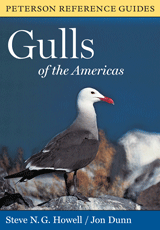 We bought a copy of this massive tome yesterday at the UC Davis Bookstore. It’s awe-inspiring. Gulls seem like the last frontier in birding, even more than sparrows…
3 December 07
Thought for the Day
“What is the cause of historical events? Power. What is power? Power is the sum total of wills transferred onto one person. On what condition are the wills of the masses transferred to one person? On condition that the person express the will of the whole people. That is, power is power. That is, power is a word the meaning of which we do not understand.”
Leo Tolstoy, War and Peace
2 December 07
Hot Stove League
Friday evening we ran into Chris at the co-op. Talk naturally turned to baseball, what’s the off-season about to bring (Bonds to the A’s???), the Hot Stove League now turning warm. None of us quite knew where that term came from, and we agreed the topic would make a good blog post. Chris then went on to teasing Pica about her new-found interest in samovars and smoky tea, and I decided to research the term, it making me think of players being traded around like sauté pans on a hot stove…
The term dates back quite a long time. The earliest reference online I could find was from a New York Times article from October 12, 1912 on the fourth game of the World Series between the New York Giants and the Boston Red Sox. The first paragraph reads:
Boston grabbed back its advantage in the world’s series yesterday on terrific smashing of Jeff Tesreau’s speed and moist offerings during the early innings, almost lost it when “Joe” Wood faltered under the strain, then cinched it by pounding Ames for a run in the ninth that made it 3 to 1 and broke New York’s last hope. Two to one in the ninth might not have been so bad, but 3 to 1, Wood settling again after three innings of the rickets and darkness gathering all conspired to make the Giants’ hopeless, and they lost without dishonor and might have won, providing a lot more hard luck alibis for the Hot Stove League this Winter.
The citation implies that the term by this date was in common use. The Random House Historical Dictionary of American Slang explains that the term is originally from baseball and defines it as “sports enthusiasts who continue to discuss their sport during the off-season”.
Paul Dickson’s book The Dickson Baseball Dictionary has a much longer account of the term, defining it as a “term for the gab, gossip, and debate that takes place when baseball is not being played”. The term gained popularity with the publication of a 1955 book by Lee Allen entitled “The Hot Stove League”, he believing that the phrase dated from the turn of the century. However, folk etymologist Peter Tamony found a usage of the term in 1886, describing the off-season in horse racing: “The sleighing has gone, and most of the trotting is done around the hot stove at present.”
28 November 07
Wanting a Samovar
I’ve finished the first three volumes of the Pevear / Volokhonsky translation of War and Peace. Rarely do I read a book this slowly, so rarely do I have the chance to realize that it’s a luxury, a pleasure all the more rich for how drawn out it is. (The last book I read of comparable length was Vikram Seth’s A Suitable Boy, which I confess I gobbled in less than a week.)
The samovar: an artifact around which people gather(ed), sometimes in great numbers, and often at great length, to drink tea. Sounds like heaven to me. I’m curious about the different types; about the way the tea was infused with the aroma of burning coals (I always thought Russian gunpowder tea was smoked to fit the Russian taste, which it is, but there’s a reason for that—it probably evokes ancestral memories of huddling companionably, perhaps on a long train journey); about how the tea concentrate (which Wikipedia tells me is called zavarka), to which the hot samovar water is added, is made. This doesn’t really seem to be the place to find this all out, because I find no indication that they actually have any samovars that are working (there seem to be an ocean of tiny teapots instead) but I may drop in next time I’m in the Castro anyway, because anywhere that takes tea this seriously (as opposed to a very poor second cousin to coffee, the West Coast norm) is worth investigating.
Slowing down, savoring. Trying to learn how to do this.