
24 July 08
Host City
Our breakfasts continue to be enlivened by following the Tour de France. Today was the critical final mountain stage, this year ending in the famed Alpine climb up l’Alpe d’Huez. Carlos Sastre rode like a banshee the final few steep kilometers, winning both the stage and taking the overall lead. The remaining decisive stage will be Saturday’s time trial; we shall see whether Sastre can hold his lead, or will lose it to a better time trialist.
Today we had exciting news about California’s answer to the Tour de France, the Tour of California. This cycling race, first held in 2006, has become the biggest stage race in the United States. These past couple of years the race has passed through Davis in a stage running from Santa Rosa to Sacramento. Thanks in part to the enthusiasm of Davis cycling fans these past two years, Davis won’t just be an intermediate town on the way, but will be the starting point for the second stage of the race next year. This stage will run from Davis to Santa Rosa. Happily, this stage will be on a Sunday (February 15) so we’ll be there to watch and take in the pre-stage festivities!
22 July 08
Confessions of an Art Supply Junkie
We’ve been keeping a fairly close eye on what we’ve been spending in 2008 in an effort to understand where all the money goes, what should (and can) be changed, and what we really need to live on. No full answers to those questions yet, but Numenius compiled a breakdown the other night.
What I spend on art materials is daunting. Do they get used right away? No. Most of them are filling nooks and crannies and the books are stacked by the bed and it’s all a bit frightening.
Katherine Tyrrell of Making a Mark has a wonderful post today on the art of economizing on art materials. First step, for me, is to organize what I have, see what I still want, and find a good home for stuff I don’t. And, proud of myself, I didn’t go into an art store in Berkeley over the weekend. This is another easy thing to do: avoid the temptation in the first place…
21 July 08
Solar Castle
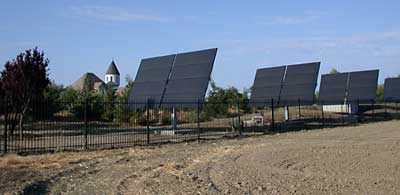 This residence just southeast of Davis on a favorite bike loop of mine intrigues me. On the south side of the residence, one sees a series of 10 massive solar panels mounted on pylons, the panels rotating to track the sun. The residence itself is partly obscured behind some recently planted trees, but one gets a better view of it in its full glory a little further down the road.
Ostentatious? To be sure. How about contradictory? In solar building design, isn’t it the first principle to start with a structure that is small and efficient, just to give yourself a fighting chance to balance a much more limited energy budget?
Or you can throw hundreds of thousands of dollars worth of photovoltaics at your McSolarMansion, I suppose, never mind about efficiency.
19 July 08
The Tour de France
Our mornings in July go like this:
I get up, get the tea on, feed the cats, get online, go to the BBC’s cycling page where there is live text commentary (no choice if you’re on dialup) on the current stage (if you’re not following it, today is moving from the Rhone delta into the alpine foothills and punishing mountains that follow). Numenius gets up anywhere between one and three hours later and is usually still in time to catch the finish.
I started following cycling when Miguel Indurain was in his heyday. He was probably the finest athlete Spain’s ever produced. Now that Lance Armstrong is no longer the king of the peloton and the interest of Americans in bike racing has sort of returned to where it was before, it’s back to following the fortunes of the unlikely, the opportunists, the ones whose last chances are this year having been unfortunate enough to have come of age when Lance did.
It’s great there’s no obvious favorite. Sentimentally, I’d like Evans to win. But mostly I just love to follow this fantastic event over the three weeks it takes, watching the emergence of the likes of Mark Cavendish (Manx sprinter) and the breakaway hopefuls. Allez allez!
18 July 08
Bicycle Economics
Inspired by David Mackay’s online book Sustainable Energy — Without the Hot Air, I worked out just how much more energy-efficient a bicycle is than a car. Here’s the math: the energy content of gasoline is about 10 kWh/liter. Our car gets around 25 mpg (none-too-efficient, I know) which equals 10.6 km/liter. Dividing through our car therefore uses 0.94 kWh/km. As for the bicycle, at a modest pace of about 20 km/hr, I use about 15 kcal/km of energy (this value comes from the excellent book Bicycling Science, by David Gordon Wilson). At 857 kcal/kWh, I thus use 0.0175 kWh/km on my bike. The bicycle is therefore 0.94/0.0175 or about 50 times as efficient as the car.
In working out these energetics problems, one quickly runs into a plethora of conversion constants. Here’s one for fun: since a kilocalorie is the same as a food calorie, driving the car 1 km uses the energetic equivalent of a pint of ice cream.
We’re doing pretty well though in minimizing our car travels. Going through our expenses this evening, I worked out that over the past six months, we spent far more money on bike maintenance and parts than we did on gas (those bicycle overhauls add up).
15 July 08
Three Weddings and a Baby Shower
Three invitations arrived last Friday. One, the wedding of some friends for whom I had designed the invitations, so not unexpected, but fun to receive all the same. The second, two dear friends will wed ten years to the day after they met. Thanks to California’s recent supreme court ruling, they can, legally, get married now. The third was to a baby shower, a couple expecting twins. They will get married the following day: the first lesbian shotgun wedding I’ve been invited to… Busy August, folks.
14 July 08
Night of Approaching Nights
ExpressJet has gone to the Great Airport In The Sky. They are ceasing flight operations as of September 2nd, citing high fuel prices. We flew ExpressJet on our trip this past April to Texas, appreciating the direct flight from Sacramento to San Antonio, though the journey ended by haggling with them about the return flight. (We won.)
I don’t see the airline industry as surviving this transition from cheap energy. Jet fuel has no substitutes — don’t expect to see hybrid planes in the air, and there is not a lot of room for improvement in the fuel efficiency of modern jet airplanes. Fly while you still can; the party’s winding up. Air travel will still exist in a decade or so, but it will be very expensive, circuitous, and basically only accessible to the rich and the elite.
This is, simply put, a vision of technological decline. It is an odd concept to get used to, conditioned as we are to expect ever-improving technology. Jet transport is an obvious, though painful, area to anticipate decline, but it stands to reason there may be others. Perhaps it’s time to ponder them.
Last night was Night of Night IX. This is an annual radio event commemorating the last commercial marine Morse Code station in the US, KPH located on Point Reyes, going off the air nine years ago. In this event, a number of these old transmitters go back on for an evening in tribute to the radiotelegraphers who worked for decades from ship and shore. I listened for a bit to the Morse Code, copying the stations from Point Reyes and from Mobile, Alabama. Voices from the past, to be sure. But we would do well to keep our skills up at trailing-edge technologies. They may yet come in handy.
11 July 08
Green Summit in November
I’ve been asked, in my capacity as Yolo Audubon president, to participate in a steering committee for a day long workshop to address conservation challenges in our region. The first meeting of this committee took place last night, and while I do actually have plenty to do this summer, I’m quite jazzed about this. It’s a fantastic group.
I sense a huge fatigue among the public, at least around here, about climate change and the environment. The brown smoke that hovers in the air, still, this morning, the days of suffocating heat we’ve been having, the drought this spring: undeniable signs of unpleasantness, with more and worse to come. The housing crisis and the price of gas and food, together, are clear indicators that what we’ve been building since WWII is untenable, unworkable. Back to growing our own food and walking or biking to the shops. This means, ultimately, less urban sprawl. (The wakeup call couldn’t have come faster, from my point of view, but I realize the transition is going to be messy, difficult, and very possibly violent.)
I think our task with this summit is to empower people to get engaged. Have workshops on how to understand planning policy and participate in the process. What does it mean? How can I help? How can I make what I do count? I don’t doubt that people around here have the will and the energy to get things to change, but they do need more tools to do it. I know I do.
This summit will come just after the general election, when the focus of everyone will be on the outside, on the country as a whole, on the body politic on the national level. Our green summit will be all about bringing it home…
8 July 08
Murk
It will be a long summer. Today it got to 106° F here with only a couple of miles of visibility, the skies still hazy with smoke as it has been for much of the past several weeks. There are still 18 fire complexes burning throughout Northern California, 10 of these in the mountains rimming the Sacramento Valley.
The current air quality is a lot better here than what it is today where we used to live. There is a major wildfire in the Santa Barbara area, in the mountains north of Goleta and UC Santa Barbara. The fire started on July 1, and has burnt about 10,000 acres. The eastern perimeter of the fire got very close to the little enclave in the mountains where we spent a year-and-a-half, the San Marcos Trout Club, but the fire was held at the ridge just above and to the west. For now the Trout Club seems okay: the residents had been evacuated but have been allowed to return to their homes as of this afternoon. And typical Santa Barbara summer weather is now helping there — evening and morning fog, highs in the low 70s.
7 July 08
Clawed
Diego had four teeth out last week. It was a miserable time for him, for us: he’s not yet four, and some kind of autoimmune virus thingy was just eating away at the roots of the teeth on the lower left of his mouth. All my vet friends say better out than in; he’ll learn to eat hard food (and in fact is already eating it with alacrity) and will get along fine. I feel like a failure as a pet-owner and all the rest. But after all, if he doesn’t need to catch his food, what does he really need teeth for? (I try to convince myself of this. Ha.)
The hard part, though, is the antibiotics. You mix the powder with water and shake hard, hoping its volatility lasts through the heat wave. (Unlikely.) The cat hears the syringe and hides under the bed, in the closet, or in one or two other places we have not been able to discern, even though there are only so many places to hide in 600 square feet.
I depress the plunger as claws from front and back feet try and get some kind of purchase on my flesh, hoping the banana-smelling stuff has gotten down his gullet in enough quantity to prevent whatever infection might be brewing, the source of impossibly larger vet bills.
My legs look like I’ve been running through brambles…