
23 November 08
Books For Notes, Books For Sketching
As Pica relates, today we went to Stockton to catch Jack Laws’ bird sketching workshop at the Central Valley Birding Symposium. Despite it being too early in the morning when I got up, I actually came up with a coherent idea for how I would take notes in the workshop. Pica once got from the campus print shop castoff 7“x17” sheets of Endeavour Velvet Book paper, and we have several stacks lying around. It’s not very good paper for anything other than color offset printing, but it works as scratch paper and for practice projects. I took eight sheets of this paper, and folded these in half to make a 7“x8.5” single signature pamphlet. I took notes and made sketches on the signature in the workshop, hoping I had neither too few or too many pages. At home I made a little cover for it out of a sheet of ivy Canson Mi-Tientes paper, and bound it with a three-hole pamphlet stitch.
I was doing my class sketches with my Derwent Graphitints, and was thinking didn’t Derwent recently double the range of the Graphitints from 24 to 48 pencils? Some searching revealed this wasn’t the case (I must have been thinking of the expanded range in the Derwent Drawing Pencils), but I did come across a distressing blog post about lack of lightfastness in the Derwent Graphitints. This post however was in a wonderful new blog by Minnesota book artist Roz Stendahl, the themes of which being sketching, visual journaling, bookbinding, and dogs. She had a great post at the beginning of the month about a major reason I’m interested in bookbinding: how else as a sketcher can one be assured of getting a sketchbook that’s exactly in the format, paper, and design that one wants?
21 November 08
Badge of the Trade
When I worked for an architect in Cambridge, Mass., many of my coworkers had a thin slice taken off their left forefinger, the result of a dull exacto blade during a late-night charrette (deadline). I went through graphic design school, went through countless Exacto blades. I always, somehow, avoided this injury.
Until today. I stuck my finger in my mouth so I wouldn’t a) swear b) see c) bleed my guts out, ran into the main office, whimpered, grabbed some paper towel, then fessed that I might need to go to the hospital. But for what? There’s nothing to stitch, it got sliced off. I got chastised, rightly, by our front desk gal, who accused me of using a razor to cut card (she’s Italian), then ran next door to the vets.
“Do I put anything on this before a bandaid?” said I, bravely, to the first wildlife vet I found — she works on lead intoxication in condors but she used to be an equine vet. “Let me see.” (They’re ghoulish, veterinarians.)
“No. You weren’t around any animals, right? Clean blade? OK, bandaid now, tight but not too tight the blood has to clot, wash it when you get home then antiseptics, another bandaid. It’s going to hurt, later.”
“You’re letting a horse doc touch your finger?” asks the biodiversity/avian flu guy who is not a vet but might as well be at this point. “Better that than most doctors,” I say, and head back to the stash of bandaids.
Badged.
Update, 11/22/08: The cats were either super solicitous or cold in our first real tule fog of the fall (they almost never come onto a lap together). My PT sister-in-law whose specialty is wound care has given sound advice and asked for progress photos (on their way.)
!
19 November 08
Local Boy Makes Good, Part 2
Last year around this time we reported that Dustin Pedroia, Yolo County native who graduated from Woodland High in 2001, won the AL Rookie of the Year award. This year he did one better and won the AL Most Valuable Player award, hitting .326 with 17 home runs and 83 RBIs for the Red Sox. At a height of 5’9” at best he’s not your typically-sized ballplayer, either.
One of these months I’m going to have to browse through archives of Woodland’s local rag, The Daily Democrat, and read about some of Pedroia’s high school batting feats.
18 November 08
Ravelling
In other news, the warm weather we’re having is giving me lots of hope for the yellow beet seeds I put in on Sunday. I have no such hope for the carrot seeds I put in at the same time. Carrots are a bust. I found what grew out of the packet of seeds I dropped sometime over the summer — arugula? — and have put it next to the beet hopefuls.
 We have bought a food mill and put a hopperful of cherry tomatoes through it. What emerged was pulp from one bit and seeds and skins from another. I made a slow-cooked tomato sauce, started in the solar cooker and reduced down on the stove. Yum.
16 November 08
Round The Gyre
In the early 1970s Davis was a happening place environmentally. The city was a pioneer in designing transportation infrastructure for bicycles. And over in west Davis, architect and developer Mike Corbett built Village Homes, an ecologically sensitive development with lots of interior green space, solar design, community gardens, edible landscaping, and natural drainages. The 70s came and went. The flourishing of environmental ideas at that time gave way to the growth of the 80s (Reagan removing the solar panels Carter had put up on the White House perhaps being a good symbol of this). Village Homes was much admired but never really emulated.
We spent the day at a Green Summit meeting held up in Woodland, about 10 miles north of here. A number of local environmental groups helped put this event on, including our own favorite, the Yolo Audubon Society (in her capacity as YAS president, Pica got drawn into being on the event steering committee). Despite the weather being spectacular today, the event drew over 230 people. The event was organized as a symposium with about four different concurrent sessions. Topics included habitat issues, water issues, land use and urban design, and outreach.
I settled into going to the urban design sessions, followed by one in the afternoon on youth and the outdoors. The first speaker led off with a bit of Dickens (“It was the best of times, it was the worst of times”) to set off the theme of sprawl versus infill for the Sacramento region and beyond. I agree very much with the premise of these urban planners that infill and compact growth are the key to preserving habitat by keeping development out of the wilder places of our landscape.
Sprawl and infill are not new issues for urban planners. But have we perhaps circled back around to the insights of the 1970s? (Though adapted to the 2010s — Mike Corbett today in response to a question about the non-adoption of the Village Homes model, said that what he would take from that model would be the elements, but not the design itself: we need far higher densities now.) I was heartened by the presentation of Mike McKeever, executive director of the Sacramento Area Council of Governments (SACOG) who talked a lot about their blueprint planning process which through a massive effort to elicit citizen input came up with a compact growth plan for the region. Happily to date, people may be acting on this plan — e.g. vehicle miles traveled are down in the region.
Here are the key factors now in this region. 1) The population in the Sacramento area is expected to grow substantially, probably by well over a million by the year 2050. 2) The region is being hit hard now by the housing crash, and the worst-off areas are the newest, most sprawling developments. 3) Responding to global warming is becoming much more of a political imperative, especially in California where the state has taken a lead on reducing greenhouse gas emissions. 4) People are starting to recognize that cheap energy isn’t always to be counted on. For instance, solar housing design is now a good selling point.
So having looped around this way before in the 1970s, are we now about to set off down the track towards sustainable design for real? We hope so.
13 November 08
Elation and Grief
It’s been over a week, now.
The edge has been taken off the elation, the sobering future facing a new administration (and all of us). This isn’t going to be easy. We’re settling into a hard, hard time. But at least there is hope.
No edge at all has been taken off the grief over the hateful passing of Prop. 8. Not the news that Mormons are resigning from their church in protest and in some numbers; not the news, today, that a legal challenge has been mounted in the courts. The grief comes from the awareness that intolerance, bigotry, and hatred are rife in our society. The culture wars in full sway. I knew this. We knew this. But it is still a cause of grief and pain.
When Numenius and I got married in 2003 I wondered whether we should. Why, when others who loved each other couldn’t, legally? When Gavin Newsom started marrying gay and lesbian couples in City Hall in San Francisco in defiance of California law, back in February 2004, I was so thrilled. Friends of mine got married then. They had to turn in their marriage licenses afterward, and our local County Clerk made a huge heroic stink about this in the news, receiving hate mail and getting expelled from her church in the process.
Now this.
How does their marriage threaten mine, pray tell? How exactly do my sisters-in-law with their three beautiful children mar marriage? And, once again, since all kinds of people need to be reminded: your beliefs are tolerated in this society, but we have a constitutional separation of church and state. We really do. If you’re gay and Mormon and believe you shouldn’t get married, go for it. I’m fine with that. I respect it. If it makes sense to your personal integrity, I support it.
But what’s at stake here isn’t just gay marriage: it’s the very concept of pluralism. We liberals labor under the delusion that everyone here, sooner or later, embraces pluralism. We’re wrong. There are lots of voters — 46%, pretty much — who would just as soon scratch it out of the books, and they are getting ready to go after all kinds of other things.
I’m not sure you can resign from the Catholic Church, but if you can, here’s mine. Might as well make it official. I cannot be even residually affiliated with an organization so hypocritical and hateful. I know and love some wonderful Catholics. But I can no longer be one of you. I’m sorry. I have said my last Hail Mary, I have for the last time blessed myself with holy water, I have bowed for the last time before the elevated host. I can’t pretend this doesn’t hurt a little, but it has been coming for a while and this is it. No more. No more authoritarian aging white bishops, no more sinister pronouncements of hatred in the name of “love.” Basta.
There are rallies all over the country on Saturday. I will not be able to attend one on that day — I’m helping organize the Yolo/Sacramento Green Summit in Woodland — but I will be there in spirit and I offer this post in tears to my gay and lesbian brothers and sisters on whom a violence has been spat. We must no longer be silent. I acknowledge my white privilege; now I own and rail against my straight privilege. I ask you to join me…
This is written in response to Jarrett’s post over at Creature of the Shade.
11 November 08
Black Book
 My latest exercise in bookbinding has been to make a black-papered book using Canson Mi-Tientes art paper. Each page is 5” high by 8” wide, good I suppose for nighttime landscapes.
The goodies available at Talas are starting to look very tempting.
8 November 08
Maine
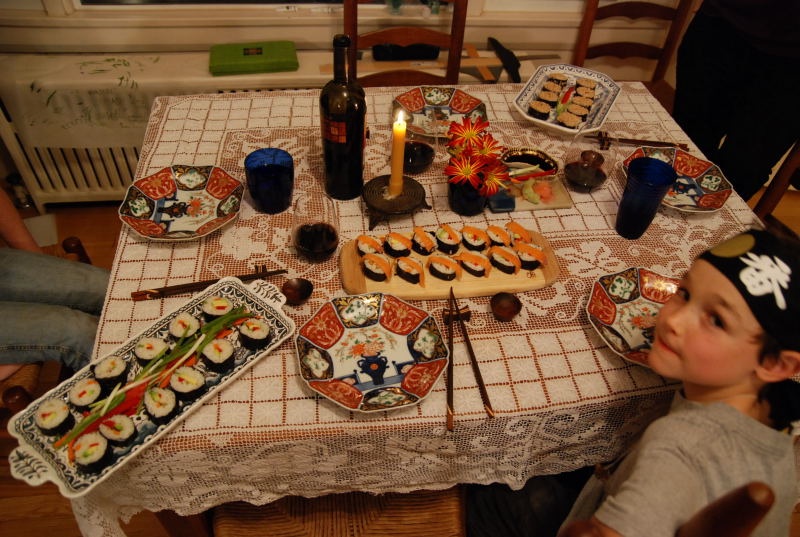
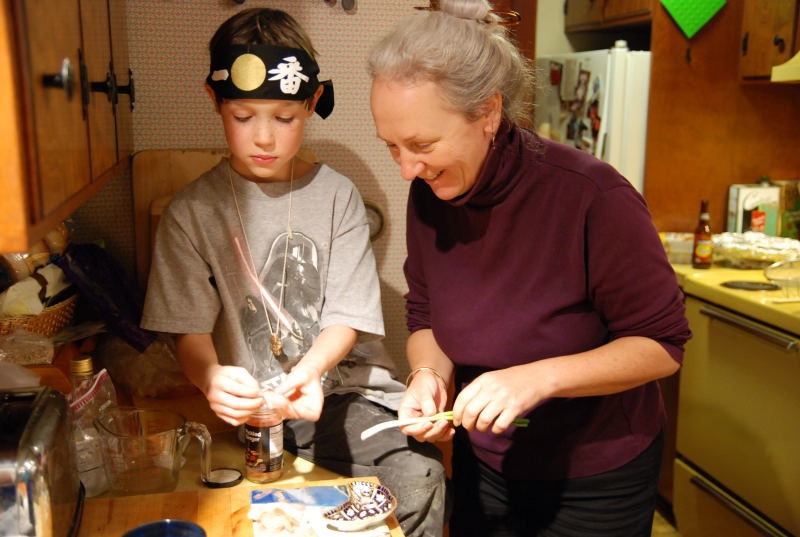 I’m in Maine, here to visit family before the snow flies. I’ve been making sushi with my nephew this evening, which I consider to be a step up from when I did this four years ago… photos will appear when I can figure out how to do it.
 At some point I’ll describe what it was like to travel across the country sitting next to two young evangelical christians, one of whom wore Sarah Palin glasses, on the day after the election…
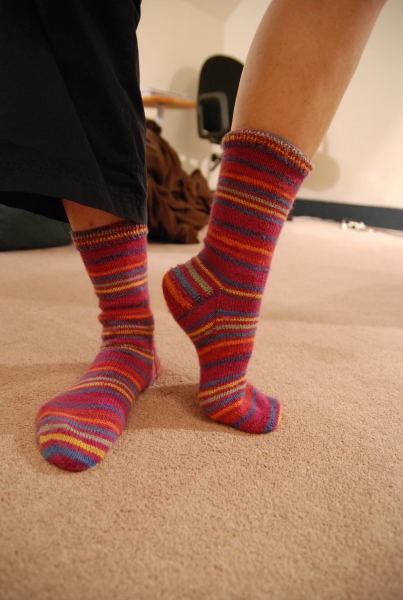 Update: finished the socks, which I gave to my sister who is modeling them.
5 November 08
Onion Soup
 Following an election night tradition she learned from Arthur Goldhammer, Pica made and brought onion soup to an election party we had over at Mary’s this evening. We’re all verklempt at the result.
3 November 08
Slogging Through the Rain
Numenius was in San Francisco two days this weekend, so I decided to spend Saturday walking precincts in West Sacramento. My job was to put a reminder to vote on the doorhandles of people who have been identified as Obama supporters but who have a low propensity to vote. It suggested who to vote for downticket and how to vote on propositions, of which there are the usual poorly written baker’s dozen for California.
It was raining. Warm, lovely, hard rain. I was soaked before I left Davis. Jeans-up-to-the knees soaked. The lists I had of addresses in a part of West Sacramento I’d never been to (demographic: heavily immigrant, lower-middle class, lots of Yes on 8 signs) were soaked too. I had foreseen this and made photocopies so I could turn in something legible.
GOTV GOTV GOTV, they say. Get out the vote. I don’t like doing this, it puts me way outside my comfort zone. But if Obama can stand in the rain urging people to get out the vote, then go and do it again in the next town, and the next — for all these days and weeks and months he’s been doing this — I can put up with a little going outside my comfort zone and get soaked. Nothing a change of trousers and a cup of chai couldn’t sort out.
I arrived back at Davis headquarters, a bedraggled thing, with my sopping-wet map and a smile. Crinkled fingers. I did it. They welcomed me with a smile and their own stories of a wet day.
This campaign has been so well-organized it’s frightening.
Hope. The world is watching, hoping…