
2 April 09
Knitting Assistant
 Charlie makes the best of finding an interloper in his chair and proceeds to supervise the knitting.
31 March 09
Bolting
 The cabbages, turnips, arugula, and all other crucifers in the garden are blooming, turning bitter as you watch. I picked the last two cauliflowers and most of the turnips.
It’s too early to plant summer veggies but not by much, and I have a lot to do before then. Trouble is, a nice big fat shipment of yarn came in, and the birds are on their way too.
And I’ve started making my Depression Sketchbook. It’s not very depressing, though…
27 March 09
Shops Out Of Time
We went to Berkeley today for a family gathering and early birthday dinner and unexpectedly had a bit of time in the afternoon for some shop-wandering, ending up at two stores that though their contents couldn’t be more different, both seemed like reliquaries rather out of time. The first place was the Lacis Museum of Lace and Textiles. The friendly folks at the Albany yarn store k2tog directed Pica to go to Lacis to find some fine mercerized thread for lace knitting. This storefront and museum, which has been around since 1965, has a fantastic collection of materials, tools, and resources for textile crafts. But not Joann’s Fabrics sorts of crafts. Rather, these are for crafts that are arcane enough that we were both gobsmacked that anybody still practices these. There were the fifty-seven different sorts of tatting shuttles. The doll’s heads for making interesting tassel forms. The horn thimbles. The Battenberg lace kits. And a full range of corset-making supplies, including both plastic and metal stays; the place offers workshops as well and a DVD on corset-making. Pica found her thread, but the true prize was a specially-made wrist yarn holder, good I think for knitting socks while going hiking.
The second store was Al Lasher’s Electronics on University Avenue which has been in Berkeley since 1960 but I don’t think I’ve ever set foot in there before. Electronics components stores are very thin on the ground nowadays, the professional market for these long having given way to mail-order and now online places like Digikey and Mouser. Nevertheless, Al Lasher’s has somehow hung on, and judging from the numbers of customers passing through, still seems to be doing okay. One woman came in there for wiring supplies to resurrect a turntable she found on Craig’s List, the previous owner having been a photographer who didn’t actually play it but rather used it for a backdrop to a photo shoot. Some of the components I think have been in the store since the 1960s, or as they say on their web page, “we tend not to throw things away.” I particularly liked the two tube-testing machines up near one of the front windows (remember those, commonly found in supermarkets and hardware stores in the 1970s). A sign over these said these testers don’t really tell you that much, other than if the tube is shorted out or not, but all the tubes we sell at this store are good. I didn’t buy anything today, but the store has now been added to my places to shop in Berkeley list.
Today, by the way, is the sixth anniversary of Feathers of Hope!
26 March 09
25 March 09
First Birds of Spring, 19th Century Version
Despite my lack of faith in the long-term durability of digital archives, it’s always nice to see digitization projects bringing resources out from dusty basement file cabinets to the light of a world-wide audience. One such project is the North American Bird Phenology Program. Housed in one of these proverbial file cabinets in Maryland is the Migration Observer Card collection, a set of about 6 million handwritten cards giving observations of the timings of the arrivals and departure of migrant birds. These observations were collected between 1880 and the Second World War by a network of up to 3000 birdwatchers. These observations are very valuable today because they help tell the story of how shifts in climate affect the distribution of animals.
Not having the funding to digitize the card files themselves, the biologists at the Patuxent Wildlife Research Center where the collection is housed came up with the idea of crowdsourcing the project. They have started scanning the cards and are recruiting volunteers over the Web to transcribe the information on the scanned images. The project is barely a month old and already has over 400 volunteers. But more are needed, so if you are interested in helping see here.
21 March 09
Remembering Dorothea Lange
The Urban Sketchbook project is an important chronicle of a moment in our world’s history, I think. Partly because of its global scope — draw a sketch on the Tokyo Metro, in the Piazza del Duomo in Milan, or in Central Park, scan it and upload it and everyone in the world can see it.
A sketch from earlier this week bidding farewell to the print edition of the Seattle Post-Intelligencer (and the coming rush of more, including two major newspapers in Northern California) has got me thinking about earlier chroniclers of desperate times. I don’t think these scans of sketchbooks will endure beyond a decade or two, but the sketchbooks might. (The Archdruid made a powerful case this week for the endurance of one kind of technology: books.)
I am thinking about making a sketchbook (or several) for the sole purpose of chronicling the slide from prosperity (chimerical though it may always have been) to want. Sketching iPhones and then discarded circuit-boards. Rusting cars. Foreclosure signs and boarded-up shop windows, of which we have no shortage now in Davis, where the recession is otherwise fairly invisible (becoming less so daily). But it will also chronicle, I hope, people learning to make it through this by helping each other, learning simpler ways of doing things. Since everywhere I go I have a sketchbook with me, and since everywhere I go there are infinite things to sketch that tell this story, I don’t imagine being at a loss much.
It’s the invisibility becoming less so daily part I’d like to start following. Since I am no good with a camera I myself will do this with a sketchbook, but I invite you to join me with whatever medium you’d like — words, camera, pen, pastels, clay, video. I’m not volunteering to put these together on a website, but if you’d like to do that, let me know. I think at the very least we could offer this as a qarrtsiluni topic for consideration…
19 March 09
Minding The Laundry
 In addition to his habit of dozing in the dryer, Charlie these days is back to the practice of spending some of his morning sleeping in the laundry hamper.
18 March 09
The Land of Knitting
 Numenius has been reading to me from the Yarn Harlot’s latest book, Stephanie Pearl-McPhee Casts Off: The Yarn Harlot’s Guide to the Land of Knitting, while I knit my sweater. The Yarn Harlot is a brilliant writer and you don’t have to be remotely interested in knitting to enjoy her prose, as Numenius will tell you between guffaws. She’s written quite a few other books, one of which is Things I Learned From Knitting (Whether I Wanted to Or Not).
I haven’t read it yet, but here are some things I’m learning about knitting as I go:
a) Don’t knit anything beyond garter stitch when drinking. Even just one glass. And maybe not even garter stitch if you have to do increases, decreases, or any kind of counting. This is really important.
b) If it’s a boring stitch or a monochrome yarn, have it be a small project if you’d like to finish it. If it’s a combination of the two, “small project” amounts to a sock for a Barbie doll. (Then watch Barbie not wear it; but why should she? You have fallen prey to Second Sock Syndrome, and there is no second sock in sight.)
c) Large projects should only be undertaken if they are staggeringly appealing to you, are knit on large yarn and/or large needles, and contain enough of interest to keep you going but are simple enough not to have you get bogged down in complexity.
d) The quality of the needles you use makes a huge difference in the ease of knitting. I’m going to guess the quality of yarn (and its price) make a big difference too. These factors are likely to determine whether or not you buy a condo in the Land of Knitting. They will also determine whether your bank account is going to get depleted in a hurry.
e) Attempting to knit lace is like embarking on reading Ulysses. It’s not about where you’re going, it’s about the journey. (In my case, a journey in the dark while riding a malevolent arab mare, spiteful rolling eyes and gorgeous. Landing in the ditch is the most likely outcome.)
16 March 09
Some Assembly Required
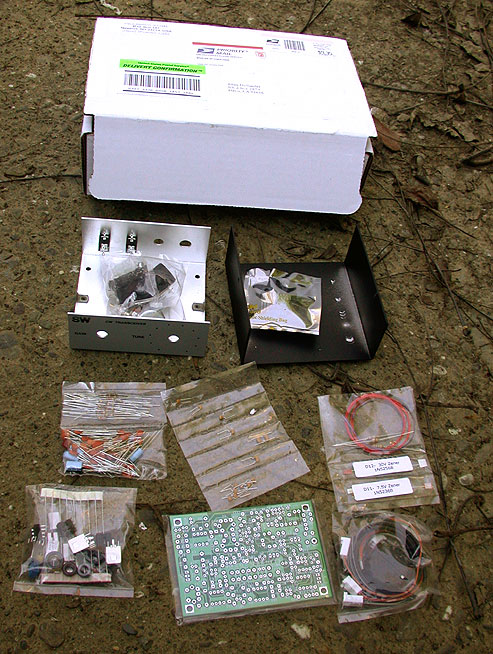 I finished building the bat detector last weekend (no bats heard yet — they are in hibernation or haven’t returned from down south) and have moved on to the next project — building a Small Wonder Labs SW-40+ 40 meter QRP transceiver. It has a lot of parts.
But I’ve been making a good bit of headway. 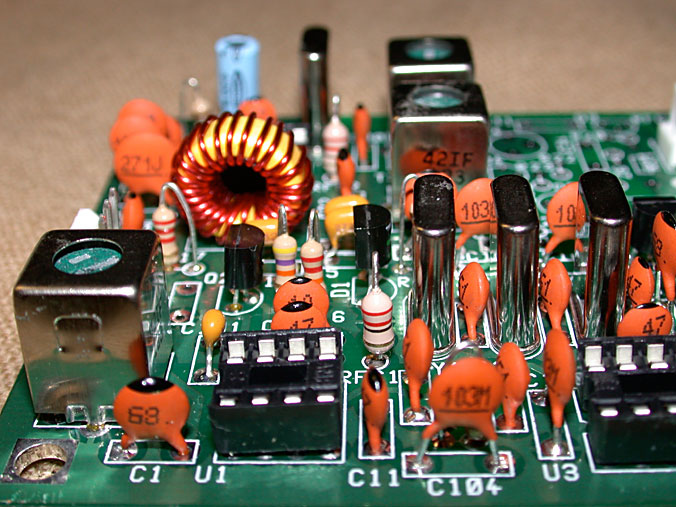
13 March 09
A Different Kind of Detection
Oxbridge attracts a particular kind of American — the academically-inclined if not outright academic, often more than ordinarily anglophilic, and, if male, spreading a bit (okay, a lot) above the beltline and sporting a bow tie. (If you’ve read any David Lodge, Maurice Zapp, though not in fact at Oxbridge though certainly wishing he were, rather than at my alma mater Rummidge/Birmingham, is the perfect portrait.) My many years away from Cambridge — 20, at this point — and my now more than 10 years away from Harvard — where this kind of person occurs in some profusion — have dulled my sensitivity to the type. To be fair, there aren’t many of them in Davis. (Thank God. Davis is, as I have said elsewhere, a cross between Berkeley and North Dakota, and such types are ridiculed in Berkeley and nonexistent in North Dakota. But I digress.)
I ran into one the other night, though, at, of all places, the Davis Knitting Group. A late-middle-aged gent expertly unwinding a skein (hank, if you’re American) of undyed Shetland yarn (horrified there was so much — gasp — color on the knitting needles around the table, not like in Yurp), expostulating on what a backwater Davis was; how when he lived in London he could go to a different play every night; how he hadn’t unpacked all his stuff yet (he owns a ball winder and swifter); how he had taught at Oxford. (Ears prick up; you don’t “teach” at Oxford.) Apparently a doctor, though interested in the intersection of music, philosophy, and the brain. (I thought oh, maybe an Oliver Sacks wannabe?)
My bullshit detector, already on amber alert, started screaming loudly the minute he pronounced Nuffield “Noofield” and I’m afraid I rather rudely concentrated on my yarnovers and knit-two-togethers rather than engage him in a lengthy discourse about London, Oxford, Cambridge, and why Europe is more interesting than Davis. (If it’s theatre you want, buddy, you should have moved to New York.) He turned his attentions to a fascinated and more easily-impressable nurse and they gabbed for three hours about the lamentable state of American medicine.
I was startled at the vehemence of my reaction to this fairly harmless, probably lonely, and certainly rudderless old bumbler. I think it’s partly because I finally, really, feel very protective of Davis. It’s my home now. I have had it with snobs, particularly American ones of the Oxbridgephilic kind. (I’ll make an exception, I think, for Yarn Snobs, but that’s another blog post.)