
26 April 03
Riding Again After Twenty Years
I’ve been riding again after a long absence. Horses are large, unpredictable creatures that seem to have a soul that resonates with mine. I know that spending even a short time around them makes me forget everything else. The smell is something we used to dream of distilling as adolescents. Basically, you either love it or hate it.
Like riding a bicycle, riding a horse is a skill remembered mostly in muscles that don’t necessarily work as well as they used to. But the old instincts are still there: I can still tell when a horse, frisky in the north wind, is about to bolt. Not that this will necessarily save me!
The UC Davis Equestrian Center is adjacent to Highway 113. There are about 60 lesson horses and many others that are owned privately. It’s time for it to move on. There’s a ranch out on Russell Boulevard which has been earmarked for the new Equestrian Center and which is being celebrated this coming week. I hope there will be an indoor arena: riding in the mud in winter and searing heat in summer is no fun. If Davis is successful in its bid to get the new Biosafety Level 4 Lab from NIH, it will sit on the current site of the Equestrian Center.
24 April 03
Gelly Roll and Wash
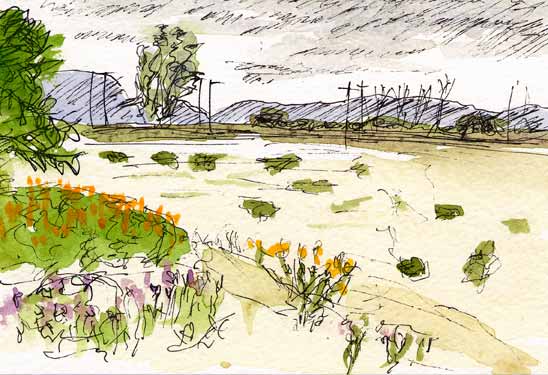
Pen and wash is a favorite medium of mine — it’s a great way to do landscape sketches quickly yet introduce a bit of color with some watercolor washes. And watercolor field kits that contain a set of small pans of paint are readily available and work well on outdoor sketching expeditions. One issue though is the choice of pen. Dip-nib pens are great in the studio but porting around bottles of ink is a risky thing to do in a backpack. Fountain pens are somewhat more portable, but generally too precious for the field, and fountain pen inks aren’t waterproof, a desirable quality if one is going to paint washes over the ink drawing. I have often used Sakura Micron Pigma pens, which are pigment-based archival-quality felt-tip pens, but these have a harsh feel to them.
Anyway, I can’t believe it has taken me so very long to discover Gelly Roll pens, also made by Sakura. They are roller-ball gel pens, and it turns out they are both archival and waterproof. Moreover, they are cheap and are available almost everywhere. Above is my first Gelly Roll and wash landscape, looking west towards the Putah Creek gap in the Vaca Mountains.
23 April 03
Boxing the Political Compass
Kos in an excellent post today discusses how the Democratic Party may now be a better home for libertarians than the GOP, since the Democrats are doing more of a job of protecting personal liberties than the Republicans are these days. It is interesting to visualize how this plays out in a more sophisticated representation of political space than the traditional one-dimensional left-right line. One such depiction may be found at the Political Compass. (Spoiler alert: if you are at all inclined to take online quizzes, I recommend you go to this site and take the quiz there before reading further).
The depiction at the Political Compass maps political positions in terms of two dimensions. The horizontal axis represents an economic dimension in the traditional sense from left to right, but the depiction adds a social dimension as the vertical axis. Authoritarian positions are at the top of the diagram, and libertarian positions are at the bottom of the diagram. The axes divide political space into four quadrants: the libertarian left (today’s progressives and Greens), the libertarian right (traditional libertarians), the authoritarian left (Marxists), and the authoritarian right (e.g. the territory of the neocon right wing).
I think most people in the U.S. today are arrayed on the diagonal stretching from lower-left to upper-right. There are relatively few traditional libertarians, and even fewer Marxists. But the diagram suggests questions for Democratic strategists. In this era of the PATRIOT act and other such perfidies, has the authoritarian-to-libertarian social dimension become more important to most people than the economic left-right dimension? Is there enough of a bloc of voters who are either libertarian left or libertarian right that the Democrats should reach downwards on the diagram—remaining centrist on the economic dimension, but becoming more libertarian on the social dimension, becoming as Kos puts it, the party of personal liberty? And for the traditional libertarians and the Greens, is it now time for a libertarian-Green alliance?
22 April 03
A Small Rural Cemetery
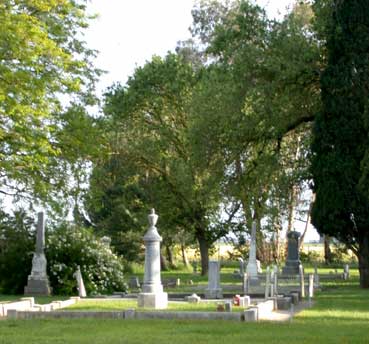 The Tremont Street Cemetery lies about five miles southeast of Davis in the middle of the farmlands that grow wheat all winter and tomatoes all summer. It’s the burial ground for the Presbyterian church in that same spot. The church is no longer used but is well cared-for, as is the tiny cemetery.
Mostly German names are listed on the stones. There was a significant German migration to this part of California in the late nineteenth century. After the opening of the trans-continental railroad in 1869 which obviated the need for covered wagons or perilous trips round the Horn, California must once again have seemed a land of gold, though the gold rush was long over
Walking through a cemetery allows me to picture family life a hundred years ago — these people worked hard, were modest in their aspirations and lives, and often lost many members to illness or hardship—at a young age. It seems they were not untouched by the flu epidemic of 1918. Though this cemetery is small, it is a lovely place to sit in the heat of the summer with its mature, tall trees providing a good nesting site for red-shouldered hawks and great-horned owls as well as blue grosbeaks and northern mockingbirds.
I have a secret hankering to live in a cemetery, to be a “caretaker.” I find them restful places of memory, not morbid or frightening—and the birds are almost always in abundance. My hopes were raised when the caretakers’ trailer was moved from this cemetery recently, but it’s been replaced by a new one.
We’re considering doing a census of this cemetery for the online genealogy project so that relatives of the people buried here but perhaps living far away can get the data they need to find a “missing link,” the eureka moment of every genealogist.
21 April 03
Bioregional Bookshopping
Today I picked two new books at the campus bookstore. The first, by UCD landscape architecture professor Rob Thayer, is entitled LifePlace: Bioregional Thought and Practice. He is part of a school here of bioregional thinkers and practitioners centered around the Putah and Cache Creek watersheds. Rob Thayer’s new book draws happily for me upon all sorts of local examples for his material.
The second book is Tim Manolis’ new field guide to the Dragonflies and Damselflies of California. It is beautifully illustrated by the author with over 40 plates done mostly in colored pencil. (It’s always striking how illustrations are much more effective in a field guide than photographs). Pica and I know very little about insects, but we had an introduction to dragonflies on a Yolo Audubon Society walk up at the North Davis Ponds a couple of years ago.
20 April 03
The Glade on the Way to Work

Probably my favorite bit on my bicycle ride into work is passing this little glade just south of the UC Davis Arboretum. There are several handsome walnut trees in it, and often it is used for pasture for animals belonging mostly to the Vet Med folks. A few weeks ago there were cattle, but right now there are about a half-dozen horses in the pasture as well as this donkey. Animals bring a civilizing influence to a campus—some of the horses will come over and say hello, and the donkey always regards me with calm bemusement.
As the joke goes, what UCD stands for is “Under Construction Daily”, and according to the current long-range development plan for the campus this parcel is slated to become part of a research park, hosting one or two three-story buildings and many, many parking places. It’s all very rational, the planning process is, with dividers in their thick binders sectioning off the chapters on scenic, habitat, and cultural values, but somehow I think the world would be better off if planners were compelled to become accomplished landscape painters before they ever touched a computer. Sigh. At least the long-range plan and forthcoming environmental impact report are still open for public review and comment.
19 April 03
The watercolor outing
 Numenius and I went out on a sketching outing to the Arboretum this afternoon. On the left is my attempt at a lupine with a California poppy behind it.

On the right is Numenius’ fremontia branch: the tree is gloriously abloom just now.
19 April 03
Spring in the Central Valley
I just saw my first ash-throated flycatcher of the year. It was outside the kitchen window in the English walnut, flycatching. I don’t know what it’s finding to eat this early in the morning with a chilly north breeze, though last night there were thousands of flying insects in the pathway… in California we are bracing for the onslaught of West Nile Virus, predicted to hit in August. Nobody knows what it’s going to do to the endemic bird populations here—particularly the yellow-billed magpie.
Inspired by Richard Bell’s spectacular Wild West Yorkshire nature diary, I’m going to try my hand at some sketching today. The California poppies have been given a new lease on life with all the rain we’ve had recently. I love to see them in juxtaposition with the lupines-orange and blue, perfect complements-but the lupines are now almost all gone, so to see them together I have to go exploring. There are still some at the UC Davis Arboretum.
I wish I were better at drawing birds, but the way to get better is to go out and do it. Another good excuse not to clean the house…
18 April 03
Low-Power FM Radio Coming to Davis
The Federal Communications Commission has at long last issued a construction permit for a low-power community radio station in Davis that will be run by Davis Community Television. They have 18 months to get the 100-watt station on the air, which will be on the frequency 101.5 MHz.
Low-power FM radio has been a battleground for media activists such as the Media Access Project and the Prometheus Radio Project who are trying to maintain local community access to the airwaves. When the FCC put forth a proposal to establish a Low-Power FM Radio service, it was strongly attacked by a coalition of the National Association of Broadcasters and National Public Radio (the latter earning my enmity in the process) and the bill in Congress nearly gutted.
But the proposal did get through Congress, albeit in watered-down form, and LPFM radio stations have slowly been getting licensed. There have been some clear successes, such as Radio Bird Street in Oroville. We are fortunate in Davis in being able to receive three independent radio stations already (KPFA in Berkeley, KDVS the local college station, and KVMR in Nevada City), but it will be great to have our own local community radio station.
17 April 03
An Elegy for Walnuts

The Solano County roads department is preparing to take out a row of California black walnuts (Juglans hindsii) along Old Davis Road to make room for bike lanes. It’s a little-traveled road, and I’m not sure that the benefits to the cyclists who use the road (mostly hard-core, with less need of bike lanes) warrant the loss of such a landscape feature.

This row of walnuts was well-established in 1937, when the aerial photograph (courtesy of the UC Davis library map collection) at left was taken. Formal roadside avenues of trees are scattered around the lower Putah Creek landscape, one of the most noteworthy being the row of walnuts on Russell Avenue west of Davis.
Juglans hindsii has an interesting history: it is widely naturalized in Northern California, but only two stands of the tree, in Napa and Contra Costa counties, are considered native to their sites. The plantings of the black walnuts provide good wildlife habitat: in this row of trees we’ve seen roosting Swainson’s hawks, and nesting yellow-billed magpies and western kingbirds.