18 July 06
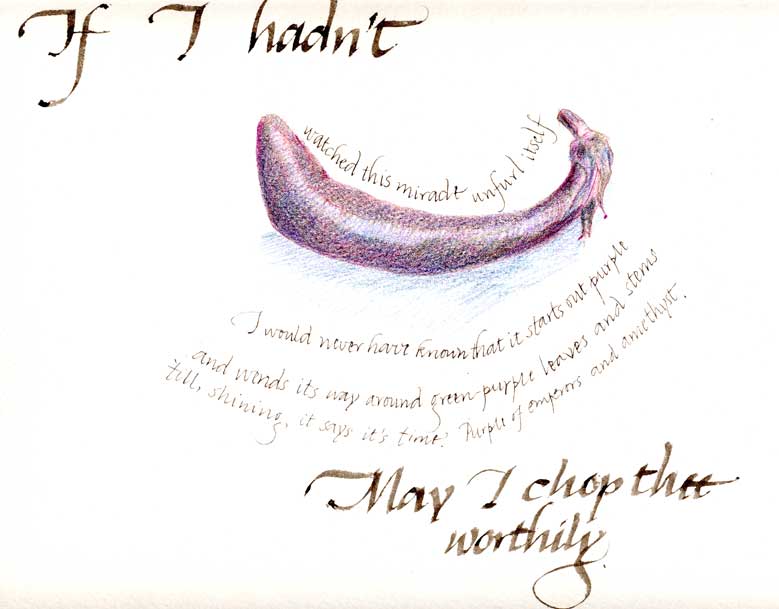
The Pen With The Transparent Barrel
Saturday’s outing in Portland was the second such pen show I’ve ever been to. Unfortunately, the pen I’d like to find, though out of manufacture, I think is too plebeian to be at such an event. This was a $6 Pentalic fountain pen that had a transparent cylindrical barrel with a green ink converter inside. This pen had a wonderful nib. I discovered it in college, and went through several of them, either losing or breaking them in the end.
I did find a pretty nifty pen though at the show. This is a Sailor Super Script fountain pen. The nib of this pen is bent back at an angle, allowing one to make lines that are extra fine to bold depending upon what angle one holds the pen. I picked one up for $15—I think it is great for sketching. It too has a transparent barrel.
17 July 06
The Black Pen
As Numenius mentioned, we were in Portland this weekend. We found out after we’d booked tickets that the Portland Pen Show was going to be taking place while we were there. I’m not a pen collector, as such, not the kind that goes looking at the condition of bakelite through a lupe, but I always like a pen that works well.
This one called me from across the room. It was, it is, a Pen With Attitude. It was made in 1910 or thereabouts, hard rubber, but it was the nib that caught me by the jugular, a flexible italic. A contradiction in terms. A hybrid, a bastard.
I started to make lines with it. No, it said, not like that, like this. I want to do more loops, because I’m half copperplate. I felt wrenched by the power of this thing, unworthy to wield it, unable to stop.
Both Dale and the young Canadian red-haired man who was trying to sell me this pen with me were sort of in shock at what was going on. I’m afraid I was oblivious. I said anything, didn’t let the pen from my hand, kept caressing the paper with these lines from Somewhere Else.
I didn’t buy the pen. I have no business paying $125 for a pen, not when I have others in my drawers I hardly ever use. I went out for a cup of tea and came back, almost buying a lesser Levenger item.
But not.
The next day, after that damn thing had yakked at me all night, the insistent patter or scolding or seduction hollering or whispering, we went back.
I now own this pen. Or it owns me. I’ll let you know. Thanks to Dale and Susan (and Masha and Erik) for insisting I go back. I’d have regretted this one if I’d passed it up…
16 July 06
Herman, Fup, Mango, and Chocolate
We just got back from a weekend trip to Portland, where we visited our blogging friends Dale and Susan. They were grand hosts, and they introduced us to Dale’s old buddy Herman the 10-foot sturgeon at the Bonneville Fish Hatchery, Susan’s faun-colored kitty Mango, her affectionate tortoiseshell cat Bit, and her ball-obsessed dog Joey. I also learned that Oregon is a fine state for chocolate, starting with the Moonstruck Chocolate café downtown, and moving south to Dagoba chocolate made in Ashland. At Powell’s, where I spent about three-and-a-half hours all told, they were having the 18th birthday party for Fup, the store cat at the technical bookstore two blocks from the mother ship.
All in all, Portland is a wonderful place.
14 July 06
Working Where I Do
This is what you find lying around the place:
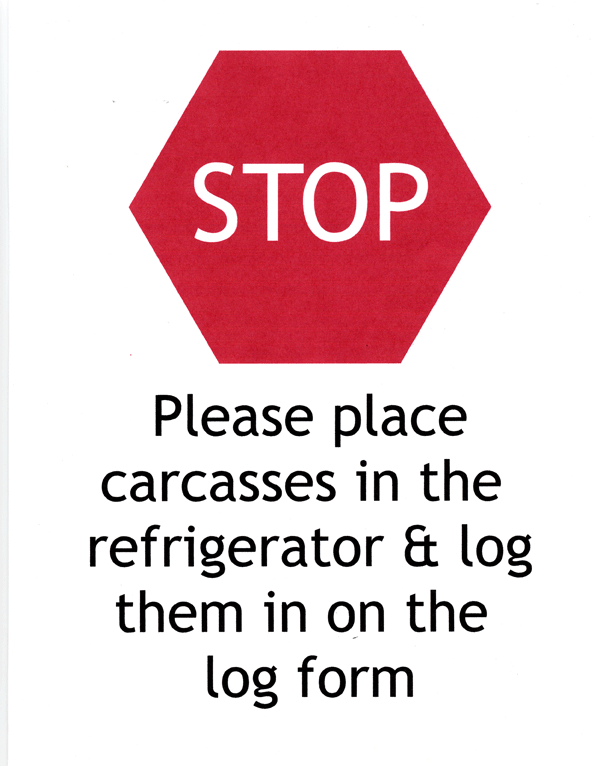
Happy Friday.
12 July 06
Not Exactly Doe Eyes
Those of you planning a trip to the Cretaceous have a new reason to be careful. A study of Tyrannosaurus rex visual geometry has concluded that the famous dinosaur species may have extremely acute vision, perhaps a lot better than the modern eagle. So be sure to have a long telephoto for your T. rex travel pix.
11 July 06
Wind
There’s a strong southerly breeze at the moment. When the wind’s out of the south, we get much cooler days. The wind will veer north by the weekend and we’ll be in triple digits again. A hot, drying wind that blows topsoil across counties into the Delta.
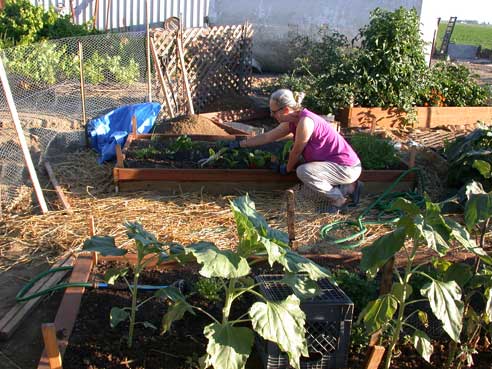
I don’t have much of a bike commute these days but it’s enough to notice when I have a strong head or tailwind. I notice the sunflowers I planted struggling against it; the squashes are big and heavy enough now to withstand this much but who knows how much else? I’m hoping the tomato cages are sturdy enough.
The mockingbird was singing furiously into it this evening while I filled my final raised bed with soil and compost.
Tom Montag of “The Middlewesterner” often writes haikus about the wind. It must be very much a part of his corner of the world and I find myself nodding in recognition. This, for instance, his lines for July 7 :
Add nothing
to nothing –
you’ve got
the wind.
10 July 06
Ratatouille and Tofu-Cilantro, Oh My!
The harvests from Pica’s garden are rolling on in to the kitchen. Often there is an additional fun step—after chopping the veggies, we put them outside in the solar cooker to stew. Yesterday was ratatouille, with eggplants and some of the innumerable squashes that are coming on in; and today was our favorite—tofu-cilantro. The tofu wasn’t from the garden (that would be an interesting project, growing one’s own soybeans and making tofu from them), but the cilantro and peppers were. Tomorrow we’re having salad greens. Tomatoes may be a couple of weeks out (they are now green on the vine) but we’re expecting no shortage.
9 July 06
Il Faut Cultiver le Jardin
 The world cup’s over. Zidane’s ugly head-butt must have been provoked in extremis. Numenius guesses racial epithet. I’m sorry about it, more sorry than I am that France lost.
9 July 06
Antenna Birding
I have my portable antenna set up near the vegetable garden, tuned to 6 meters. Having figured out the guy cord system, I’m more inclined to leave it set up for a while. But this means it’s a good perching spot for birds, the antenna elements being up about 16 feet or so. Today we had a western kingbird on it. What will be next?