
25 February 07
Sudoku Pencils and Friends
If you’re getting frustrated with trying to solve Sudoku puzzles maybe you need a pencil specially designed for the task. This site Pencil Things sells everything related to the writing implement. Who knew that you could buy plastic caps to protect pencil points?
24 February 07
Attacked by a Pomegranate and Other Gardening Dangers
I was planting a pomegranate tree yesterday morning when I grazed one of the sharp branches with my right eyeball. No major harm done, though there are lots of sharp things in gardens and it’s good to be reminded to avoid them.
Numenius doesn’t do a lot of gardening, preferring to potter with radio stuff nearby while I dig. So when I begged him to go to a worm composting workshop at Project Compost today on my behalf, since I had a bird trip to lead for Duck Days, and he complied and schlepped a newly-filled worm bin to his office, he earned a nice lunch. There are now lots of worms in the house, but I’m hoping they’ll stay confined to their bins till we figure out exactly where they’re going to end up. (One will go to Mary and Jim’s across the street, I’m hoping, since I already pick up their scraps for the compost.)
The leeks have emerged from their potting soil disconcertingly quickly. I now have to work out how to keep them uncovered and their neighbors not… and at what point to pull the gardens apart and line them with gopher-proof wire mesh. Should have done that last year when I was putting them in.
Oh it’s all such a lot of work, and aren’t I happy as a clam when I have dirt under my fingernails…
23 February 07
The Joy Of Destroying One's Shopping
Yesterday I heard Richard Stallman speak on copyright and community. He started off by talking about the four freedoms that software should have to be considered truly free: the freedom to run the software, the freedom to modify the software for one’s own needs, the freedom to redistribute copies so one can help one’s neighbor, and the freedom to improve the program, and release the improvements to the public, so that the whole community benefits. Of these, he noted, only the first two apply to physical objects rather than software.
It’s fun to buy something with the intention of destructively modifying it right away. I’m trying to build up a computer soundcard interface for my transceiver out of bits and bobs you can find at Radio Shack and OfficeMax. Today’s foray was to OfficeMax to pick a keyboard/mouse extension cable of which I promptly cut off one end. I just need the 6-pin connector at one end and bare wires at the other. No luck so far in getting the interface to work — I’m still getting the same RF noise back into the receiver as when I did when I wired it straight using a mono audio cable with 1/8” plugs. But that’s tinkering for you.
21 February 07
Riding South
The Tour of California is turning into a very good race. Today’s stage featured the toughest climb of the whole tour, up Sierra Road east of San Jose. The route went from Stockton to San Jose. There was a breakaway early on of about 16 riders that threatened the overall leader Levi Leipheimer, who was getting little support from the peloton to try to close the breakaway. Finally on the big climb he made his move and caught the remaining riders in the breakaway, though he was edged out at the finish by one of the breakaway riders, the veteran Jens Voight.
Tomorrow is the longest stage in the race, going from near Monterey to San Luis Obispo along the spectacular coast road Highway 1. It is also predicted to be quite wet with winds coming from the southeast at 15 to 30 miles per hour. I think the riders will all hunker in the peloton and not try anything outlandish — look for a sprint finish in San Luis Obispo.
20 February 07
Tour of California Comes to Davis
We got back from a quick trip to Monterey to see birding friends from Massachusetts in time to catch the don’t-blink-you’ll-miss-it third stage of the Amgen Tour of California, running from Santa Rosa to Sacramento via Davis.
My optometrist’s shop is on 2nd street and I needed to get my glasses adjusted, so we opted to camp out at the finish of the 2nd Street intermediate sprint, which conveniently was right outside Mishka’s (ran into my co-trainee for Cold Canyon docenting, Iraj, and we had a good yak about how to cut a reed pen for calligraphy; Numenius’ boss and five of his labmates were across the street).
There’s a lot of waiting about for a race like this. The pink-dreadlocked lass in front of us has taken these days off as vacation and was following the tour as it sped through parts of California she’d never seen before: she coaxed me to the edge of the street as long as I didn’t get in the way of her digital camera. On Thursday, the race heads down Highway 1 past Big Sur, where we were yesterday, looking for condors. (Unsuccessfully.) That’s a long stretch of road to tie up with a bike race, but a thrilling race trajectory (too bad a storm’s coming in that day). My pink-haired friend was wondering whether she should get down there really early and wait for them along the cliffs, or see them off at the start…
The Davis sprint was exciting: a three-man breakaway had one guy clearly in the lead and about to take it when his green-clad rival snuck up behind him and took the sprint by about 12 feet.
We rode our bikes home, into the strong south wind, only to find that our landlord had plonked himself outside Baker’s Square to watch the race (about 300 yards up the road). He said all the waitresses came out to watch too, since there was nobody in the restaurant.
A great turnout for a workday: well done, Davis. After four days off, it’s back to the grind for me tomorrow…
18 February 07
Ethical Shopping In Your Back Pocket
Pica ran into a pal at the coop today who was raving about a book entitled The Better World Shopping Guide, by Ellis Jones, who is here in Davis. So she picked up a copy of it. There are plenty of books about socially and environmentally responsible shopping but this is a very practical guidebook. It’s small, so it easily fits in one’s pocket, purse, or pack. It gives A to F grades to many of the prominent companies in about 75 categories of consumer goods ranging from airlines to wine. Some of these ratings are expected (under ice cream, Ben and Jerry’s is an A, Nestle is an F); others are not, and may cause us to rethink our shopping choices. The author has a website for his book here.
16 February 07
Snow Day
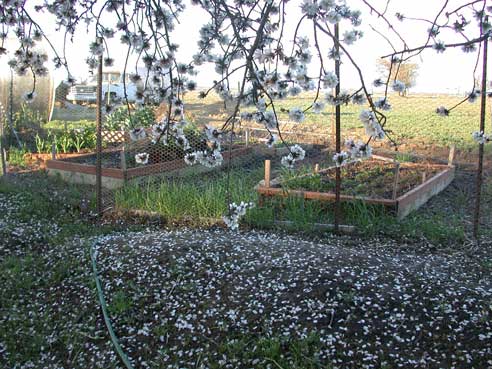 Dedicated to all my friends and family in chilly, snowy climes: hang in there, spring’s on its way!
Also check out the launch of the new Madrid wiki, Madripedia. (via Puerta del Sol Blog )
14 February 07
Reclaiming Your Inner Autist
We heard Dr. Temple Grandin today give two talks on campus sponsored by the UC Davis M.I.N.D. Institute (Medical Investigation of Neurodevelopmental Disorders). The two talks overlapped much in content, the first entitled Exploring the mind of a visual thinker, and the second entitled My experience with autism. My favorite work of hers is her book Animals In Translation in which she uses her experience of being autistic to better understand what animal consciousness is all about. She is a photorealistic visual thinker, and believes that many animals function the same way. Thought without language happens. It’s not a mode common in humans, but such a pattern gets developed under certain circumstances.
She identified three specializations of autistic thought — visual thinkers, music and math dominance, and verbal thinkers. The first, the photorealists like her, are those who function like having a movie projector in the brain, or in a contemporary analogy, a Google Images-like search engine. The second type are those who are good at patterns — much more abstract than the visual thinkers. She illustrated this with a slide of a praying mantis made in origami overlaid on top of the quite complex folding pattern of its square of paper. Some very pattern-oriented mind came up with that folding sequence. Finally, the verbally-oriented folks are those who are good at facts — the history buffs, the sports trivia buffs.
It seems autism isn’t one single thing or syndrome, rather it’s a manifestation of how different brains can specialize. Obviously it is important to work on making autistic individuals functioning members of society, but as Temple Grandin puts it, we don’t want to cure Einstein (non-verbal at age three). What we see in extreme in autistic individuals are unusual combinations of the intellectual potentials we all have.
13 February 07
Imped
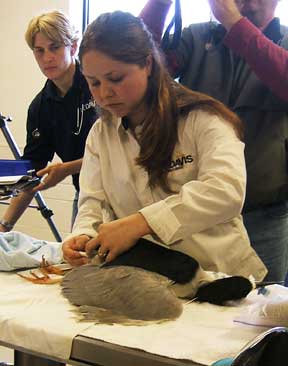 Yesterday for work I was present at a surgical procedure on a bird. A black-crowned night-heron had gotten snagged in some fishing line and was found in December, dangling from a tree, with its left wing flight feathers severely damaged.
Feathers grow back, but you have to wait for a new moult, which can take months, always to be avoided with wildlife. So the vets decided to undertake an “imping” on the bird, a transplant where donor feathers are grafted onto the trimmed existing shafts using bamboo skewers and five-minute epoxy glue. No blood involved: this is all dead tissue.
This night-heron had nine feathers imped yesterday.
Wondering where the term came from (the vet who did the surgery didn’t know, but he knew it was a very old falconry technique), I asked Language Hat. Right person:
“You’ve come to the right place! The Oxford English Dictionary says it’s from a (rare) Old English verb impian, which is related to various other Germanic verbs (like German impfen) but its earlier history is obscure, though it’s presumably ultimately derived from Greek emphuteuein ‘to implant, engraft.’ Its earliest meaning was ‘to (en)graft,’ which goes back to around the year 1000; what you want is definition 4:
4. Falconry. To engraft feathers in the wing of a bird, so as to make good losses or deficiencies, and thus restore or improve the powers of flight; hence, allusively, with reference to ‘taking higher flights’, enlarging one’s powers, and the like. In various constructions: a. To imp feathers into or in a wing, etc. Obs. 1477 Paston Lett. III. No. 794. 185 Like as the fawcon Which is alofte, tellith scorne to loke a down On hym that wont was her feders to pyke and ympe. 1580 LYLY Euphues (Arb.) 249 Ymping a fether to make me flye, when thou oughtest rather to cut my wing for feare f soaring. 1589 NASHE Pasquil & Marf. 11 Such an Eccho, as ultiplies euery word..and ympes so many feathers vnto euery tale, that it flyes with all speede into euery corner of the Realme. 1641 ROME Joviall Crew II. Wks. 1873 III. 374 To see a swallow..with a hite feather imp’d in her tail. 1706 PHILLIPS, To Imp a Feather in a awk’s Wing (among Falconers), to add a new piece from an old roken stump.”
etc.
The bird was expected to stay in an aviary for a week or two while it strengthened its flight muscles. By nightfall yesterday, though, it was was flying around and generally freaking out. It was released this morning after a band had been put on its leg; flew up into a tree where it stayed for 20 minutes, and then headed off into the Suisun Marsh.
12 February 07
Evening Pile-up
Tune around the ham bands and sometimes you will hear dozens of chirpings slightly out-of-tune from one another, some loud, some barely audible, sounding all the world like a large flock of colonial seabirds trying to attract a mate. In fact, they are trying to get the attention of a ham operator who has gone to some forlorn corner of the world and is transmitting from there. (Like birders, many ham operators are listers — what they list are the geographic entities they have made contact with.)
I heard such a colonial din this evening low on the 80 meter band. I looked up online what was attracting their attention. Appropriately enough, they were trying to contact an expedition in the Caribbean to Aves Island.