
6 July 07
Why Chilis Are Hot
Coturnix sums up the evolutionary reasons for this here. Short version — this is a mechanism by chili peppers to deter mammal herbivory in favor of bird herbivory, since seeds that pass through avian digestive tracts are fertile, but seeds that pass through mammalian digestive tracts are not. It turns out birds lack nerve receptors for capsaicin, the chemical that makes peppers hot.
5 July 07
Nestling Break
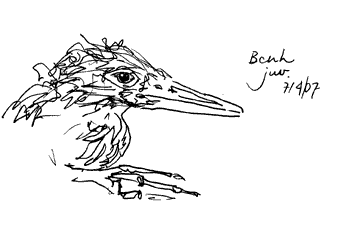 The gals were working on some black-crowned night-heron babies whose nest had failed. It was hot today — 105 degrees — and the babies got samples taken in the air conditioning. They’re going back this evening.
5 July 07
Breeze
We knew it was going to be hot for today’s holiday, and we wanted to go for a hike, so we headed to the East Bay this morning in search of cooler temperatures. We went to Wildcat Canyon Regional Park and hiked up along the crest of San Pablo Ridge. It was sunny but not hot and especially on top of the ridge there was a nice breeze coming up from San Pablo Bay. It was lovely to stretch our arms out and cool down after the climb. Good birds too — we saw a horned lark and numerous lazuli buntings and grasshopper sparrows.
It got to be 102 degrees F today in Davis. No wind either.
3 July 07
Jane Austen with Fangs
On a friend’s recommendation I got a couple of novels out of the library by Ivy Compton-Burnett. I had vaguely heard of her, thought she was vaguely Victorian in the same generally vague way that Edith Wharton might be (I’d say this with more authority if I’d ever read Edith Wharton, which is my loss, I’m sure).
I’ve finished one of the novels — The Mighty and their Fall — and started a second, and I’ve just never read anything like this.
The characters speak (and there is no description, or narrative, at all: these could easily be one-act plays) what they feel, all the time. It’s mostly not edifying. (Especially when children speak, unedited despite the best efforts of governesses — they are monsters.) Raw, sparse, cruel, ironic, and ultimately sort of hopeless. The house — a decaying Victorian estate — is a character in the Edwardian background, a menacing presence that somehow affects the plights of the family members busily ripping one another apart, watched by one or two servants. (I think I now know where the idea for Gosford Park may have originated.)
Compton-Burnett has been described, I’ve discovered, as post-Impressionist, and as a torchbearer for the Nouveaux Romanciers. It seems ghastly to read this stuff at all, and if I were less honest than her characters I might mumble about the chronicling of the busting open of the British class system. But in fact it’s riveting, this kind of voyeurism. I’m mesmerized. If I’m honest.
What is so astonishing, though, is the way the two worlds collide: the brutality of honesty, definitely post-World-War-One, juxtaposed with the veneer of pre-war respectability of diction. It seems so seamless. This is how it comes across as so very modern. It almost makes me want to some try and imagine the households of my great-grandparents, overlaying the stuffy syntax with what little I know to have been the quasi-sordid truths about their financial and personal dealings. It has me thinking deeply about what their world must really have been like, rather than what I can see in photographs. What must have been spoken about at luncheons, and what must have been avoided, the big silence as eloquent as any effusion…
1 July 07
Bats And Bats
One of the enjoyable things about baseball is that a team that is generally not very good can still have great days. This makes the games worth following, even if we know that the team statistically is not bound for overall success. Today the Giants beat the Arizona Diamondbacks 13-0, the Giants’ rookie pitcher Tim Lincecum striking out 12 and walking nobody.
The Diamondbacks’ Triple-A affiliate the Tucson Sidewinders didn’t fare so well either tonight. They played the Sacramento River Cats and we went to the game this evening. We saw a superb performance by River Cats pitcher Kazuhito Tadano who went eight innings, striking out five and allowing only four hits, the River Cats winning the game 5-0. It was very nice to see Tadano do so well tonight since on our last trip to the River Cats, on June 21, we saw Tadano give up eight runs in 3-plus innings as the River Cats lost 7-13.
It was a short game, lasting only 2 hours 8 minutes, and the sun was setting when we drove back to Davis. Heading over the causeway over the Yolo Bypass, we saw a flight of bats — the mammalian kind. There is a colony of Mexican free-tailed bats that lives under the causeway, and we were lucky enough to see them as they headed out for their evening foraging.
29 June 07
Back from Monterey
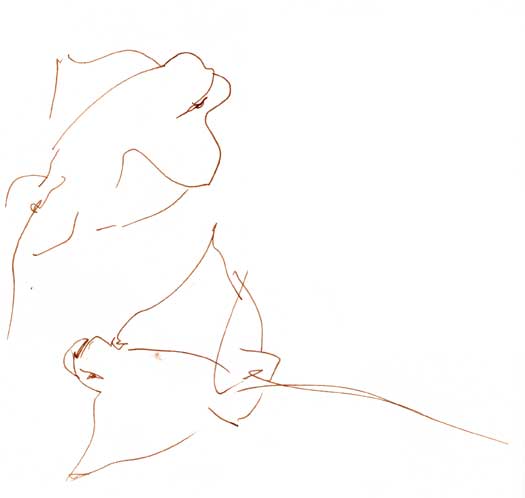 I now know what organs are most affected in Japanese quail by Napthalene (kidneys); that until very recently the Norwegian response to oiled wildlife was to shoot it; that shade cloth makes a better covering for bird-drying pens than either sheets or blankets if you want to have better air flow (which you do, because it cuts down the incidence of lethal fungi like aspergillus in birds that are being rehabilitated); that bat rays will suck on your fingers if you try to feed them shrimp; that the application and subsequent magnetic removal of iron powder to oiled feathers removes more oil than detergent washing alone.
 I also now know the best spot in the world for breakfast if you want it in the company of a horned puffin, three sea-otters, and a constant stream of pelagic cormorants…

29 June 07
Our Oldest Friends
A DNA study just published in the journal Science suggests that domestic cats split from their wild progenitors in the Near East perhaps 100,000 years ago. This well predates the archeological evidence for cat domestication, which goes back 9500 years.
25 June 07
Flourishing
 I spent the day in Berkeley yesterday, taking a class in off-hand pointed-pen flourishing. I am saturated in ink, doodles, fru-fru — yet there is something so beguiling in all this. I see the temptation. I resist it on the grounds of good sense and because of my aesthetic training — but it’s so SATISFYING...
 Swoosh. Loop, press, release, curl, swoosh.
 I have no idea what to do with this. I took the train down and back (no time for lunch, I missed the Berkeley International Food Festival Ron told me about), and returned in a train full of Giants fans who had witnessed the miracle of their team beating the Yankees for the second day in a row.
Swoosh. Loop. Press. Release. Curl. Yell. Loudly.
23 June 07
A Ride, a Wedding, and a Win
There is a ribbon around the front handlebars and stem of our tandem. It was left over from our wedding. Our plan was to ride the tandem home from our wedding, suitably bedecked. Alas, owing to the calamité at the wedding, this excursion never happened. But we finally got to ride the tandem to and from a wedding today. This was for our friends Andrea and Steve, who got married out on Putah Creek Road at the Center for Land-Based Learning farm. This is an educational farm and walnut orchard dedicated to teaching about wildlife-friendly and sustainable agriculture. All had a good time at the wedding, and the food was excellent, catered by the happily-named Magpie Caterers of Sacramento, whose t-shirts Pica was coveting.
Another auspicious event occurred today — the Giants broke up an eight-game losing streak with a win at home today in extra innings against the Yankees. We were following the game by radio on the ride out to the farm, and the Giants were down 4-1. Not so good. After the ceremony, having found a spot at one of the reception picnic tables, we started following the game again, joined by our baseball co-conspirator Barbara. The game was tied 5-5 going into the bottom of the 9th. The Giants were in fact leading 5-4 at the top of the ninth, but the Giants gave up a mammoth home run to Alex Rodriguez. It was not until the bottom of the 13th that the Giants won on a squib hit by rookie Nate Schierholtz. Barbara let out a whoop, and a fine day was made complete.
20 June 07
Varmints and Other Creatures
There’s something eating the okra plants, snapping it off at ground level, at the rate of about one a day. If it’s only jackrabbits, there’s an easy fix — make sure to fasten the gate shut every evening. If it’s ground squirrels, I’ll be reminded that it would have been worth it to line that bed with mesh. The okra is pretty: red stems, red buds, bright green leaves. At this rate we’ll be lucky to get a few pods before they disappear into the compost pile, wilted and miserable.
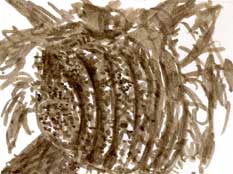 The bees continue to expand their premises in the hive on the nectarine tree. The edifice is ribbed and flowing, like the walls of a limestone cave. I wish I knew more about how they can put such a thing together… It’s certainly difficult to draw because the hive itself is white but the whole thing is brown, no contrast, pulsating with insects. They are feeding on the few flowers left on the alfalfa at the edges of the field, the plants that escaped mowing. My California fuchsia is starting to bloom bright red but I think that’s more interesting to hummingbirds than bees.