
3 November 07
Cat in Higgins Eternal
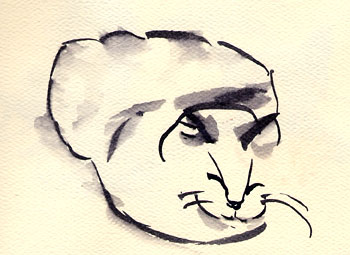 Since we’re going sketching at the zoo tomorrow, I thought I might try the experiment of putting Higgins Eternal ink in a new Sakura Koi waterbrush and sketching with that. Charlie here is my test subject. So far so good, the main trick is going to be keeping the brush from bleeding ink all over my hands.
1 November 07
Sketchcrawl is this Sunday!
The 16th Worldwide Sketchcrawl is going to be held this Sunday, November 4th. The Sacramento contingent will be meeting at the Sacramento Zoo at 10:30-11:00.
If you’ve never done this, consider spending part of the day sketching something somewhere: it takes you outside your normal preoccupations, gets you into a meditative state of total absorption. Join a group near you, or just start one! Or sketch alone.
It’s fun, too, folks…
31 October 07
Baseball Pitches Illustrated
Now that baseball season is over and we’re left with the saga of what team will A-Rod doom to penury with his next record-setting contract, it’s time for a little bit of off-season study. I certainly by looking at a pitch can’t tell a changeup from a splitter, but maybe this guide will help.
31 October 07
Massage Envy
They recently opened a branch of this outfit here in Davis after the last of the local hobby/scrapbooking shops closed. The paper was offering coupons — $39 for an hour — way back in August; I clipped one and stuck it on the fridge, waiting till the place opened. (I’d first heard about Massage Envy when we volunteered at the Princess Promenade, where they were providing free massages to the gals who finished the ride: it made a good impression.)
I’ve had a lot of experience with massage and bodywork, and wish I could afford to go every week. Every month, even. The flip side of that is that I need my therapist to understand my body issues, who can tell I’ve been doing too much digging in the garden and can feel the consequences (of course I tell them this, but I had no idea, for instance, that the lateral ligaments on my left ankle were so very, very tight — only they can find those hidden things).
It wasn’t a bad massage, this evening. But the place is SO corporate. Suggested gratuities tastefully set in italic palatino above where you leave your clothes. A full lecture afterwards about payment plans and membership options (the last thing I want after I’ve had a massage is to be given a sales pitch by a 19-year-old with a nail through her forearm — is this something that the massage gods would approve, I wonder? does she take that thing out to get a massage? It was red and looked very sore).
It WOULD be affordable, their payment plan. But the place lacks soul. It has as much soul, in fact, as most of the local manicure/pedicure places. And massage is about connection and healing. (If you’ve been reading Mole, you’ll know what this means. Soul in spades.)
30 October 07
Pondering Adaptations.
Thanks to Richard’s recommendation I have just finished reading Philip Pullman’s exquisite trilogy His Dark Materials. I am skeptical though about the upcoming film of the first book The Golden Compass due out in December. There are too many possible ways the movie can go wrong. At the very least, it has quite a tightrope to walk: how do you make a movie that will appeal to mainstream theistic America when a major theme of the trilogy is condemnation of organized religion. The answer seems to be to water down the philosophy and throw in lots of CGI.
Several years ago there was a stage adaptation of the trilogy performed at the National Theatre in London in two different runs. I will never get the chance to compare the versions but I suspect that I would find the theatrical version much more satisfying than the upcoming film. Theatre leaves a lot more to the imagination, after all.
29 October 07
Over for the Season
The Sox did it in four, overpowering a team I feared (and hoped) would give them more of a fight than it did. I’m excited about the young players whose salary isn’t in the league of the huge crazy sums we’re used to hearing about, but whose salary will undoubtedly increase after today.
No more baseball, now, till spring…
28 October 07
The Last Ratatouille
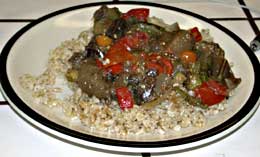 Pica harvested the last of the zucchini and eggplant the other day. The one green pepper she added to it turned out to be quite picanté.
26 October 07
Pomegranates and Winter Gardening
 The pomegranate tree I planted earlier this year is still going strong. A few blossoms over the summer didn’t translate into fruit, but it’s still small. I drew these ones for my dear friend Joe who sent a card from Turkey. I associate pomegranates with Turkey… and with blue tiles.
I went to a short presentation on winter gardening yesterday. There are four things to remember: a) timing b) timing c) variety d) everything else.
Looks like I’m too late for brussels sprouts which need to be planted in
Oh well. It is a good time to plant peas, now, and certainly to put in onions, garlic, and the rest. So I’ll focus on those.
25 October 07
Comet 17P/Holmes
A normally inconspicuous short-period comet (it completes one orbit around the sun every 6.9 years) brightened amazingly over a few hours a couple days ago, going from magnitude 18 (visible only in very large amateur telescopes) to magnitude 2.8 (naked-eye visibility). After getting home this evening from a Yolo Audubon fundraising letter stuffing party (not to mention watching the ballgame), I had a look from out in the driveway. It was easy to spot in binoculars once I figured out I had to look up higher than I was, it appearing as a little round fuzzball against the star field in Perseus.
With the 7” telescope I could see a bright central spot in the middle of the circular fuzzball.
In mid-northern latitudes the comet is now visible in the northeast portion of the sky in the evening, around 35° high at 9 PM local time. There is a finder page linked from this page about the comet.
24 October 07
Superstitions
We’re losing them, we Red Sox fans. I’m feeling confident enough with a 13-1 lead over the Rockies at the top of the eighth inning to type these lines. I’d never have done this in, say, 1996, for fear of jinxing something.
There are seven games, and you have to win four. But it’s looking good so far…
[Postscript: the mail guy came in today with a Red Sox shirt on, 15, Pedroia. He used to play baseball with Dustin’s dad up in Woodland…]